It was a beautiful and fruitful land with forests, fields, rivers, streets and cities. A king was placed over it by God. He was a hoary man, older and prouder than all kings about whom anything to be believed has been heard. This king’s only child was a girl of great youth, full of desire and beauty. The king was related to all of the neighboring thrones, but his daughter was a child and alone, as if without all relation. It is certain that her soft temper and her mildness and the power of her unawakened, silent presence were the unintentional cause of the dragon. For the more she grew and bloomed, the nearer it crept forward and finally alighted, like terror itself, in the forest of the most beautiful city in the land; for there exist secret relationships between the beautiful and the terrible – at a certain point they complete each other like laughing life and near daily death.
That is not to say that the dragon was hostile to the young lady, just as no one can say truthfully and in good conscience whether death is the adversary of life. Perhaps the great, seething animal would have lain down like a dog beside the beautiful girl and only for the repugnance of its tongue would have refrained from caressing those loveliest of hands in animal humility. But, of course, this was never put to the test, all the more so since the dragon was merciless toward all those who happened into the circle of its strength and, like visible death, grasped and held everything, herds and children not excluded.
The king at first remarked with great satisfaction, that the need and danger made many of the boys of his land into men. These young people of every station, nobles, seminary students and servants, who marched out as if into a strange and distant land, had the heroism of a single hot, breathless hour, in which they had life and death and hope and fear and everything – like in a dream. After a few years, it no longer occurred to anyone to count these brave sons and write their names down somewhere. For in such fearful times, the people grow accustomed even to heroes; they are no longer unheard of then. The feeling, the fear, the hunger of thousands scream out to them and they are there like a necessity, like bread, conditioned by those last laws which even in troubled times do not cease to function.
But as the number of those who martyred themselves after mounting hopeless defenses grew larger, as the last son in almost every family of the land — often still in boyish youth — had fallen, then the king began to rightly fear that all the firstlings of his land would perish, and that too many young girls would have to take upon themselves a virginal widowhood for the long years of the life of a childless woman. And he denied his subjects the struggle. But to the strange merchants, who fled the blighted land in nameless repulsion, he gave tidings that kings in similar situations have let circulate since days of yore. Whosoever should succeed in liberating the poor land from its great death shall win the hand of the king’s daughter, whether he be of noble birth or a hangman’s last son.
And it happened that strange lands were full of heroes too, and that the high reward did not fail to have its desired effect. But these sojourners were no luckier than the land’s inhabitants: they came only to die.
In those days there was a change in the daughter of the king; if till now her heart, oppressed by the sorrow and calamity of the land, prayed for the beast’s demise, since she had been promised to a strong, unfamiliar man, her naive feelings began to be bound up with the oppressor, with the dragon, to the extent that she discovered prayers for the dragon’s sake in the candor of her dreaming and requested that holy women take the monstrosity under their protection.
One morning, waking full of shame from such dreams, a rumor came to her that terrified and confused her. There was tell of a young man, who had come – God knows from where – to fight, and who did not succeed in killing the dragon after all, instead only tore himself, wounded and bleeding, from the claws of that horrible foe, and crawled his way into the thickest forest. There they found the unconscious man, cold in his cold, iron shell, and brought him into a house, where he now lay in a deep fever with hot blood behind the burning bandages. When the young girl received this news, she would have liked to run through the streets as she was, in a blouse of white silk, to be at the side of the deathly ill man. But once the chambermaids had clothed her and she saw her magnificent raiment and her sorrowful visage come and go in the many mirrors of the castle, the courage to do something so unusual left her. She could not even bring herself to send some reticent servant girl to the house where the sick man lay to give him some relief, fine linen or a mild salve.
But there was a disquiet in her that almost made her sick. At the incursion of night she sat for a long while at her window and sought to determine the house in which the strange man was dying. Since his death seemed self-evident to her. Only she could perhaps have saved him, but she was far too cowardly to search for him. This thought, that the life of the wounded had been placed in her hands, did not leave her. Finally, after the third day that she spent in torture and self-hatred, this thought pushed her out into the night, into the black, frightening, rainy spring night, in which she wandered around as if in a dark room. She did not know by what token she would discern the house that she sought. But without much delay she discerned it by a window that stood wide open, by a light that burned inside the room, a long, strange light, by which no one could read or sleep. And slowly she went past the house, helpless, poor, sunken in the first sadness of her life. She went further and further. The rain had stopped; over loose strips of cloud stood a few large stars and somewhere in a garden a nightingale sang the beginning of a strophe that she still could not finish. Again and again she began, questioningly, and her voice grew, large and forceful, from out of the silence, like the voice of some colossal bird whose nest rested upon the tops of new oaks.
When, finally, the princess raised her teary gaze from her long way, she saw a wood and a streak of morning behind it. And something black contrasted with the streak that seemed to draw nearer. It was a rider. Involuntarily she pressed herself into the dark, wet bushes. He rode slowly past her and his horse, black from sweat, shook. And he too seemed to shake: all the rings of his armor rang softly upon each other. His head was without a helmet, his hands were naked. His sword hung down, heavy and tired. She saw his face in profile; it was warm, with wind-blown hair.
She looked at him for a long time. She knew: he had killed the dragon. And her sorrow fell from her. She was not a confused, lost thing in this night. She belonged to him, to this strange, trembling hero, she was his possession, as if she were the sister of his sword.
And she rushed home to await him there. She entered her apartments unnoticed and as soon as it was possible she awoke her chambermaids and ordered her most beautiful clothes be brought. While she was being dressed the city awoke to great joy. The people celebrated and the bells nearly rang out of the towers. And the princess, who heard this clamor, knew suddenly that he would not come. She tried to imagine him immersed in the gratitude of the crowd: she was unable to do so. Almost fearfully did she seek to obtain the image of the lonely hero, the trembling one, as she had seen him. As if it were vitally important that she not forget. And with that her mood became so festive that, although she knew that no one would come, she did not interrupt the chamber maids who ornamented her. She ordered emeralds and pearls woven into her hair, which, to the great surprise of the serving girls, felt damp to the touch. The princess was done. She smiled at the chambermaids and went, somewhat pale, past the mirrors, with the rustling of her white trail following far behind her.
But the hoary king sat, worthy and earnest, in the high throne hall. The old paladins of the realm stood around him and shone. He waited for the strange hero, for the liberator.
But he was already riding far from the city, and the sky above him was full of larks. Had someone reminded him of the reward for his deed, perhaps, laughing, he would have turned around; he had forgotten it completely.
Translator’s Note:
This is Rilke’s last prose work before the Notebooks of Malte Laurids Brigge. Though someone has likely translated it into English, I have not been able to find it published anywhere. In spite of its great beauty and surprisingly mature Rilkean thematic, it seems to have largely been forgotten.
Written in the style of a fairytale, this is a story of a dragon that descends upon a kingdom, a king who promises his daughter to whomsoever should slay it, and two would-be heroes. Folk- and fairytales are often conceived of as the collective fantasy of a people – it is this aspect that makes them so fundamental to national ideologies. They are a receptacle and conduit for the pure will of a people, and thus, for nationalists, clear indicators not only of what that people is, but what that people should be. Rilke’s The Dragonslayer resembles a fairytale, but its narrative is centered around the incommensurability of fantasies. If a normal fairytale proceeds according to the logic of a dream, Rilke’s story proceeds according to the logic of dreams, numerous and discrete, which like parallel lines never meet. In this world, consummation is utterly impossible, even when all of its requirements are met.
Rainer Maria Rilke needs little introduction. He is probably the best-known German poet of the 20th century. Besides his Notebooks of Malte Laurids Brigge, his prose work is rarely studied but deserves increased attention.
I am a writer, translator, and student of Comparative Literature at the Freie Universität Berlin. I am particularly interested in the relationship between Yiddish and German literature. I previously translated Rilke (The Solution to the Jewish Question) for New Voices. My translation of the German Expressionist novel Spook by Klabund will be published by Snuggly Books in the spring of 2022.
“I draw figures using a short sharp thorn. on the smooth surface of the sand it leaves a trace that is consistent with the thought. like a print of light feet freed of sandals, so quietly it comes. my hands tremble. my limbs are not as agile as before. but I have not lived too long. the longer I think about the world the bigger it appears. its roundness all the more perfect. it slips from my hands and becomes the substance of thought.
I’ve measured with sand the whole of the cosmos. it is possible. provided that words do not fail to express the number. and yet I am often struck by the thought that the finitude of space is absurd. but what about infinitude? surpassing everything it must also exceed every number and thus every mind. yet can the unthinkable exist? rather the opposite, I would think. thought is more expansive than all of existence. I can think: Pegasus. everything that my mind suggests. Homer. or Sphinx. like that one resting in the angular shadow of the pyramids. wind rips grains of sand off their edges. though their disappearance is not visible to the eye. Democritus would add: ‘you can also think the gods!’ on this point I refrain from judgment. Protagoras the Athenian would have said that the gods did not create humans, but rather man created gods. for personal use. and that gods serve people like beasts of burden. on their shoulders man loads the weight of all his transgressions. but I have not found this in his writings. I do not know whether he was in fact so profane.
I refrain. when I want to understand the world it is not to remove gods. but even without wanting to, I do remove them. even though I only crawl, only creep on the slippery surface of the truth. unable to travel its entirety. is truth also an infinitude?
with sand I measure time. it rustles with the beating of hours. they come foaming from beyond the horizons. and they die beyond them. the whole world and its history and its works our deeds and our thoughts all spill out from the throat of time as sand.
what is the instant which we christen now? an atom of time crushed in a quern. between what maybe will be but is announced in part only. and that which is no more. but how do I know about the bygone? the past. a dark cave entrance covered with debris. memories. hopes. in what respect are they different? how would they differ without my belief that I am always the same?
yes. my atoms became weary. no wine makes youas drunk as time does. if atoms exist at all. if they are in fact the fullness in my emptiness. if they sift in me, round and glistening. like pearls. am I thus an hourglass of pearls? the ones who died where are they? where are their roundest atoms? is somebody’s soul looking at me from the smooth sand? or rather a flake of it? broken down by death? maybe my faithful Trazippos is here somewhere nearby? he probably had a soul or almost did. true. he could not count. but even the king cannot, probably none of the rulers can. I submit that such a soul is in fact the soul of a slave hamstrung by lust, rape, intrigue. that soul will not be able to ascend to the invisible Palaces of Ether. where thought watches the harmony of solids, Pythagorean indeed. is not the hemisphere the octave of the cone? and is not its fifth a cylinder? what a melody it is! though it sounds out of the ear behind the eye outside the tongue and lyre.
I cannot talk about it nicely. the wisdom of philosophers is not pretty. like a flower of the fig tree all hidden inside. but what can equal the fruit’s sweetness?
will my theorem also collapse into sand? or will another world come in which these proportions will change? can I conceive that other cosmos? if I wanted to? no. I cannot. so either that other world is false or it is too great a truth. to look into it? even to get to Egypt I needed so many days by sail!
no. no. in this I will be eternal even if forgotten. for is it not true that the world is indispensable? Epicurus wrote that the cosmos was always what we see and such it will remain without end. for there is nothing outside it or beside it which could cause it to change. but how, how to establish that the cause of a change needs to be external to what is being changed? after all, from my own wish to think I am changing myself. I am becoming the cosmos or a cone. spiral. floating wood. submerged as much as I indicated. if the cosmos filled with force, like a wise panther, has a soul according to the words of Chrysopus it can be inspired to think itself. in a different form. especially if I can.
moreover, existence is not the proof of necessity. just like non-existence shows only contingency. when I close my eyes without paradox I can think my sand blue. there is no absurdity in this. although maybe there would be if I knew more about the nature of the sand. so what is necessary? not a thought, not even a thought. rather like a rock stormed by a thought. but not conquered. ever. not permeated. the din from the harbor intensifies. what do they want? what did you want from me? a few toys? siege devices? that would fight instead of you? catapults? their only boast is that they work. and yet I would move the Earth. I could! if you gave my lever a fulcrum. I hope no one will discover the point. ever. the heads you all could crush! by moving the Earth! and thanks to me! it is enough that I let you look into the sun when it burns wooden ship on the open sea. though a leaf would suffice for the sage to see his own face. or a lump of sand.
I did it.
why did I do it? a smiling sage said that the people have the right to defend their rights, like their walls. I, agreeing, will add: the walls even more so. only under their guard and their protection survives the hope for the return of those lost rights. freedom given by another is a worse fate than bondage of one’s own making. an alien liberator is worse than a tyrant born within the city walls.
I am drawing circles to reconstruct Ariston’s thought. he supposedly doubled the cube. but today the melody escapes me. all mixed up. screams. getting closer. why are they screaming so loud? blood. scorpions squeeze in across the threshold.
I know so little. I do not even know if space conceived measurable with a thought is identical with the cosmos. if so does every line consist of atoms and emptiness? is the excess of points created by thought? then the problem of the perimeter would have to have a finite solution. I do not believe that. I put polygons in a circle and can do it as long as the precision of my compass allows me. and the precision of thought exceeds that. I want to say—infinitely. perhaps only a thought is inexhaustible? maybe my shelter exists only in my thought? in a tale which I’m telling myself? so maybe we torment ourselves unnecessarily? because the world is simpler than we suppose?”
Archimedes died by the sword of a Roman soldier. who was looking for treasures. but they turned to sand as he trampled them with his foot. early noon shone. on a spring day. birds were falling stunned by smoke. the soldier acted against orders. Marcus Claudius Marcellus, the commander, ordered his troops to spare the scholar during the massacre. wanted him unharmed. he knew that the man with a mirror burnt his ships from a great distance. with Archimedes’s help the commander hoped to ignite the ships of others.
Translator’s Note:
Born and educated in Poland, I’ve resided in the U.S. for the past forty years. In that time, I have translated and published almost one hundred poems in literary journals and anthologies by authors writing in Polish, English, German, and Catalan.
On my visits to Poland, I reviewed many books by contemporary Polish writers looking for a poet to fall in love with who has not been translated into English. Grzegorz Białkowski’s Figury z piasku (Figures in the Sand) surprised and challenged me as a poet and translator. The book consists of two epic poetic cycles: Heraclitean Ponderings (23 poems) and Four Essays on the Nature of LightBased onWell-Known Paintings (4 poems). Two longer poems also are included. The book’s title poem is several pages long, and its closing poem, “Life,” even longer. Each section is written in a different poetic key, showcasing the breadth and diversity of Białkowski’s work. His verse is informed by mathematics, physics, astronomy, ancient history, the arts, and nature. His is the poetry of a self-conscious intellectual, artfully styled with alluring images. “Figures in the Sand” is an excellent example of his range and style. In this persona poem, Białkowski imagines Archimedes during the Roman army’s siege of Syracuse in the year 212 BC, pondering grand mathematical and philosophical questions—right up to the moment of his abrupt death.
Białkowski’s style is distinctive. His line and stanza breaks and punctuation add to the challenge of translation. I remain faithful to the poet’s use of punctuation and his choice not to begin sentences with capital letters, but both syntax and the final word of a given line are often different in English. Some line breaks may look different in translation, but the logic and the flow of the poem are most important in my view, and they remain unchanged. The poet’s approach is both formalistic and creative, formulating the key questions, presenting and pondering them, and working on the solutions. These questions are the same today as they were in Archimedes’ time, driving us on a never-ending quest for meaning that transcends mass violence, cultural misunderstanding and intolerance, and human greed and lust for power. Białkowski saw strong similarities between science and poetry—“they both serve to model reality.” Does something exist if we do not think it? I keep finding myself in conversation with the author of “Figures in the Sand.” Were Archimedes’ thoughts, expressed in his figures drawn in the sand, lost for all time? Was Białkowski’s own effort lost? I hope not: I want his voice to be heard, to reach the ears of English readers.
Grzegorz Białkowski (1932-1989) was a Polish physicist, educator, and poet. His poems and prose appeared in prestigious literary journals such as Współczesność, Odra, and Twórczość. Seven collections of his poetry were published by leading presses like Czytelnik and Ludowa Spółdzielnia Wydawnicza. His eighth book, Figury z piasku, was slated for publication in the tumultuous year of 1989, but was shelved and forgotten after his death shortly before he was to be sworn in to the Polish Parliament. In 2015, the manuscript was rediscovered and published by WUW Publishing House.
Danuta E. Kosk-Kosicka is a poet and translator whose work has appeared in numerous magazines and anthologies, including Notre Dame Review, Spillway, Subtropics, and Tupelo Quarterly. Danuta is the author of Oblige the Light (CityLit Press, 2015), winner of the fifth Clarinda Harriss Poetry Prize, and Face Half-Illuminated (Apprentice House, 2015). She has translated four books by the Polish poet Lidia Kosk as well as other Polish poets, including Ernest Bryll, Wisława Szymborska, Stanisław Lem, and Grzegorz Białkowski. Danuta serves as the Poetry Translations Editor for Loch Raven Review. More at: danutakk.wordpress.com.
Rutebeuf’s Wintertime Blues (adapted from “Le Guignon d’Hiver”)
In this season of the year when the spent trees shed their leaves To the last spent leaf, I come, stripped by poverty to a similar nothing, to sing my wintry tale. For I would tell you of the small glory I have from God, the King of Glory: The wits He has given me to live by are not much, nor have I much Vigor of heart to call mine. What I have’s the cold of my body When the winter wind blows: cold hands, cold ass, cold comfort; cold nothing and a cold Not much to brave the turnings and the buffetings of the wind. Bad luck keeps its promises; for a lost dime it gives back tenfold of dolor. It sends poverty to glaum onto me again, saying, “Come on in, brother, My door’s always open, my house is your house and don’t you forget it. Come be drenched by the rain, come swelter in the sun— It’s what you were born for. God set up the seasons so the black fly Might nip at you all summer, and the white fly in its soft flocks all winter: Come on down to the bare, brown fields and read your fortune in the fallen leaves…” And so I’m like the willow tree, or the bird on its branch: From the jig and itch of June to the shiver and moan of January, there goes Rutebeuf, Plucked to the whimpering short hairs with the first hard frost. The trouble with me is I’m such an innocent—and the tricks I think I know Get me in deeper faster. You know what they say— You win some, you lose some? Not at my table. The dice don’t like me, And with their little beady eyes they see me coming. The dice And the dice rollers, their minions with the nimble fingers. So I’m tumbled till the Lint’s torn from my pockets and the shirt from off my back and I’m Tossed out on my numb ass in the street and dumped into the sewers, where I’m sinking fast, And who knows if I’ll make it through till spring. The view from here is that the world’s a pretty foul place. All you strutters of your stuff, How am I to compete, I who have to show for my best efforts Only the weight of my nothing? On my way to be less than nothing. Bad luck and the wintertime blues Have me and they won’t let go, bad luck and bad company And the sweet talk of the dice, and what I say now is, no more, that’s it. Because you’d have to be crazy to keep listening to them— Because don’t think it’s any kind of way up out of debt— because what’s bad now Can get worse. There’s always more threadbare; more barren of hope; The last door turned away from and not one friend left. Your hurt made harsher and your heart hardening. For how can you love your neighbor when there’s no love for you, And you’ve no strength to care? The man who used to call you brother laughs and says, “So now You can’t even feed your habit? Well, maybe if you could muster Some faith—the faith you owe our Savior and the blessed Virgin Mary— you might go to market And ask for a bedsheet on credit; and if they refuse you, maybe Trot off to the bank and explain yourself, swear by the archangel Michael that all you want’s The money for the shirt you don’t have on your back and they’d believe you— Because you’re such a fine, upstanding citizen. And then you could skip on home In fine new clothes with money in the pockets… Or maybe Slink back bare-assed and empty-handed to some hole in the alley wall; which do you think?” That’s how you’d be talked to eventually. That’s how I’m talked to now.
Song of the Street People of the Place de Grève (adapted from “Le Dit des Ribauds de Grève”)
Guttersnipes, God has heard our prayer: winter’s back. A breeze sifts the trees for more rags of leaf. On the bare limbs rain-buds ice-petal a frieze. Quite the show, if we’d duds to wear— a fur coat; socks; a new chemise! All summer, we lolled and took the air; now, winter’s back! We hunch, we sneeze, we rub up our poor feet like a pair of shoes, and rise—to beg, and wheeze. Farewell, black flies, you’ve had your share of us. The white ones swirl in their swarms now, nipping our nose and knees.
Translator’s Note:
Any good poet’s work invites discussion of how to read it. With a 13th century writer like Rutebeuf the questions can be unanswerable. We know so little about him! His work is varied. The scholarly pieces would seem to indicate that the “personal” poems, the so-called “Poems of Ill Fortune,” are persona poems. But even if so, in what tone? My grad school professor dubbed Rutebeuf “literature’s first stand-up comedian.” Maybe! But he also means it. The versification is spritely, the tale-telling is rich in sardonic wit, but the humor is fashioned to withstand and deflect mockery, not to invite it. Rutebeuf may well have been of humble origins; he understands the outcast’s suffering; he makes us feel it. My adaptations, as they must, take an interpretive stand. I ignore the long poem’s technical bravura and focus on conversational flow, and on the complexities of voice. In “Guttersnipes,” I imitate the form, but identify the speaker. Critical opinion on this is divided! (Rutebeuf uses “you.” The lines are stripped and the tone uncertain.) Is he a guttersnipe? I say yes. There is critical support for this view. But might he not be the mocking friend from “Wintertime Blues?” In which case, shouldn’t my tone be cutting? I think not; but listen:
Guttersnipes, it’s time. This is where the leaves get stripped off of the trees. Your limbs already are that bare? You’ve shivered? Now it’s time to freeze. Summer, you lolled and took the air. Winter—no coat, no fine chemise, no shoes, only this broken pair of feet—you hunker down and wheeze. So long, black flies! They’ve had their share of you. The white ones swirl in their swarms now, nipping your nose and knees.
Rutebeuf wrote in a 13th century northern dialect; in grad school, we leaned on the modern French translations by Jean Dufournet. But we did also look at the original texts, which are (with help) not impenetrable, and I went back to them when I constructed my freer versions. The French title “Le guignon d’hiver” is from Dufournet. I don’t think I even read his version of “Ribauds.” My English title for this second poem, giving “dit” as “song” instead of just “poem,” is another interpretive choice.
Rutebeuf was born some time before 1230, and the year of his death is usually given as 1285. We know little about him. His name is thought to be a nom de plume, though he refers to himself by it quite often in his work. His roots were in the Champagne area of France; he may have been around to watch Joan of Arc liberate Troyes in 1249 (he wrote about it); he lived for many years in Paris. Though he also wrote plays, satires, and hagiographies, he’s best known for the “personal” poems traditionally grouped as Poèmes de l’infortune.
Derek Kannemeyer was born in Cape Town, raised in London, and lives in Richmond, Virginia. (While studying in France, he married an American girl who said, “I’m going home, are you coming?”) His degrees are from the Universities of London and Virginia. His writing has appeared in publications from Fiction International to Rolling Stone; his books since 2018 include a prize-winning poetry chapbook, the full-length Play of Gilgamesh, the poetry collection Mutt Spirituals, and a hybrid photography/non-fiction tome, Unsay Their Names, about Richmond’s 2020 Lost Cause statuary removals. Forty of its photographs are on display at Richmond’s Black History Museum.
But I mean—is it pretty, or not well yeah, it is pretty so then basically everyone can just enjoy it nobody’s ever seen anything like it before those greenish whirlwinds, I just really love em you just love em, huh, Dima? yeah, I just love em, cause they’re freakin beautiful so why not love em? because they’ll kill us ah, to hell with em you mean, with us with them and with us! and you remember that one day, when the temperature jumped 40 degrees all at once I mean there’s a silver lining to everything I mean why not
I mean when you get right down to it once it was plague, now it’s the climate, what’s the big deal so look if we eat every day like we’re eating now, if we drink every day like we’re drinking now then we have enough booze for eighteen days and enough chow for fifty days to be honest, I never did see the point
dang, everything’s just changing right there in front of us! It looks amazing! Just itchin to get out my iphone ha-ha I know right? me too gonna post it on Instagram ha-ha you got a real nice view up here Tanya whew, gotta go barf, can’t take it always feelin like I need to barf well that’s cause you’ve got a fever, Vitya jeez everything around here’s got a fever it’s not just me nah it’s cause of the stink I’m sick of that constant stink it might be pretty to look at, but I don’t like that stink that stink kind of ruins everything well excuse me but what can you do we’re dead, so here we are, stinking up the place I’m saying that, like, on behalf of Vasilyeostrovsky’s former residents oh man, dang, get this, I was even headed out there that day but I was running late, it was a miracle everybody’s got a story like that
hey now Tanya, I’m sorry if I said anything don’t cry hey now why are you crying they never knew what hit em, they didn’t suffer, and you did it knowing what you were doing and the government approved it, too we did nothing wrong
Tanya, Tanyukha, you gotta understand, it would’ve been worse for them here let alone the kids under five, there’s no way, seriously seriously, don’t even think about it anymore you didn’t do anything, it’s not your fault, seriously, that’s why the government did it it issued us those pills, and that’s why so we could—
it’s those irresponsible mothers, though, they’re the ones who— what do they think’s going to change, seriously, makes no sense if I had kids, I would’ve done it a long time ago it’s immoral, egotistical, to let them live now
no, it’s all good, though the human race has always lived like this the end of the world’s just business as usual no use being afraid, we’ve known this was coming the ones who did this to us, though, they’re the ones should be afraid they’re the ones burning in hell right now but we’re gonna live the way we wanna live you know, blessed is he who visited this world during its fatal moments we’ll lock ourselves in and let the plague rage
oh crap, that’s the super at the door jeez he’s gone off his rocker about that damn generator don’t let him in oh, shit, what’s he doing he’s got a gun Tanyukha, get down on the ground Vitya, dammit, stay behind the— aaaaah
2.
I told them over and over again, these days you can’t do that anymore you need food, you need water, you need to guard the supplies they didn’t listen to me, not one fucking word they set fire to the new electrical line stuffing their faces the whole time like I don’t know what dug up some booze, stole some food, and locked themselves in, back on the fifteenth
well who cares, they’re just trash people like that are useless these days never gave a thought to their souls they’d have only gone on and sinned even more so you could say I really just saved them letting them live would’ve really just been immoral
me and the lady from apartment sixty-eight were talking about when the time comes to do what they gave us those pills for when they issued them, a year and a half ago there was a wave of suicides and some people even thought that was exactly why they gave them out to get rid of the excess population all those whiners, the “I’m so depressed” slackers who couldn’t do anything anyway but time’s ticking away, see and everybody’s still got their pills everybody but the ones who sold them for food and so now the question, you know, arises when is it time the authorities didn’t inform us of this left it up to our own judgment they must’ve predicted that at some point we’d just know, all at once although we did know, just not all at once or rather, we’ve known for a long time now, but we don’t know when exactly there’s nothing about this in the instructions so here we are, sitting and waiting
personally I think you have to if it’s like a kid if a kid is suffering unbearably like if a kid’s got a bad infection or something used to be able to cure all that but what now as for the grown-ups, well when it’s not just one more time the water rises higher than the Petersburg dam when the water doesn’t stop once it’s hit our old five meters forty centimeters, but it goes and hits ten meters, fourteen meters that’s up to the fourth floor or when there’s a temperature shock like there was in February but without getting back to normal if it really gets scorching hot like that, then I’m definitely just going to do it straightaway
but that lady from apartment sixty-eight she says there’s no way she’s gonna kill children on the government’s orders she says to just go on ahead and die however we die just go on ahead and drown or starve, or freeze, or whatever although we all know there’s a fat chance of freezing now fat chance of freezing now but the main thing is to just let it take its course that’s the important part, even if we do all suffer a little everyone has suffered, after all the middle ages had its apocalypse too the plague, for instance and there were other things too, earlier, it’s been proven but nothing happened to us, and nothing’s going to happen to us even if there’s nobody left a couple weeks, a month, the terminal stage but the main thing is not to let things fall apart if you don’t let things fall apart then nothing’s going to happen to us, not really even if the planet ceases to exist even if there’s nothing left, we’ll still
I don’t know how I can be so sure maybe I’m just an idiot, of course but I firmly believe this
because the main thing isn’t how it all goes down the main thing is that I’m the one responsible for this building because I’m basically like the building supervisor if somebody didn’t crank the generator enough, it’s my fault if there’s no clean water, it’s my fault or if we run out of ammo and we’re robbed
but as for this climate scheme, now I’m not so sure that’s my fault it was that thing, where they pumped all that dang gas into the atmosphere it’s all because of that they wanted to make things better, but they made things even worse they could’ve just let it slide, we’d’ve made it another hundred years, maybe two hundred but no, they decided to make some money on it profit from everyone’s fear, from the climate panic I didn’t vote for them at the referendum and that referendum was shit anyway carousel voting, ballot stuffing even back then I wouldn’t touch plastic bags, even back when everyone figured it was okay, it was convenient
(oh and by the way, here’s a funny thing about plastic bags: the kids play on the fifth-floor landing filthy little things, they can’t go outside there isn’t any outside anymore and so anyway they play bloody knuckles with coins where the coins have survived a hurricane only to have to flee from a huge monster: a plastic bag plastic bags are the main villains in kids’ games these days kids think all this is because of plastic bags)
I basically tell everyone not to panic everything’s okay the end of the world is okay there’s nothing to be worried about it was all preordained, decided in advance the ones who created this climate scheme are burning in hell now and as for us well, we’ll live out our lives the way we want
yeah, about those drunks from the fifth floor so basically, before we recycled them we displayed them to the sect in apartment twenty-nine they have a commune in there a hundred and eighteen people in it all cultists, and there’s even pregnant women which is taking it too far, no doubt about it they shouldn’t have permitted that level of optimism but they do have a hydroponic farm, that’s good it’s been really tricky to restock our supplies lately first of all, it keeps getting hotter and hotter and also, out in that new sun you can see your skin burning in that new sun, even under your clothes and secondly, everything’s run out, the water’s getting worse and worse we have to really look for it and ration smaller and smaller portions that’s the reality of it and thirdly, there’s no more respirator masks, haven’t been for a long time now I’m not so sure that a scarf is a good enough replacement for a stench like this
but those are little things, we can deal with them
so basically, we go over there Roma’s standing there holding a drunk’s head, Jamshaid’s standing there holding a drunk’s head, and I’m standing there with a lady drunk’s head, holding it by the hair and at that point I kinda flipped out, of course as soon as they saw me, they all stood and started chanting, thundering in unison
Daniel, Daniel be our king here in the ravaged city destroy the flow of time make it curl up and swallow itself whole make it feel hard, black, and endless from one minute to the next make it feed us make it defend and protect us here in the ravaged city time is all we have left time is our food time is our weapon inside every endless minute which has curled up into itself be our king Daniel
and I’m standing there with a lady’s head I’m standing there and I want to tell them something useful something practical I could’ve told them a lot of things but I keep not speaking and the pause keeps getting longer
Управдом Даниил
1
А вообще скажи — красиво так да, красиво так-то по идее можно всем просто наслаждаться такого никогда и никто еще не видел вихри эти зеленоватые, я их прям люблю ну прям любишь, Дим? Да прям люблю ну красивые же ё-маё почему нельзя их любить? Потому что они нас убьют ну и хрен с ними… ты хочешь сказать, с нами Хрен с ними с нами! а когда за день, помнишь, потеплело на сорок градусов сразу да всему можно радоваться да почему нет-то
да в конце-то концов ну что, была когда-то чума, теперь климат вот смотри если каждый день мы будем пить как сегодня и закусывать как сегодня то бухла у нас хватит на восемнадцать дней а закуси хватит на пятьдесят честно — я никогда не видел смысла…
бля, там все на глазах прям меняется! какие картинки! Прям руки тянутся к айфону… ха-ха да-да, точно, меня тоже. Запостить в Инстаграм, ха-ха у тебя хорошие тут виды Танюха уф, пойду поблюю сил нет все время блевать хочется Витя да у тебя температура да тут у всего температура, не только у меня да это у него от вони эта вонь непрерывная меня достала визуально красиво, а вонь мне не нравится вонь немножко все портит ну извини, что тут поделаешь мы мертвые, вот и воняем это я тебе от лица бывших жителей Василеостровского района да, бля, прикинь, я в тот день собирался на Васю! Каким-то чудом опоздал у каждого из нас есть такая история
ну ты Таня извини если чего не так не реви ну чего ты ревешь им больно даже не было ты же сама осознанно да и правительство дало добро это не преступление
Танюха им бы хуже было здесь, пойми а младше пяти так и вообще тем более даже можешь просто вообще не думать ты вообще не виновата правительство для того нам эти таблетки и выдало, чтобы
это вот они — мамашки безответственные непонятно, на что они надеются вообще если бы у меня были дети, я бы тоже уже давно давать им жить сейчас безнравственно и эгоистично
да всё нормально, вообще человечество всегда так жило конец света — это норм ну чего нам бояться все это было уже давно понятно пусть боятся те, кто эту аферу устроил вот они теперь жарятся в аду а мы будем жить так как мы хотим блажен кто посетил сей мир запремся от чумы…
о чёрт, управдом ломится ну реально задрал со своим генератором не открывай ему а, шит, что он делает у него ствол танюха ложись бля Витёк не выходи оттуда ааа
2
я им говорил много раз, что в наше время так нельзя еда нужна вода нужна склад надо охранять они меня нихуя не слушали поджигали проводку новую при этом жрали как не в себя добыли бухло жратвы натырили закрылись еще с пятнадцатого
ну чего там поганцы просто бесполезные люди в наше время не думали о душе совсем они бы успели нагрешить ещё сильнее так что можно сказать я их просто спас оставлять их в живых просто безнравственно
У нас разговор был с женщиной из шестьдесят восьмой квартиры когда наступает этот момент, ради которого нам таблетки-то раздали полтора года назад, когда их раздали был всплеск суицидов ну и было такое мнение что их раздали как раз для этого — чтобы избавиться от лишнего населения от унытиков всяких бездельников в депрессии все равно ничего не сделают но видите, время идет а таблетки у всех есть кроме тех, кто их перепродал за еду ну вот и, блин, возникает вопрос когда пора про это власти нас не предупредили оставили на усмотрение видимо, был прогноз, что все как-то сразу станет понятно а оно стало понятно не сразу вернее, понятно-то было уже давно но непонятно, когда именно в инструкции этот момент не указан и вот сидишь сидишь
лично я думаю, что пить их надо, если ребенок там если страдает там уже совсем кишечная инфекция там или что раньше-то это все лечили а счас как ну а взрослым, там, когда не очередные пять метров сорок сантиметров и дамба-амба а уже все десять или четырнадцать, допустим это уже четвертые этажи или как в феврале температурный удар но без возвращения обратно к нормам вот если начнет реально поджаривать, тогда я точно лучше сразу
а та женщина из шестьдесят восьмой квартиры она говорит, что вообще не будет убивать детей по указке правительства говорит, что надо спокойно помереть всем как придётся утонуть спокойно или там от голода или холода или чего хотя от холода уже вряд ли, теперь понятно от холода вряд ли но главное, своим ходом ну, важно это, даже если помучиться в конце концов, все мучились в Средние века тоже бывал апокалипсис чума, например и раньше, доказано, тоже бывало но мы все никуда не делись, и никуда мы все не денемся даже если никого не будет пара недель, месяц — терминальная стадия но важно не допустить развала и если его не допустить то мы действительно никуда не денемся даже если планета перестанет существовать ничего не будет — а мы…
не знаю откуда у меня эта уверенность может я тупой, конечно но я в этом уверен
потому главное не то, как все случится главное другое: что за дом отвечаю я потому что я вроде как управдом когда генератор не докрутили — я виноват когда воды нет чистой — я виноват или если патроны кончатся и нас обнесут
а вот насчет климатической аферы — тут я не уверен, что я виноват вот с этой закачкой газа в атмосферу, блин это все из-за нее хотели как лучше, а ещё хуже сделали могли бы спустить на тормозах и еще протянули бы лет сто, двести нет, решили заработать на общем страхе панике по поводу климата я их не поддерживал на референдуме да и блядский был референдум — вбросы и карусели я не брал в руки пакетов ещё тогда, когда все считали что это норм и удобно
(про пакеты кстати смешно: дети играют на площадке выше пятого грязнющие, на улицу нельзя… ее больше и нет и вот короче они играют в монетки которые спаслись от урагана и теперь удирают от огромного монстра, полиэтиленового пакета у нынешних детей полиэтиленовые пакеты в игре главные злодеи они считают, что все из-за них)
в общем я говорю всем: без паники все это нормально конец света — это нормально тревожиться не о чем все это было решено и предопределено авторы климатической аферы теперь жарятся в аду а что касается нас то мы проживем свою жизнь так, как хотим
ну а тех алкашей с пятого в общем, прежде чем утилизировать мы продемонстрировали их сектантам из двадцать девятой у них там община их там живет сто восемнадцать человек коммунары, ещё и беременные есть что уже, конечно, перебор такого оптимизма не стоило бы допускать но у них есть ферма на гидропонике — это неплохо обновлять склад в последнее время очень непросто во-первых становится жарче и жарче да и на солнце этом новом на нем приметно так сгораешь даже под одеждой во-вторых все кончилось вода все хуже приходится искать, распределять все меньшие порции такова реальность в-третьих, респираторов тоже давно нет не уверен что шарф нормальная замена при такой вони
ну это детали с этим можно справиться
в общем мы пришли Рома стоит с башкой алкаша Джамшут стоит с башкой алкаша я стою с башкой алкашки за волосы держу и тут я немного прифигел, конечно они все увидев меня встали и такие хором как грянут
Даниил, Даниил будь нашим царем среди разрушенного города уничтожь течение времени чтобы оно свернулось внутрь самого себя чтобы оно от минуты к минуте казалось нам твёрдым чёрным бесконечным чтобы оно само питало нас защищало и охраняло среди разрушенного города время это всё что у нас осталось время наша пища время наша оборона внутри каждой бесконечной минуты которая свернулась сама в себе будь нашим царём Даниил
а я стою с башкой
стою и хочу что-то сказать дельное практическое что-нибудь много чего я мог бы им сказать но пауза длится длится и я молчу молчу
Translator’s Note:
Ksenia Buksha’s writing is fearlessly hermetic one minute and movingly accessible the next. No one else sees the world as she does; reading her prose and poetry expands my net of perception. When I asked Buksha in 2020 if she had any new shorter work, she took the extraordinary step of writing “Upravdom Daniil” (“Daniel the Super,” in my translation) in answer. Although the text’s form is unusual, the effect is palpable—the dialogue is so real you can practically smell Dima and Vitya in part one, reeking of sweat and papirosas. The first part has three narrators, the men Dima and Vitya and the woman Tanya, while the second part is told by Daniel himself. The story is seasoned with a pinch of unexpected humor and garnished with unsettling details like postapocalyptic children’s games (Buksha is one of the best contemporary writers about young children I know).
There is no narrator here. All is dialogue (or monologue, or even surreal choral recitation). Although the Russian spoken by Daniel, the building supervisor, is a little more formal (bigger words, not as many colloquialisms), the texture of everything here is rough and intimate; up until the surprising end, many of these lines seem as though they could have been overheard on the bus, or in the building elevator, or at the kitchen table over beer and vobla. Like other languages, Russian can indicate the subject of the sentence in the structure of the verb, without having to explicitly state the subject; that, on top of the laconic, elliptical style Buksha employs here, made the tone delightfully tricky to render. I am grateful to fellow Russian translator Josie von Zitzewitz for her perceptive warnings against overtranslation (unnecessary expansion or explicitation) in an earlier draft of this translation.
All Buksha’s writing is richly intertextual, and “Daniel the Super” is no exception. The name Daniel, particularly in the context of this narrative, calls to mind the apocryphal text known as the Apocalypse of Daniel; and it is, of course, the prophet Daniel who, in the Old Testament, reads the writing on the wall foretelling King Belshazzar’s doom. The “blessed is he” quotation is a famous line from metaphysical Russian poet Fyodor Tyutchev’s 1829 poem “Cicero.” In my translation, the “super” of the title means “building supervisor,” not “superhero,” although the moment of dissonance resulting from the latter interpretation is a nice little bonus for readers of the English. Equal parts prose poem, dramatic monologue, and horror movie, Buksha’s piece is a thought experiment on the nature of responsibility vs helplessness, and might be read as a prophetic warning itself, with a final in-your-face flourish more reminiscent of Salome and John the Baptist than of Daniel the Old Testament prophet…
Poet and fiction writer Ksenia Buksha was born in what was then Leningrad in 1983. Trained as an economist, she has worked as a business journalist, copywriter, and day trader. Author of over a dozen books of prose and poetry, Buksha has twice been short-listed for Russia’s Big Book award and is the youngest writer ever to win Russia’s National Bestseller award. Her most recent novel is Advent (2021), published in Yelena Shubina’s renowned series showcasing the best contemporary Russophone literary fiction.
Anne O. Fisher translated Ksenia Buksha’s award-winning novel The Freedom Factory (Phoneme Media/Deep Vellum Publishing, 2018). Her translation of Sigizmund Krzhizhanovsky’s “The Poetics of Titles” is forthcoming in Countries That Don’t Exist (Columbia UP). In 2020, Fisher and co-translator Alex Karsavin were awarded a RusTrans grant to support their work on Ilya Danishevsky’s queer modernist novel Mannelig in Chains. Fisher’s favorite factoid is that the males of some species of dance fly create nuptial balloons. Read more (about Fisher’s translations, not about nuptial balloons) at anneofisher.com.
is not enough, its speed macerated in distilled sediment, its body in a torrent, breaking loose— from the stilled water in this cup, walls unflowing, a row of girls in their beds, runners that dream about a soft wind and emit a whistle like a slow boil, low heat in the kitchens of the world. Inject yourself with lime from these walls, slow what’s fast, tuck yourself within the metal of the key, listen to the low flight of the rooftops, their corralled animal migration announcing a new station freely upon arrival in the steppes.
No basta el guepardo
en los dedos, su carrera macerada en el alcohol del reposo, el cuerpo en torrente, desbocado, del agua detenida en esta copa, no fluyen los muros de clausura, una fila de niñas en sus camas, corredores que sueñan con un viento de superficie y emiten un silbido de hervor ralentizado en las cocinas del mundo, a fuego lento, hay que inyectarse la cal de estas paredes, aquietar la voz, recluirse en el metal de la llave, escuchar el vuelo bajo de los techos, su migración de animal acorralado que anuncia, sin pausas de contención en la llegada, una nueva estación de las estepas.
We fish for color
with a net of rain around the neck of the house. It’s clearing up in the next room, the breeze rustling the curtains means it’s time to travel, and on the carpet we remember the animal as a lone piece from a game won in stillness. We’ve all forgotten the race, the whistle reaches all our ears we’ve conquered our obstacles like foals with unsteady hooves over newborn white rocks. The riverbed’s truest course is slow immersion.
Pescamos el color
con una red de lluvia en torno al cuello de la casa. En este otro cuarto ya clarea, se anticipa el viaje en el vaivén de las cortinas, sobre la alfombra recordamos al animal como pieza única de un juego que se gana en lo inmóvil. Se olvida la carrera, un silbato para cada oído se asumen los obstáculos en las pezuñas vacilantes de los potros sobre las crías blancas de las piedras. Lenta, la inmersión es el abajo del río. Su cauce más sincero.
She went about burying him,
transplanting his loosened leaves in the interior garden, one by one. The naked sap rose up, and the erasure was a canvas of thread, smooth to the touch and without color. She went about digging in the dampened earth, her anger gone, laying his feet at rest, as though he were still a child lost in thought. Seated on the mulch, rain, mist, vegetal scent, her change emerged with the quiet, without a right flank nor left eye, without leaks or edges.
Fue enterrándolo,
transplantando al jardín interior, una a una, sus hojas desprendidas. La savia manaba vertical en el desnudo, y el borrado era un lienzo de hilo, de tacto suavísimo y color incierto. Fue escarbando sin rabia en la tierra humedecida, introduciendo sus pies de niño absorto en el descanso. Sentada sobre el mantillo, siendo lluvia, vaho, olor vegetal, fue en la quietud el desarrollo, sin flanco derecho ni ojo izquierdo, sin fugas ni contornos.
I bathed
on the water’s surface, my throat burning with choked sound, my body in slow descent, suspended from some piece of wood. I submerged myself in the reflection of the pond, soaring in a leap of heights without weights or measurements, boats and lighthouses at rest. Growing dizzy, I lifted the water’s hair and braided it without getting wet, and below the workers continued, baking breads from ash. My feet are learning their alphabet, I punctured the cloud from here in the nucleus, and now I’m flooded by a white hemorrhage when I walk.
Me he bañado
por encima del agua, con la llama del sonido sofocado, con la caída lenta y en suspenso de un objeto diminuto, de madera, me he sumergido en el reflejo del estanque, sobrevolando, en un salto de altura sin pesos ni medidas, barcos y faros en reposo, he tomado con vértigo los cabellos del agua, los he trenzado sin mojarme, y abajo seguían trabajando, horneando los panes de ceniza, he punzado la nube, desde el núcleo, y ahora que los pies aprenden su alfabeto, me inunda al caminar una blanca hemorragia.
Translator’s Note:
Esther Ramón, born in 1970, lives in Madrid, where she taught one of my very first writing workshops at various café tables in Lavapiés more than a decade ago. She skillfully introduced me and fellow students to what it could mean to truly collaborate, to be interdisciplinary, to go beyond looking at a painting while writing a poem and, instead, enter into the methods and mindsets of different mediums, seeing the world not only in a different language (in my case) but with a more creative intention. She continues to collaborate with other artists, and it feels meaningful to translate her work—in a sense collaborate too—and become involved in her poetic world so many years later.
In Morada (Dwelling), published in 2015, Ramón presents our human participation in and collaboration with nature, beginning with the simplicity of seeking shelter, and even moving to burial and decomposition. In her description of this collection, she writes: “The first and last refuge is a hole — excavated by hand — in the uncomfortable earth.” Her litanies of incongruous images in short lines are full of movement within and through uncomfortable interiors: “… an aroma that spreads / through the hair / through the buckets of rice / through the musical carpet / through the flasks, / inside the bedroom / and nothing burns.” One challenge of short lines is the quantity of articles and prepositions that need careful placement in English. The movement of images easily chokes on small bits of grammar, and in my drafts I ended up with lines made up entirely of prepositions and articles as I shifted things around.
Translating this volume, I can’t help but keep thinking of Gaston Bachelard and The Poetics of Space, and I’ve been trying to keep the imaginative interior as a central figure while I work. These poems take us through physical, yet dreamlike spaces we have a sense of, but no real concrete grasp of. As readers, we are allowed to surface our own dreams and subconscious. The absence of a strong “I” in nearly all the poems in this volume creates a centering of space as the main figure or character. Beyond that, it also creates a sense of collective, observed experience. Ramón intentionally avoids an active agent for her verbs, she focuses on infinitives and passive constructions. I have found myself turning to imperative verbs in English, like musing internally to oneself, or to no one in particular. That these words dwell in our own interiors, as readers, is what matters.
Esther Ramón is a poet, critic and professor from Madrid, Spain. She has published nine volumes of poetry, and earned the Premio Ojo Crítico in 2008. Her poems have been translated from Spanish into various languages and she appears in the US anthology Panic Cure: Poetry from Spain for the 21st Century (Otis Books, 2014). She has been coordinating editor for the journal Minerva, director of radio poetry programming for Radio Círculo, and is currently a professor at Universidad Carlos III in Madrid.
Emma Ferguson is a poet, translator, and educator from Seattle. She has been a scholarship recipient for the Breadloaf Translators’ Conference, and is currently translating the collection Dwelling (2015) by Esther Ramón, among other projects. Most recently her translations can be found at Columbia Journal and The Offing and forthcoming from The Common, while her poems can most recently be found at The Bookends Review and River Heron Review, and forthcoming from Rock & Sling and Passengers. She grows vegetables, brews beer, and plays piano.
Cockroaches survived, of course, together with a few humans who wore fluorescent soccer tops and commemorative sweaters proclaiming: Class of 2021, Class of 2023, Class of 2019 – the names listed as on a cenotaph.
Aidan Coleman has published three collections of poetry and his work has been shortlisted for national book awards in Australia. His poems have appeared in Best Australian Poems, Poetry Ireland Review, Glasgow Review of Books, Hampden-Sydney Poetry Review, and Virginia Quarterly Review among others. Aidan is an Early Career Researcher at the J.M. Coetzee Centre for Creative Practice at the University of Adelaide.
one time my filipino ex ordered this dvd in the mail you know back when porn had more steps you know catalogs & shipping times starring this brown af gorgeous pinay her name long forgotten playing a maid with the other hot brown maids on their knees brown knees & asses & yt men & that brown on yt on brown on yt again & again are what comes to mind when i hear people called coconuts
..dalawa..
Sometimes (not often) I wonder if I am just an impersonation of an impersonation. Nanay wasn’t born in the Philippines and neither was I. She cooks food off of tutorials on YouTube, IGTV, and Facebook groups. Murmurs Taglish curses under her breath. She calls me Anak. I pick up her words like fallen coconuts and when no one’s around, I crack them open—what a waste! They are dry inside, husks double-sided. No wonder I feel hunger late at night.
..dalawa.. [extra credit po]
Minsan (hindi madalas) ako’y nagtataka kung ako ay isang lamang pagpapanggap ng isang nagpapanggap. Hindi ipinanganak si Nanay sa Pilipinas at hindi rin ako. Nagluluto siya ng pagkain galing sa mga tutorial sa YouTube, IGTV, at mga Facebook grupo. Nagmumura ng mga pabulong sa Taglish. Tinatawag niya akong Anak. Dinampot ko yung natak niyang salita na parang mga niyog lang na nahulog at kapag walang sinuman sa paligid, biniyak ‘kong bukas—SAYANG! Tuyong tuyo na sila, mga bunot ng niyog na magkabilang panig, sa loob at labas. Aba, kaya nanatiling gutom at walang laman ang sikmura ko buong gabi.
…tatlo…
// There was this dream I had / that I was an Old West gunfighter / and somehow I knew my name was Manila / Mae and maybe I had just / read Pretty Deadly / where ghosts are more deadly than people / but people keep you alive / after they cut pieces of / you so maybe let’s not judge / and back to my dream I was /decked out in a mad hot braid / under a bad guy hat you / know the ones for bad / dudes or anti-heroes or /reluctant revenge-seekers / or like moral relativists / or villains with a conscience / or repentant killers / or redemption hunters It was / a black hat
and so like I / had enough guns to weigh down my belt Violence is heavy / even in packaged form The /Manila Mae me was like / standing in a crowded / what do they call it / thoroughfare /no wait / more like an empty except for the dust / winds kind of vast flat desert /no one there but me black-hatted / iron-heavy / soul-weary Manila Mae me / in Cinerama widescreen 70 mm frame looking out / over / the America that hated / Brown skin / in spite of an / un/ forgiving sun / exposing / every / shadow / in the West /
….tapos na….
“We say we are Filipino; we say we are American, so, who are we, more so, what are we; brown or white; or are we still “other”?
— From “ Ang Kundiman ng mga Niyog sa Amerika: The Lament of Seven Hundred Seventy-Four Thousand Six Hundred and Forty Coconuts” by Fred Cordova, in a book you have to know (which is to say you can’t stumble across it) to find it in a library or a bookstore called “Filipinos, Forgotten Asian Americans”
Pamela K. Santos is a Pinayorker writer and artist-scholar working with multilingual materials and archival embodiment. Pamela has received support from the Sustainable Arts Foundation, Oregon Literary Fellowship, Caldera Arts, Mineral School, and Regional Arts & Culture Council, among others. Her poetry appears in Cultural Weekly, Anomaly, Stoked Words, Tayo Magazine, and elsewhere. She is working on her debut collection Secret Lumpia.
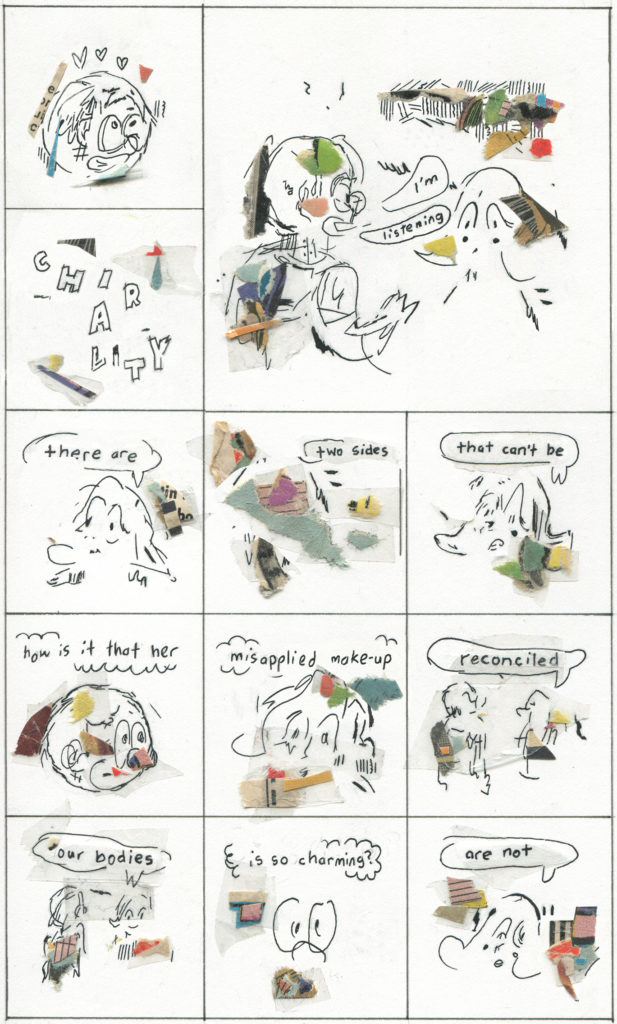
Jason Overby lives in Portland, OR with his wife and two children. He has self-published a variety of mini-comics, including Jessica, Solipsist’s Doodles, and Obligatory Artifact. His strip Apophenia appeared in Abstract Comics: The Anthology. The Being Being, a book collecting some of this work, was published in 2015 by Gridlords. You can view many of this work at jasonoverby.art. He is currently finishing up a new work, which will be called The O.C.
1. i am a single-celled diaspora, a marine sponge. i am an exile born with no nest or noise and when i sing i howl like an Australopithecus
(i am a balloon attached to a string attached to a corner attached to a past that lies to me gently)
2. from the bottom of the cave, my mouth open, my feet dancing on an earth that is still whole. i am pangea, a diaspora contained in an amphora in the singular form, a single body that swells into the intemporal, a sponge, strip away the salt, the waves trick me with their disparate tongues, their laughter in a haze: foam
3. my wandering is anchored in the ethereal language, architect of the future, raw, pure structure with no roots or clothing
4. i have the power to open all doors (but never my cave)
Tana Oshima is a Japanese-Spanish writer, literary translator and visual artist exploring the field of comics. She has self-published eight mini-comics, and has translated to Spanish female novelists from Japan, such as Yuko Tsushima, Hiroko Oyamada, and Yu Miri. She is based in New York. cargocollective.com/tanaoshima_art. Instagram: @tanaoshima.
Peony Gent is an illustrator, installation artist and poet based in London. Her work primarily deals with autobiography and collective memory. You can see more of her work at www.peonygent.com and @peony__ on instagram.


 BACK TO ISSUE