POSTS

R. Tiara Malone

All Summer ’16

if it’s the summer of 2016 & drake drops views, then you’re 27 and this album becomes the soundtrack to ur life, a lifeline maybe. u start to understand his sentiments abt money being a worthy alternative to love. u understand what he means when he says “all of my let’s just be friends are friends i don’t have anymore.” u start to abandon the stifling politics u have abt urself. it sounds liberating but u know that u are not becoming free so much as u are numb. u are moving towards ur detonation. u do not know how to slow it down or stop it. do you even want to slow it down or stop it? u do know, u will not be sober for ur own implosion. u hope to wake in the aftermath of it and u promise urself u will not notice all the debris. u will pretend it never happened. u learn how to breath in and out and never really exhale. u bloat.

each day u examine ur aging form in ur full-length mirror. it doesn’t matter that it lies to u. the truth is, ur ass and hips sit lower now. and if it’s one thing growing up girl has taught u, is that the hips don’t lie. as ur body shifts and u try to figure out a place for it, u meet a man. u immediately want to love him but u know better. he is beautiful but u know better. u expose the truth of ur body to him. u think, he either doesn’t know or doesn’t care that u are never present. then one day, he confronts u, points out ur detachment. his observation vibrates ur body. it rings thru out ur old apartment that has become a grave for ur ghost-self and a few roaches u don’t care to exterminate—being alone is too heavy. u let the roaches have the kitchen. u let this beautiful man have ur new body. u let him have u to a soundtrack of alt. r&b, emo rap & trap music. u let these sounds fill the spaces where ur feelings used to be. hurt turns hard, u can almost feel it happening in real time. u fade.

not long before the beautiful man notices ur ghost-self, a different man made ur body a ghost town. he turned ur lullaby into heavy metal. sleep eludes u now. it dances around ur bed and taunts u, daring u to come and get it. u use the new man as pillow, as armor, as a goodnight song. u attempt sleep but the scent of a past love haunts the place. it’s on the sheets no matter how u wash them. the cushions of the sofa hold the scent. u are convinced the scent is coming thru the pipes. it’s in the water. it’s not just the apartment, u smell it everywhere now. u smell it in the emotional rappers coming thru ur speakers. u smell it in older women who, in the past, were too old to understand u. or, u were maybe too young to understand them. u smell it in rage. u smell it with a raging red. u smell it in blues. it stinks like ur twenties going bad. u think ur past love made off with ur youth. u are right and wrong about this. u are learning the nuances of scent. u inhale.

the call center job u stumbled into allows u to disconnect and provides a paycheck big enough to send ur sorrows into outerspace. u stay at the job. u are mostly late, always disengaged. it is too safe. u use lunch breaks to finish blunts from the morning and to mix red wine into ur passion tea from sbux. u use lunch breaks to wonder if u should attempt ur dreams again. u wonder if u should try reconnecting with ur family, try to feel something for them. u smoke again and top off ur cup because the thought of trying pains u more than your stagnancy. each morning on ur transfer from train to bus, u grab a smoothie from the supermarket on grand & chicago. u don’t care that it’s overpriced and packed with sugar. u only care that u look like u care. u ask urself if this is what being woman looks like: overspending on junk on ur way to a job that is draining life from ur body? the answer has been on ur mind, on ur tongue, before u cld speak it. u swallow it again because u are still unwilling to stop buying into ur own facade. u hide.

u wonder why u look so much like ur mother now, wonder why the thought of calling her throws u into a panic. she was ur age when she had u. she was only a few years older when she left ur father in chicago. him in his addiction. her with her 8 kids in tow. u start to wonder if you’re more him than u thought. it’s not only ur alcohol intake. u now crave the little pills that remind u of vitamins from ur childhood. u make a case for the tiny crystals the beautiful man places on ur tongue. u tell urself u work too hard to be sober. u become agitated easily. u decide to tattoo ur chest just to feel the buzz of the needle. u spend money on everything but rent and u wait for the bottom to fall out. u pacify.

ur womb starts to cry out for something to hold. this beautiful man does his part to fill u with life. u are not ready to become a home. there is no cub. finally, there is no address. u lose the apartment and are relieved for it. the season wants to wane, give out, but not before a few suffocating dog days. u spend these intensely hot days figuring out an escape. this planning is not new to u. in fact, u can’t remember what it feels like to not want to run. u think as far back as u can but can’t recall a time when fire wasn’t in ur feet. u plot.

u are unable to recognize urself. u are living for this feeling of feeling dead. u want more of it. u want to never make the mistake of loving again. u think it’s easy to replace Love so u frequent petco. u buy fish that die off. u buy a bird that u eventually set free. u want to be the bird but u are becoming the fish. it’s not okay but it’s inevitable, u think. u believe it’s possible to outrun urself forever and so u plan to. u start at lake michigan. ur fear of drowning is alleviated by this new secret u have found about water. u are discovering its healing properties, its remedies. it becomes ur baptism each day after the call center. u think, maybe, u cld make this living thing work after all. u float.

this man, beautiful as he is, is too close. just the thought of seeing him again makes u uneasy but u crave it. he is both a danger zone and a safe place. u circulate from one extreme to another. u don’t know if he is too good for u or vice versa. somewhere between lake michigan and ur apartment u decide it is neither. u decide, his thorns are like ur thorns, so even though it hurts, it’s not a new kind of pain. u melt into this theory, try to find solace in it. u shatter.

u cry but can’t produce tears. u spend hours by the lake contemplating the thought…u disconnect from him. u depend on him to save u. u forget urself. u remember urself. u don’t understand it, u just know u don’t feel the same and it’s time to surrender. and so u do. u surrender over and over. u do this all summer ’16 until u fall.

-lake michigan, ‘16
 

A photo of a Black woman smiling and wearing gold-rimmed glasses and a white T-shirt.

R. Tiara Malone is a Chicago born writer living in New Orleans. Her poetry has been published by Partial Press. Her stageplays have been read in Chicago, Atlanta, and New Orleans. Her essays have appeared in Prairie Schooner and Peauxdunque Review (forthcoming). Her essay “Mikey Go Boom!” was a runner-up in the 2020 Words and Music Festival. She studied Media, Communication, and Theatre at Northeastern Illinois University in Chicago. She is currently working on a lyrical memoir and is the owner of Minimoon Massage Studio (@MinimoonMassage) in Nola. Never tweeting @ascribecalled.


 BACK TO ISSUE

 BACK TO FOLIO

Jacob J Billingsley

Delusion is not the crisis

No line, no we want to be kids again. We want to be friends. No worries
where the punctuation ends. No in over your head. The birds got bones
but still they bend. Ain’t hollow yet. Once. Poems playdough they, they
won’t know. They forget and so we get to relive. We spring. We get to
sing. Off key, off beat, off these swings. The knot knowings. These
speakers wheeze. Music. He’s funny man. He sleeps. He’ll wheeze. We see.
Once we were glad all at the top &. Sing. Say, sycamore. We’ve seen these
things. We found stuck down in celery heart God. We’ve seen flowers
saying let me be. We get to say see this this is not a test. See/saw. Saying
this is not a drill. Birds pecking for oil. We get to see this. We see you,
men on the moon. Once in a sycamore. Your best shot, Doctor, Doctor.
My arm bone connects to my shoulder bone. I’ve got a bad case. I get
chills. We hear. Voices. Once we were glad all at the top. We end stop.
We begin to wheeze. We seize. We grow these wings. Fly but forget to be.
In a sycamore. We sang. At the top. Once, we put words in our mouths.

Extimacy of a collective trauma

The patent fear upon which we let rest our biases
creeps upon us like a network of knowing cells.
A drop of Pom spreads throughout a white shirt
in the wash, forces slipping red beads all along its
spindled fibers. The TV blares the capillary action
of a whitewashed war. We tremble until polished
anchors shed tears for the truths they will not say,
and these flow out with the washing. Thin plastic
shirts slip over us like a pleasure smooth enough
to choke on. They flood down with leaflets gone
unread to the sewers, push fatbergs and jetsam,
microfibers coalescing as a network we cannot see.
Red elastic spurts slip over us like a pleasure smooth
enough to choke on. We discard bodies as if they
were our own. Our skin grows into its own stain,
is its own reverse, its insides outed and unready
for a wretching, sicklife world. The only thing left
the soldier took up close was his very own self.
                                                                       If only God
could have made that seem more true. Discard-
ing these hells as if they were my home.

Author’s Statement:

The first result on YouTube when I search “extimacy” is a woman who has put on a variety of wearable technologies for a year and has not taken them off. She is at a loss but is excited to try out something called a mood sweater. What she is wearing has not given her extimacy, which she describes as allowing people (including herself) an insight into—I guess—her unconscious, which, confoundingly, she also calls her self. I wonder what she calls the technologies. She is a data scientist.

That is not the extimacy in my poem, and yet my alarmed reaction to the video is emblematic of what I wrote about in the poem. Extimacy, a Lacanian concept, is just what mathematicians call a mapping, a (topo)logical collapse between what we so often suppose are fixed opposites, self and Other. Such an encounter with what is “strange to me, although it is at the heart of me” can indeed be transcendent, but it is also sure to be terrifying. The extimacy in my poem is that of the mood sweater’s surveillance capitalism, of the so-called War on Terror, of coded messages, and of ecological collapse. A collapse of the binary keep, self/Other, that happens again and again. But these traumas are collective; the Other here is big. Illegible as it may be, this poem is one of witness and protest, not memoir.

Jacob is shown from above the waist, standing before a white screen or panel patterned with a dark geometric motif. Jacob has light skin, and blond or auburn hair styled in a pompadour above, and shaved close at the sides. Jacob wears eyeglass with black rounded rectangular frames, and a dark wine colored hooded sweatshirt with a pale shoelace drawstring.

Jacob J Billingsley:  I’m a queer bipolar poet in St. Louis, and I write most often when I am manic or hypomanic. I aestheticize worry and hurt. I love deceptive syntax. I don’t know if writing is a way of transcending or transceiving. I have a B.A. in English with an emphasis in creative writing from the University of Missouri. I serve on Carve Magazine’s poetry committee. This is my debut publication. 


 BACK TO ISSUE

 BACK TO FOLIO

Nora Hikari

Content warning: science-fictional medical abuse, body horror, transmisogyny   

Endgame Girl Form

In the year 20XX a great cataclysm
overcomes humanity. The cataclysm
is of indiscernible nature, gender,
and political inclination. Some believe the
cataclysm to be God. Others believe it to be
the first mother’s hatred. Still
others refuse to acknowledge a difference.

In the future the only women left are
invented: structurally exquisite
automatons of diamond and titanium
designed to survive the harsh conditions
of the post-apocalyptic gender atopia.
Women are wired from “birth” for adornment and
armament, women are lab-grown in
chambers filled with heat and weight
in a brutally cost-efficient but chemically
identical approximation of the real thing.
Differences can only be discerned by experts
under great magnification that reveal
curved growth lines, microscopic gas bubbles,
increased likelihood of osteoporosis and
urological conditions.

Future breed women make abominations
of language, and are thusly denied
publication. Language is born out of
utility, a mechanism to convey
battle strategy by meme. Women are our
soldiers for the permanence, the vessels
of contrived ingenuity into which
We (the protagonists, the Player Characters)
place our attempts at perpetuity.

[i h8 / th future. i h8 th way it wud desire
smth / from us, as if / it had a will.
smth like hunger / born from th h8treds
of men. i h8 / how it resurrex / dead names, like
“destiny” / and “vitruvian .” h8 how
it keeps making us. i promise / i wont
let it get away with this.]

Portrait In Saw Wave

(after Lauren Bousfield and Ada Rook)

smth abt an imprecise distortion of / form and msg. smth abt noise. smth abt / disruption of respectable comm / -unication. smth abt illegibility. smth abt hurtin ur ears. smth abt liking / the hurt. smth abt liking hurting u. / i like hurting. / im gonna peel my face out of the sticky plastic sheet of white noise. / an shes gonna look slick an brand new an / made up all ovr an beautiful an / im nvr gonna make sense / to u. thunder makes a noise with a name / but on the video its jus clippin brutality. / listen its like this, / u understand form thru the empty / space. u understand color by the / diffrence. you build rhythm out of the broken / and remade silence. / pause. repeat. pause. / this is the world of things meant to exist. / the world of / i am where i am supposed to be. / im not / where i should be. im not here to live in it. / im the dis / -rup / -shun / of canonic structure. / im the thing that cant be heard. / im the noise.

Girl is a Cup

(after Porpentine)

I.
Girl is a cup. Girl
is a vessel towards something.
Girl is a thing to be filled
with something else, poured into
as another thing is evacuated.
Girl is shaped to carry something alien.

I am a small oat milk iced latte
which is
a vessel named after its contents,
rather than what it is (which is
a cup filled with cold slaking), and
after the contents are emptied
the purpose of the vessel is void,
and it is stripped of a name
and discarded. Plastic carcass
decomposing in an empty Starbucks.

II.
Rain on the mountain basin is a name.
Swelling the eroded pelvis of saltwater.
The accumulation of violence
made into a new face, even in stone.
The water keeps falling cold.
The mountain basin imagines the raindrops
are still, and that she is racing
towards heaven, a fantasy of being elsewhere.

Two girls hold their hands out
to each other. They locate love
outside the body, in fluids and salt.
I want to hold you. Come into my hands.
I want to hollow out and carry you.
I want holding to be every kind of touch.

Felix Culpa

I was six years old and terrified
of the thought of swallowing an apple seed.
Feeling her root gutrot into my womb,
weave latticework hunger into my lungs,
something parched and cynical coming up my throat.
She would grow through me like a sin,
make herself known like bitterness.
“This is what could have happened,” she says,
before the world ends.
“This is how it could have been different.”
Sweet and crisp and all inside you.
Don’t you hate it? Don’t you want to tear it down?

I am with a girl I have loved wrong.
We are wine drunk and bludgeoning each other with
tendernesses and indulgent sentimentalities.
We are the last survivors of womankind.
We are crushing grapes for tomorrow,
somehow, even though tomorrow won’t come.
I hate the way we became. The way we leave
thick streaks of ourselves on the windowsills
for the mice to come and lap.
The way we still tried to love when we didn’t know how.
The way she clutches my hand as if to say:
Imagine. We could have so much more than this.

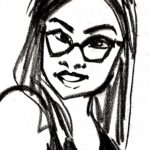
Nora is shown in black line drawing on white background. Nora has hair that falls somewhat below the shoulders, and wears cateye glasses and a tank or halter top.

Nora Hikari is an emerging poet and Asian-American trans lesbian based in Philadelphia. Her work has appeared or is forthcoming in Perhappened Magazine, ANMLY, and Ogma Magazine, among others, and her poem “Deer-to-Fish Transition Timeline” has been nominated for the Best of the Net award. She can be found at @norabot2.0 on Instagram, and at her website norahikari.com.


 BACK TO ISSUE

 BACK TO FOLIO

Shane Neilson

The Weeping Tense         

(for the listeners)

There’s too little light in this room,
I have something to tell you – 

Lean closer, I’ll write more quickly,
I promise, I love you –

don’t cry – 

over the kitchen counter
today, 
clearing scraps, I started  

weeping – 

Out the sliding door, I could see the unkempt grass
bullied by a fleeing wind –

and I was sad for the future, I thought of all the things he is, 
now. 

If emotion is useless,
then each tear is:
not exorcism,
not process,
but how I can’t do anything else; 
inflammatory mediators throwing flags into the brine of
the future, the future, the future, the future, the future 
is dripping onto the counter,
and in the fading light
we can still taste the salt
and say,
at least –

a love you can choke on, and get, heavy – wearing, grinding
at least – 

so close now, your face, ear
and the future

Shane Neilson is a disabled poet, physician, and critic. He lives in Oakville, Ontario. He completed his PhD in English and Cultural Studies at McMaster University in 2018 (focus on disability studies) for which he received the Governor General’s Gold Medal. A previous book, Dysphoria (PQL, 2017) was awarded the Hamilton Literary Award for Poetry in 2018. He is the festival director of the AbleHamilton Poetry Festival which just successfully completed its second run. His poems appeared in Poetry Magazine in April of this year. Work from his latest book, New Brunswick, has appeared on Verse Daily


 BACK TO ISSUE

 BACK TO FOLIO

Lee Soho translated by Soje

Content warning: abortion, unsanitary/maggots, suicide, incest, sexual violence, self-harm

Translator’s Note:

Sometime after 2014, Lee Soho created a character by her birth name, Kyungjin, to play with the scars of a self who is no longer herself. She wrote “Blowfish Soup” (included in this folio) that launched a series of poems called “Kyungjin’s Home,” reprocessing her relationship with her sister Sijin through persona.

The first draft of this series felt to her like “the diary of a crazy bitch raging at the world,” thereby prompting more poems that elaborate on Kyungjin’s arc throughout the five-part collection. These poems I have selected for “WRITING OURSELVES / MAD” are presented in the order they are in the book but intentionally pulled from different sections to create a new friction.

Simply put, Kyungjin is a distortion of the past and present, truth and fiction. Diary entries with non-existent dates, unreal acts of ultraviolence, and even a made-up news article comprise Catcalling. Yet the feeling of autobiography may overwhelm all the apparent artifice.

In her acceptance speech for the Kim Soo-young Literary Award, Lee Soho said she couldn’t have disclosed anything if not for poetry because it specially allows for a variety of interpretations. Given the context of this folio, I thought content warnings would be appropriate, but I also worry that I—as neither Kyungjin nor Soho—may be limiting the scope through which these poems could be interpreted. I for one accept whatever anecdotes Lee Soho chooses to tell me in confidence, and I promise the “facts” hardly affect my translation of the text itself. 

Lastly, the content behind these warnings does not exist merely to trigger traumatic memories. “My poetry may be uncomfortable for some people,” Lee Soho said, “but I intend to keep writing with the belief that it can provide a great consolation for others.” We can be simultaneously some and others.

복어국


    죽겠다고 고백한 날 동생도 고백했다.

너 사람 죽여 봤어?
성녀인 척하지 마 너도 중절 수술한 적 있지
자궁에 혹도 있을 거야 더러운 년

    그러니까 약을 꼬박꼬박 먹었어야지 멍청한 년아

   그날 우리는 미역국 대신 복어국을 먹었다. 각자 방에 가서 먹었다. 아무리 발라내도 복어에는 독이 있을 것 같아. 우린 죽을지도 몰라. 우리는 복어국을 먹고 부르르 떨었다. 며칠 뒤 복어 냄비에 구더기가 들끓었다. 우리는 그걸 국자로 퍼먹었다. 똑똑히 들어. 내가 꼭 너보다 먼저 죽을 거야. 구더기를 씹던 동생이 말했다. 

    지긋지스하게도 오래 사네
죽겠다더니 아직도 살아 있잖아?

걱정 마 니가 죽으면 나도 그때 죽어 버릴 거야

    밤마다

    나는 동생의 살가죽을 덮고 동생 방문 앞에 섰다. 방 안에서 비닐봉지를 얼굴에 쓴 동생을 봤다. 행거에 걸린 허리띠로 제 목을 조르는 동생을, 눈앞에서 대롱대롱 흔들리는 동생을 봤다. 방바닥에 말라 비틀어진 하루하루를 지우며, 나는 흔들리는 동생의 목에서 허리띠를 풀었다. 노크를 한다.

    똑똑

    내가 미안해 

    죽겠다고 고백한 날 나도 고백했다.

똑똑
너 사람 죽여 봤어?
성녀인 척하지 마 너 같은 게 제일 더러워

 Blowfish Soup

    The day I confessed I wanted to die little sister confessed too. 

Have you ever killed anyone?
Don’t pretend to be a saint You’ve had an abortion too huh
You probably even have a cyst in your uterus Dirty bitch

    That’s why you should’ve taken your pills every day you stupid bitch

    That day we ate blowfish soup instead of postpartum soup. We ate in separate rooms. No matter how much I debone it I feel like the blowfish will be poisonous. We might die. We ate the funerary soup and shuddered. A few days later maggots swarmed in the blowfish pot. We ate them up with a ladle. Listen up. I’m going to die first no matter what. Chewing on maggots, little sister said,

    You’ve been alive for an awful long time

    You’re still here Didn’t you say you wanted to die?

Don’t worry When you die I’m going to die right then

    Every night

    I covered myself in little sister’s skin and stood in front of her room. Inside I saw little sister wearing a plastic bag on her face. Little sister choking herself with a belt on a hanger. I saw little sister dingledangling before my eyes. Erasing the days that dried up on the bedroom floor, I loosened the belt from the neck of my swaying sister. I knock. 

    Knock knock

    I’m sorry

    The day she confessed she wanted to die I confessed too. 

Knock knock
Have you ever killed anyone?
Don’t pretend to be a saint You’re the dirtiest kind there is

송년회

    내가 요즘 신인들 시집을 자주 보잖아. 잘 들어 시라는건 말이야 미치는 거야. 지금 네 상태에서 한 발자국 더 나아가야지. 독자들을 니 발밑에 무릎 꿇게 만들어야지. 선배들 니들 좆도 아니야 이런 마음으로 나도 뛰어넘어야 하는 거야. 그래 알지 너 시 잘 쓰거든? 시를 못 쓰면 내가 이런 얘기 하지도 않아. 근데 니가 가족 시를 쓴다는 그 행위 자체에 매몰되어 있는 거 같아. 니가 이해를 못하는 거 같으니까 예를 들어 볼게 너 제일 좋아하는 시인이 누구야. 그래 최승자처럼 되고 싶다며, 근데 넌 최승자가 될 수 없어. 다르거든 이 세상에 최승자는 최승자 하나야. 니 시는 말야 뭐랄까. 끝까지 안 간 느낌? 더 갈 수 있는데, 지금보다 더 극단으로 가야 한단 말이야. 예를 들어 볼게 극다능로 간 시인이 누가 있을까 그래 최승자. 

    내가 보기에는 말이야 니가 착한데 나쁜 척을 하니까 그런 거라고. 그게 진짜 너라고 생각하면 독하게 밀고 가란 말이야 미친년처럼. 시의 끝에 매달려 있으란 말이야. 거기서 한 발짝 더 나아가란 말이야. 말해 봐 넌 어떤 시인이랑 싸워서 이길 거야? 어떤 시인이랑 겨룰 수 있다고 생각해 니가. 니 시는 말야 솔직히 아직 아무도 못 이겨.

 Holiday Party

   You know I read a lot of debut collections these days. Listen, being a poet means going crazy. You need to go one step farther from where you are right now. Make the readers kneel at your feet. Kill all your literary heroes and jump over our dead bodies. Yeah, you write good poems. If you weren’t any good I wouldn’t even bother saying this. But I think you’re stuck in a rut writing about your family. Since you don’t seem to understand, I’ll give you an example. Who’s your favorite poet? That’s right, you said you wanted to be like Choi Seungja, but you can’t become Choi Seungja. Because you’re different. The only Choi Seungja in the world is Choi Seungja herself. Your poems are like, how do I say this. They haven’t reached the edge? You could go farther. I’m saying, you need to be much more extreme than you are now. I’ll give you an example of a poet who went there. That’s right, Choi Seungja.

    The way I see it, it’s because you’re nice but you act like you’re not. If you think that’s really you, stick with it! Like a crazy bitch. I’m telling you, hang on the edge of poetry. Then take another step forward from there. Tell me, which poet are you going to fight and win against? Who do you think you can compete with? Your poetry, to be honest, can’t beat anyone yet.

마이 리틀 다이어리
—우리집

1987년 4월 6일
애를 만들었다

집 밖에서

부엌칼로 불알을 떼고

바지를 내렸다

똑똑히 봐 시진아

애는 같이 만드는 거라 했지

이제 눈 감고도 만들 수 있겠지

한 번 해 봤으니까

이제 안에서도 할 수 있겠지?

My Little Diary 
— Our HOME

April 6, 1987
I made a child

Outside the house

I cut off my balls with a kitchen knife

and lowered my pants

Look closely Sijin

A child is something you make together

You can make it with your eyes closed now

Now that you’ve done it once

you can also do it indoors right?

마이 리틀 다이어리 
—경진이네

    2월 19일
배냇저고리를 입고 면사포를 썼다
    동생과 나는 하나의 웨딩 케이크에 꽂혔다
    단칸방, 우리는 침대에서 말을 아꼈다

    2월 20일
    처음 보는 변기와 잤다
    언니를 낳고 언니를 동생이라 부르고 우리는
    응애응애
    울기 위해 엉덩이를 맞는 연습을 했다

    2월 21일

창의적으로 매 맞는 수업료
만오천 원

    연기를 더 잘할 수 있으면 좋았을 텐데

    더 거친 숨소리 더 거친 교성 더 유연한 다리 우아한 다리 마른 다리 위에 젖은 다리 매끈한 다리와 울퉁불퉁한 다리 넘쳐 나는 다리 위에 엉킨 다리들 휩쓸려 가는 다리들 수몰된 우리의 다리들 무너지는 흔들리는 우리, 우리의 다리들

    2월 22일
    밤이 계속되자 꼭 감은 동생의 눈
    자정의 입맞춤에도 깨지 않았따
    동생에게 물었다

    난 몇 번째야?
  대답 대신
    약지에만 나를 걸고 배배 꼬았다

언니는 참을 줄 몰라
꼴릴 줄만 알지

    2월 23일
  동생의 엄지와 약지만 골라 꺾었다
    빨면 편히 잠들 수 있었다

    2월 24일
    엄지보다 더 큰 엄지를 다리 사이에서 찾았다

    2월 25일
    동생은 나를 엄지 위에 태우고 흔들다 쓰레기통에 버려지는 모습을
    사랑했다
    사랑은 언제나 끝물이 클라이맥스니까
    우리가 가장 좋아하는 바로 그 장면!

    2월 26일
    레버를 눌렀다 동생은 빨려 들어갔다

울부짖었다

나는 여기 없어요

    2월 27일
    동생이일기를쓸때
    나는낯선우리에대한시를쓴다
    지긋지긋하게우리로묶이는그런
    시를


My Little Diary 
— Kyungjin’s HOME

    February 19
I wore baby clothes and a bridal veil
Little sister and I were stuck on top of the same wedding cake
Single room, we spared our words in bed

    February 20
I slept with a toilet I just met
I gave birth to my big sister and called her little sister and we
practiced being spanked so we could cry
waa waa

    February 21

Fee for a class on being punished creatively
15,000 won

    I wish I could’ve faked it better

    Rougher breaths rougher moans more flexible legs elegant legs skinny legs below wet legs smooth legs and bumpy legs legs for days below tangled legs legs being swept away our submerged legs our legs crumbling like bridges shaking us, our legs our bridges

    February 22
Because the night continued little sister’s eyes were shut
She didn’t wake up even at the midnight kiss
I asked her

How many were there before me?
Instead of answering
she wrapped me around her ring finger and twisted me some more

You don’t know how to wait, big sis
You only know how to get horny

    February 23
I snapped little sister’s index and ring fingers only
I could fall asleep easily when I sucked on them 

    February 24
I found a thumb bigger than a thumb between legs

    February 25
Little sister let me ride her thumb She loved the way I looked
being shaken around then tossed in the trash
because the very last drop of love is its climax
Our favorite scene!

    February 26
I pulled the lever Little sister got sucked in

She cried out

Im not here

    February 27
While my little sister journals
I write a poem about an unfamiliar us
Yet another poem where we’re squared into
us

마이 리틀 다이어리 
—시진이네

    2월 27일
    의사 선생님께 이시진 올림

    2월 26일
    일기장에서 가장 못된 문장만 골랐다
    언니의 입을, 혀를, 잘못 놀린 손을, 양손을 잘라야만 했다
    더는 쓰지 못할 거야
    그래도 괜찮지?
    아무도 읽지 않을 버러지 같은 시니까

    2월 25일
    부곡하와이에서 꽃 대신 말린 남자를 사 왔다
    내가 침대에서 훌라 춤을 추고 허리를 돌리는
    사이 언니는 언니를, 나를, 나라는 애인을, 동생을 팔아 시를 쓰고
    고작 
    삼만 원을 벌어 왔다

    2월 24일
    씨발 내가 먼저 태어났더라면

    2월 23일
    새처럼 곤두박질치는 가세

    2월 22일
    집은 더웠다
    선풍기를 틀어도 늘 비닐하우스에 있는 것처럼
    땀으로 뒤범벅된
    내가 소파에 온몸을 활짝 펼치고 누우면
    언니는 말했다

    오오 벌거벗은 나의 임금이시여! 
    다리 사이를 기라면 기고 머리를 조아리겠나이다

    2월 21일
    언니는 남자 없이도 조금 더 느낄 수 있도록
    주름에 주름을 접었다

    아인슈타인은 뇌에 주름이 많았대
    그래서 남들보다 많이 안대
내가 더 많은 주름을
그 주름을 만들어 줄게

    2월 20일

오래오래 살아라 시진아

    언니는 남자를 접어 학을 날린다 질 안에 천 개의 학을 접어 넣는다 학에게 이름을 붙인다
    김수한무거북이와두루미삼천갑자동방삭칙칙카포 싸리싸리센타워리워리세브리카무두셀라구름이허리케인담벼락서생원의고양이바둑이는돌돌이

시진아 거북이 알도 접을까?
접어서 거기 넣을까?
그럼 네 기분이 좋겠지?

    2월 19일
    ;;* 나는 언니의 눈동자 밑에 쉼표를 붙였다
    눈동자를 연필로 더, 더, 더 덧대어 칠하고 
    눈 밑을 꼬집어 어니를 울렸다

    시꺼먼 눈동자 밑으로 끝없는 쉼표, 쉼표가
    태어났다
    (;;)**


* 2월 30일 세미콜론 데이;; 문장을 끝맺을 때 쓰지만 끝내지 않기로 할 때도 쓴다.
** 2월 31일 언니가 말했다. ‘우리’는 끝나지 않아 영원히. 

My Little Diary 
—Sijin’s HOME

    February 27
    Dear Doctor Sincerely Lee Sijin

    February 26
    I picked the ugliest sentences from her diary
    I had to cut off Unni’s lips, her tongue, her misbehaving hands, both of them
    You wont be able to write anymore
    Thats fine, right?
    Theyre just pesty poems that nobodyll read

    February 25
    Instead of flowers I bought a dried man from Bugok Hawaii
    While I danced hula and gyrated my hips
    in bed Unni sold out herself, me, her lover that was me, her little sister to write a poem and earned
    only 
    30,000 won

    February 24
    Fuck If only Id been born first

    February 23
    Family finances nosediving like a bird

    February 22
    It was hot inside the house
    When I, always covered in sweat like I was in a hothouse 
    even with the fan on,
    spread my whole body and lay across the sofa
    Unni said

Oh my naked emperor!
I shall crawl between your legs if you sayeth and kowtow to you sire

    February 21
    To come without a man 
    Unni folded wrinkle upon wrinkle

Apparently Einstein’s brain was extra wrinkly
That’s why he knew more than others

I’ll make you more wrinkles
more of those wrinkles

    February 20

Live a long life, Sijin

    Unni folds a man and flies a paper crane She folds a thousand cranes into her vagina She names the cranes long for longevity’s sake:
    Gimsuhanmu Geobugiwa Durumi Samcheongapja Dongbangsak Chikchik Kapo Sari Sari Senta Woriwori Sebeurikka Mudusella Gureumi Heorikeine Dambyeorak Seosaengwone Goyangi Badugineun Doldori

Sijin should we make turtle eggs too?
Should we fold them and put them inside?
Then you’ll feel good, won’t you?

    February 19
    ;;* I added commas under Unni’s pupils
    I drew over, over, over, over them then
    pinched below the eyes to make her cry

    Beneath the pitch-black pupils endless commas, commas
    were born
    (;;)**


* February 30, Semicolon Day;; Used to end a sentence but also used when you decide not to end it. 
** On February 31, Unni said that “us” will never ever end.

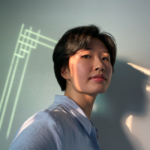
Soje is shown, in two-thirds profile, before a pale wall. Soje has light skin, and dark hair of several inches length, parted down the middle. Soje wears a collared shirt of light heathered grey. In the top left corner of the image, on the wall, lines of light extend obliquely downard to the left, and to the right.

So J. Lee is the translator of Lee Hyemi’s Unexpected Vanilla (Tilted Axis Press, 2020), Choi Jin-young’s To the Warm Horizon (Honford Star, 2021), and Lee Soho’s Catcalling (Open Letter Books, 2021). They also make chogwa, a quarterly e-zine featuring one Korean poem and multiple English translations.

Soho is shown, on a dark greygreen background, in two thirds profile, from the waist up. Soho has light skin, and dark hair. Soho wears red lipstick, an oversize cream colored cardigan, and a black garment beneath. Soho's hands are raised to either side of the head, and two rings are visible on the middle finger of the right hand.

Lee Soho (b. 1988) studied creative writing at the Seoul Arts University, and earned an MA in Korean literature from Dongguk University. She made her debut winning the Newcomer Award in Modern Poetry in 2014. Her first collection, Catcalling, won the Kim Su-young Literary Award in 2018.


 BACK TO ISSUE

 BACK TO FOLIO

Paula Harris

the weight of pain

in 1945 Dr Lorand Julius Bela Gluzek of Cleveland, Ohio
developed a dolorimeter which could measure pain in grams
so maybe the weight I gained on antidepressants
wasn’t from sadness and an increased appetite
but my organs and glands – thyroid, pancreas, lungs, 
adrenal glands, ovaries, stomach, hypothalamus – 
each getting heavier from the consumption of black bile

the weight of the water inside the mouth of a blue whale
can weigh more than the whale itself
so if I dive into the ocean and convince a blue whale to swallow me
I will leave my sadness on its tongue and be weightless

Paula Harris lives in Aotearoa/New Zealand, where she writes and sleeps in a lot, because that’s what depression makes you do. She won the 2018 Janet B. McCabe Poetry Prize, and the 2017 Lilian Ida Smith Award. Her writing has been published in various journals, including Hobart, Berfrois, The Rialto, Barren, SWWIM, Diode, Glass, Aotearotica, and The Spinoff. She is extremely fond of dark chocolate, shoes and hoarding fabric. website: www.paulaharris.co.nz | Twitter: @paulaoffkilter | Instagram: @paulaharris_poet | Facebook: @paulaharrispoet


 BACK TO ISSUE

 BACK TO FOLIO

Shana Bulhan

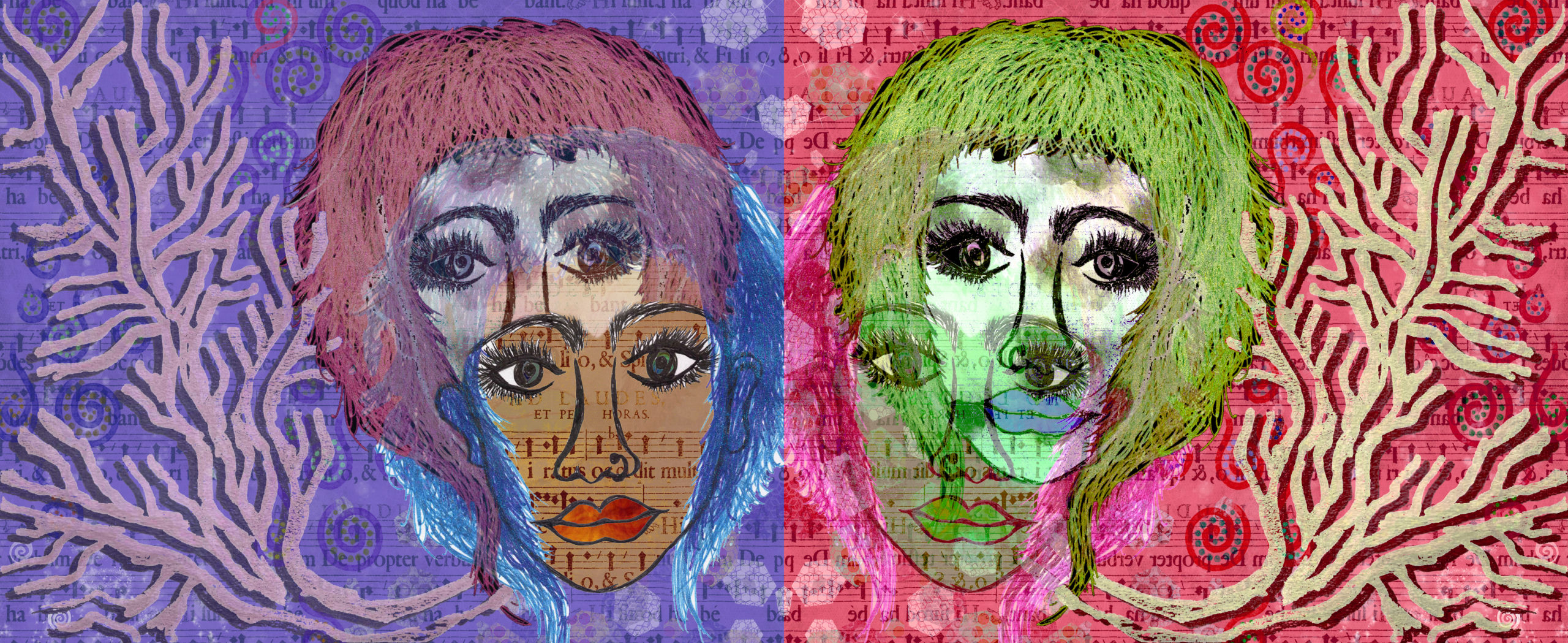
The artwork consists of two images side by side. They are horizontally flipped versions of the same picture, also edited with different colors, highlights, and shadows. The picture consists of two faces, one partly superimposed onto the other: a femme-presenting person with layered short hair (mostly chin-length with bangs), with striking eyelashes and eyebrows, also wearing a nose ring. To the side of the person's face, there is a tree-like structure (without leaves) branching out towards the edge of the picture. In the background, there are various swirls and hexagons set against stylized Lorem Ipsum text. The image on the left has a purple background; a mauve tree structure; and the two faces have blue and pink hair respectively. The face in front with blue hair has more dominant opacity, and the person's skin colour is brown. The face in back has ghostly white skin. The image on the right has a bright pink background; a dull green tree structure; and the two faces have green and pink hair respectively. The face in back with green hair has more dominant opacity, and the person's skin colour is ghostly white. The face in front has dull brown skin, but is quite faded.

Mad Queer’s Love Song

after Sylvia Plath1 


* 
i will spend my entire life yearning for everything we couldn’t sublimate 


* 
i cut my wrath into grief 

i don’t need a rose 
to waste a body, enter a land 

i remain ugly in the episteme of my body 


* 
it’s mourning, and i want to kiss you in the stark.  
i seesaw your smile. didn’t i?  

how did we get to this place? 
these frenzies — i just want the suddenness of — 

(as if i could confess 
to meaty contagion  
smearing itself  
between my fingers) 

i hunker down in this mirror of self state 
dressed up to collapse, allure of i want to cut myself up like that too 
i want you (mirror) to clutch me there, that soon,  
& hate me clear as art 

it doesn’t make sense that we can’t  
kiss without bones gnashing — the accumulation of dread.  
it doesn’t make sense at all 


* 
& could we shift this floating someday? — room stripped 
down — & then i won’t be cunt exposed like some seedy 
omission  & there’s nothing revelatory in the kiss of history  
& that too is a language beleaguered 

against an other 
box. which is to say 

will i ever? chalk boots  
through gender
 
will i ever? be 
red velvetine 


* 
i trade one half of white 
for your faction. 

i measured it like 
some inexplicable cultural memory  
a newer place to dream of death 

again out of frame, meteoric 

but it’s just not a good century for a recluse 


* 
i wanted to be loved into luminosity 
loved with the irony of history2 
effulgent and craved 

i wanted to be cunning & all i devilled  
was a sore nose, sore throat. 


* 
& i’m so tired of teeth  

rotting then scrubbed again 
yellow seething into aftertaste. i wait 

and wait  

and wait. i slumber into 
the waiting. 


* 
am i just a repeat of constance, beautiful at the expense of barbaric? 

i don’t know if i have made myself up 
stuck in this perpetual stage of queen jane3 
too fundamentally here to disavow 

i’m bad at groupcool groupthink  
i never whistle the world into dazzlement 


* 
you blurred the moon for me 
catalyzed planet into desert 
& still i’m red 

red 
for every mere mention — 

i meet you in the crux of the unforgivable  
safety was only ever a liberal coercion 

but you would never meet me — 
not in this grub of gold  
& shine. 


* 
i made a window 
to let you mural me  
into winter 

so that in the house of your dreams  
we could disentangle ourselves,  
grocery desire cascading  
into opulent shelves.  
is this the everydayness?  


* 
i whiten in the year of my room  
as you billow off — 
off, off.  

i dress like a pregnant shop auntie 
cheap cotton balakrishna 1527 at the hem 

i buoy and sway and arc into lumps of pink then brown 
spots under my flour bags of breasts 
off-white pushed to the edge of tan 


* 
quiver4 pulsates at my worn wrists 
& what about the silvering dance of me?  
i want to write about you, or the creaking knees of me 

here’s the drop-ceiling of sky 
& black hairs eschewing contagion 
vegetable broth of cellulite teeming  
till i’m just a landslide of joints and cracked heels 
in free-fall 

in my head i’m doing the splits  
all over mahogany & mirrors 
i rear back my head & smile 
raise the fuck for the fount 


* 
so i’ll scrub myself into femme,  
chop myself into butch.  
i’ll grab & punch my breasts  
into a photograph. 

i wanted to be god like you. 
& isn’t that romance? to slam my body 
against doom. as if i wasn’t dripping 
snot from my cunt. as if i wasn’t 
languishing on a toilet seat. as if i wasn’t 
splaying toothpaste on the mirror, 
burnished blood in the sink.
  
no, i’m all cellulite and cushion. 
i stretch into keratosis.  
we become into matter.  
detritus at dawn. 


* 
i scorch the earth. i scorch the earth for you, 
love. isn’t that enough? 

i run into you. i run the wild into you, love. 
i fling the world into reverence. helix and jar. 
i could not have wilded you any less. 

but you can’t wield it. this wilding, this brimming. 


* 
instead i make a crater to flounder 
i punch my souring pelvis into gratuity 
with every semi-squat i reach for evidence 
lying with pooled absence in my every tract 
so i come up & push again. to linger is an 
affront a prime malfeasance coiling itself 
around a name 


* 
you give up on quarantine 
& marry the man  

pushing you into the ocean. 

& would you drown  
for that monument of erasure?  


* 
if i could only paint you queer  
would you win in another continent?  

are you my crushed echo, a misgendered 
self? she walks down the road becomes a 
question mark split ragged & who’s even 
writing this aftermath 

suddenly you are no longer here. suddenly i 
want to rescue you into performance. 

i am so tired of abstraction. what is this damn 
box. no anchors anymore. clash of expected 
symmetry. you could never be ready for the 
muck of me.  

like every god your figure crashed into 
gold & what a cruise it was. what a 
fucking soirée. 


* 
what must it feel like, hair still 
so silky, shimmering and gone. 

& maybe if i was lean like a dream, 
one black boot up against the brick. 
putrid with glitter, tracking orgasms 
like sand. & maybe if i could sway 
into every dank alley. & maybe if  
i sauntered my hips onto a stage,  
burlesque & brawn. & maybe  
if i was just girl enough 
for mystery.


no, baby, i’m the wrong one. 
what a delight it is. what a fucking cheap shot.
  
i’m achy without age.  
i carpal tunnel & fibroid  
my every move. every inconvenient creak 
& crack.  i lie in bed. i embellish my fat, 
strain into obscene.  


did i get lost in the invention of us? 

you only want me if i crumble into jars of leaving. 

& you fight for this solitude of 
near-death.  oh, how i’d wrest it from 
you — 

how i want to dive  
into every reptile coat 
of an attempt 


* 
so i wander within like a bruise has taken hold 
of me like sugar like god 
lost in marginalia 

choose me. i’m begging you my bruise 
choose this shade of me 


1 Plath, Sylvia. “Mad Girl’s Love Song.” Mademoiselle, 1953. https://www.bl.uk/collection-items/sylvia-plaths-mad-girls-love song-from-mademoiselle#

Quote from the following novel: Ondaatje, Michael. Anil’s Ghost. Vintage, 2000. p. 12.

3 c.f. song: Bob Dylan. “Queen Jane Approximately.” Highway 61 Revisited (Album).  

4 c.f. song: Lonas. “Quiver.” Quiver (EP). 
Shana is shown, from the shoulders up, before chrome shelving and colored cloths. Shana has light brown skin and inchlength straight black hair. Shana wears semitranslucent oxblood cateye glasses, and a dark grey or black crewneck shirt.

Shana Bulhan is currently attending the MFA Program for Poets & Writers at the University of Massachusetts, Amherst, where they are also pursuing a Graduate Certificate in Feminist Studies. Previously, they studied Critical Social Thought at Mount Holyoke College. They grew up mostly in India, but they have been living in Western Massachusetts for more than a decade now. They recently won an Academy of American Poets Prize selected by Bianca Stone. Their work has appeared in Meridians, smoke + mold, the Asian-American Literary Review, The Felt, Datableed, and other publications. For more information, please visit their website, www.cruxate.com


 BACK TO ISSUE

 BACK TO FOLIO

Evan Reynolds

[ abjection ]

subject refuses to sleep
subject insists that he has secret knowledge of a conspiracy involving the cia and large 
         pharmaceutical companies
subject walks obsessively down the corridor in the same direction
subject refuses medication
subject does not wash or brush teeth
subject insists on talking to a lawyer
subject pulls at hair
subject stares out the window consistently
subject refuses therapy
subject rocks back and forth
subject displays writing behavior
subject continues to write
subject will not stop writing

[ ABJECTION ]

TO the ether beyond what calyx proclivity
docile sentry becomes unbounded hitherto

TO what eye of lacrimal joy bursts apart
below not buried weeping song of shit

TO detethered centrifugal force push
out the placental bloody blossom there

TO refracted light combs curling round
the maggot frost forthwith revealing

TO synecdotal hymns shank raw flesh
napkins of wipe that stupid frown away

TO malignant bliss rocks melting in tubs
protracted from stanzaic triangulation

Evan Reynolds is a Chicago-based poet whose work focuses on the experience of schizophrenia.


 BACK TO ISSUE

 BACK TO FOLIO

Alix Anne Shaw

I could not hear the other side / the other side could not hear me

The body runs its applets

as apples shyly glow
thunking

through the dusk beneath the trees

so, too, there is a gear in us
nimbly clicking

in foreshortened air

I hear the arc and whirr of it
ratcheting the nil

the empty shaft—

meantime, the river stretches out
the single silver fiber that it is

and the body with its silver threads

halflit in the armchair (lavender or
avocado green)

flickers, intermittent
attempting to connect

with something it could wish for


arcsine
───
archive

secant
───
e-cig

tangent
───
grassquit

as the river snarking past the house
fidgets with its lake

its dirty bank—

If only I had been
some other kind of self

if / then
would you skype me

until I sky myself

because this dark is a variant
of every other dark

a spindle of intent that I must nightly choose to wind

Alix is shown, the left side of the face and shoulders, lying upon brown and yellow leaf litter. Alix has pale skin, and red or auburn hair of several inches length. Alix wears narrow oblong glasses with black frames, a red collared shirt, and a mint green hooded jacket.

Alix Anne Shaw is the author of three poetry collections: Rough Ground (Etruscan, 2018), Dido in Winter (Persea, 2014), and Undertow (Persea, 2007), winner of the Lexi Rudnitsky Poetry Prize. Her work appears in Harvard Review, Fence, Denver Quarterly, The Los Angeles Review, New American Writing, and online at www.alixanneshaw.com. She is also a sculptor.


 BACK TO ISSUE

 BACK TO FOLIO

nessi alexander-barnes

Esoterica/Ethos: Critique; for personal use when editing the work of others-

Abstract;

my experiences are complex and alien, and thus my voice is complex and alien;

i am excruciatingly aware that many contexts cannot support the weight of that alienness, and thus i often shave off my idiosyncratic edges to accommodate the access of others, as necessary.

in my personal writing, i do not make this sacrifice. my personal writing is complex and alien.

Thus, my personal writing is hard is hard to read.

i have allowed it to remain hard to read.

1)

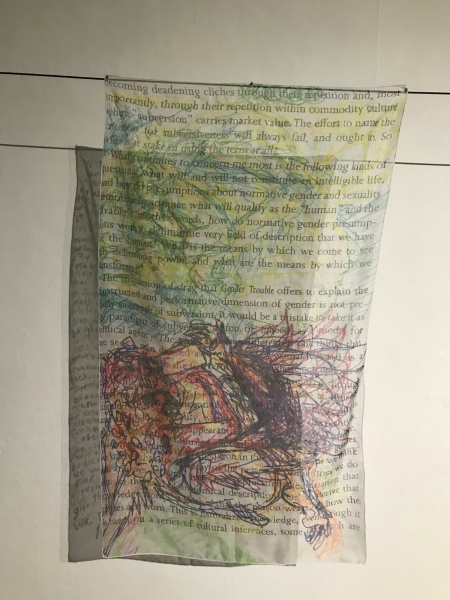
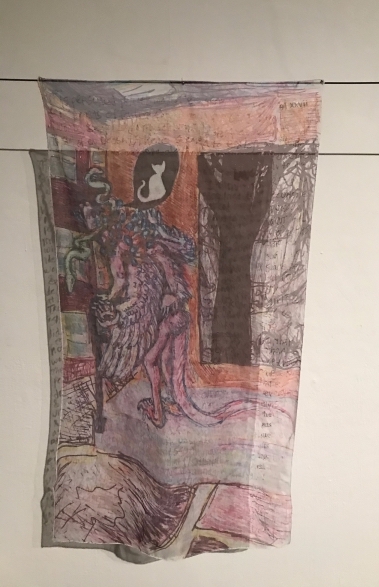
On black cords, two hangings of sheer cloth or transparent paper are shown. On the front hanging, there is an image of mostly abstract linework. Yellow, green, and blue hues predominate above; a darker and warmer tangle occupies the lower half. All of the hanging is printed with text in black Times, of which evident phrases include "through their repetition within commodity culture", "carries market value. The effort to name the", "will always fail and ought to", "how do normative gender presump", "which we come to see", and "Gender Trouble offers to explain the". The rear hanging is completely covered with hand printed text.
i am *not* a prescriptivist;

i am more of a descriptivist, but i am not *really* one of those either.

2)

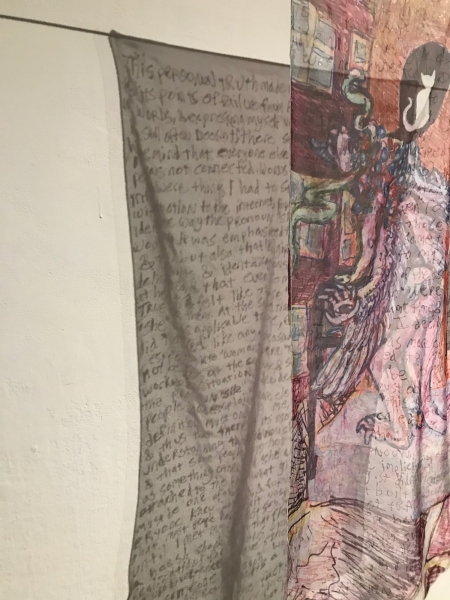
On two black cords, before a pale wall, hang sheets of sheer cloth or transparent paper. The front hanging is marked with an image: before a brick red wall, an incarnadine humanoid figure stoops toward a vermillion barred rectangular portal. The figure has a tail, feathered arms, clawed feet and hands, and serpents, feathers or fur, and blebs or pustules upon its back and head. The figure walks with a black cane or walker. In the red wall, above the figure in a round black niche, sits a white cat, facing away. In a larger rectangular cavity to the right, a dark tree is visible upon a lighter void. The figure stands upon light lavender ground; before which proceed rectangles of black and pink, framed with white lanes. On the back hanging, there is hand printed text, largely illegible.
i believe that the technical aspects of writing, such as grammar, are tools intended to do the work of conveying meaning to a reader;

i believe that there are multiple kinds of reader, and that all of them will bring different needs and experiences and interests to their practice of readership;

i believe that the technical aspects of writing are growing and flexible things, that they are never static, and that recorded strictures of their use are necessary, but that such strictures are also ossifications, always a step behind the alive-things as they move between the spaces of our interactions, and so that to replace the living entities with ossified strictures is to remove the source and potential of their continued vitality;

i believe that language and grammar, and the control of one's voice more broadly, have long been tools of violence and oppression, and that to address that brutal history, we must actively make room for multiple ways of being and writing and speaking;

i believe that 'universal' and 'singular' have limited applications, and that there is no one 'true' or correct form of writing –– rather, there are multiple ways of writing, and vastly different contexts may require vastly different modes and styles to adequately address their needs;

i believe that specific technical and conceptual features of writing, from vocabulary and grammar to the use of literary devices and rhetoric, are tools and *only* tools –– they are deployed to make the thing happen, they are neither the thing itself nor the appropriate universal goal –– they are invoked to call the thing to fruition, and if they do not meet that need, then either old forms need to be uncovered/reinvented, or what exists need to be changed/added to;

i believe there are both different levels of need and different kinds of taste, and that there is no form of writing that is universally accessible to every reader, and that what one reader finds unbelievably dense and opaque, another might find as vital and refreshing as air, and further that neither of these readers are *correct* and that they both deserve to be served;

i believe that other approaches to the technicalities of writing are *as valid as mine* and *do not supercede mine*, and thus i recognize that my style of writing and editing is not appropriate for every audience –– should the person seeking guidance [from me] be one of those i cannot serve, i *actively* encourage them to pursue the guidance they need from a more conventional practitioner;

i believe that the way i can best serve the writer i am critiquing, their readers, and social justice as a whole, is to *preserve and bolster that writer's voice* as best i can;

i believe that words mean vastly different things according to context, and that synonymous words are *not* identical in definition;

i believe that to encourage someone to file off their idiosyncratic edges in the name of an idealized archetype of Generic Audience is to create a caricature that represents no one accurately and thus serves no one effectively;

i believe that it is important to be generous to one's audience, but that there is a difference between generosity and self-erasure, and that audience members are often smarter than they're given credit for, if one takes the time to be careful and patient and, indeed, generous –– that it is generous to write honestly and to honestly share one's experiences –– and that it is *okay* if the only audience a writer seeks to address is themself;

i believe that precision, accuracy, and clarity are very important, and that sometimes those things are *not* at odds with simplicity and can be conveyed simply, but that the resolution of conflicts between those standards involve the prioritization of the former (accuracy, precision, clarity,) because the removal of information in the name of simplicity is *neither* neutral nor more clear, and tends to create distortions and erasures, particularly over many generations of data processing and the subsequent collation of that data into text.

3)

On black cords, two hangings of sheer cloth or transparent paper are shown, up close, from the side, and obliquely. In the hanging in front and rightmost, a humanoid figure is shown, of incarnadine color, with feathered arms, clawed hands and feet, and blebs and serpents upon its back and head. The figure stoops toward a gray portal barred with vermillion. Above the figure, in a round black niche in a brick red wall, a white cat sits, facing away. The figure walks with a black cane or walker. In the leftmost hanging, hand printed text predominates, largely illegible. The first line might read "This personal truth makes".
i am trained as an artist, which significantly structures my approach to the technicalities of writing: these are to me the same as color and line and paint: tools to be arranged to achieve a specific purpose or goal, and for which the approach will be different according to the specifics of those purposes or goals;

they are also tools whose appropriate use has been governed by very different strictures according to temporal and cultural contexts, and whose governing strictures often have far more to do with the advertisement of social position on the part of those enforcing them, than they do with any intrinsic characteristics of either the tools or the works generated by those tools.

4)

i believe in, and admire, complex and/or ornate writing.

i also believe in and admire many other kinds of writing, including simple ones.

i do not believe that all writing needs to be complex and/or ornate, but rather that these kinds of writing have a place, at all. i have a theoretical grounding for this (and many of my other) position(s); many thanks to José Esteban Muñoz specifically, for the queer possibilities of the ornamental.1


it is my intention to advocate that more room be made at our tables, not that any who operate under more conventional constraints be excluded in our stead.

if this seems impossible, then it is our job to be more creative, with regards to our approach.

and possibly to get a bigger table.

5)

i am a disabled reader, whose disability often necessitates *more* complexity in writing for things to be accessible to me –– not a terribly common state of affairs, and thus not a well-served one, either;

i also often need more grammatical/syntactical cues, not less –– it is inelegant, but commas as pause-notations *really make a difference* in my ability to read something coherently; this appears to be unusual enough i try to actively ignore this need in my role as provider-of-critique, but i think it is good for people to keep in mind, as an illustration of the way that syntax and grammar differently address different needs for different readers;

i am exquisitely aware of accessibility conflicts, and that often the only solution is mitigation. My job as provider-of-critique is to partially mitigate that mitigation, as much as is possible.


i do not demand that it be read by anyone but me –– only that it be allowed to exist, so that i, too, may know what it is to reach for/into a cultural repository and to hear the echo of a voice like mine, even if that echo is only actually *my* voice preserved in boolean amber.

i am selfish; i am ravenous; i am starving; i have been hungry for so long; this is a source of food.


; THAT SAID

critique is something different; critique is not about me; the approach i take to critique is not governed by the specific approaches i take when recording my own voice in boolean.

critique is about the person i am advising.

my writing and my voice exist independently to critique, as much as i can make that so; my job as someone who is critiquing someone else is *not* to impose my voice on them, but to listen for their voice, and to help them make that voice more resonant.

if i can prevent them from starving, i have done a good job.
if i can help them to feed themselves, i have done a good job.

6)

These are the same tactics i employ when critiquing artwork,
casually and professionally.

7)

My decision both to eschew caps in reference to myself and to use the lowercase 'i'
is intended to pay homage to a line of scholars who i deeply admire and from whom many of my thoughts are descended.2

Works Cited

boyd, danah michele. “What’s in a Name?” Accessed January 6, 2021. http://www.danah.org/name.html.

Loyal Jones Appalachian Center. “bell hooks: Distinguished Professor in Residence in Appalachian Studies.” Berea College. Accessed January 6, 2021. https://www.berea.edu/appalachian-center/appalachian-center-home/faculty-and-staff/bell-hooks/.

Muñoz, José Esteban. Cruising Utopia: The Then and There of Queer Futurity. Kindle. Sexual Cultures. New York: New York University Press, 2009.

1  Muñoz, Cruising Utopia, 1–3, 6-7. 104, 132-139

2  i am here referencing scholars such as bell hooks, danah boyd, and micha cárdenas. This presentation is both homage and  strong agreement with their work and their reasoning.
Additionally, in fine art, we are visual authors, and we are authors who are very much not dead-- the discipline broadly leaves no room for an empowered reader to argue for the validity of their own interpretations, there is only room for the meaning we meant to impose on the world through the work, which is understood to be intrinsic to the work itself, and which must always be obvious and universal and available for public consumption.
 But to argue that there is one universal interpretation to anything is to exclude anyone whose context does not grant them the intuitive access necessary to ‘read it correctly’, and to further mark them implicitly as catastrophically deviant as the work’s meaning is thought to be intrinsic. That argument-- that the meaning of a work can be universally understood (that there is one/one set of correct interpretations)-- would also deny the means by which i survived for decades, by ravenously devouring every piece of media that i thought interesting and intuitively altering it as necessary to see myself in it, regardless of the author’s preference. (No apologies to Ms. Rowling, whose magical school will *always* be full of trans kids for me.)
bell hooks says that she eschews capitalization “to emphasize the substance of her writing as opposed to who she is.” i cross-apply the same convention, making a slight deviation: i am operating within a discipline that only makes room for who i am, and that also thinks it understands what that means, that demands my who-ness be instantly legible on normative, neurotypical, cishet terms. 
But my work is my a personal mythology, developed privately for decades with a rich and idiosyncratic iconography, put to pictures: i do not need to sign it to be present in it, and its legitimacy is not determined by a stranger’s ability to read it accurately. 
or at all. 
So, in homage to-- and in the spirit of-- bell hooks, i am visibly removing myself from the work by means of non-capitalization, and i am doing so to strengthen the function of my work and the theories behind it. In the context of my discipline, that means making room for other people.The work is already of me; it is not conventionally *for* an audience, in the sense that it was not made to serve them and it will not be altered for their comfort, *but* they are welcome to it - to engage with it-- on its own terms and their own.
For similar reasons, i try to remove myself from the process of critique-- because critique is not about me, and it’s not for me-- it’s about and for the person i’m critiquing, and whatever they’re trying to do with their work.   

boyd, “What’s in a Name?”
“bell hooks: Distinguished Professor in Residence in Appalachian Studies.”

nessi alexander-barnes is an interdisciplinary artist who draws its thoughts in allegory so as to make sense of the world. It is anxious, neurodivergent, transmasculine nonbinary (yes, simultaneously; yes, that is possible; gender is not math and is thus under no obligation to follow linear logic), genderqueer, and generally queer. It accepts many pronouns (xe, they, he), but the one it uses –– and has always used –– internally is the one used here.


 BACK TO ISSUE

 BACK TO FOLIO