Athavarn Srikantharajah

The Sun, the Moon, and the Agony of Fire

“To the tongue of the serpent that sinks and soars;
you have brought the force sustaining the three;
bright spheres of sun, moon and fire;
the mantra unspoken asleep in the snake;
and explicitly uttered it.”

—Avvaiyar (Tamil Sangam Poet)
Vinayaka Ahaval, Adoration to the Remover of Obstacles
Translated from Tamil by Tiru K. Swaminathan

The Tongue [நாக்கு Nākku]

There’s a little loft in my parents’ suburban Toronto home where I come to write. It’s mostly unused—a thin layer of dust has settled over the mahogany coffee table, a large east-facing window nourishes the many plants which fill the room, and a wooden mantelpiece has turned into a small shrine for my grandparents. There’s two framed photos in front of a silver plate with incense and a small mound of thirunoor, or sacred ash. Most photos of my grandparents were destroyed during the 1983 pogroms in Sri Lanka, so we’ve framed a sepia portrait of Tha-tha which we suspect he took sometime between 1940 and 1960, and a photo taken by my older brother on his last visit to Pahti in India.

Tha-tha died before I was born and while Pahti lived with us for many years, she too died when I was young. It’s in the years that followed that I’ve come to know my grandparents, mostly through the stories they passed on to Amma and the memories of her childhood she’d recount late into the night as we sat across from each other in the living room. Whenever she told stories of life in Sri Lanka’s upcountry, it was as if she was dropped into a dream and couldn’t remember how she arrived. Each detail would lead her to the next, but she’d leave before the scene could fully play out. I avoid interrupting her, as if any disturbance might sever her connection to the past.

Sri Lanka’s upcountry, or Malayaham as we say in Tamil, is distinct from the rest of the island. In addition to the Sinhalese and Muslims, the region is home to a large population of Indian Tamils, brought to the island by the British as indentured labourers for the tea estates. They spoke a more musical Tamil, closer to a South Indian dialect than the northern one I was familiar with, using words like kochika rather than milagai for “chilli.” There were still palm trees but people walked by them gripping their scarves and jackets tightly across their bodies—though Amma says it isn’t as cold these days as it once was. The region is a stretch of tropical highlands prone to landslides due to heavy monsoons and soil erosion, the latter of which was caused by centuries of tea farming on European-owned plantations.

I find my mind wandering to the upcountry more and more. There was something drawing me there, which at first I thought was nostalgia, but I was born in Toronto and never lived there for any substantive amount of time. Longing was more accurate. A longing not only to return to the upcountry but to the version of it that lived in Amma’s mind. A version from before the riots, where my grandparents’ home still stood and if I entered, I’d find Tha-tha reading a newspaper at the dining table or Pahti tending to a bubbling pot in the kitchen. It was a longing to be with my grandparents. To ask for their vaazhthu, or blessings, as I’d seen so many Tamil kids do by bowing their heads and reaching their fingertips towards their grandparents’ feet.

In the absence of that, the loft became a temple of sorts where I could sit by the large window under my grandparents’ watchful gaze and meditate on their lives. Staring out as the sky turned to dusk in Tha-tha and Pahti’s company, watching the sun set and the moon rise over the neighbourhood, was a kind of prayer. When I eased into silence, when I truly listened, I could hear what they wanted to teach me.


The Sun [ஞாயிறு Ñāyiṟu]

Tha-tha settled in Unugalle, a tea estate south of Hali-Ela, where he was crammed into the small estate line-house his family was allotted. As an Indian Tamil, Tha-tha was disenfranchised—the 1948 Ceylon Citizenship Act made the hundreds of thousands of Indian Tamils effectively stateless and subsequent legislation criminalized the rest of the island’s Tamil minority. Amma often recalls the day her neighbour from across the road was dragged into the street by soldiers and beaten, just for looking out the window during a curfew. Instituted by the government to quell anti-Tamil violence, the curfews became one of many means for suppressing the growing Tamil resistance, and would do little to prevent the July 1983 pogrom which destroyed Royal Printers—Tha-tha’s printing press.

And still, in the midst of great fear, in the cracks of a dying nation, Tha-tha built a life. With only a third grade education he left Unugalle to start working for a tailor, sewing buttons for ten cents each and saving whatever he could to one day start his printing press. At its height Royal Printers employed over forty workers, supplying paper products throughout the upcountry. Tha-tha was not only able to provide for his family but for his siblings, cousins, neighbours, and employees. For anyone who looked like they needed help in increasingly hard times. Amma remembers her home was always filled with children—Tamil, Muslim, and Sinhalese—who Tha-tha was helping to put through school. Tha-tha often said it was his duty to give what he could, for if other children grew strong then his could too.

We eventually found a single photo of Tha-tha in front of his printing press—he was stout, his arms crossed behind his back, his greying hair combed neatly to the right. He wore a bright shirt with a matching sarong. A few feet above him was the shop sign: Royal Printers, Estate & Commercial Printers, 29 Banderwala Road, Hali-Ela. There were two young men who likely worked for Tha-tha rushing into the shop behind him, glancing back to realize they were interrupting the shot. Hanging in the shop window behind him were photos of Vishnu, Buddha, Jesus, and the Kaaba. A symbol of the fragile agreement to coexistence which held Hali-Ela together in the time before Sinhala nationalism took hold, before the island’s descent into the long night.
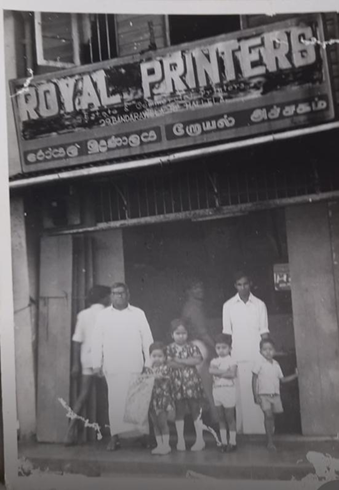
Tha-tha photographed in front of Royal Printers. (Date unknown).

On Sundays, Tha-tha would host a big feast for his family and friends—he’d have everything pulled from the showcase, gold trimmed cups and steel plates, while Pahti cooked an array of curries, something different each time. His television, which was the only one in town, was dusted for when the guests would gather around and watch a show while sipping tea. Amma remembers playing with the many children who’d visit, drawing squares on the road for hopscotch or swimming in the river behind the house, returning only after lunch was served. Tha-tha’s home became a sanctuary of sorts. It wasn’t utopia, it didn’t represent the possibility for a different kind of country, nor was the kinship of neighbours enough to stop the coming pogroms. But in his small piece of the world, they could sit around his dining table, their bellies stuffed with rice and laughter, while the TV gleamed in the opposite room. After the table was cleared and warm tea was served, everyone trickled out, returning to the reality of an island at war with the Tamils.

Wealth afforded Tha-tha a certain level of protection—like many other Tamil business owners at the time who survived the earlier pogroms unscathed—but he could always feel someone watching. There was a group of soldiers who often huddled outside Tha-tha’s door, their rifles hanging from their shoulders, demanding he serve them tea. Without opening the door he’d call for Pahti, who would rush to the kitchen and set a kettle to boil. Perhaps paradise was—and could only ever be—temporary.

After the pogroms of 1977, Tha-tha received a letter without a sender or return address—a warning from the Tamil resistance movement. Worried that further violence was coming, the letter urged upcountry Tamils to resettle in the North-East. Many upcountry Tamils had relocated or joined the movement themselves, while others fled abroad. Perhaps, in his stubbornness, Tha-tha believed that the life he built would endure the coming violence. Or perhaps he knew it wouldn’t and preferred to savour it for as long as he could. He stared at the letter for a while before leaving it at the back of a drawer. When Amma asked who sent it he shrugged his shoulders. “It’s no one, don’t worry.”

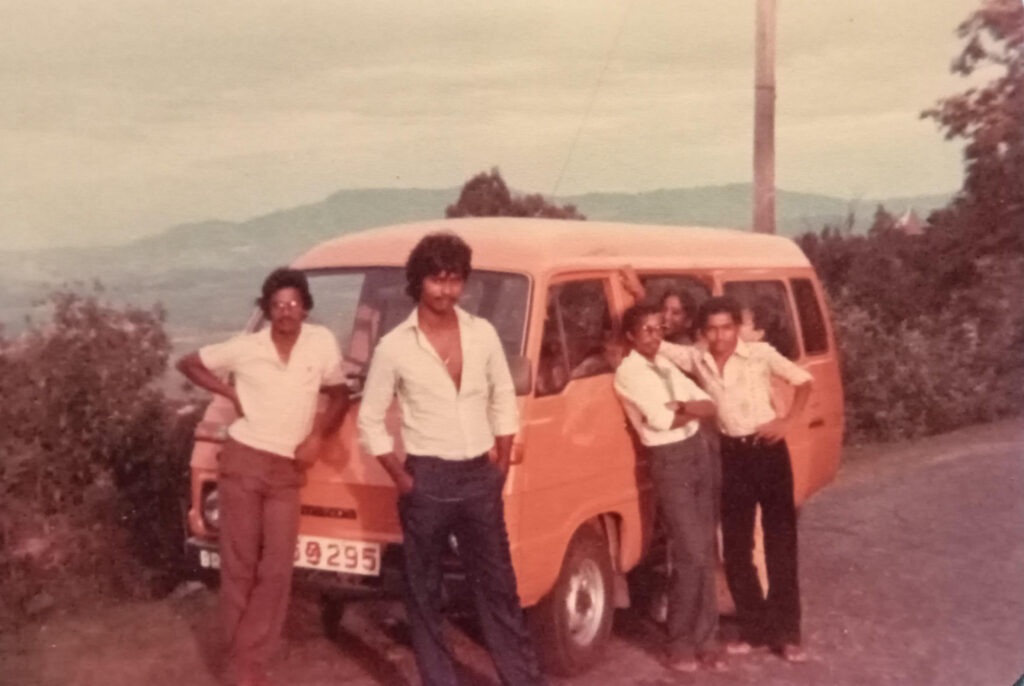
Amma and her siblings, most of whom were married or attending college, returned home for a family road trip in May 1983. Amma remembers the trip fondly—they squeezed into the orange Mazda van Tha-tha had bought only months before, then drove from Sigiriya to Yala. I eventually found a photo of the van from another trip—the boys posed around the van, their bellbottoms pulled up to their ribs, their thick black hair trimmed neatly. Amma was poking her head out from between the door and her friend’s arm, which was stylishly resting against the van.

Tha-tha wasn’t in frame. I figured he might’ve been behind the camera, directing the shot, savouring the bittersweetness of a fleeting time.
○○○

Each Thai Pongal, the Tamil harvest celebration, Amma boils sweet rice with cashews and raisins on the stove until the pot bubbles over—a gesture of thanks to the Sun for keeping us warm, for nourishing our crops, and for guiding us into a new day. I’d chew the sweet porridge slowly, savouring each grain of rice as recompense for the Sun’s labour. For the Sun’s task is an impossible one—to provide the means for life to flourish in the harshest of conditions. While we humans may be more familiar with death, the Sun is a mortal creature just the same. It too must die. When that day comes, eons from now, I wonder if it will look back and take pride in the life it made possible? There was no way for me to be certain, all I could do was finish the bowl in gratitude.


The Moon [நிலவு Nilavu]

I didn’t warm to Pahti at first. I remember the day she arrived in Toronto—Amma strategically waited until we got to the airport to tell me I’d have to share my room with her. I had just transitioned to having my own after sharing with my older brother only to find out I would have to give it up again, but this time, to my eighty-year-old grandmother. Pahti was disciplined—almost militant—which made our first few months together difficult. She’d wake each morning at 6 o’clock to comb her hair, applying a thick layer of coconut oil and pinning it back into a tight bun, taking care to ensure each thin strand of white was accounted for. The rhythmic plucking of her comb at the knots in her hair meant it was time for school.

Sri Lanka’s war against the Tamil people resumed in 2008 after a tense ceasefire—the same year Pahti arrived in Toronto. The Sri Lankan army began indiscriminately shelling tens of thousands of Tamil civilians in so-called “No Fire Zones.” What I remember of that time were mostly protests—we joined caravans of Tamils travelling from Toronto to Ottawa, Washington, and New York City—thousands of us trying to bring our people’s plight to the eyes of the world. There’s a photo of Pahti from those days that I love—she’s wearing a thick fur coat over her blue saree, her white hair pinned into a neat bun, staring solemnly at the camera as she stands in front of the Washington Monument next to my brother. After killing tens of thousands of civilians in the final stages of the war, the Sri Lankan army declared victory on May 18, 2009.

The nightmares—some of raging forest fires, some of bombs exploding, others of great floods—began a few weeks after. In my dreams, I was the only one who could see disaster coming. I’d scream for us to run but neither of my parents believed we were in any danger. I’d wake up panicked, scrambling down from the top bunk and waking Pahti. She would sit me beside her and sing a prayer, the blue glow of the moon pouring in through our bedroom window, illuminating her face as she sang. “Everything will be okay,” she’d say, before sending me back to bed. I didn’t know much about Pahti’s life then, or what she’d been through, but I knew if anyone could save us it was her.

Suffering was one of Pahti’s first teachers. Born in Nammakkal, a small city in South India, Pahti described most of her childhood as painful. Both her parents had died very young. She often spoke of the day her father died, when she took his head and placed it gently on her lap so he might feel some comfort as he passed. The time shortly after his passing was some of the most difficult. As a child, her and her siblings spent most of their time scavenging for food. On some days she’d chew on tamarind rinds just to trick her stomach into feeling full. By the time she was a teenager, her forearms had been covered in tattoos, various tribal patterns etched with a needle and a mallet—gifts from the town’s wise women offered alongside food in exchange for completing their odd jobs.

Tha-tha, who also lived in Namakkal, eventually married Pahti and took her with him to start anew in Sri Lanka. Pahti became Tha-tha’s equal—a matriarch, confidant and advisor, but most importantly a friend—she stood by him as he struggled to build Royal Printers. For the many children who Tha-tha had put through school, it was Pahti who cooked and attended to their needs.

Fear was her other teacher. A group of squatters had once holed up at one of Tha-tha’s properties in a nearby town, so he and Pahti went to investigate. The squatters had forged the land transfer documents, making it difficult to prove Tha-tha’s ownership. Upon realizing they would need their lawyer’s help settling this dispute, he returned to Hali-Ela while Pahti stayed behind to observe the squatters. Annoyed by Pahti’s presence, the squatters called the police claiming she and her children were attempting to steal the land. Amma remembers her delight when Pahti refused the policeman’s offer of water and food in protest, who instead arranged for meals through one of her nephews. He brought with him bags of curries and rice, and some sweet buns—Amma’s favourite. Once Tha-tha spoke to the police over the phone, they released Pahti and drove her back to the property, ordering the group of squatters to leave.

A few months later, the squatters returned, this time with a truckload of thugs armed with machetes. Pahti and the kids ran out of the house and scattered through the fields behind it.Kali is complex—most are unable to look past the bloodied heads of the guilty adorning her neck. But Kali is also the mother goddess—a goddess of the natural world, the margins, and liberation. In the ensuing chase, a makeshift explosive filled with sand was thrown at her, bouncing off her saree and exploding a few meters behind. Pahti narrowly escaped. Instead of hiding, she returned to the police station on foot, informing the police chief of what happened. When she returned to the house with the officers a few hours later, it was empty—plates of half-eaten food and empty beer bottles strewn across the floor. As the police were preparing to leave Pahti heard a noise coming from upstairs—the thugs had heard the police cars pull up and hid in the attic. She watched as each one was arrested and driven back to the station.

This was the Pahti I’d known—the one who caught spiders and kept away the ghosts at night. But I often wondered if underneath her quiet resolve, was a part of her that felt afraid?

Pahti wanted nothing to do with the television when Tha-tha brought it home, seeing it as a distraction from her household chores. But whenever her daughters turned it on, Pahti would stop and watch, broom in hand. She became absorbed in a popular Japanese show Oshin (1983), which followed a young girl through the hardships of her life—navigating the death of her grandmother and sister, her struggles with poverty, and the harshness of Japan’s Meiji period. The character was inspired by the life of Katsu Wada, co-founder of the Yaohan supermarket chain. Amma remembers often turning back to find tears gently rolling down Pahti’s cheek as she watched. Pahti said she saw herself in Oshin. I later found a clip of the show where in the midst of a harrowing blizzard, an imperial soldier asks Oshin if she needs help getting home. She gently declines, “I know the way.”

○○○

Pahti often said Kali atha, the goddess of war and destruction, would one day rid the earth of evil. Kali is complex—most are unable to look past the bloodied heads of the guilty adorning her neck. But Kali is also the mother goddess—a goddess of the natural world, the margins, and liberation. Celebrated during new moons, when the moon’s light no longer accompanies us through the night, Kali asks us to face our fears so that we may find our own path through the darkness. Her name can be understood as “the one who governs time” or “one who is dark.” I had always avoided spending time in the dark, afraid of what lurked within. But on the night we got the call that Pahti had passed away, it beckoned. As Amma wailed for her mother on the staircase, I quietly climbed up towards my room, shut the door, and turned off the lights. As frightening as it was, I was somehow sure that the darkness—the unknownness of a new world, one without my grandmother—wasn’t here to hurt me, but to hold me through to the other side.


The Fire[நெருப்பு Neruppu]

Tha-tha had ignored previous pogroms, first in 1955 and again in 1977, confident his wealth and status would protect them. But Pahti knew this time would be different. On July 23, 1983, the Liberation Tigers of Tamil Eelam (LTTE) killed thirteen soldiers in an ambush in Thinnevely. In response, the army killed fifty-one civilians and in the coming days, Sinhalese rioters killed, robbed, and raped Tamil civilians across the island in retribution. The rioters went town by town, armed with voter registration lists of Tamil households while the police stood by and watched as they committed horrific atrocities.

The rioters arrived in Badulla, a larger town to the north of Hali-Ela, on the following Wednesday. Many were bussed in from throughout the upcountry. “They’ve burned shops in Badulla,” Pahti said to Tha-tha, rushing back home from the store after she heard the news from the owners, who were quickly closing up and packing their things to flee. “We should stay with my niece in Unugalle. Her son said he’ll drive us up the mountain.”

“They won’t do anything,” said Thatha, shrugging her off. “How many of these riots have we seen? And look, we’re still here.” He stayed seated at the dining room table, attending to the cup of tea in front of him. They stayed that way for what felt like hours, as the rioters slowly approached down Banderwala Road, the main throughway connecting both towns.

Pahti took an empty Krisco biscuit container and ran upstairs to collect her jewelry—cherished family heirlooms, yes, but useful currency during a crisis. It reminded me of reading Octavia Butler’s Parable of the Sower (1993), where Lauren Olamina had turned a few pillowcases into her “go-bag” and filled them with what few items she could scavenge if she ever needed to flee at a moment’s notice. Nuts, some old pots, cash, and seeds. Lauren knew it wasn’t a matter of if looters would come for her small gated community, but when. Within a few hours the rioters arrived at Royal Printers.

First, a group of them dragged Tha-tha’s orange van into the middle of the road and set it ablaze. Our cousins in Unugalle would later say they could see the van from atop the hill—a warning for others to stay away. Then they smashed the windows of Royal Printers and looted the building before it too was set on fire. By the time they reached the house, Pahti had come back downstairs with the Krisco container under her arm, grabbed Tha-tha by his wrist, and quietly guided him out the back door.

She stopped halfway down the steps leading towards the ravine. “Wait,” she said quietly as she pointed behind her. Tha-tha hesitated at first then followed her instruction, looking back towards the house and the printing press. “Everything we worked for is burning. Look at it. Then turn around and keep going. This story is over.”

His fragile paradise was on fire—black smoke billowed from the window, carrying the sound of cracking wood and cheering rioters. In front of him was his loving wife beneath the fire’s glow, a staircase leading behind her into the darkness. Whether they would survive the night or where they would go next, they could not have known. He had to trust that his wife knew what he needed now was to turn towards the fire and say goodbye.

They both turned back towards the ravine and ran.
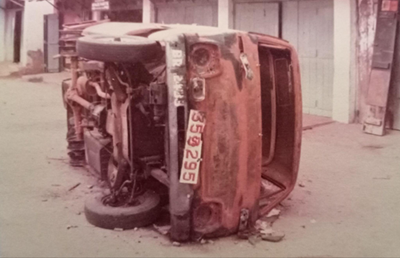
Tha-tha’s orange Mazda van, destroyed. Captured July 27, 1983 (approximately).
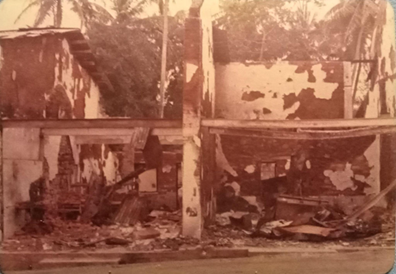
Royal Printers and my grandparent’s home, destroyed. Captured July 27, 1983 (approximately).


The Serpent[நாகம் Nāgam]

The serpent in Avvaiyar’s poem is an ouroborous meant to represent the unawaked consciousness. It sleeps at the base of the spine, coiled around itself, eating its own tail. In the poem, Avvaiyar honours the elephant god Pillaiyar, the Remover of Obstacles, for bringing her awareness to the cycles of the sun, moon, and fire—life, death, and rebirth. For awakening the serpent within her as she approached the end of her own life. In this conversation between the poet and the god, the snake has no say. A kind of self-mutilation, ingesting parts of itself it may not have been ready to let go. The moment the tail passes into its mouth is the end of countless other possibilities. Perhaps it knows there is no choice in the matter, that to survive is to let go of what was and what might have been, endlessly.

But I often wonder, does the serpent grieve its tail?

○○○

Earlier this year, I came across a report by the Sri Lankan government titled the Presidential Truth Commission on Ethnic Violence (1981-1984). It included hundreds of testimonies from Tamil survivors, documenting horrific murders and the destruction of property. As if written in an autopsy report, I found a line referencing Tha-tha’s printing press: …Royal Printers, where 40 persons worked. During the communal riots of July 1983 it was destroyed. There was something dreadful about seeing a pivotal moment in our family’s history distilled into a single line. Determined to see the remains of Royal Printers for myself, I flew to the island with Amma.

The rest of the drive into Hali-Ela was quiet—I spent most of it admiring the fog as it rolled over mountain tops, slid down their green slopes, and then dissipated over the valley—interrupted only by the sound of Amma’s voice as she recounted her childhood memories. I was last in Sri Lanka in 2005, after the LTTE and the Sri Lankan army agreed to a ceasefire to deal with the aftermath of the Indian Ocean tsunami. I was returning to a different island.

As we drove through Tamil areas scarred by economic crises and natural disasters, I remembered the particularly absurd passages of the truth commission report. A kind of reckless optimism bordering on satire. One passage reads, “pursuing a utopian ideal would be akin to chasing after a mirage in the desert. But if we do recognize, that indeed, we are in the midst of a desert, we would realise that we have no choice but to keep on chasing after the mirage until we reach the oasis. Surely, we will, hard though our way! And oasis, there are!”

And oasis, there was, I thought, as Amma and I eventually found ourselves in front of her old house—or rather, where it used to be. Replacing her old home was a concrete building with a green sign that read: Hithamithuru Beer Shop. Next to the house, where Royal Printers once was, was a convenience store. For a while she simply stared above the shop’s sign, at nothing. “There was a window there,” she eventually said. “That’s where we used to sit, in the bedroom, after the curfews started. I still hear the soldiers’ boots marching down the road. We saw everything from that window. Some nights, when the town was dark, we could see the stars. Other nights, we’d sit under the windowsill and write poems. The stories that window could tell.”

Amma didn’t want to ask the beer shop owner if we could see inside and suggested we try her Sinhalese neighbour instead. We walked left from the store, two doors down, unsure if anyone would be home. We peeked through the gate and saw a man laying tiles on the veranda. He noticed us, went inside, and to Amma’s surprise returned with Nissanka, the youngest of the family. He welcomed us with a big smile, a hug, and invited us in for tea.

Their conversation drifted easily to memories of their childhood and of my grandparents. He eventually led us downstairs and through the kitchen to his backyard. Nissanka’s yard was neat, a small path cut through the thick bushes and rows of palm trees towards the ravine. A seven-foot concrete wall blocked the view of my grandparents’ property—an addition by the new owners. Nissanka pointed to a mound I could climb onto for a better view of the adjacent yard. A lump grew in my throat as I climbed up and peered over the wall. From up top, I saw only broken concrete, tall grass, and the heaps of garbage which now filled the yard. Only a single door from Royal Printers had withstood years of demolitions, as if keeping vigil.

Turning my head away from Amma and Nissanka, I started to weep quietly. I grieved the life my grandparents built, and the life that could have been. A life we could have shared. But I had to remember that even if Royal Printers was destroyed, it wasn’t gone.

On the way to Hali-Ela we stopped in Colombo to visit Tha-tha’s friend, Sivarajan, who for decades worked at Royal Printers as Tha-tha’s right hand. We met at the restaurant which he started with his son a few years back. Over tea, he reminisced about his days working for Tha-tha. He said it was Tha-tha’s teachings that gave him the courage to build this restaurant.  He even recited one of Tha-tha’s proverbs from memory, “a man who can’t respect one penny will never make ten pennies.”

As if it were pollen carried by the wind to more fertile ground, the memory of this place lived on in those who still spoke my grandparents’ names with reverence, in those who learned something from their lives. It lived on in Amma, and now, in me.

In her book, A Paradise Built in Hell (2009), Rebecca Solnit writes about the big and small acts of connection in crisis, which are “by [their] very nature unsustainable and evanescent, but like a lightning flash it illuminates ordinary life, and like lightning it sometimes shatters the old forms. It is utopia itself for many people, though it is only a brief moment during terrible times.” She adds that the work of making joy and freedom in crisis “can inspire people to return to that society in its everyday incarnations with renewed powers and ties.”

As we walked back towards the house, Nissanka told us about his mother who kept an eye on the property after the pogroms. Strangers bought and sold the land, never staying more than a few years. The river behind the house had dried up and the jackfruit trees had stopped bearing fruit.

“Only ghosts live there now,” Nissanka’s mother often said.

I turned back to look at my grandparents’ home one last time, listening for their ghosts. Perhaps it was just the cold breeze rustling against the palm trees, but for a moment, I could almost hear them laughing.
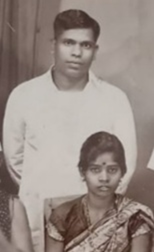
For my grandparents, Kaathan Veeramalai Pitchaimuthu and Rasamma Pitchaimuthu. For their children—my mother, uncle, and aunts. And for the Tamil people—in the mountains, by the ocean, and those far from home.

 

Athavarn is an Eelam Tamil facilitator, writer, and event curator. His writing engages with memory, community, ecology, and spirituality as terrains for political transformation. As a facilitator, he supports social movements to navigate conflict and cultivate shared purpose in times of uncertainty. He loves R&B, astrology, tarot, sci-fi, his friends, and his family. He lives on the lands of the Mississaugaus of the Scugog Island First Nation. nilafacilitation.com.


 BACK TO ISSUE

 BACK TO FOLIO

Anand Mohan Gupta

THE VEILED HOLLOW: A DIPTYCH

I. Narmada

[FILE REF: NB-61-SUBMERGENCE-MAP] The Narmada does not flow. It carves. It is an ancient path through the heart of the subcontinent. In the Nimar plains, the river behaves like an exposed artery. The soil is heavy. Black. A deep, fertile silt that clings to the skin. It is a second shadow. To the north, the Vindhya Range rises. Stony defiance. This is where the timber lobbies look down. They see the valley as a scenic resource. They view the river as a backdrop for luxury resorts.

Annotation: The Vindhya range acts as a geological barrier. It separates the labour of the valley from the leisure of the peaks. Displacement is a topographical constant.

Manav worked the lowlands. Two hundred acres of black cotton soil. It was an inheritance of sweat. His palms were etched with earth. No chemical could scrub it. He was not like the urban investors. He did not build weekend retreats near the Maheshwar ghats. Manav arrived before the first temple bells. He stayed until the light died. He coaxed wheat from the earth. He treated the river like a temperamental god.

[CLIPPING: THE INDORE TIMES – PAGE 4] A headline caught his eye: “Hudson Valley Farmer Shot in Land Conflict.” The photo showed a man named Jimmy. He stood before a birch tree. The wood was skeletal against a white fog. It looked like a Narmada peepal tree shrouded in monsoon mist. The report spoke of a developer from Brooklyn. It spoke of a local cop named Mona.

The pressure arrived via the Land Acquisition Office. Damp plaster. Stacked files. Manav sat on a wooden bench. Clerks read out survey numbers. It was a list of the condemned. The state redrew the maps. They designated his acreage as a submergence zone. His dirt was no longer valued for yield. It was valued for the water it would hold. The industrial parks in Gujarat demanded it. The compensation was a fraction of the market rate.

The builders arrived. White SUVs. Political connections in Bhopal. They wanted the high ground. They wanted the land that would remain dry. Manav’s ancestors had ditched this bottom land by hand. Now, a local MLA’s brother-in-law held the development rights for the Narmada Riverside Project. Manav fought in the courts. Petitions disappeared. He realized the river was being stolen. It was a tool for the cities.

Meenakshi carried displacement from the south. Kerala backwaters. Salt-tinged water. Emerald lagoons. Then the floods came. Catastrophic surges swallowed her home. The tourism industry bought the ruins. They built floating villas. Hiraeth followed her. It was a grief for a homeland that had economically evicted her.

She took the Sub-Inspector post. She thought the law would be straightforward. It was not. Her first test was illegal sand mining. Midnight on the riverbanks. Boots sank into the hollowed shore. Heavy machinery bit into the riverbed. Spawning grounds were destroyed. She photographed the trucks. She traced permits to a corporate lobbyist. Inspector Sawant found her the next morning. Tobacco-stained teeth. Thirty years of compromises.

“Keralite,” he said. His voice was a rasp. “That sand builds the malls in Indore. Nobody cares about fish.”

“The NGT guidelines are clear,” she answered.

Sawant blocked the door. “The builder is pouring foundation tomorrow. That means kickbacks for the local boys. You start filing cases and that money stops. Families eat because of that sand. Are you going to be the one explaining to the MLC why his project is stalled?”

She did not let it go. She filed the First Information Report. The mining stopped for two days. Then a stay order arrived from the High Court. Meenakshi was a liability. Whispers followed her through the barracks. They smelled like stagnant water.

They met at a dhaba. Yellow lights. Diesel fumes. Meenakshi was off-duty. She nursed a chai. Manav rubbed a cramp in his leg. Their hands brushed. Silt against steady nerves.

“You look like you’re carrying the whole river,” he said.

“Only the parts that didn’t drown yet.”

No sonnets. Mutual recognition of survival. They took truck rides. The cab smelled like harvested grain. They watched the moon reflect off the water. He took her hand. They fit like jagged stones. Six months later, she moved into the farmhouse. On Sundays, he washed the station’s grime from her hair. She hummed old Malayalam songs. The badge sat on the dresser.

The calls began in December. Hidden numbers. Voices called her a foreigner. They called Manav a radical. Meenakshi cleaned her service pistol. She did not tell Manav. Her mind drifted to journals. She thought of the Scottish Highlands. The Clearances. Ancestral glens turned into empty deer forests for the gentry. The pattern was a global blueprint. The lowlands sacrifice so the cities can glow.

The Tuesday arrived with thick fog. A damp shroud. The kid stepped out from the shadows of a peepal tree. He was the son of a neighbour who had sold out. His father had spent the compensation on a bad investment in Indore. He died of a broken heart. The boy held a country-made pistol. He saw Meenakshi as the outsider protecting the man who refused to move.

“You think you own this?” he shouted. “My father is dead because of people like you.”

The gun rose. Meenakshi reached. Manav stepped forward. He put his bulk between her and the barrel. The shot was a flat pop. Manav spun. He hit the muddy ground. Meenakshi fired once. The kid vanished into the tall grass. She knelt in the black soil. Blood pulsed over her fingers.

“Stay with me.”

“Did you get him?” he whispered.

“Just breathe.”

The investigation was a farce. Internal Affairs officers in Indore asked about her political leanings. They asked if she was inciting the farmers. Captain Deshmukh sat in a windowless room. His face was like a cracked riverbed.

“The system is a levee, Meenakshi. It holds back the flood. You poked holes in it. You brought your southern grievances here. Now the water is rising.”

Manav healed slowly. The scar on his shoulder was a puckered mark. They went back to the river. The town watched them with a quiet, complicated stare.

“Everything feels different now,” he said one evening.

“It should,” she agreed. “We were too quiet before.”

She laughed. A sharp sound against the wind. “We are twin embers now, Manav. We are burning the house down.”

“Let it burn,” he said. “The ash makes the best soil.”

INTERLUDE: THE LEVEE

[ERROR: SYSTEMIC PRESSURE EXCEEDED]

The sediment is identical. Black cotton soil. Hudson silt. The river demands a price for the elevation of the few. Capital is a hydraulic force. It flows downward to drown the worker. It rises upward to hydrate the estate. The map is a grid of violence. The ink is the water. The paper is the skin of the dispossessed.

###

II. Hudson

The Hudson Valley does not roll gently. It carves wounds. The river slices like a vein. Geography is destiny. Lowlands bear the work. Uplands hoard the power. The river mediates. It carries runoff down to drown the fields.

Annotation: The silt identifies the crime. The global police force protects the same foundations. The levee is not a metaphor. It is the wall of the archive.

Jimmy worked the lowlands. Third-generation farmer. Broad back. Palms etched with earth. He was not like the weekenders. They bought parcels uphill for hobby vineyards. They arrived with trust funds. They commissioned stone walls. Jimmy arrived before dawn. He stayed until the light failed. He coaxed grain from soil that gave nothing.

[DIGITAL LOG: ANBA-ARCHIVE-402] Jimmy scoured digital archives. He found a grainy video. A man named Manav stood waist-deep in black Narmada silt. Beside him stood an officer named Meenakshi. Her badge glinted in the harsh midday sun. The landscape was a world away. The dirt under the farmer’s nails looked identical to the soil under Jimmy’s own.

The pressure fractured him. The county reassessed the valley. They drove up values based on the sales of upland mansions. Jimmy’s dirt was now valued for the mansions that could be built upon it. He could not farm his way out of a four-hundred-percent tax spike. A developer from Brooklyn targeted the back forty. Fertilizer costs doubled. Corn prices stagnated. The bank sent letters. Jimmy fought at town meetings. The board was stacked with realtors. He sold at a loss. It felt like amputation.

He stood on the fresh stump field the day the machines came. Foundations were poured where his winter rye once greened. He did not cry. He went home and poured bourbon. He realized the river was not his partner. It was a tool for the people on the hills.

Mona carried displacement across the ocean. Snowdonia had been slate and sheep. Mines tunnelled deep under the mountains. Then the pits closed. Villages hollowed. Hiraeth was not just nostalgia. It was grief for a homeland that had economically evicted you. She took the badge in this river town. Law was supposed to be straightforward. It was not.

Her first test involved an illegal dump in protected wetlands. She traced the waste to a county supervisor’s brother-in-law. Sergeant Malone found her in the evidence bay. Tobacco-stained moustache. Gravel voice. “Those wetlands are marginal, Mona. The developer is pouring foundation next week. You start waving paperwork and those jobs dry up. Let it go or you will find yourself alone out there when you really need backup.”

Mona did not let it go. She testified quietly to the state. The developer paid a fine. No one lost a job. But the message landed. Mona was trouble. Whispers followed her through the precinct like exhaust.

They met at the diner. Mona was off-duty. Jimmy rubbed a forearm cramp. Their hands brushed. Silt against steady nerves. Static snapped.

“You look like you’ve seen a ghost,” he said.

“I think I’m becoming one.”

It grew deliberate. Truck rides after shifts. Detours to overlooks. On Sundays he washed precinct residue from her hair. She hummed old Welsh hymns. The badge sat aside.

The world refused to stay separate. At the Policemen’s Ball, the navy uniforms were starched. The stares were cold. People asked who invited the mud man. Jimmy had mixed heritage. He was a perpetual outsider. Mona’s accent sealed it.

“The badge won’t save you forever,” he said one evening by the river. “Upland money needs lowland space. We are just the debris.”

“I know.”

The calls began in November. Distorted voices called her a traitor. Mona cleaned her Glock. She kept it from Jimmy at first. One storm evening she spoke of farmers along the Narmada. Their ancestral fields vanished. “The pattern is ancient,” she said. “The lowlands sacrifice so the uplands can glow brighter.”

Jimmy pulled her close. “Granddad ditched this bottom by hand. Now the edge of my fields is vinyl siding. We are being squeezed out like your miners.”

Tuesday arrived with thick fog. A kid stepped out from behind a birch. He was the son of a neighbour who had sold out. He held a used pistol. Radicalized resentment. “You think you belong?” he shouted. “Outsiders are ruining it for real valley people.”

The gun rose. Mona reached. Jimmy stepped forward. He shielded her. The shot cracked flat. Jimmy hit the muddy ground. Mona fired once. The kid vanished. She knelt in the soil. Blood pulsed hot over her fingers.

“Stay with me.”

“Got him?”

“Just breathe.”

The investigation was a farce. Captain Harlan sat in a windowless room. “Laws serve order, Mona. Order means keeping upland investment flowing. You poked holes in the levee. Now the water is rising.”

Jimmy healed slowly. The scar on his shoulder was a puckered mark. They went back to the river. The town watched them with a quiet stare.

“Everything’s broken,” he said.

“It was already broken,” she replied. “We just finally noticed.”

She laughed sharp. “We are twin embers now, Jimmy. Burning the house down.”

“Let it burn,” he said. “We will plant on the ashes.”

They watched the current gnaw at the banks. The Hudson was relentless. It carved paths through stone that had forgotten it could change. The veiled hollow held them. The pressure forged them into something harder than the law.


Anand Mohan Gupta is a writer based in Raipur, India. He brings over twenty years of experience from India’s leading power generation company to his work as an author. Gupta writes speculative fiction by firelight during nights and weekends, exploring silence and the small decisions that shape a life. Recently named a winner of the Wisden Writing Competition, his work is forthcoming in the 2026 Wisden Cricketers’ Almanack. His story “The Room Below the Gas Chamber” appeared in Mouthful of Salt (December, 2025).


 BACK TO ISSUE

 BACK TO FOLIO

Leonard Yip

a dying world is still a world

The morning is livid with wet and colour, the grass cool about the ankles as we pass further into the space between the either and the or.

I have brought my friends to the thinnest of places here in Singapore. Together we are threading an eastward path, along a strip of grassland that borders two worlds. On our left is the long, sharp line of wall, boundaries that mark where the property of each neighbourhood family ends and the next begins. On our right, as the low slant of a valley begins to cascade downwards, the world is shimmering with green. Pale lime of grass, emerald of fern, muddy dark bloom of trees older than memory reaching out of the last remaining primary forest beyond.

Edgelands such as these are particularly susceptible to the dislocations of the modern day. Land-scarce as the island is, forests are disappeared overnight, and what scars of earth remain are ceded just as quickly to concrete and glass. They alter and scramble the memory of a place in their rising. The pace of redevelopment means that the shape of the land changes faster than our ability to process it. Walking through a place as threatened as this, therefore, is an act of record-keeping. The land scapes itself into our feet as we move through it, etching its contours into muscle memory. To notice what is around us is to allow our senses to act as an archive – growing alive to what life still insists upon its here-ness, though the walls of the suburb on our left are ever-encroaching.

Quietly, Jacob recounts how cities were once defined by the presence of walls. They kept out the wilderness when it was still a thing to be reviled, in an age before the nostalgia of the pastoral yearned for it again. The residue of such tension remains, even this long since then. I watch the tremor of leaves reflected in long panes of glass, passing to wire fences, to steel rebar.

As we walk, the land falls and rises like the breath of a furled, sleeping thing. The babble of birdsong chases along the top of the slope’s upward curl, beyond what we can see. Something about this cacophony, so close to the forest fringe, seems out of place, and we realise why as we draw up the slope. A dozen cages hang from the boughs of the trees, and within them the birds are speaking. A magpie robin trills one lonely half of a song, drowned by the syrup water-trickle of the white-rumped shama’s whistle in the cage next to it. But the caged birds are not alone. Drawn by the familiar song, other shama have come, flitting through the trees in dark sudden fragments, singing back to the ones hung in their domes.

Miriam, reading aloud from her guidebook to the birds of Singapore, has learnt that the population of white-rumped shama in this forest is thought to have originated from released cage-birds. What do they say to each other, we wonder? To which side of the cages, swaying now in the wind, does the dream of home belong? Tail feathers dip curiously, catching light in the dappled shade like the glimmer of a midnight stream. Men sit by their van and eat their breakfast in silence, watching the birds rupture the currents of air with song.

Past the cages, a shock of bamboo has detonated out of the earth. Some three storeys high, the skyward fanning of the bamboo is an echo of birthing. There was an age in the young years of the earth when the bamboo forests were evidence that something was coming, that the steppes were about to be covered in flowing rivers of grass. Today they are much the same, proof of life. Bats nestle in the slats and slivers of space within their stems, a sign for those who look to know if a place is good for other things to grow.

Below the bamboo the earth stirs with memory. Rootbeds have been ripped clean, soil and mud rutted into troughs and trenches. These are the traces of wild boar, which are seen more often than the animal itself. At this hour, they are gone, retreated back to the groves and hollows of great trees. Such great divots and upturns of the earth are the muscular echo of their passing; freshly churned each morning, a dawn-time ghost of their presence from the night before.

“Boars are landscape engineers that alter the ecology of their woodlands,” writes the author Helen Macdonald. “Wallowing holes fill with rainwater and become ponds for dragonfly larvae, seeds and burrs caught on their coats are spread wide, and their rooting on the forest floor shapes the diversity of woodland plant communities.” Imagine the little worlds that form in these furrows—shrubs and flowers found only in deep forests, carried to and taking root at the fringe of human life. So displaced, they will die in time; the pools of water will dry out, pollinators will seek other fields. But a dying world is a world nonetheless.

I think then of the Great Forest Spirit in the film Princess Mononoke (1997), whose path is marked by abundance and decay. Fungi, grasses and flowers spring from its footsteps, growing then rotting in the same moment. The ruts left by boar are much the same; slower, but no less capable of such lushness. The forest megafauna of this small island – wild boar, sambar deer – are world-shapers and makers, and they make the film’s old gods seem curiously possible in these late days of the Anthropocene.


This morning, the ruts of the boar have come right up to the edge of the boundary wall. Soil and loam are compacted against the fence, branches at the forest fringe trampled clean into the dirt by sheer passing mass. I wonder what it must be like for the people who live in these houses, hearing the grunting and heavy tread of the herds each night as they emerge from the undergrowth. Do they listen with curiosity behind their fences, or familiar nonchalance? Or is it fear which has driven them to line the tops of the walls with shards of broken glass?

We live closer to the end of Princess Mononoke than its beginning. The old gods are gone from its world, the last Forest Spirit decapitated by zealous hunters. The flood of its ichor unmakes the towns and burns the deep wood into a scorched nothingness. But then the green insistence of the grass comes, a salve over a wound. Where the old trees have died, it grows shallow, but it grows anyway, thin new saplings complicating the borders of the town. The forest spirit is gone, mourns San the wolf girl, amidst the desolation of her sacred shelters and childhood groves. Some wounds cannot be forgiven, and she can no longer remain here. Ashitaka, the prince who must stay to rebuild the world of men, can only look upon the face of the girl whom he loves and cannot follow, as the grasses flow and flow about their feet.

The morning grows warm, unfurling the wings of butterflies and buzzards circling above us. We leave the forest fringe as the grass spills into the end of a cul-de-sac. Where the asphalt is clean and wet from last night’s rains, white fallen flowers scatter the grey like abandoned stars. Saksham plucks one of them from the floor. He recognises their name and shape from home. In Lucknow, he tells us, the Harsingar flowers scatter in the middle of October, and signal the coming of winter. The fall of flowers is a reminder for families to pull coats from cupboards, and keep each other warm. For Saksham, a ground so covered is also a sign that his mother’s birthday is coming. Tonight, he will think of flowers and call home.

Outside their house, an elderly couple pauses their game of badminton to ask where we’ve emerged from, as if we were ghosts slipped from the borders of another realm. When we tell them where we’ve been, they smile, and speak of paths they have walked through the grasses that lead deep into the nature reserve, unmarked on any map. I look back in the direction where they point, and just for a moment, the road appears momentarily to disappear beneath its blanket of moss, and the low wall of the houses seems to melt like the shadow of an open door into the shroud of leaves.

The forest spirit is all around us, insists Ashitaka to San in the film’s final frames, as the grass blurs where the buildings end and the forest begins. He is here, trying to tell us something—that it’s time for both of us to live.


Leonard Yip is a writer of landscape, place, and people. He holds a BA and an MPhil in English from the University of Cambridge, where his work on multimedia representations of Singapore’s edgelands was awarded the Members’ English prize for best overall dissertation. His essays and poems have been published with Moxy Magazine, Ekstasis, and the Nature Society (Singapore). He lives and works in Singapore, with a continued focus on the changing terrains and ecologies of the Anthropocene.


 BACK TO ISSUE

 BACK TO FOLIO

Marie Anne Arreola

Downpour: An Anatomy of Emotional Weather and the Sky’s Oldest Lesson—that Everything Changes State

Rooted like a seed or a small planet just beginning to spin, I stirred—an underwater flicker haloed in breathlight. The wood-paneled room held me the way an old bowl holds the memory of whatever it once contained. Above me, voices drifted like weather: my mother’s alto, my father’s soft-edged tenor, tuning the atmosphere into something almost breathable. No sentence has ever been able to hold that moment without splitting at the seams.

I didn’t arrive in language. I arrived in function, lungs jerking and seizing, catching air like a match that flares and gutters in the same wind. My spirit didn’t think; it pulsed. An animal grammar older than speech, older than intention. The motor, the sails, the ship.

“Go on,” I imagine someone whispering now, as if from the underside of memory. “You are just in time.”

I learned early the scent of my mother after showers; damp, floral, a little wild. Steam still singing off her skin. That ritual, the way water slid her into another version of herself, became my first grammar of time: before and after, waking and waking again. It taught me that a body can be rewritten daily, tenderly, without apology. Inside me, something older than memory quickened—an inhabitant made of touch: the warm weight of a woman’s chest, the milk-and-muscle scaffolding of being held. I carried that architecture long before I had a name for anything.

Out past our farmhouse, where the grass turned gold from too much sun and too little rain, that inner inhabitant dreamed. Sometimes I think it dreamed of tides, small ones, shy ones, just enough to rinse thought clean, to baptize the ground that became our floor, our field, our eventual burial. We ate with plastic forks that bent in our hands. We thanked the animals we killed with a solemnity I didn’t yet understand. In those gestures, we rehearsed a violence older than language. And I floated, awkward, new, somewhere between the logic of the world and the logic of wonder. Always in the interval. Always in that crooked grace where everything is half-formed and holy, where the body remembers before the mind can speak.

Memory plays now in wide, color-smeared screens. My mind spools a dusk-colored filmstrip of beginnings: the fear of going blind; the first vision inside darkness—not an object but awareness itself. I wiped breath-ovals off windows with my sleeve, searching for myself in the blur of glass, in acres curling away in every direction. The land remembers, even if I don’t. Above the barn, a sea of stars drifts loose as thought. Some gentle gravity gathers my fragile self together, spirit, flesh, longing, bound with something holy and almost laughable.

I am a body now, furnished slowly with bones and gestures and rooms. A dwelling for memory. A vessel for desire. Still tethered, seedlike, orbiting, learning to stay. Learning to grow from the inside out.


The sky often began with a spill, as if the earth had confessed something too tender to bear alone. My father once said, “These drops are only the beginning, supposedly.” We were planting seeds, oregano or mint, and his voice held the weary awe of someone who’d made peace with mystery long ago. He said the rain would return after it grew teeth and learned to call itself a leaf. It did return, though not always as water. I saw it sliding down my mother’s face, an erosion more intimate than weather.

On the table: yesterday’s newspaper, the landline off its hook. My aunt’s voice fraying over static as she told us my grandmother had been washed away by another kind of flood. Grief rearranged itself into weather, something you prepare for with small rituals: folding tea towels, slicing fruit, anything to keep the hands from drowning.

Once rain enters the bones, it stretches the days from the inside.

Sometimes life arranges itself in small, unruly lessons. I bought packets of seeds at Walmart, the cheap kind with bright pictures of impossible blossoms, thinking maybe I could coax something into staying alive. The doctor, around the same time, handed Dad a prescription—Wellbutrin, he said gently, as though offering a handrail in a dark stairwell. Outside, winter kept rehearsing its old tricks. Inside, Dad watched war movies on loop, each explosion echoing through the walls.

“Don’t you want to watch something different?” I’d ask, though I already knew the answer.

When I left for a weekend, I forgot about the seedlings on the windowsill. I returned to find them collapsed in their pots, small silhouettes of what they could have been, already brittle with resignation. Waiting, it turns out, demands its own kind of devotion, and I hadn’t learned how quietly a life can tilt toward undoing.

You start dreaming of building forts indoors. You learn the slow art of floating through waterlogged rooms in your mind. Some days the house stays cloaked in cloud. Shadows lean into corners like forgotten guests. Time becomes a second presence pooling in the kitchen, fogging the hallway, hovering by the windows. And then, at the hour you stop watching, the first green shoot appears. Nothing grand. Just the quiet insistence of life dressing itself in an ordinary afternoon—the kind of afternoon when I carry tissues to my mother’s room without needing to ask why.

My grandmother lives forever in the armchair of my memory—spine bent like a comma, fingers knitting stories into yarn. The last time I saw her well, I washed the farm dust from my sneakers before the gray jaw of New York opened to receive us. She welcomed us with television static and the steady rhythm of crochet. She let me crack eggs into the mocha-almond tart she’d prepared days before, stories falling into my lap like warm flour.

That night, it rained. We slept together, pajamaed and safe. A week later, I wore black without understanding. Back on the farm, the rain returned, carrying its old knowing.

“Rain is holy,” my father always said. “It feeds the land.”

But holiness can take, too.

I began to fear the sky when it darkened. Rain had a habit of stealing what I loved, like a tornado, like when Dad tells me that when he was a kid, they’d hide in the innermost room because they didn’t have a basement. He says the sound was violent, “like a train,” he claims every time, and every time I listen as if it might end differently. I picture him crowded in the bathtub with his siblings, adults on the floor, the whole family clenched inside that tiny room while the wind tore at the house. Windows shattering. Pictures falling down the hallway. And yet the bathroom, this one small, stubborn shelter, left untouched, preserved.

Transformation is quiet: a green stalk breaking soil. Grief sliding under a closed door. Sorrow filtering through the body like water through stone. And years later, when I finally look up, I understand what the sky had been trying to say all along; that every loss, every tenderness, every spill and re-gathering belongs to a single water cycle, returning in forms we barely recognize. Dad understood this in a way. He never had the right gun for the things that needed ending—some regulation, some cost, some old silence around harm.

So when the raccoon wedged itself in the live trap behind the barn, he did what farmers do when the world refuses to offer clean choices. He steadied himself. He acted. He carried the weight no one else wanted to lift. Watching him then, his breath clouding in the cold, his patience worn but intact, I could see how a life becomes its own weather system.

How a man can shoulder years of storms without ever speaking of the flood. Our little life, at times, a heavy raincoat: clumsy, soaked through, yet still something that keeps us standing in the downpour.


Marie Anne Arreola is a bilingual poet and editor whose work lives at the intersection of speculative lyric, digital culture, and diaspora memory. She is a 2025 Pushcart Prize Nominee, author of Sparks of the Liberating Spirit Who Trapped Us (Foreshore Publishing, UK), winner of the Plumas en Ciernes Short Story Prize, and founding editor of VOCES, a bilingual platform for global artists and writers. Her work appears in over 40 literary journals across the US, Europe, and Latin America. She is a two-time finalist for the Francisco Ruiz Udiel Latin American Poetry Prize (V and VI editions) from Valparaíso Ediciones, and a recipient of the 2024 Young Poets Scholarship awarded by the Gutiérrez Lozano Foundation. Writing across journalism, poetry, essays, and hybrid forms, she is committed to fostering inclusive, transnational conversations that honor community histories and cultural transformation.


 BACK TO ISSUE

 BACK TO FOLIO

Becca Rose

The Stillness That Once Saved Me

My fingers lock in a death grip where I sit, creaking like the branches around me. The wind brushes past the skin on my cheeks, fluttering the leaves on the vines that wrap around my arms up to my neck. It is easy to breathe around them now. We have accepted each other as one and the same, as beings that grow together until you can’t tell where one begins and the other ends.

I can’t remember why I sat here in the first place, but I know it felt safe. Hidden away from a life too open. Too dangerous. The light is always strange, a draft chilling my arms from somewhere far away. The quiet of the years I have spent here makes my ears sensitive; I flinch at any sound, even from a distance. Sometimes I think I hear laughter, boots crunching on dry ground, my best friend calling me with fractured words. I never dare listen long enough to know if they’re real.

My dark eyes only crack open slowly once a day when the sun is brightest, when the vines and I both look up towards the warmth. The roots feed on the rays, growing deeper into the skin of the forest’s single monarch, holding me down on this throne. Their embrace used to sting. They would pinch me, twist me back each time my thoughts of standing grew too large for them to hold. Now moss covers me in the soft comfort of a mother’s arms, telling a face I have forgotten that it is beautiful.

I stopped believing them as the years dragged over my body. Their words grew fragile as the stems and leaves began crawling across my face. Flashes of an older woman with the same dark hair as mine jolt across the back of my eyelids. A distant memory of my cheek being held by something softer, made up of lines engraved with kindness. These thoughts cause the leaves to whisper words of safety into my aging ears: that to live is to experience pain much worse than the nettles caressing my skull. The skull of a queen who is meant to be here, adorned with silence and time.
Endless time.

The forest knows me. It has all my being entirely wrapped up in its green arms so that I cannot lie. The vines do not know that I still dream. Behind my closed eyes isn’t pitch black and counting seconds, but colour. The owner of the voice that calls to me through the trees is shining, arm outstretched to me, beckoning me forwards. I see mouths that stretch wide and a body that runs. I know it’s only a dream, but I stay there as long as I can, still and cautious, hoping the trees won’t see what I’m doing beneath their canopy.

Distant knocking always wakes me, the rattling of a door I haven’t opened in a long time. The dreams always end with a thorn-free hand, holding something that glints silver, something sharp. They are going to set me free. Finally. I can never see their face, only the lines on their palms showing me the path to freedom. The throne feels especially cold on the days after those dreams.

I feel most comfortable in the rain. The vines soak up the droplets, and the noises of the forest are swallowed by the torrent until they can’t hear my eyes join the clouds. The grey sheet of water hides my open eyes and the reflection of sunlight that remains in them, no matter how long they have tried to dry them out. My feet burn as I stare unblinkingly at the edge of the clearing, where the sun peeks through on summer days, enough to create new shapes on the ground.

My eyes track them with expert precision, wishing I could feel them with my own hands, run my fingertips through the blades of grass until they trust me enough to remove my nettle crown. My head feels heavier with every shape I trace that looks like home.

Guilt wraps around my throat to join the brambles, skin itching from the fear of my own desires. A queen who wants to leave her own kingdom truly is a traitor. A betrayal the bark of this throne will never forgive me for. Even now, my body begs me to run and submerge myself in flowing water like I have lived there before, like it knows how to.

My friend is shouting for me. I can’t hear what she is saying, and it is shattering me like a disappointed plate on a tiled floor. In the darkness of this rainy night, I try to move my left wrist and feel the thorns dig deeper, the sharpness mixing with my blood until I can taste it. The warning rushes around my body, reminding me that what’s out there, beyond the clearing, is unknown.

The stillness that once saved me is strangling me now. This throne is too soft to be made of wood. The pain in my wrist blurs beneath the pressure building in my chest.

Being the queen on this throne may be all I was meant to be, but the need to know if I could be more is all-consuming. Going out there may hurt me, grip me with something harsher than leaves until I am begging for my forest to let me back in. Still, I can’t tear my eyes away from the sunlight.

I pull my wrist harder, wiggling my fingers through the resistance until one finger becomes free. Specks of red dance amongst my landscape of green so starkly that my eyes unfocus, and the forest flickers around me. My little finger finally bends after countless years of holding tightly to the arm of this throne. It is just enough to crack the bone and feel the air underneath it. The cold shocks me enough to raise goosebumps all over my body. The skin on my cheek twitches.

I think to love myself is to suffer the consequences. Limb by limb, I will untangle myself. I will stand cold and shaking, afraid of what my name will be once I am stood on my own two feet. I need to stop the relentless burning of my body as my mind wanders to somewhere I cannot yet reach.

Tonight, when I enter my dreams, I think the face of my rescuer will become clear. I will look up into dark eyes that shine as bright as an April sunrise. Her body is scarred and stiff, yet wholly her own. The silver will flash towards me. Blood, sap and tears mixing together until I don’t know who is bleeding. I will laugh for the first time in decades as I take her hand and watch her hair flow in the cool evening breeze, held back by a crown woven from nettles.


Becca Rose is a writer based in Greater Manchester, UK. Her work explores interior worlds through image, embodiment, and emotional restraint.


 BACK TO ISSUE

 BACK TO FOLIO

Courtney Ebert

Idols

Songs serenaded us to live fast, die young—pulsed through three-foot-tall speakers next to a stage atop which we danced and gyrated against one another in front of a dusty red velvet curtain—a relic from a previous decade—we felt the outline of each other’s bodies under tight micro skirts outfitted of the same material as the cheap leggings we wore to class the next day while our country financed wars in Iraq and Afghanistan and blood poured from the mouths and eyes of children. This was when Big Pharma got rich off white pills being crushed and snorted or swallowed by teenagers hooked from football injuries or mothers trying to forget who they were and girls were being fed heroin-chic adverts and a constant media feed that they would never be good enough and young people were being trafficked across state lines without any media attention to submit to unthinkable acts for men profiting off our misery and we bought into the idea that anywhere would be better than here. I got off on anyone looking at me as I danced atop a speaker, objectifying me, infantilizing me. I wore a lacey push-up bra from Victoria’s Secret, a flowy thin shirt, a long necklace with a gold feather pendant, 3-inch wedges. I had never felt so skinny. The crowd reached up to our smooth, sweaty legs—palms up, hopeful.

We had grown up with the fog of war inside of us—growing in normalcy through consistency and morphing chaos into white noise. The hum of chaos lulled us to sleep. White parents who grew up in the 80s were too focused on fulfilling the American dream, realizing nuclear family fairy tales to notice the rise of surveillance society marketed as national security. They had made it—and there was nothing that was going to pry it from their white knuckled grasp—not when they had earned it. Not after their parents had fought for our continued freedom.

Most war movies then were a phallic tug aimed toward WWII nostalgia and victory. The US was the hero, our flag hoisted high—red, white, and blue flapping in the wind like a cape cutting through bright blue sky. Individualism shoved down our throats, collectivism rejected. What does war mean to a child who lives outside of it, clutching a tiny American flag on a wooden stick, wearing a t-shirt emblazoned with the same flag and manufactured in another country using cheap labor at a propaganda machine disguised as an outlet store? I saw the American flag so innocently then—though it still represented the same ideals as today.

 While the housing market crumbled and the price of college tuition skyrocketed, we grinded atop the thighs of boys and men too old for us. Once, I was sure that a man had a dildo stuffed down his pant leg where I rubbed myself up and down its shaft. His head was shaved; his jeans too tight and acid washed.  Not bad, he said in my ear as I dismounted and walked away, my hair stringy and dripping sweat. The nightclub was an old theatre with the seats ripped out and the floor was sticky with cheap beer and cranberry juice. Hired photographers took pictures of the local scene and posted them to the earliest versions of social media where we clambered to be noticed, showcasing our sparkly new identities and pearly white smiles and deep V-necks, then searched online to see if our photos had made the cut the next day.

I was most often hungover, bored, waiting for the night to fall so that something deep within me could awaken. The news, current events, the real world—none of these things mattered. I was enamored with our youth, our lust, with the dark, deep sleep we fell into after running home from bars barefoot—chunky wedges held in one fist by the straps slapping against my forearm. I believed in nothing, and in that sense of nihilism, all I had were my hedonistic impulses. I fucked people I wouldn’t be able to place in a line-up the next day, went home with people I wasn’t attracted to, did things I didn’t want to do. I let myself sift through people’s fingers and hoped for the best—called it feminism and freedom—but I didn’t know how to say no to anyone. I wasn’t making choices for myself. I was living a life curated by mass marketing and Hollywood delirium. I was such an easy target, easily manipulated, eager to please, afraid of being seen negatively, willing to label traumatic experiences as a crazy night. The stories we tell hold the power to keep us alive—or bring upon our annihilation—depending on point of view.

When you grow up in the middle of nowhere, you think everyone is living a wilder, fuller life than you, so you overcompensate for the perceived inadequacies of living somewhere no one has ever heard of without pausing to wonder if it was actually a blessing. Instead of developing a counterculture focused on progressive politics, peace, and togetherness, we were fed reality television and a false sense of hope to become almost famous. The representation of women in popular culture and reality TV was a performance put on by hired “actors” or daughters of nepotism to appear dumb and slutty. Was this liberation? Was this the beauty that the pill and Plan B afforded us? To fuck without fear of procreation? To fuck without transaction or romance? To learn that to be progressive was to be wild and talk in a baby voice? I had no interest in these shows, but the culture created there leached into the real world through forms of cultural appropriation and exploitation. I still see the aftereffects happening to some women I know, a rejection of self for a character they deem more desirable and interesting. It wouldn’t be until over a decade later that the masks would fall, that we would hear the real voice of a reality star and learn that she wasn’t so dumb after all. That she had created a persona for the benefit of ratings and entertainment and sold it as authenticity. What is the self? Are we all just embodying projected personalities we see on screen? What does it mean when we latch onto specific characteristics? How much choice do we have in who we become?

Middle America was brainwashed into wanting to flee their lives and families, leave their small towns, stop focusing on community—believing that we had to go out into the “real world” to make it, baby. That was the only thing that mattered—leaving. This false narrative is still being sold today. The more that people leave for bigger cities in more expensive states, the more their small towns would wither. Almost everyone I grew up with has moved away from our hometown, including me. Instead of inheriting or opening businesses, building communities, investing in where we came from, we chose to “find ourselves” and “follow our dreams”. Instead of focusing on the collective, making city politics more progressive, lobbying for a better future, we chose to run away. Instead of being the voice of change, we chose to forgo our voices altogether and follow the same capitalist vision of the one percent. We chose to fund bigger cities and other states with our tax dollars and our time and energy. In this way, small businesses are at risk of failing and bigger corporations will continue to thrive. When progressive people move away from swing states to established blue ones, their homes lose those votes and their states become more conservative. We are tipping the scales ourselves—looking at each other in bewilderment—wondering how we got here.

Then there was the flood. Images of children hanged and burned. Videos of planes falling from the sky. Rage bait posted with an endless stream of comments and reaction videos that create more hate and division. A constant onslaught of negativity aimed toward one’s deepest insecurities so that we feel worthless and incapable of joy or change or love—so that we feel that everything is hopeless and that maybe the end is near. We perpetuate our realities. Humans are a collective. What is normalized becomes normal. Our outlook, our point of view, changes our perceived truth. Not much is hidden anymore but we sit back and accept what is given in complacency. We get distracted by misleading headlines and don’t take the time to read further, dig deeper. We can ask our phone anything—hope for the right answer—and I do. We praise false idols. We expect happiness and fulfillment and validation from posting on social media and watching clips and reels and writing out our thoughts and throwing them into the void. I crave a time that never existed. My attention span has been whittled down to nothing. Rarely can I watch a full reel—I continuously flip my thumb for the next video, the next photo, wait for the dopamine to hit, for the serotonin to save me, wait for a laugh, a sob, maybe rage—wait for anything at all. Isn’t that what the fairy tales here taught us? That if we’re good, if we’re beautiful, if we’re submissive—something will come—something will save us.


Courtney Ebert graduated from the NEOMFA program through Cleveland State University. She has work published in Atticus Review and Surely.


 BACK TO ISSUE

 BACK TO FOLIO

Sharni Wilson translates Tamaki Senomoto

The Other Side of the Float

Fierce warrior faces loomed out of the night. The blood-stained warriors were painted on a fan-shaped paper lantern as tall as a house, the parade float that we were pulling along.

‘Ya-re, ya-re, ya-re, ya,’ a man shouted into a megaphone.

The other kids all around me yelled it back. Shrill flutes mixed with booming taiko drums and jagara gongs; the music would trail off when there were bends in the road or power lines overhead, but the same chant was repeated over and over.

It’s the Neputa Festival.

In Tsugaru, for one week in August, the Neputa floats are pulled across the green fields. This one’s a small town festival, not as famous as the one in Hirosaki.

Eri was holding a rope tied to the Neputa float, and she looked back over her shoulder at me. ‘Satomi, are your feet okay?’ The way she said ‘okay’ sounded more like ‘onkay’.

‘Bit tired but okay.’

Eri’s in year three, same as me, so she must be eight or nine. I met her yesterday but we got along. Her mum and little brother were walking in the parade too. She has a baby sister as well. Eri’s so confident being a big sister, she looks after the baby and everything. She doesn’t know me that well but she looks out for me too. She was wearing a lemon-coloured summer kimono with ajisai flowers on it, sashed with a pale green obi.

Yesterday she told me to make sure to wear good shoes for the Neputa festival, because we’d walk for ages.

Now she explained that last summer, she’d worn new shoes to match her obi to walk in the parade, got blisters and had to miss two days of the festival. Her baby sister had just been born and her shoes were the last thing on her mum’s mind.

‘Babies are cute, but they’re a lot of work,’ Eri said with a knowledgeable air, then turned back to the front to call out ‘ya-re, ya-re, ya-re, ya!’ Next year, she’d be in year four, and then she’d be allowed to join the musicians. She’d told me they’d been practising for months, meeting up after dinner. She looked so proud, standing straight and tall. Her hair was neatly braided and rolled into two buns that sat just below her ears. I wondered if her mum did her hair for her.

The big Neputa floats glowed with light, and the grownups in the parade had lanterns, but when we walked out into the countryside, rice paddies as far as I could see, the dark got really thick. I hadn’t noticed it walking through streets with houses, but there were hardly any streetlights out here, and the night felt so heavy, way different from Kawasaki. I looked down at my feet and a paddy canal was just ten steps away. The croaking of frogs was closing in. Grandma and Junko had told me that somewhere round here lived a massive frog lord. What did he rule over, out here in the dark? He might sniff me out, because I’m not from here, and drag me down in the mud. My breath came faster and I wanted to go home. Why did they make me walk around at night in this place way up north, where the way everyone talked and the streetlights were all different?

*

Threat-ed pree-term lay-bour.

In my mum’s tummy there was another baby. This time, it stayed and it was growing well, but after eight months, Mum started bleeding and had to go back to the baby doctor. I only had school in the morning that day, so I skipped it and went to the hospital with her.


When Mum came back from behind the curtain, the doctor with bushy white hair was looking at the screen. ‘You should stay here and rest,’ he said.

Mum’s been to this hospital for baby problems loads of times. Every time she’d stay for a couple of days, so I thought this time would be the same.

‘Satomi, I’ve got to stay in the hospital for a while, the doctor says.’

‘Uh-huh. I heard him say that.’

‘I want your little brother born in good health.’

‘Uh-huh. I know.’

‘Satomi, will you be okay if I’m not around?’ Mum’s always calm and gentle, but she can be a crybaby. She looked like she was going to cry but she kept blinking.

Dad teased her that her ‘discussions’ weren’t discussions, they were ‘announcements’. Obviously I couldn’t say I wouldn’t be okay. And I’d survive. Dad’s food is so-so (bit too salty), but he’s fun, so he’d take me somewhere on the weekends, and I could hang out with my friends at the holiday kids club. ‘I’ll be fine.’

I never thought I’d be stuck at my grandparents’ place for the whole summer holiday. Mum said that Dad was a systems engineer so he could work from home if his boss said yes. If I didn’t go and visit Mum, she’d be lonely and she’d cry all alone. She had such a big belly and she had to stay in bed.

‘It’s safer to keep baby in your belly until 39 weeks, if possible,’ the doctor told Mum.

Then the doctor said to me, ‘I bet baby just can’t wait to meet his sweet big sister.’ He was being nice about why my little brother wanted out.


Junko is my dad’s little sister. She used to live in Tokyo until a few years ago. She’s twenty-something, and she said, ‘Don’t you dare call me auntie,’ so I call her Junko. She took me to Disneyland and the Tokyo Skytree. She used to have a boyfriend, and he lived with her, but then he moved out, and she moved back in with her parents in Aomori. Junko used to say ‘Aomori’ the same way I do, the Tokyo way—‘Aah-mori’—but now she says it ‘A – o – mo – ri’, like they do here in Tsugaru.


Junko’s a nurse at the hospital, so she was working mornings while I was there. Grandma was so busy looking after Grandad, who was going to have an operation, and me staying was an extra hassle for them. I blamed my dad. He had dumped me at his parents’ place at an awkward time for them without a second thought. I’m already nine—I was born in May. I’d even explained to Dad that in the summer holidays, I could walk to the kids club all by myself, come back home at 5pm, fry up a bit of meat, cook the rice and wait for him to get back, and I’d be fine with that, but he didn’t listen.


Just before 1pm, after we finished the lunch Grandma made, Junko came back from work, and Grandma left to go and see Grandad in hospital.

‘How’s your homework going?’ Junko asked. She took the clingfilm off her lunch and started to shovel it down.

‘I’ve got about ten more pages of summer holiday homework to go.’

‘From the first of the month, you’ll be busy with Neputa, so you should get that done fast.’

I remembered that ‘should’ didn’t mean ‘must’ in Tsugaru dialect: it was more of a friendly ‘let’s do that’. When I first got here, Junko always used standard Japanese, but she was slipping into Tsugaru dialect when she talked to me.

‘Naofumi really loves the Neputa Festival,’ she said. She explained that when my dad, Naofumi, was a little boy, he’d organised a Kids Neputa and he was always the life of the party.

‘The neighbourhood kids made smaller parade floats that could be pulled by three or four kids,’ Junko said. ‘They paraded them around in a kids-only version, separate to the big Neputa Festivals held by each district. They went door to door, shouting, ‘Come lookit Neputa,’ and asking for spare change.’

‘Kinda like Halloween?’

Junko laughed. ‘I guess they both have scary pictures.’


Two days ago, after we went to visit Grandad in the hospital, we went to Tsugaru-han Neputa Village in Hirosaki City. There were lots of huge Neputa floats and traditional Tsugaru crafts. There was a man playing a Tsugaru shamisen and I’d never heard that before. It was completely different to the electric guitar Dad played when he’d been drinking: it gave me a tingle down the spine, like cracking open the door of a big old abandoned house. As the shamisen twanged on, I whispered in Junko’s ear, ‘Makes me feel kinda cold,’ and she whispered back, ‘This is music that can fight off heavy snowfall.’ I had no idea what she meant by that. When I talk to Junko something’s always a bit off, I don’t know why, but she looks happy to be living in Aomori. Her cheeks are rounder, she’s more easy-going and she laughs more loudly than when she lived in Tokyo.

At the part where the giant Neputa floats are on display, visitors can have a go playing the festival drums. Junko handed me the long thin drum sticks. The sticks were bendier than I thought. It was tricky to hit the drum with the bendy sticks hard enough to get much sound out of it. I bashed away as hard as I could, and the staff joined in on hand-held jagara gongs and flute.

‘Miss, you’re good, really good,’ a lady praised me until I felt uncomfortable, and Junko said, with a proud grin, ‘She has Aomori blood in her veins.’

She kept calling me ‘her niece from Tokyo’, even though Kawasaki is in Kanagawa Prefecture. When I asked her why, she just said, ‘For people who live here, anyone from the Kanto region is from Tokyo.’

*

‘My niece is here from Tokyo. Mmhm, Naofumi’s wife is about to have a baby. Mm, threatened preterm labour. She’s been in hospital all this time, but she’s in her final month. Should be all right. So he wanted the little one to go in the Neputa parade. Really? That’d be great! ’Cause I’ll be on pick up duty.’

After Junko finally got off the phone, she took me to Eri’s house to say hello.

Eri’s dad is the boss of the Neputa Festival here. I didn’t know what she meant by ‘go in the Neputa parade’, but Eri’s mum said, ‘Did you bring a summer kimono? If not, I’ll borrow one from my family.’

Before I figured out what was going on, I was signed up to be in the festival parade.

‘It’s onkay, I’ve got one I used to wear when I was her age.’ Junko thanked Eri’s family, beaming.


Grandma helped me into the yukata that used to be Junko’s, and I followed Eri’s advice and wore trainers, not zori or sandals, to walk for miles on country roads. Junko wasn’t joining the parade because she had other plans. The yukata had big blue yo-yos and goldfish on a white background, with a bright red obi. It was way different to the one Eri was wearing, and I felt self-conscious, but Eri’s mum said, ‘It’s so cute how the goldfish look like traditional goldfish lanterns.’

*

‘Ya-re, ya-re, ya-re, ya!’ Eri’s father led the chant with a megaphone. The children shouted ‘ya-re, ya-re, ya-re, ya!’ back at him, but I couldn’t make myself join in.

‘Ya-re, ya-re, ya is a better chant than yā-ya-dō, don’t you think?’ Eri started chatting to me—maybe she noticed how I’d gone quiet. I had no idea what yā-ya-dō was, but I tried to smile at her. We must’ve been walking for over an hour and I was tired. Eri said that when we went round the next corner up ahead, which wasn’t that far away, we’d see the Neputa hut we started from, and the parade would finish there for the day.


I hoped Mum was okay. She and Dad said it was ‘for the baby’s sake.’ I tried to care more about my little brother but I couldn’t really. I didn’t know what his face looked like, what kind of kid he was or anything about him. But if I said so, they’d think I was bad, so I never told anyone and buried it deep. The truth was, I worried about Mum the most, more than the baby, more than myself too. I didn’t mind being an only child, I wasn’t lonely, but Mum still said she wanted to give me the chance to be a big sister. Mum’s so stubborn, once she makes up her mind to do a thing she’ll do it. Every time she came back from hospital, I’d hear her sobbing in the room next door in the middle of the night. In the living room, Dad turned up the TV and drank more beers than usual. I would lie in bed grinding my teeth—I didn’t want a ‘sibling’ that made Mum cry.


The last time I saw Mum, in her hospital room, was on the 24th of July, just before I got on the bullet train to go to Aomori.

Junko came all the way to Kawasaki to visit her in hospital. Mum had a tube stuck in her hand, and when she heaved herself to sit up in bed, her belly looked like it was literally about to burst. I pushed up her pyjama top to see and there were kind of like cracks around her belly button and her veins were sticking out.

‘I’ll start using the oil Junko gave me today,’ she said, pulling her top back down.

Mum and Junko chatted until it was time to go.

‘You two will get to meet each other soon.’ Mum rubbed her belly with one hand, the hand with the tube in it, and stroked my hair with the other. She looked a bit more awake now. ‘Junko, thank you so much for looking after Satomi.’

*

Suddenly, the big drums at the back of the procession thundered out all at once, like a grand finale. I wondered if the drummers took turns. All the grownups began to shout happily and jump around. The racket was so loud it could reach my mother’s belly and my baby brother would go berserk. It was so powerful. But it’s not good for the baby to come early. It’s not good.

‘Naofumi!’

Someone had the same name as my dad. The parade was about to wrap up, and everyone was getting tired. The powerful drums fired us up again, like the ritual water given to sumo wrestlers before they fight. I whipped around and saw a familiar, tall man in shirtsleeves, beating a taiko drum with all his might. He nodded toward us. ‘Satomiii!’

‘Dad…’ I stared at him.

‘Is that your dad, Satomi?’ Eri was surprised too.

‘So he came on the evening bullet train without letting Satomi know.’ Eri’s mum smiled.

Dad handed the drum sticks to someone else and ran toward us. He swung me up in his arms, saying my name again, and gave me a peck on the cheek.

I wanted to say, ‘Your beard’s too scratchy,’ but I burst out crying.

‘Naofumi, don’t make your daughter cry,’ someone mocked.

‘What you mean? She’s shedding tears of joy at the sight of my handsome face,’ he shot back in Tsugaru dialect, and then said to me in standard Japanese, ‘Satomi, did I give you a shock?’

My dad, with his beery breath, could easily switch like that, but in both dialects what he said was beside the point. Grumpily I butted my head into his chest. He couldn’t see what was going on with me, and it was really annoying sometimes. He didn’t get how I felt or how Mum felt, he just swept us all up in his good vibes.

‘Satomi’s been so worried about her mum, she’s been bottling it up.’ Eri’s mum was dabbing at my eyes.

‘Come lookit the Neputa,’ he said. Without worrying about me, he ran around behind the float, still holding me in his arms, and rushed over to various people he knew. ‘Lookit my lil’ daughter!’

On the back of the Neputa float was painted a picture of a graceful woman, very different to the warriors on the front. Her head was tilted to the side, like she was tired. The woman was as pale and slender as if she came straight from a folk tale, wearing light blue. The blue reminded me of Mum’s favourite pyjamas. When will I see Mum again? My eyes twinged again, right in the corners, and I buried my face in Dad’s chest.

Eri’s dad shouted, ‘Neputa no mondoriko!’

The flute music changed and the drums slowed down a bit. It sounded like it would all be over for the day soon.

‘When we get to the Neputa hut, you’ll get some snacks and juice. Beer for me!’ Dad was enjoying his first festival in ages. ‘Your mum wants to come along too—next year it’ll be the four of us.’

When I looked up, he winked at me and made a face like the warriors on the floats.

‘Naofumi, lend us a hand?’ Lots of people were calling my dad.

‘Let me down,’ I told him. I shook off his arms and ran straight toward Eri. I was going to be a big sister.

¹ Tsugaru dialect: daijōbu sounds more like daijonbu.
² beshi


扇灯りのたもとで

夜の闇にぼぉっと浮かび上がる猛者の顔。少し血生臭い勇壮な姿が、扇型の行燈に描かれている。

「ヤーレヤーレヤーレヤ」

荒く音頭をとる大人に続いて、子供達の甲高い囃子声が、その山車を先導していた。太鼓とじゃがらで織りなすリズムに、横笛の滑らかな旋律が流れ、曲がり角や電線などの障害物につきあたった時に止まることはあるけれど、そのわずかな数小節は運行中、絶え間なく繰り返される。

ねぷた祭り。ねぷたは、八月の夜、一週間という短い期間、真緑の津軽の野づらを渡り歩く。弘前市のねぷた祭りが有名だが、津軽一帯の小さな町や村で、それぞれのねぷた祭りが開催されている。

「足、大丈夫?」

私の前で、ねぷたにつながるロープを握ったえりちゃんが、振り返って私に声をかけた。えりちゃんが話す「だいじょうぶ?」は、「ダイジョンブ?」に聞こえる。   

「ちょっと疲れてきたけど、平気。」

昨日、叔母に紹介されて知り合ったばかりのえりちゃんは、同じ小学三年生だ。五歳の弟とお母さんが、えりちゃんの前を歩いていた。弟のほかに、まだ一歳の妹もいるそうだ。えりちゃんは面倒見がよさそうで、いかにも「お姉ちゃん」らしい。よそ者の私にも、物怖じせずに親切に話しかけてくれる。

「けっこう、長い距離歩くはんで、慣れだ靴が一番だよ。」

昨日、そう教えてくれたえりちゃんは、レモン色に紫陽花が描かれた浴衣にペールグリーンの帯を合わせている。去年の夏、帯に似た色の新しい靴で参加したところ、靴擦れを起こしてしまい、祭りを二日間、休む羽目になったそうだ。妹が生まれたばかりで、お母さんはえりちゃんの靴にまで気が回らなかった、と。

「赤ちゃんって可愛いけど、お世話は大変だはんで。」

えりちゃんは訳知り顔で語ったあと、向き直り、「ヤーレヤーレヤーレヤ」と囃した。来年にはえりちゃんも四年生になるから、ねぷたの楽器隊に加われるのだそう。二ヶ月くらい前から、夕ご飯のあと、集会所に集まって練習をするのだという。ねぷた祭りを解説してくれるえりちゃんは、背中越しにも誇らしげに見えた。えりちゃんの髪は、綺麗に編み込みされていて、二つのお団子が耳の下あたりに並んでいた。お母さんが結ってくれたのだろうか。 

ねぷた本体の灯りのほかに、隊を先導する大人がもつ提灯などの明かりはあるものの、水田風景が一帯に広がる農道にさしかかると、闇はぐんと深まった。住宅街を歩いているときはそれほど感じなかったけれど、街灯の数が極端に少なくて、川崎とはあまりにも違う夜に圧倒されそうだった。足元をみると、十歩も横に行けば、田んぼの用水路だ。何十匹もの蛙の鳴き声も迫ってくる。ばっちゃや純子ちゃんが話していたけれど、この辺りには、とても大きな蛙の「主」が住んでいるそうだ。「主」はこの闇のなかで何を支配しているのだろう。主がよそ者の私を見つけて、泥に引きずり込んだりしないだろうか。想像するだけで怖くなり、おうちに帰りたくなった。私は、どうしてこんな北国の、言葉も街の灯りも違う町で、夜道を歩いているのだろう。


セッパクソウザンー。

お母さんのお腹に何回目かの赤ちゃんが来た。今回は、順調にやっと育ってくれて、八ヶ月目を過ぎてから出血があり、急遽、産婦人科を受診した。たまたま学校が午前授業の日だったし、私もこっそり休んで、病院についていったのだった。

「入院して安静がいいね。」

ふさふさの白髪先生は、カーテンの向こうから戻ってきたお母さんに、画面を見ながら告げた。

お母さんは、これまでにも赤ちゃん関係(私はこう呼んでいる)で、ここの病院で入院したことがあって、白髪先生はお母さんの体質をわかっていたし、お母さんも先生を信頼していた。入院と言ったって、どちらも二、三日で退院してきたし、今回の入院もそれぐらいのものだと見積もっていた。

「さーちゃん、お母さんね、入院しなきゃだめだって。」

「うん。聞いてたよ。」

「お母さんね、さーちゃんの弟を元気に産んであげたいんだ。」

「うん。わかるよ。」

「さーちゃん、お母さん居なくても平気かな?」

お母さんは、いつも穏やかで優しいけれど、泣き虫なのが玉に瑕だ。すでに目を潤ませているし、そのくせ、けっこう強情だ。

お母さんがする「相談」は、「相談」ではなく「報告」だ、とお父さんがよくひやかした。もちろん、私に「やだ」の回答権はない。それにたぶん乗り切れる。お父さんのご飯もまあまあ美味しいし、(ちょっと味が塩っ辛いけれど)、楽しいことが大好きなお父さんのことだから、週末はきっとどこかに連れて行ってくれるし、学童にだって仲良しはいるから、それなりに過ごせるし。「平気だよ。」と答えたのだった。

それが、まさか、夏休みの間、お父さんの実家に置いていかれるなんて、想像していなかった。お父さんはシステムエンジニアだから、会社に相談すれば、おうちで仕事をすることだってできるから、ってお母さんは話していたのに。私がお見舞いにいかないと、お母さんは寂しくて、またひとりで泣いてしまうかもしれないのに。あんな大きなお腹で、ずっと寝たきりでいなきゃいけないというのに。

「38週、できれば39週まではお腹に置いてあげた方が安心だからね。」

白髪先生は母に説明した後、「赤ちゃん、可愛いお姉ちゃんに早く会いたいんだろうな。」と、早く出たがっている弟をかばった。


純子ちゃんは、お父さんの妹で、数年前まで東京で暮らしていた。まだ二十代だったから「叔母ちゃんは勘弁。」となり、純子ちゃん、という呼び名になった。一緒にディズニーランドも、東京スカイツリーにも行った。当時は、同棲中のカレもいたのだけれど、結婚しないままお別れしてしまい、数年前に青森の実家に帰っていた。あの頃の純子ちゃんは青森を「アーモリ」と、私と同じ風に発音していたのに、今では、「ア・オ・モ・リ」と、すべての母音を強く言う。

近くの病院で、看護助手の仕事に就いている純子ちゃんは、私の滞在に合わせて、シフトを午前だけにしてくれたようだ。ばっちゃは手術を控えているじっちゃの世話で、これまた忙しそうにしていて、自分が厄介者のような気がして居心地が悪かった。実家がこんな大変な最中に、無神経にも私を預けたお父さんに対して裏切られた思いもしていた。私は五月生まれだから、もう九歳。夏休み中も、学童に一人で通って、五時になったら一人で家に帰って、簡単なお肉ぐらいなら炒めて、ご飯を炊いて待っていられるから、私は平気だから、ってお父さんにあれほど言ったのに。


ばっちゃが作ってくれた昼ごはんを食べ終えた午後1時前、純子ちゃんがパートから帰宅してきて、ばっちゃは、入れ替わりにじっちゃの病院へ向かった。純子ちゃんは、ラップをはずした昼ごはんを掻き込むようにして私に問いかけた。

「宿題どう?」

「あと十ページくらいで夏休みドリルは終わるよ。」

「一日(ついたち)から、ねぷたで忙しくなるはんで早く終わらせるべし。」

どうも、この「べし」は津軽弁では、「〜すべき」ではなく、「そうしようね。」の提案表現になるらしい。こちらにきて一週間ぐらいは、純子ちゃんも標準語で話してくれたのに、だんだんと、私にも津軽弁で話すようになっていた。

「尚文こそ、ねぷた好きだんだ。」

お父さんが小さい頃、『こどもねぷた』を製作して、近所でも有名な盛り上げ役だったらしい話を続けた。


「三、四人で引っ張れる小型のねぷたを、子供だちがつくって、地区ごとの大きいねぷたとは別に、子供達だけで引っ張ってまわるの。『ねぷたっこ見でけろじゃ。』って、一軒一軒回ってお小遣いねだるの。」

「ハロウィンみたいな感じ?」

私の例えをきいて、純子ちゃんが吹いた。

「んだね。どっちもおっかない絵だしね。」 


おととい、入院中のじっちゃの病院を見舞い後、弘前市の「津軽藩ねぷた村」を訪れた。大型ねぷたや津軽の工芸品が展示され、販売もされている。初めて津軽三味線の演奏を聞いた。お父さんが酔っ払ったときにだけ弾く、エレキギターとは違う、ちょっぴり妖艶で、怖い弦の響き。がらんどうの、古いお屋敷の戸を開けたときのような、背中がぶるっとして、痺れてくる、そんな圧力を覚えた。演奏中、純子ちゃんに「なんか寒くなる。」と耳元で伝えると、「大雪と闘える音だんだ。」と意味不明に返された。純子ちゃんとの会話は、どこかいつもずれるのだけれど、本当に青森のことが好きなんだ、となんとなく思う。東京にいた時よりも、ふっくらとして、開けっ広げになったし、大声でよく笑う。

大型ねぷたの展示コーナーでは、祭り用太鼓の試奏ができた。純子ちゃんは、私に長くて細いバチを持たせた。このバチが意外によくしなる。しなるバチを太鼓に当てて、それなりの音量を出すのが難しい。精一杯の力を込めて叩いたら、係りの人たちが「じゃがら」と呼ばれる手持ち鐘と、横笛で、私の太鼓に合わせてくれた。

「お嬢さん、上手、上手。」

係員のお世辞に、こそばゆくなっている私の横で、

「青森の血が流れてるはんで。」

純子ちゃんは妙に得意げだった。

川崎は神奈川県なのに、純子ちゃんはいつも「東京から来た姪」と説明した。理由を聞いたら、「こっちの人にとって、関東はみんなトーキョーだの。」と強引にくくった。


「トーキョーから姪っこ来てらんだ。ん、尚文の奥さん、お産近くてさ。ん、切迫早産。ずっと入院してらんだばって、もう臨月だね。大丈夫だびょん。んで、ねぷたさ出してやってけって言われでで。んだ?助かるー。わ、迎えに行がねばまねくてさ。」

そう純子ちゃんが誰かと電話したあと、私は、えりちゃんの家に挨拶に連れていかれたのだった。

えりちゃんのお父さんが、この地区のねぶたを仕切っているらしい。私は、「ねぷたに出る」の意味もわからないままなのに、えりちゃんのお母さんは

「浴衣あるな?ねば、親戚から借りでくるよ。」

あれよあれよと祭りに参加させられることになっていた。

「わの小さい頃に着たのあるはんで、ダイジョンブ。」

純子ちゃんは笑顔でお礼を伝えた。


私は、ばっちゃに、純子ちゃんのおさがりの浴衣を着せられて、えりちゃんのアドバイスに従い、草履でもサンダルでもなく、スニーカーを履き、馴染みのない田舎道を歩いていた。純子ちゃんは、何やら用事があるとかでねぷたには出なかった。青色のヨーヨーと金魚が大きく描かれた白地の浴衣に、朱色の帯は、えりちゃんが着ている今風のデザインとは大きく違っていて、気恥ずかしかったけれど、えりちゃんのお母さんは「金魚ねぷたみたいでめんこい。」と言ってくれた。

「ヤーレヤーレヤーレヤ」

拡声器を使って音頭をとっているのは、えりちゃんのお父さんだった。お父さんの掛け声に続けて、子供達の元気な「ヤーレヤーレヤーレヤ」が響くけれど、私はまだ、このお囃子を口に出せないでいた。

「『ヤーヤドー』より、『ヤーレヤーレヤーレヤ』の方がいいと思わない?」

そんな私に気づいてか、えりちゃんが話しかけてくれる。私は『ヤーヤドー』が何かもわからず、愛想笑いをした。歩き始めて一時間以上経っただろうか。疲れていた。えりちゃんの話によると、四百メートルぐらい先のあの角を曲がれば、最初に出発した「ねぷた小屋」が見えてくるから、そこで今日の運行は終わりらしい。

 お母さん、大丈夫かな。「赤ちゃんのため」って、お母さんもお父さんも言う。けれど本当は、顔も性格もわからない弟のことなんて、心の底からは心配してやれなかった。それを言ったら、私は悪い子になっちゃいそうだから、口に出さずにずっとしまっておいた。本当は、赤ちゃんのことより、自分のことより、お母さんのことが気がかりだった。私は一人っ子でも寂しくなんかないのに、お母さんは「さーちゃんをお姉ちゃんにしてあげたいの。」と言う。お母さんは頑なだから、一度決めたことは絶対に叶えたい人。入退院のたびに、夜中、隣の部屋で声をあげて泣いていた。お父さんは、リビングでテレビの音量を上げて、いつもより多めのビールを開けた。私はベッドのなかで、大事なお母さんを泣かせる「キョウダイ」なんて欲しくないって、奥歯を噛んだ。 

最後にお母さんと、病室で会ったのは、新幹線に乗る直前の七月二十四日だったと思う。

純子ちゃんがわざわざ川崎までお見舞いにきてくれた。左手に点滴をし、ベッドでゆっくりと上半身を起こしたお母さんのお腹は、文字通り、はちきれそうになっていた。私がパジャマをめくったら、おへそのまわりにひびみたいなのができていて血管も浮き出ていた。

「純子ちゃんがくれたオイルを今日から塗ってみるんだ。」

気恥ずかしそうにパジャマを戻した。

「もうすぐ会えるからね。」

前より少しキリリとしたような顔つきになったお母さんは、左手でお腹をさすりながら、右手で私の髪を撫でた。

「純子ちゃん、本当にありがとう。さとみのこと、よろしくお願いします。」


突然、後方の太鼓の音が大きく響いた。叩き手が交替したのだろうか。大人同士が楽しそうな声をあげてはしゃぎ始めた。この音は、お母さんのお腹に響いて、弟が暴れ出しそうだ。強い。赤ちゃんが早くに出てきてしまってはよくないのに。よくないのに。

「尚文!」

誰かがお父さんと同じ名前で呼ばれていた。運行も終盤で疲れが滲み始めた隊に力水のようなどよめきが起きた。後ろを振り返ると、よく見慣れた背の高い男がワイシャツのまま、太鼓を叩いていた。こちらにひょいと顔を出し、「さとみー」と声をあげた。

「お父さん・・・。」と私が目を丸くしながら呟くと、

「さとみちゃんのお父さんなの?」とえりちゃんも驚き、

「さとみちゃんに内緒で、夕方の新幹線で帰ってきたんだって。」

えりちゃんのお母さんが目を細めた。


太鼓のバチを誰かに渡して、お父さんはこちらに向かって走ってきた。私を抱き上げると「さーちゃん」と言って、ほっぺにチュウをしてくる。「ヒゲ痛い。」と言いたかったのに、代わりに涙が込み上げてきた。

「尚文、娘とば泣がせるなー。」

誰かに冷やかされると

「なんもや。男ぶりいい、わの顔見で、感動の涙とば流してらだけだね。」

と返してから、

「さーちゃん、ドッキリさせ過ぎちゃった?」

ちょっぴりビールの匂いがする息で、バイリンガルのように言葉を使い分けるお父さんは、その器用さとは正反対に、どちらも見当はずれだった。「もおっ」と怒ったふりで、お父さんの胸に頭突きをしてやった。たまに憎たらしくなるほど、どこかずれている。私の気持ちもお母さんの気持ちもわかっていないくせに、すべてを勢いで包み込み、その場をさらってしまう。

「お母さんのこと心配で、さとみちゃんは、いっぱい我慢してきたんだびょん。」えりちゃんのお母さんが、目をこすっていた。


「ねぷたっこ見でけろじゃ。」

「娘っこ、見でけろじゃ。」

お父さんは、そんな私に構うことなく、私を抱きかかえたまま、ねぶたの後ろへ回り、あちらこちらにいる知り合いに駆け寄った。

 ねぶたの後ろには、表の武者とはまったく印象が違う、優美な女性の絵が描かれていた。小首を傾げて、少し悲しげに立っている。昔話に出てきそうな、色白で切れ長の女性は、水色の薄い布地を纏っていた。お母さんのお気に入りのパジャマの色に少し似ている。あのパジャマを着られる体に戻れるのだろうか。目頭の奥が、またじんわりしてくるのを感じて、お父さんの胸に顔をうずめた。


「ねーぷたのもんどりこ」

笛の音色がやや変わり、一瞬テンポがゆっくりとなった。えりちゃんのお父さんの合図で、今日の運行がまもなく終わるのが私にもわかった。

「ねぷた小屋に着いたら、ジュースやお菓子をもらえるぞ。俺はビール。」

お父さんは久しぶりのねぷたが楽しくて仕方ないようだ。

「おかあさんもねぷたに出てみたいってさ、来年は四人で参加だな。」

私が顔をあげると、お父さんはウィンクしたあと、ねぷたの鏡絵の顔真似をして戯けた。

「尚文ー、こぢ手伝ってけろ。」

あちらこちらから、お父さんを呼ぶ声がした。私は「降ろして」と、お父さんの腕を振り解き、えりちゃんめがけて駆け出した。


Translator’s Note:

When Tamaki Senomoto first shared this story with me in June 2025, I immediately wanted to attempt a translation, although I knew it wouldn’t be easy. It spoke to me as a proud uplifting of Tsugaru dialect and tradition, as well as an authentic, wholesome insight into family life, while presenting a complex challenge for translation. There were difficulties on many fronts: recreating its use of dialect, conveying cultural aspects a reader may not be familiar with, and capturing the voice of its nine-year-old protagonist. I had previously undertaken a series of short story translations set in different prefectures of Japan (2020-22), under the aegis of the Japan Cultural Expo, which spurred me on to tackle this story, set in Aomori Prefecture.

Tsugaru-ben, which is an endangered dialect spoken in the Tsugaru region of western Aomori Prefecture (northern Tōhoku), is famously one of the most difficult for non-speakers to understand; historically this has led to prejudice and marginalisation. It uses heavy contractions, voices consonants that go unvoiced in standard Japanese, has a strong nasal quality and uses a distinctive intonation and rhythm that Japanese speakers have compared to French. Aomori Prefecture has a rich literary history and present, which includes a vernacular movement which began in the 20th century; a full discussion of this is beyond the scope of this note. 

Where possible, the Tsugaru-ben found in the dialogue is reflected in English-language pronunciations (e.g. ‘onkay’ for ‘okay’) and by shortening standard expressions (e.g. ‘What you mean?’) to give a more direct sense of its variation. We felt that alternate strategies for translating dialect were less suitable, such as substituting an ‘equivalent’ English-language dialect (e.g. Doric), which would conjure up the spirit of a location widely removed in place/time from Tsugaru in northern Japan, or inventing a fictional dialect out of whole cloth.

The translation was completed in close collaboration with Senomoto, using a shared document and emailing back and forth: as a result, with the author’s permission, many aspects were made more explicit in English in order to be accessible. These range from minor glosses, where an English word is added to the original Japanese word (e.g. ‘jagara gongs’, ‘ajisai flowers’, ‘sashed with a pale green obi’) to in-text explanations of festival floats and traditions, and an extra sentence at the very end to capture the meaning of the story for an English-language reader, who would otherwise likely be confused, whereas in Japanese the implication is clear and it is more elegant to leave this unsaid.

Other aspects alluded to may be impossible to grasp without some familiarity with the region in question. For example, the history of Tsugaru shamisen, pioneered by the master Chikuzan Takahashi, who created an original way of playing despite his blindness, his poverty and the efforts required to survive the severe climate with its heavy snowfalls. The struggles he experienced living in Tsugaru were expressed in his music; a music which has been compared to jazz.

We hope that this translation will expose more readers to the unique cultural vibrancy of the Tsugaru region.


Tamaki Senomoto (瀬本 環) is a writer and poet from Aomori, Japan. She showcases the rich diversity of Tsugaru dialect in prose, one of the most distinctive and difficult dialects of Japan, which is at risk of disappearing. Her work draws on the inner life of families and Tōhoku tradition, along with a deep love for American literature, French cinema and roots music.


Sharni Wilson is an Aotearoa New Zealand writer of fiction and a Japanese-to-English literary translator. She is a three-time graduate of the British Centre for Literary Translation Summer School. In 2020, she was a finalist for Lunch Ticket’s Gabo Prize for Literature in Translation & Multilingual Texts.


 BACK TO ISSUE

 BACK TO FOLIO

Ban Yan translates Geng Yao

Year 8012

Hey, when I saw you off into that alley where you vanished, scuttling 
past the steel gates, a flurry wet my hat.
All those feelings, like hot mist from the street vendor’s buns,
whirling, whirling, they dampened the misty-eyed alleyways
and threw themselves into the bleak morning. 

It had been some time. I liked listening to her voice in the dark,
a language studded with dark gleaming minerals. Bitterness
sprinting up my nose, messy fists threatened to burst out of my chest.
My anxious ears, always raining, always pouring,
always waiting for the gold ray of some strong will to shoot me clean through.

Hey, they call this Year 8012.
Foreheads rot quickly after eating too many lies.
Tyranny rotates its delicate wrists—
I see you, scuttling from this end to that end of the year
on the train platform, against the thinning lamplight and the crowd.

The more a person clenches failure in a fist, the more dignity bleeds vividly out of them.
Someone once said: “raise a toast to liberty”. 
In the snow white of one’s eye, those urgent cries are scattering… 
Still that scuttling, legs running up a breeze,
a breeze snuffs out those cold, aching ears.
And so you see me, always going backwards. 
Going backwards into a single tear at the edge of your rapidly blinking eye. 


8012年

嘿,当我送你消失在那口巷子,铁门前
一阵小跑,小雪沾湿了我的帽子。
心情很多,像路边包子铺的热雾
翻涌着,翻涌着,雾透了善感的窄巷
向冷寂的清晨倾投而去。

好些日子了。我喜欢黑里听她说着话,
那些语言嵌满闪着暗光的矿物。酸涩在
鼻尖踊跃,有一顿乱拳要闯出我的胸口。
我的耳朵紧张,总是下雨,总是滂沱,
总在等候一道意志的金光把我整洁击穿。

嘿,他们称这一年为8012。
因为吃了过多谎言而获得速朽的额头。
暴政轻轻转着它的手腕——
我看见你,从一年的这头小跑到那头,
逆着月台上越来越稀疏的灯光和人。

一个人攥紧失败,一个人就越渗出鲜艳的自尊心。
也有人说: “勉励自由一杯酒。”
雪白的眼哞里,要紧的喊声在失散……
还是那一串小跑,两腿卷着风
风卷灭了冻得发疼的耳朵。
于是你看见我,不断倒退,
倒退进你眼边飞眨的一滴泪。

Originally published in Shige Yuekan (Poetry Monthly, the New Youth Issue, placement 10.037, 2019).


New Jersey

The ground trembles with thin light.
Before cracking open its shell
the sky is a giant egg that incubates a day’s worth of colors.
Just before daybreak, rebar and concrete entwine into valleys
before our eyes
and stand as a black and white shan shui painting.

Light’s brush has yet to ignite all those dazzling hues.
Be it five star hotels or business buildings,
shopping mall or swimming pool,
all are humbled by the shortage of human touch.
Our nest has also become spacious
the exhaustion from day-to-day reincarnations
buttresses our Jing Ting Mountain layer-by-layer.

It’s nice, moments like this
even though there’s the guilt of delaying tomorrow,
the hours rise like waters under the levee
steadily coveting me.
There’s also the small joy in the occasional ripples.

We call this place “New Jersey”.
Neither of us have actually been there. 
In this high-rise building, people are assigned four-digit door plates.
I clutch the marble belonging to us tightly, it is so small.
What soaks into the root of our tongues
may just be the kind of distance that comes with dreaming.
Like the wine mailed from Japan, “Haku Shu”
I don’t even know if that’s a place or a name.

On the seventeenth floor, Moroccan carpets spread all over the balcony.
We’ve saved up some faraway incense and reforged them.
“I fell in love with you watching Casablanca…”
So many things happen at once, a hawk darts by
those papers buried in my subconscious, when my breath
lands on your airport tarmac.

Light’s musical pitch climbs higher
dark shadows silently increase in density
the landings of daylight’s flight are always unnerving.
We are like translucent rivers
shakily melting into one. 

You love me,
at the tail end of the day, this is the string tied around my waist.
You remember.
When the satellites are done with work,
this is the epilogue of the day.
Drowsiness ushers in the dawn
our nourishment.


新泽西

大地随微光颤动,
色彩出壳前
天宇的巨卵里蓄养着一天的色度。
仅仅在拂晓,钢筋水泥相挽成山谷
在我们眼前
站定成一幅黑白山水画。

光的笔刷尚未触发斑斓色相
无论是五星级还是商务楼,
喜街还是游泳池,
都因稀疏的人欲而谦卑。
我们的巢穴也变得空阔
一天轮回的疲惫
垫满我们的敬亭山。

真好,这样的时候
虽然因推迟下一天的到来而愧疚
光阴像堤坝处上涨的水
安稳地觊觎着我。
也为一些细小的浪花而欢欣。

在十七楼,铺满摩洛哥地毯的阳台
我们攒下一些遥远的香,把它们重新锻有。
“I fell in love with you watching Casablanca…”
那么多事情同时发生着,一只鹰隼掠过
意识深处的纸张,当我的呼吸
落在你的停机坪。

光的音调爬升,
阴影无声地增加着密度
一天的停落总是心惊。
我们像通明的河
哆嗦着融为一体。

你爱我,
在一天的末尾,这是拴在我腰上的绳子。
你记着。
人造卫星完成了作业,
这是一天的结束语
睡意推来清晨
我们的粮草。

Originally published in ding-ding-fing! (Issue 13, page 43, June 2023).


Translator’s Note:

The pen name of the poet Geng Yao 更杳 (b.1992, they/them) refers to the echoing drums of ancient Chinese timekeepers as they call out the late-night hour—“Geng Yao” is thus a name where both characters ought to be read as one combined unit. When I first read Geng Yao’s works, I was struck by their distinct voice. Composed in simplified Mandarin, the most common language used in mainland China, Geng Yao’s poetic language is, nonetheless, quite different from everyday speech or the speech-like pace one may find in many contemporary Chinese lyrical poems. In these intensely hybrid poems, dense neologisms are deftly tuned to the cadence of popular catchphrases, mystical symbols emanate from the detailed descriptions of concrete objects. While these poems are often complex and compact, they also ring with a visceral earnestness. As I read more, I discovered that Geng Yao frequently writes in response to political and cultural crises: from the #MeToo movement’s introduction into the Sinophone literary world, to the impact of the brutal, exam-driven education system on young people, to the traumatic reverberations of the COVID-19 pandemic—important topics that I thought were too taboo, sensitive or complex to be wrestled with in publicly circulated poetry in China. I realize now that part of why Geng Yao’s voice is so striking to me is because they strive to write about things and feelings for which ready language rarely exists. The Chinese Geng Yao weaves together is, through necessity and through their own refusal to be insincere, an invention of their own. In my translations, then, I also tried my best to resurrect in English that exhilarating strangeness and intimacy that I felt when reading the Chinese. I cherished the jagged, alien density of the originals and did not want to obscure the fact that my works are translations grasping constantly towards something outside themselves; I hope that the tenderness in these poems will nonetheless breathe through. 

“Year 8012” was one such work. The poem responds to the mass arrests of Chinese student and labor organizers in the aftermath of the 2018 Jasic labor dispute, a seminal moment in the contemporary Chinese labor movement. The quote “raise a toast to liberty” is originally from “A Song to Encourage Feminism” by late 19th century Chinese feminist revolutionary Qiu Jin; the line became popular among contemporary Chinese feminists, including a key organizer in the Jasic incident who adopted it as her social media tagline. The poem’s title, which rearranges the year “2018” to the number “8012,” refers to a popular gesture on Chinese social media for netizens to comment on the absurdity of real-life occurrences. Incidentally, 2018 was when the #MeToo movement entered mainstream discourse in mainland China; this was also the year Geng Yao committed to being an activist for LGBTQ+ rights despite mounting social pressure against such issues. 

I met Geng Yao in person for the first time roughly eight months after I first read their poems on my phone in Chicago; they handed me the spare keys to their apartment in Guangzhou on that same night. Their lovingly decorated studio apartment was a narrow cell in a 40-floor, beehive-like complex located in Panyu District, an industrial area on the outskirts of glamorous, metropolitan Guangzhou. I discovered only after I left Guangzhou that this apartment was the basis for the poem “New Jersey”. That apartment and this poem are both incredibly dear to me. 

During my stay, Geng Yao and I met up in the many burgeoning alternative spaces and artist studios across the city, and I was folded into a community of artists and activists that I had previously only glimpsed through their work. My tentative hope as a reader proved to be true: Geng Yao’s craft and aesthetics as an artist are part of and develop with their practice and politics as a member of these ongoing networks. Many of Geng Yao’s poems were written for and about their friends and comrades—those who passed away, those who disappeared, and those who are still staying despite it all. 

I struggled to write this translator’s note, mostly because these two poems—which, to me at least, represent so much of the vivid and precious feelings of being part of the Guangzhou communities—had taken up bittersweet new meanings since I first sent my translations to ANMLY. Geng Yao moved out of the apartment that inspired “New Jersey” last year. An important online public account for organizing was suddenly and permanently banned due to “irresistible force” in February. A cherished underground gathering space in Guangzhou had to abruptly cease operations just this weekend in March. Numerous queer-friendly spaces and sympathetic bookstores in the region have also been relentlessly targeted in the past weeks. Geng Yao and I marveled at the strangeness of seeing “Year 8012”, a poem that seems so grounded in a specific Chinese historical context, find a new home in an English language magazine and make its way to a broader readership at this particular moment. As I listen to the news in America, Geng Yao’s phrase “always raining, always pouring” often comes to mind. In the introduction to a fellow Guangzhou artist’s work, Geng Yao writes: “in these turbulent times, we should not be ashamed to admit that we are trembling.” 

We perk up our cold ears in this thunderstorm, listening for those urgent, scattering cries. 


Geng Yao 更杳 (they/them) is a Chinese poet, artist, activist, and researcher based in Guangzhou. Working across poetry, installation, and performance, they trace fragile entanglements between bodies, materials, and environments, attending to what persists, leaks, and resists containment. Informed by queer ways of sensing and committed to social and ecological justice, their works gesture towards not-yet-fully-realized modes of living and relating. They are the founder of the art collectives Pukou Factory and Lava Lake. Their first poetry collection is forthcoming with Showwe Press (Taiwan, 2026). Recent works appear in Ground Sea (te editions, 2025) and Ming Pao (Hong Kong).

Ban Yan Profile Photo

Ban Yan 斑焰 (she/her) is a translator and poet currently based in Chicago. Her languages are Cantonese, Mandarin, and English. Her works and translations are featured or forthcoming in Mouse Magazine, Voice & Verse Poetry Magazine, Hayden’s Ferry Review, and elsewhere.


 BACK TO ISSUE

 BACK TO FOLIO

Sionnain Buckley Translates Rainer Maria Rilke

Iterations on a Fragment

Fragment einer Auferstehung

Der Engel stemmt mit den Trompetenstößen
die Steine auf-, und sie, in parallelen
Entschlüssen, strecken sich nach ihren Seelen,
die Oben stehn, geordnet nach den Größen

Fragment (also: scrap, shard, splinter, remnant) [of] a resurrection (rebirth, rising, literally: on-creation/up-creation)

The angel lifts (stems, presses) with the trumpet-blasts (-blows, -bursts) the stones (rocks, pieces, pits) up-/on-/off- [with “stemmt”: prying/prize open, force open, lever up], and they/she, in parallel (simultaneous, at the same time, analogous, similar) decisions (resolutions, resolve, determination) [*very similar word to decryption, deciphering, unscrambling], stretch (lengthen, elongate, maybe: reach) [themselves, can be included in verb form for “stretch”] for (towards, after, by, over to) their souls/spirits, that/who/which above (overhead, aloft, upward, upstairs) [*noun form] stand/are, arranged (sorted, organized, ordered, put in order, disentangled, unraveled, arrayed, tabulated) after (by, according to, towards, for, past) the/their size (largeness, height, value, dimensions, volume, magnitude, heft)


Fragment on a Resurrection

Trumpet blast: & the angels pry
back the stones — in perfect unison, all
stretch themselves taut toward their souls,
hovering above, sorted according to size

Fragment (also: scrap, shard, splinter, remnant) [of] a resurrection (rebirth, rising, literally: on-creation/up-creation)

The angel lifts (stems, presses) with the trumpet-blasts (-blows, -bursts) the stones (rocks, pieces, pits) up-/on-/off- [with “stemmt”: prying/prize open, force open, lever up], and they/she, in parallel (simultaneous, at the same time, analogous, similar) decisions (resolutions, resolve, determination) [*very similar word to decryption, deciphering, unscrambling], stretch (lengthen, elongate, maybe: reach) [themselves, can be included in verb form for “stretch”] for (towards, after, by, over to) their souls/spirits, that/who/which above (overhead, aloft, upward, upstairs) [*noun form] stand/are, arranged (sorted, organized, ordered, put in order, disentangled, unraveled, arrayed, tabulated) after (by, according to, towards, for, past) the/their size (largeness, height, value, dimensions, volume, magnitude, heft)


Scrap of Re-creation

Angel, with the blast of its trumpet, forces open
the rock-door. And they: in parallel purpose,
will themselves longer to reach their own souls,
there, overhead, ordered according to worth

Fragment (also: scrap, shard, splinter, remnant) [of] a resurrection (rebirth, rising, literally: on- creation/up-creation)

The angel lifts (stems, presses) with the trumpet-blasts (-blows, -bursts) the stones (rocks, pieces, pits) up-/on-/off- [with “stemmt”: prying/prize open, force open, lever up], and they/she, in parallel (simultaneous, at the same time, analogous, similar) decisions (resolutions, resolve, determination) [*very similar word to decryption, deciphering, unscrambling], stretch (lengthen, elongate, maybe: reach) [themselves, can be included in verb form for “stretch”] for (towards, after, by, over to) their souls/spirits, that/who/which above (overhead, aloft, upward, upstairs) [*noun form] stand/are, arranged (sorted, organized, ordered, put in order, disentangled, unraveled, arrayed, tabulated) after (by, according to, towards, for, past) the/their size (largeness, height, value, dimensions, volume, magnitude, heft)


Remnant, a Rising

The angel with the air of its trumpet lifts
the pieces up — and they move as one, the many
reaching out toward their souls,
waiting upstairs, arrayed by height, by heft

Fragment (also: scrap, shard, splinter, remnant) [of] a resurrection (rebirth, rising, literally: on-creation/up-creation)

The angel lifts (stems, presses) with the trumpet-blasts (-blows, -bursts) the stones (rocks, pieces, pits) up-/on-/off- [with “stemmt”: prying/prize open, force open, lever up], and they/she, in parallel (simultaneous, at the same time, analogous, similar) decisions (resolutions, resolve, determination) [*very similar word to decryption, deciphering, unscrambling], stretch (lengthen, elongate, maybe: reach) [themselves, can be included in verb form for “stretch”] for (towards, after, by, over to) their souls/spirits, that/who/which above (overhead, aloft, upward, upstairs) [*noun form] stand/are, arranged (sorted, organized, ordered, put in order, disentangled, unraveled, arrayed, tabulated) after (by, according to, towards, for, past) the/their size (largeness, height, value, dimensions, volume, magnitude, heft)


Shard. A Rebirth.

Breath of the far-world plays across the stones.
Opens them. And they all make the same
decision. Stretch out for the souls they held.
Floating in the open now. Sorted by size.

Fragment (also: scrap, shard, splinter, remnant) [of] a resurrection (rebirth, rising, literally: on-creation/up-creation)

The angel lifts (stems, presses) with the trumpet-blasts (-blows, -bursts) the stones (rocks, pieces, pits) up-/on-/off- [with “stemmt”: prying/prize open, force open, lever up], and they/she, in parallel (simultaneous, at the same time, analogous, similar) decisions (resolutions, resolve, determination) [*very similar word to decryption, deciphering, unscrambling], stretch (lengthen, elongate, maybe: reach) [themselves, can be included in verb form for “stretch”] for (towards, after, by, over to) their souls/spirits, that/who/which above (overhead, aloft, upward, upstairs) [*noun form] stand/are, arranged (sorted, organized, ordered, put in order, disentangled, unraveled, arrayed, tabulated) after (by, according to, towards, for, past) the/their size (largeness, height, value, dimensions, volume, magnitude, heft)


Fragment of a Resurrection

Voice of the universe trumpets away
the stones —, and they all, at once, know
what to do, know to raise themselves to meet
their risen souls, waiting, there, where they go

Translator’s Note

Translation is a process of erasure. The work of translation necessitates a choosing of certain linguistic and semantic paths over others, picking a route from source language to target language and erasing the other possibilities. Some translators are aiming for this effect—to make the translation feel so “natural” in the target language that a reader doesn’t register any latent or suppressed or erased alternate possibilities. But there are other translators who attempt to highlight or acknowledge the presence of those possibilities in the text, by refusing to make the text “behave” in the target language, by letting the difficulty, the impossibility, of perfect or natural translation vibrate across the page and the reader’s mind.

These vibrations, these possibilities, are most legible in the middle material of the translator: the trots and the rough drafts born from them. The trot, a literal word-by-word or phrase-by-phrase translation, can help the translator get a basic sense of the shape and movement of a text, even while it may not yet be legible structurally or idiomatically in the target language. This kind of middle material is used most often by translators who don’t have a native or fluent knowledge of the source text, but may also be used by translators more generally as a first pass tool, which can then be modified and adapted to capture the poetry, lyricism, and shades of meaning that aren’t apparent in a literal translation.

As a non-native German speaker—and truly, a student of German language when I began translating Rilke—I was aware always [immer: forever, constantly, at all times, the whole time] of the possibilities of the text, of ones I could read and make sense of, and ones I was certainly missing without a much deeper understanding of the language. My trots then, were matrices of possibility, often acknowledging patterns, multiplicities, versions, idioms, questions, reminders, incompatibilities, and unknowns, as I encountered them in the text. They were and are alive things, creatures [Kreatur: creation, critter, wretch] writhing with an overflow of words, too many to capture in any one poem. I have a soft spot for these hybrid intermediate texts, Frankenstein’s monsters hidden from the light, unfit for reading the way the finished translation purports to be.

This kind of trot is immensely rich, overflowing [strömen: streaming, gushing, spilling over] with linguistic opportunity, with semantic too-muchness. “Iterations on a Fragment” is my attempt to play inside that rich space, to see what a version of Rilke’s poem, and a version of translation itself, might look like when it more explicitly names the fullness, the many-ness of the interstice between source language and target language. Where else can that fullness send me? What other routes can I take towards meaning? What conversations can Rilke and I continue to have in the open [Freie: open space, outside, beyond] between our languages, our times, and our worlds?


Rainer Maria Rilke (1875–1926) was an Austrian poet and novelist. He is considered one of the most significant figures in German literature, and one of the most important poets of the 20th century. He is best known for his major works, the Duino Elegies and the Sonnets to Orpheus, as well as his posthumously published collection of correspondence, Letters to a Young Poet.

Sionnain Buckley is a writer, translator, and visual artist based in Massachusetts. Her work has appeared in DIAGRAM, Poet Lore, Wigleaf, and others, and was selected for Best Spiritual Literature 2024. Her translations of Rainer Maria Rilke have appeared in Hayden’s Ferry Review and Samovar. She holds an MFA in fiction from The Ohio State University, and has received fellowship support for her work from the Oak Spring Garden Foundation, the Kimmel Harding Nelson Center for the Arts, and the Adirondack Center for Writing. More of her work can be found at sionnainbuckley.com.


 BACK TO ISSUE

 BACK TO FOLIO

Dawson Ford Campbell translates Adrien Lafille

The Transparency

frozen horizon

It is the edge of town and the horizon is flat, it is a plain, its grasses crunch with cold under Dan’s feet, his fingers are blue, he is heading north and a cloud comes from his mouth. The afternoon is almost over, a warmthless light brightens the left side of his face.

Marie sits back against her house, arms crossed, she sees Dan, who is still so far away, who comes closer, he cuts through the air.

A third person is there.

Kazimir is heading south, the sun’s coolness brightens him too, he makes the frost crunch, and his ears are red. Dan stops in front of him, he lifts his hands to show his fingers, Kazimir has never seen fingers so blue, he then bites his lips between his teeth, he shows his ears which are very red, he points to them with his index fingers.

The bluest fingers opposite the reddest ears.

Then both turn toward Marie, they walk toward her, they pass close by her, but just before they go on, toward their separate homes, right before they disappear, they tell her that everything breaks on the ground, that everything which cracks turns into rays, they tell her that it takes eyes to see them.

cloud of dust

The warehouse is straight ahead, covered in gray metal, warehouse metal, it is a metallic sight. Air moves by, but air is not visible. And right in the middle of the warehouse, a door, also made of metal, a door that cannot open without its key, that will not open without a turn of its handle, it is a red door which shines, a door which the sun shows all the red reflections of.

Midnight was eight hours earlier.

A car approaches, its sound is at first quieter than the other sounds, then it becomes louder, the car being so close, the car now being stopped outside the door, it is a light-blue car, lighter than all the skies there are.

The steering wheel is held by two hands at the end of two arms, two arms covered in a white fabric, then a gray fabric, a gray with nothing metallic about it. The steering wheel is held by someone, who looks into the distance, at eye level, horizontal like no other level.

His right hand turns the key counterclockwise and everything stops under the hood, the six cylinders do not move at all anymore, if they keep doing nothing for long enough their temperature will fall to freezing. His left hand leaves the wheel, it finds the door handle and pulls, he steps out fully, into the air, he feels the hardness of the ground, presses down on it through his two shoe soles.

He opens the red door.

Inside, a voice says: Sam, you cannot come in here anymore, nothing else can ever turn under your key, we will change the locks, so that you, Sam, can never do anything else here, so that you cannot come here anymore.

Sam then throws his keys as hard as he can toward the voice in the warehouse, he leaves, he stands with his back to the open door, and he says something very softly: all the concrete in the world will be broken, and with its fire the sun’s rays will burn the rest.

That is all he says.

He gets back into his car, he starts it, he accelerates to spin the wheels as fast as they will go, they make a cloud of dust, and then there is a loud bang, it is the sound of the car against a concrete wall. In the entire city, there is only one wall that stands in the middle of a street, this one, which Greg walks around every day on his way to school.

The car is broken everywhere, it is distorted, the wall is not, and Sam is dead.

Greg saw it all from the start, he was the only one to see it all, he heard it all too.

Greg nears the car now, and because he comes closer he ends up in front of Sam, he sees his head, which is broken, smashed against the broken windshield, where red blood flows. Greg has never seen anything like it, he has never seen so much blood.

Suddenly, light stops entering Greg’s eyes and he falls to the ground.

Moments later his eyes open again, he sees the day, he is lying on the dusty ground next to Sam, under a gray cloud of smoke passing over the sky.

spread

The room is full of children. All of their attention is focused on the person calling each of their names, one by one. But one child does not hear his, he is in the very middle of the room, since 8:05 a.m. he has heard nothing but the sound of waves, he hears the same sound as inside a shell. The voice repeats his name, Greg, and repeats it again, then says: you, get up now, stand over there, stare at the wall, you can go back to your seat when you answer. The voice speaks to Greg but he keeps doing nothing, which is all he can do, all he does is breathe, and even this could stop, he could hold his breath forever.

Lili is sitting next to Greg, she elbows his ribs, which should make him cry out in pain but he does not cry out, all he does is silently screw up his face and twist his mouth. Lili sees Greg grimace and feels her own mouth twisting, she then stares at the wide blackboard in front of her so as not to look at Greg, but her grimace does not go away.

It is Miss Isa’s voice calling the names, she finishes her list, everyone answered except for Greg and Lili, she forgets that they exist. Then she starts to read a story as loud as she can, the story of some animals who break their jug while collecting eggs scattered along the ground, eggs which cannot enter into any vessel nor any other hollow body meant to carry them anymore, and the animals look at the pieces of broken jug, they say that porcelain is not stone and that the difference is in the debris, since shards of porcelain shine while shards of stone do not reflect.

Greg cannot hear any of this, all he hears is waves, all he hears is the shells of his ears. And next to him, Lili and some others start to hear as if in shells too, they feel dizzy, their vision is blurry, and things are not things anymore. There is a limit around Greg and four other children, it separates dizziness and the absence of dizziness.

Miss Isa talks about a bird now, she says that everyone should know, that everyone must have already heard of it, and that everyone will recognize the branch, the cheese and the red creature that lives on the ground. Yes, everyone knew but none can tell her what is happening anymore, what happens next. There is no sound, no arm raises, no head nods, nothing.

The whole room is Greg, he is sitting in the middle and is sitting everywhere, the limit is gone, dizziness fills the classroom.

None answer Miss Isa and she sits.

Then a few more words, she says that Max is absent, or else he is very hard to see, present but invisible, she goes on about Max the oddball, about Max the little weirdo, and that is all she says, she does not move anymore, she is behind her desk, her arms on top of it and laid flat on it. She is still, she is Greg, the whole room is Greg, he is all the way into the walls, into the passing time, he is every second and every speck of dust in the room.

And it goes on like this until the bell rings, which is the same as every day, but which is usually a knife that cuts them off. Today it is nothing, because nothing and no one does anything at all or moves even a little, the bell has nothing to cut off and no one understands that class is over because there is nothing to end.

All the children stay seated, Miss Isa stays seated, and Greg is still everywhere, he is and will continue to be, there can be nothing else for now, nothing except for hearing waves.

wind blows

In the west of the city is the industrial park, the gray-metal building park, it is where the vacant lot is.

One of these buildings has a red door, there are tire marks on the dusty pavement out front, they end at a wall, and on this wall is another mark. What could a wall be doing in the middle of the street, why only build a wall.

Some liquid has spread along the road, it is engine oil, and oil is viscous, it is slick and very hard to remove from any surface, sand must be applied and well, and this oil has been covered with sand, since no one wants to walk on pure viscosity.

Olga does not care about the oil or the wall. She is here for only one reason, she came to throw her plane into the wind. Her plane is light, it is made of little wood pieces on the inside and thin orange plastic outside.

In this city the wind is everywhere, it blows hardest in vacant lots because there is nothing to stop it, it pushes bodies from every direction.

The wind lifts what is too light to stay on the ground, much higher than the tallest buildings in the city of heights.

Olga is not afraid of the wind, so she plants her feet in the dirt of the vacant lot and throws her plane, it pierces the air, turns, glides behind her, it has already risen dozens of feet high, become a speck, it circles above the building with the red door, it is a wood and plastic eagle.

All eagles have prey except this one.

Icy wind can cut skin, Olga’s face is full of scrapes but her eyes are full of sunshine.

The plane is back over her head, it is very high, it is a little orange cross against the blue. It turns in wide circles, Olga loves when her plane flies, she loves the vacant lot.

But then she sees her plane suddenly fall in a long arc, it slides down the air without turning, it lands gently and comes to a stop in the middle of the vacant lot.

She picks it up and throws it as hard as she can, it flies a very short straight flight and lands again.

Nothing else whips against Olga’s skin, her hair does not move anymore, she knows what is happening: it is the disappearance of the wind.

This disappearance is a silence that can be spoken in.

At school, in the city of heights, they learn that all vacant lots are full of wind and that the opposite does not exist.

But today the opposite does exist.

Olga picks up her plane and goes home, it is dinner time, she sits in front of her plate of mash, she tells her parents that the wind fell to the ground today and will never rise to the air again.

Her parents turn to each other, they say that the day has come, as it was written in the book, the one which everyone owns. There are twenty-five thousand people here, there are more than twenty-five thousand books.

This is the book of the city, it explains how the world works.

It is made of lines that meet and never bounce back, every line is absorbed by what it meets, from there another line forms and goes off in a straight line, until it meets something else, which absorbs it and this thing forms another line, and so on.

This is all there is to know about absorption, since it is a matter of little microscopic particles that combine with the lines.

These lines are the substance of the world.

This substance is called the great radiation.

The book also describes events. One day, an illness like the plague was to come, it came. One day, this illness was to disappear, it disappeared. Later, grasshoppers were to eat the fields, they did.

There are also mistakes. It was written that one day the wind was to blow hard enough to kill everyone, but this day never came. And because nothing written about the wind has happened yet everyone assumed that the book was always wrong about it, everyone assumed that the wind would never end.

But today, the wind stopped

Olga’s mother is not eating, she flips through the book for the part about the wind, she reads that when the wind ends the sky will stop moving, that in the blue sky there will be a single white cloud and that outside the city limits the sky will change as always.

Olga and her parents open the window, they stick their head outside, they look at the sky, they see the cloud.

And everyone in their building has their head out their window, and so do the neighbors across the street.

In the book there is an image of a cloud, it is this exact same cloud.

Olga turns to her mother who tells her that today is the day, she turns to her father who tells her the same thing.

But already no one knows what else to say about the cloud, everyone looks at one another, everyone gestures with their eyebrows, gestures with their mouth, they turn their head, but no one has anything left to say.

Above Olga, a man shouts loudly for attention, then he says that the air is not the wind, that there is still air but this air will become hard to breathe, so hard to breathe that they will have to leave the city.

None answer, the windows close, it is cold outside, very cold with a bit of frost, the vacant lot crunched under Olga’s feet. Now her plane will hang on her bedroom wall, it will not fly very high anymore, not without a motor, but Olga does not know what a plane motor looks like, she only knows about propellers.

She was in Greg’s class for the first silence.

She was in the vacant lot for the second silence.

Everyone knows: silences are never the same.

This one does not prevent speech but does cause fatigue, the whole building yawns, the whole city wants to sleep, but it is still early, it is only 7:45 p.m. and yet there has never been such fatigue. As was written in the book of the city: the absence of wind will cause the most intense fatigue, an unlived day will follow, the year will only have three hundred and sixty-four days, it will be the shortest of any year.

Olga goes to bed, her parents do too, as does the whole city, the whole city feels tired and now everyone is in bed.

passage

For a long time, Lise has not left home.

She is scared.

That is what she says.

She lives at the edge of the city, she has been watching the house across the street since morning.

This house is half in the city of heights, half in the other city whose name is not worth mentioning.

For a letter to be delivered here, it must be addressed to both cities, otherwise it will be lost.

Decades ago, a couple built this house, its exterior is tiled entirely in blue, in little sky-blue tiles, little tiles from old swimming pools.

The two people who built this house each came from one of the cities, and neither wanted to leave theirs, they would say: I was born in this city and I will sleep in it forever. And the other would answer: me too.

But they wanted to spend their life together, so they built their house across the two cities, it is split in half by the city limit, which runs straight down the middle of their bed.

Both of them died twenty-five years ago. Their child would not live alone in the house, he did not think he could, there had to be two to live there.

The house was sold.

Pam and Sam bought it.

People always ask Pam: what city are you from? And same for Sam. They answer: both cities. They say: our address is double, and what happens to one, happens inversely to the other.

Today, if Pam looks out one window, she would see a beautiful sky, so beautiful that it is blue. If she looks out another window, she would see a terrible storm.

And Lise, across the street, can see on one side of the limit one half of a house that is normal, and on the other side one half of a house that is caught in the storm. She also sees Pam pacing from one side of the house to the other, her face in one window, then in another, and so on.

Every house that Lise has ever seen has a roof covered in shingles, but all the shingles are almost gone from half of this house, they are torn off, they are lifted into the air then fall to the ground where they break, on top of cars which they dent, they would fall on peoples’ heads if people went outside, they would kill those people with their speed and their weight.

Because of the missing shingles, water pours into the house with the little blue pool tiles, and this water does not stay in just one part, nothing stops it from spreading to the other half of the house, it flows across the floor.

Lise does not see Pam pacing anymore, now she sees her step into the city of heights, water flows outside when she opens the front door. The city of heights is flooded by the city next door because a passage runs through this house from one city to the other, it is the special house, it is the only house in the city that can do this, it is the only house that is two but one, the only house where the rain from one city can run into the other, it is the house with the little blue tiles.

It is the pool-house.

Lise worries that half of the house will be carried away in a tornado, lifted into the sky like a bird, flying faster than a plane, and that when the tornado stops, the house will fall so fast that when it hits the ground it will explode, will shower across the ground like a pool filled with dynamite, she thinks that the streets will smell like chlorine, and Lise loves the smell of chlorine, it is her favorite smell, but because she is scared she cannot go to the pool anymore, Lise can only take twenty steps down the street before she gets scared, and twenty steps for Lise makes thirty feet.

But Lise does not see a tornado, because there is none, half of the house does not lift off, it just keeps losing its shingles, water is still pouring in through the roof and flowing out through the front door.

Pam stands outside, under the blue-sky city, she holds a photo of Sam.

She watches the water flow, the street which was once so dry is now covered in a thin layer of water, Pam jumps on it with both feet, she jumps and jumps again, by jumping she makes miniature rain showers which fall inches above the ground, it is the only kind of rain that requires neither umbrella nor hood.

Pam shouts that it is raining in the city, shouts that the wind will return thanks to her house with the little blue pool tiles.

It is true, the pool-house is a secret passage for the water and inside water there is always wind, Lise opens her window to tell Pam.

Lise shuts the window, she has never spoken to Pam before and now she starts to tremble, she shuts the curtains, she waits, she checks the clock, it is 1:00 p.m., minutes pass, it is now 1:15 p.m.

It has been fifteen minutes, Lise has fifteen colored pencils in her pencil case, she has fifteen marbles, she has a fifteen-thousand-piece puzzle, she has fifteen thousand puzzle pieces.

It is now 1:20 p.m., she looks between the curtains, through a gap the exact size of her eye, she sees Pam in the middle of the road, Pam lifts a hand to say hello.

Lise shuts the curtains again.

She counts to fifteen, she opens the curtains again, Pam is pressed against the window, she shouts: open up or else I will break your window with this. She lifts her hand to reveal a hammer.

Lise backs into a corner of the room, she is against the wall, she cannot move anymore, the hammer strikes and the window breaks, she sees shards of glass drop below the curtain, the hammer drops too, and in climbs Pam.

She goes up to Lise and says: careful, there is glass in your room, I came to tell you, your bare feet cannot step on shards of glass because skin is soft, skin is a million times softer than glass, only one small piece and the blood will flow, and you do not want a pool of blood in your home, so stay off the floor, stand on a chair, stay on the chair long enough, and once the glass has disappeared you can get down, then come see me across the street and I will show you how to break windows, I will show you real fear.

Pam does not wait for an answer, she leaves the room through the window.

Lise has almost stopped breathing entirely, she listened to everything Pam said, she waits on the chair with a colored pencil in her right hand, she snaps it in two and throws the pieces to the ground.

A colored pencil is either used, or it is broken.

Lise does not use her colored pencils.

Pam is back home, she looks around her house. Unless she does something it will end up growing mold, fungus will eat through the walls and everything will crumble. So she starts pushing the rest of the water toward the front door, she pushes with her hands, she is on her knees, and she chases out the water, she tries.

This is not so easy so Pam decides to cast a spell: water, you are nothing but wet sky, out you go the same way you came, get out of my house little liquid, out of my sight army of droplets, may the warm and dry replace the cold and damp.

If the spell works, the floor will dry on its own in less than a minute.

If the spell does not work, it will not dry.

She waits a minute, her watch keeps very good time, one of the three hands moves ahead once every second, she counts sixty.

The floor has not dried at all.

She will have to keep pushing the water with her hands, but she is not kneeling anymore, she has lost all her strength and lies on her back on the floor, water seeps through her clothes and to her skin. She also feels the wind coming from the other city, it blows through the roof, it moves around her, the wind is so fine that it fits between the floor and her back, which is more frozen than frost.

Lise does not see any of this, how could she see through the walls.

Someone sitting on a chair cannot go through walls.

Nobody can.

Pam feels the other city’s rays around her, they bounce off the walls, off the floor and ceiling, they go out the door.

The rays rumble longly, even if Pam is too tired to look at her watch she can tell a length of time.

All at once everything stops rumbling.

The storm is over.

The rays start to soften.

Lise climbs down from her chair, she puts on her shoes to go to the window without cutting her feet. She sees the cloud traveling across the blue sky, and sees other clouds entering the city.

The small cloud moves in one direction, the others move in the opposite direction, the smallest cloud disappears into all the others.

Through her broken window, Lise feels the wind on her face and in her hair.

Wind that would make snow fall if it were up in the clouds.

Lise’s neighbor appears, she always sees him go out at 1:55 p.m., he has a yellow hat on, he has his hands in his pockets, he stands in the street, he looks toward the neighboring city. The first flake lands on the bill of his hat, and then more, and his hat quickly turns white.

It is Tuesday, it is 2:00 p.m., it is snowing, Lise is cold, glass shards do not cut her shoes, a colored pencil is broken, the pool-house is wet, Pam lies on her back in the midst of the rays, half of the roof is missing, snow is falling, it settles inside Pam’s house, the sky is moving once again, there is wind, it should not have come, it came all the same.

state of things

The cities are very quickly covered with snow.

It attracts attention but causes all to be forgotten, it conceals what has happened, hides the days.

Places full of debris are covered just the same as those with none.

The snow’s rays are strongest.

But snow disappears.

The air and the dirt can pull it away.

There is no debris in the city of heights, but there are things to hide, because the sky was still, because the wind went away and came back.

There is nothing left to say, it is not to be spoken of anymore.

None of this is visible now but is locked inside everyone.

All will remember the sky and the storm.

When the snow has disappeared the city limits will reappear.

Debris on one side.

None on the other.

The stopped sky will return as memories.

It has not left them.

The wind can stop at any time. From now on something must be asked every day: does it still whip things into faces, does it still stir dead leaves and hair.

What happens, even only once, could repeat.

Something that disappears can always return, there are no disappearances.

last look

The plain’s grasses are covered in snow, they have their color, it is the color green, but white is all there is, it is an entire horizon of green grass under the white of snow.

Not one blade of grass has disappeared.

Marie is sitting, her hands rested one on top of the other, she wears gray gloves, a gray scarf, a black velvet coat, a black t-shirt, black pants.

She looks at the sun which is directly in front of her, it is rising, it is orange as the snow, it is white but orange. Marie feels this disk of light settle somewhere inside her, she closes her eyes, she still sees the disk of light.

The light fades, then disappears, and she opens her eyes.

She speaks for the horizon: you are big and flat, so far away that the distance between us does not exist.

Marie knows the horizon, she knows how to say what it is.

But the horizon is something that cannot hear what is said.

Every morning, she says a few things to it anyway, she stays seated afterward, just to hear nothing.

She sees Dan and Kazimir, they walk together in the plain every morning and evening, then they go their separate ways, even in the full sun they are never blinded by the light, because there is brightness more intense than the day’s.

They leave.

The plain is all that is left, and if watched for long enough and from far enough away one might make out the transparency that hangs over it, and in this transparency there is all that exists, all that dies, and all that is born.


Translator’s Note

Adrien Lafille’s stories operate within their own defined limits and do not call upon what is external to them. His style is minimalist, it is rhythmic yet stilted in a way that heightens the incantatory and enigmatic nature of his prose. I like to think of Lafille’s work as falling somewhere in the Venn space of Heraclitus, David Lynch, and Gertrude Stein. Poetic and philosophically-charged, Lafille’s second novel, la transparence (The Transparency), may be summarized in one word: estranging.

In broad strokes, The Transparency can be divided into two distinct parts: 1) a character witnesses a tragic accident and falls silent, perhaps bottling within himself a trauma which nonetheless emanates from him and spreads (i.e. the silence), first throughout his classroom to his peers and then across the entire city; and 2) the city’s sky freezes in place, englobing all the characters under a second silence: the silence of the sky. These two parts make up this polyphonic novel’s thirty-two chapters. Each is a node: a (nearly) self-contained portrait of one or more characters—of their habits, actions, interactions, in a place at once strange and familiar, set within the limits (for the most part, at least) of a city at times cloistered and at others boundless.

The “city of heights” is, in fact, very much a character of its own (one that contains all the other characters within a multiplicity): not only is it acted upon by its inhabitants, but it, in turn, acts upon them with a violence and tenderness of its own. As Lafille details the commonplace elements of this city—its water, grass, wind, trees, branches, concrete, etc.—down to their most infinitesimal parts—rays, sounds, particles—the extraordinary appears at every turn, creating a tapestry of converging and diverging potentialities. In his second novel, Lafille creates a world of floating and plural relations; a world governed by an omnipresent transparency.

While my translation of these seven chapters cannot capture the full range of habits, actions, sensations, etc. that make up The Transparency, I hope it gives readers a taste of Lafille’s unique style. It is, however, important to note that the style of this piece is largely an invention of translation. One might quickly notice the complete—and, to some, perhaps nagging—lack of contractions throughout. French does not contract as English does, which makes this quirk something that was found in translation. This is a stylistic choice I’ve made that was almost purely intuitive, a matter of knowing-feeling that often arises when poring saccadically over parallel source and translation. To my ear, this choice helps to echo the prose-poetic simplicity in Lafille’s work. It is this, Lafille’s crystalline rhythm, that produces a kind of transparency of its own, a kind of silence of its own (the silent transparency of the universe?).


Adrien Lafille was born in 1986 in the Paris region, where he now lives and works. He has a master’s degree in philosophy from Paris Nanterre University. Before his most recent publications with Éditions Corti, Le feu extérieur (2024) and La maladie de l’eau (2026), he published two novels with Éditions Vanloo, milieu (2021) and la transparence (2022). Along with Anaël Castelein, he is the co-author of :kappa: (2022), published by Rrose éditions. He also regularly publishes in journals, and edited one called Confiture.

Dawson Ford Campbell lives in Vancouver, Canada. He received his master’s degree in Translation Studies from Concordia University in 2022. Dawson translates literature from France and from Quebec, for which he was awarded an emerging translators mentorship from ALTA in 2025. His work has appeared in carte blanche, World Poetry Review, and Hopscotch Translation.


 BACK TO ISSUE

 BACK TO FOLIO