
The Sun, the Moon, and the Agony of Fire
“To the tongue of the serpent that sinks and soars;
you have brought the force sustaining the three;
bright spheres of sun, moon and fire;
the mantra unspoken asleep in the snake;
and explicitly uttered it.”
—Avvaiyar (Tamil Sangam Poet)
Vinayaka Ahaval, Adoration to the Remover of Obstacles
Translated from Tamil by Tiru K. Swaminathan
The Tongue [நாக்கு Nākku]
There’s a little loft in my parents’ suburban Toronto home where I come to write. It’s mostly unused—a thin layer of dust has settled over the mahogany coffee table, a large east-facing window nourishes the many plants which fill the room, and a wooden mantelpiece has turned into a small shrine for my grandparents. There’s two framed photos in front of a silver plate with incense and a small mound of thirunoor, or sacred ash. Most photos of my grandparents were destroyed during the 1983 pogroms in Sri Lanka, so we’ve framed a sepia portrait of Tha-tha which we suspect he took sometime between 1940 and 1960, and a photo taken by my older brother on his last visit to Pahti in India.
Tha-tha died before I was born and while Pahti lived with us for many years, she too died when I was young. It’s in the years that followed that I’ve come to know my grandparents, mostly through the stories they passed on to Amma and the memories of her childhood she’d recount late into the night as we sat across from each other in the living room. Whenever she told stories of life in Sri Lanka’s upcountry, it was as if she was dropped into a dream and couldn’t remember how she arrived. Each detail would lead her to the next, but she’d leave before the scene could fully play out. I avoid interrupting her, as if any disturbance might sever her connection to the past.
Sri Lanka’s upcountry, or Malayaham as we say in Tamil, is distinct from the rest of the island. In addition to the Sinhalese and Muslims, the region is home to a large population of Indian Tamils, brought to the island by the British as indentured labourers for the tea estates. They spoke a more musical Tamil, closer to a South Indian dialect than the northern one I was familiar with, using words like kochika rather than milagai for “chilli.” There were still palm trees but people walked by them gripping their scarves and jackets tightly across their bodies—though Amma says it isn’t as cold these days as it once was. The region is a stretch of tropical highlands prone to landslides due to heavy monsoons and soil erosion, the latter of which was caused by centuries of tea farming on European-owned plantations.
I find my mind wandering to the upcountry more and more. There was something drawing me there, which at first I thought was nostalgia, but I was born in Toronto and never lived there for any substantive amount of time. Longing was more accurate. A longing not only to return to the upcountry but to the version of it that lived in Amma’s mind. A version from before the riots, where my grandparents’ home still stood and if I entered, I’d find Tha-tha reading a newspaper at the dining table or Pahti tending to a bubbling pot in the kitchen. It was a longing to be with my grandparents. To ask for their vaazhthu, or blessings, as I’d seen so many Tamil kids do by bowing their heads and reaching their fingertips towards their grandparents’ feet.
In the absence of that, the loft became a temple of sorts where I could sit by the large window under my grandparents’ watchful gaze and meditate on their lives. Staring out as the sky turned to dusk in Tha-tha and Pahti’s company, watching the sun set and the moon rise over the neighbourhood, was a kind of prayer. When I eased into silence, when I truly listened, I could hear what they wanted to teach me.
The Sun [ஞாயிறு Ñāyiṟu]
Tha-tha settled in Unugalle, a tea estate south of Hali-Ela, where he was crammed into the small estate line-house his family was allotted. As an Indian Tamil, Tha-tha was disenfranchised—the 1948 Ceylon Citizenship Act made the hundreds of thousands of Indian Tamils effectively stateless and subsequent legislation criminalized the rest of the island’s Tamil minority. Amma often recalls the day her neighbour from across the road was dragged into the street by soldiers and beaten, just for looking out the window during a curfew. Instituted by the government to quell anti-Tamil violence, the curfews became one of many means for suppressing the growing Tamil resistance, and would do little to prevent the July 1983 pogrom which destroyed Royal Printers—Tha-tha’s printing press.
And still, in the midst of great fear, in the cracks of a dying nation, Tha-tha built a life. With only a third grade education he left Unugalle to start working for a tailor, sewing buttons for ten cents each and saving whatever he could to one day start his printing press. At its height Royal Printers employed over forty workers, supplying paper products throughout the upcountry. Tha-tha was not only able to provide for his family but for his siblings, cousins, neighbours, and employees. For anyone who looked like they needed help in increasingly hard times. Amma remembers her home was always filled with children—Tamil, Muslim, and Sinhalese—who Tha-tha was helping to put through school. Tha-tha often said it was his duty to give what he could, for if other children grew strong then his could too.
We eventually found a single photo of Tha-tha in front of his printing press—he was stout, his arms crossed behind his back, his greying hair combed neatly to the right. He wore a bright shirt with a matching sarong. A few feet above him was the shop sign: Royal Printers, Estate & Commercial Printers, 29 Banderwala Road, Hali-Ela. There were two young men who likely worked for Tha-tha rushing into the shop behind him, glancing back to realize they were interrupting the shot. Hanging in the shop window behind him were photos of Vishnu, Buddha, Jesus, and the Kaaba. A symbol of the fragile agreement to coexistence which held Hali-Ela together in the time before Sinhala nationalism took hold, before the island’s descent into the long night.
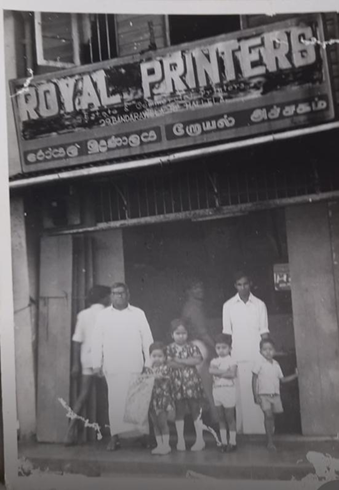
Tha-tha photographed in front of Royal Printers. (Date unknown).
On Sundays, Tha-tha would host a big feast for his family and friends—he’d have everything pulled from the showcase, gold trimmed cups and steel plates, while Pahti cooked an array of curries, something different each time. His television, which was the only one in town, was dusted for when the guests would gather around and watch a show while sipping tea. Amma remembers playing with the many children who’d visit, drawing squares on the road for hopscotch or swimming in the river behind the house, returning only after lunch was served. Tha-tha’s home became a sanctuary of sorts. It wasn’t utopia, it didn’t represent the possibility for a different kind of country, nor was the kinship of neighbours enough to stop the coming pogroms. But in his small piece of the world, they could sit around his dining table, their bellies stuffed with rice and laughter, while the TV gleamed in the opposite room. After the table was cleared and warm tea was served, everyone trickled out, returning to the reality of an island at war with the Tamils.
Wealth afforded Tha-tha a certain level of protection—like many other Tamil business owners at the time who survived the earlier pogroms unscathed—but he could always feel someone watching. There was a group of soldiers who often huddled outside Tha-tha’s door, their rifles hanging from their shoulders, demanding he serve them tea. Without opening the door he’d call for Pahti, who would rush to the kitchen and set a kettle to boil. Perhaps paradise was—and could only ever be—temporary.
After the pogroms of 1977, Tha-tha received a letter without a sender or return address—a warning from the Tamil resistance movement. Worried that further violence was coming, the letter urged upcountry Tamils to resettle in the North-East. Many upcountry Tamils had relocated or joined the movement themselves, while others fled abroad. Perhaps, in his stubbornness, Tha-tha believed that the life he built would endure the coming violence. Or perhaps he knew it wouldn’t and preferred to savour it for as long as he could. He stared at the letter for a while before leaving it at the back of a drawer. When Amma asked who sent it he shrugged his shoulders. “It’s no one, don’t worry.”
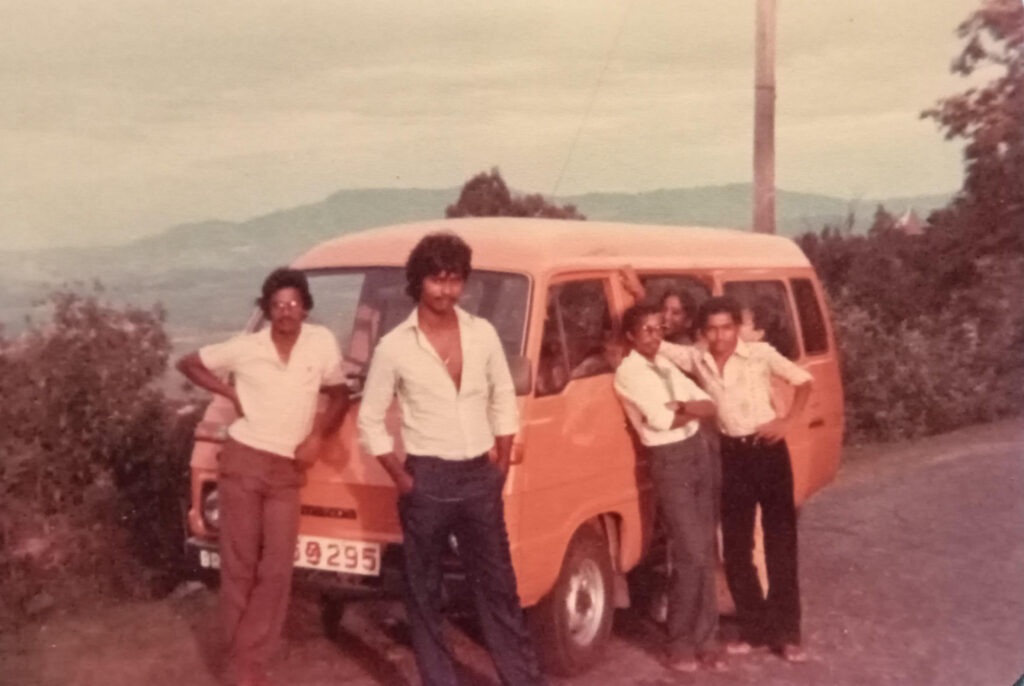
Amma and her siblings, most of whom were married or attending college, returned home for a family road trip in May 1983. Amma remembers the trip fondly—they squeezed into the orange Mazda van Tha-tha had bought only months before, then drove from Sigiriya to Yala. I eventually found a photo of the van from another trip—the boys posed around the van, their bellbottoms pulled up to their ribs, their thick black hair trimmed neatly. Amma was poking her head out from between the door and her friend’s arm, which was stylishly resting against the van.
Tha-tha wasn’t in frame. I figured he might’ve been behind the camera, directing the shot, savouring the bittersweetness of a fleeting time.
○○○
Each Thai Pongal, the Tamil harvest celebration, Amma boils sweet rice with cashews and raisins on the stove until the pot bubbles over—a gesture of thanks to the Sun for keeping us warm, for nourishing our crops, and for guiding us into a new day. I’d chew the sweet porridge slowly, savouring each grain of rice as recompense for the Sun’s labour. For the Sun’s task is an impossible one—to provide the means for life to flourish in the harshest of conditions. While we humans may be more familiar with death, the Sun is a mortal creature just the same. It too must die. When that day comes, eons from now, I wonder if it will look back and take pride in the life it made possible? There was no way for me to be certain, all I could do was finish the bowl in gratitude.
The Moon [நிலவு Nilavu]
I didn’t warm to Pahti at first. I remember the day she arrived in Toronto—Amma strategically waited until we got to the airport to tell me I’d have to share my room with her. I had just transitioned to having my own after sharing with my older brother only to find out I would have to give it up again, but this time, to my eighty-year-old grandmother. Pahti was disciplined—almost militant—which made our first few months together difficult. She’d wake each morning at 6 o’clock to comb her hair, applying a thick layer of coconut oil and pinning it back into a tight bun, taking care to ensure each thin strand of white was accounted for. The rhythmic plucking of her comb at the knots in her hair meant it was time for school.
Sri Lanka’s war against the Tamil people resumed in 2008 after a tense ceasefire—the same year Pahti arrived in Toronto. The Sri Lankan army began indiscriminately shelling tens of thousands of Tamil civilians in so-called “No Fire Zones.” What I remember of that time were mostly protests—we joined caravans of Tamils travelling from Toronto to Ottawa, Washington, and New York City—thousands of us trying to bring our people’s plight to the eyes of the world. There’s a photo of Pahti from those days that I love—she’s wearing a thick fur coat over her blue saree, her white hair pinned into a neat bun, staring solemnly at the camera as she stands in front of the Washington Monument next to my brother. After killing tens of thousands of civilians in the final stages of the war, the Sri Lankan army declared victory on May 18, 2009.
The nightmares—some of raging forest fires, some of bombs exploding, others of great floods—began a few weeks after. In my dreams, I was the only one who could see disaster coming. I’d scream for us to run but neither of my parents believed we were in any danger. I’d wake up panicked, scrambling down from the top bunk and waking Pahti. She would sit me beside her and sing a prayer, the blue glow of the moon pouring in through our bedroom window, illuminating her face as she sang. “Everything will be okay,” she’d say, before sending me back to bed. I didn’t know much about Pahti’s life then, or what she’d been through, but I knew if anyone could save us it was her.
Suffering was one of Pahti’s first teachers. Born in Nammakkal, a small city in South India, Pahti described most of her childhood as painful. Both her parents had died very young. She often spoke of the day her father died, when she took his head and placed it gently on her lap so he might feel some comfort as he passed. The time shortly after his passing was some of the most difficult. As a child, her and her siblings spent most of their time scavenging for food. On some days she’d chew on tamarind rinds just to trick her stomach into feeling full. By the time she was a teenager, her forearms had been covered in tattoos, various tribal patterns etched with a needle and a mallet—gifts from the town’s wise women offered alongside food in exchange for completing their odd jobs.
Tha-tha, who also lived in Namakkal, eventually married Pahti and took her with him to start anew in Sri Lanka. Pahti became Tha-tha’s equal—a matriarch, confidant and advisor, but most importantly a friend—she stood by him as he struggled to build Royal Printers. For the many children who Tha-tha had put through school, it was Pahti who cooked and attended to their needs.
Fear was her other teacher. A group of squatters had once holed up at one of Tha-tha’s properties in a nearby town, so he and Pahti went to investigate. The squatters had forged the land transfer documents, making it difficult to prove Tha-tha’s ownership. Upon realizing they would need their lawyer’s help settling this dispute, he returned to Hali-Ela while Pahti stayed behind to observe the squatters. Annoyed by Pahti’s presence, the squatters called the police claiming she and her children were attempting to steal the land. Amma remembers her delight when Pahti refused the policeman’s offer of water and food in protest, who instead arranged for meals through one of her nephews. He brought with him bags of curries and rice, and some sweet buns—Amma’s favourite. Once Tha-tha spoke to the police over the phone, they released Pahti and drove her back to the property, ordering the group of squatters to leave.
A few months later, the squatters returned, this time with a truckload of thugs armed with machetes. Pahti and the kids ran out of the house and scattered through the fields behind it.Kali is complex—most are unable to look past the bloodied heads of the guilty adorning her neck. But Kali is also the mother goddess—a goddess of the natural world, the margins, and liberation. In the ensuing chase, a makeshift explosive filled with sand was thrown at her, bouncing off her saree and exploding a few meters behind. Pahti narrowly escaped. Instead of hiding, she returned to the police station on foot, informing the police chief of what happened. When she returned to the house with the officers a few hours later, it was empty—plates of half-eaten food and empty beer bottles strewn across the floor. As the police were preparing to leave Pahti heard a noise coming from upstairs—the thugs had heard the police cars pull up and hid in the attic. She watched as each one was arrested and driven back to the station.
This was the Pahti I’d known—the one who caught spiders and kept away the ghosts at night. But I often wondered if underneath her quiet resolve, was a part of her that felt afraid?
Pahti wanted nothing to do with the television when Tha-tha brought it home, seeing it as a distraction from her household chores. But whenever her daughters turned it on, Pahti would stop and watch, broom in hand. She became absorbed in a popular Japanese show Oshin (1983), which followed a young girl through the hardships of her life—navigating the death of her grandmother and sister, her struggles with poverty, and the harshness of Japan’s Meiji period. The character was inspired by the life of Katsu Wada, co-founder of the Yaohan supermarket chain. Amma remembers often turning back to find tears gently rolling down Pahti’s cheek as she watched. Pahti said she saw herself in Oshin. I later found a clip of the show where in the midst of a harrowing blizzard, an imperial soldier asks Oshin if she needs help getting home. She gently declines, “I know the way.”
○○○
Pahti often said Kali atha, the goddess of war and destruction, would one day rid the earth of evil. Kali is complex—most are unable to look past the bloodied heads of the guilty adorning her neck. But Kali is also the mother goddess—a goddess of the natural world, the margins, and liberation. Celebrated during new moons, when the moon’s light no longer accompanies us through the night, Kali asks us to face our fears so that we may find our own path through the darkness. Her name can be understood as “the one who governs time” or “one who is dark.” I had always avoided spending time in the dark, afraid of what lurked within. But on the night we got the call that Pahti had passed away, it beckoned. As Amma wailed for her mother on the staircase, I quietly climbed up towards my room, shut the door, and turned off the lights. As frightening as it was, I was somehow sure that the darkness—the unknownness of a new world, one without my grandmother—wasn’t here to hurt me, but to hold me through to the other side.
The Fire[நெருப்பு Neruppu]
Tha-tha had ignored previous pogroms, first in 1955 and again in 1977, confident his wealth and status would protect them. But Pahti knew this time would be different. On July 23, 1983, the Liberation Tigers of Tamil Eelam (LTTE) killed thirteen soldiers in an ambush in Thinnevely. In response, the army killed fifty-one civilians and in the coming days, Sinhalese rioters killed, robbed, and raped Tamil civilians across the island in retribution. The rioters went town by town, armed with voter registration lists of Tamil households while the police stood by and watched as they committed horrific atrocities.
The rioters arrived in Badulla, a larger town to the north of Hali-Ela, on the following Wednesday. Many were bussed in from throughout the upcountry. “They’ve burned shops in Badulla,” Pahti said to Tha-tha, rushing back home from the store after she heard the news from the owners, who were quickly closing up and packing their things to flee. “We should stay with my niece in Unugalle. Her son said he’ll drive us up the mountain.”
“They won’t do anything,” said Thatha, shrugging her off. “How many of these riots have we seen? And look, we’re still here.” He stayed seated at the dining room table, attending to the cup of tea in front of him. They stayed that way for what felt like hours, as the rioters slowly approached down Banderwala Road, the main throughway connecting both towns.
Pahti took an empty Krisco biscuit container and ran upstairs to collect her jewelry—cherished family heirlooms, yes, but useful currency during a crisis. It reminded me of reading Octavia Butler’s Parable of the Sower (1993), where Lauren Olamina had turned a few pillowcases into her “go-bag” and filled them with what few items she could scavenge if she ever needed to flee at a moment’s notice. Nuts, some old pots, cash, and seeds. Lauren knew it wasn’t a matter of if looters would come for her small gated community, but when. Within a few hours the rioters arrived at Royal Printers.
First, a group of them dragged Tha-tha’s orange van into the middle of the road and set it ablaze. Our cousins in Unugalle would later say they could see the van from atop the hill—a warning for others to stay away. Then they smashed the windows of Royal Printers and looted the building before it too was set on fire. By the time they reached the house, Pahti had come back downstairs with the Krisco container under her arm, grabbed Tha-tha by his wrist, and quietly guided him out the back door.
She stopped halfway down the steps leading towards the ravine. “Wait,” she said quietly as she pointed behind her. Tha-tha hesitated at first then followed her instruction, looking back towards the house and the printing press. “Everything we worked for is burning. Look at it. Then turn around and keep going. This story is over.”
His fragile paradise was on fire—black smoke billowed from the window, carrying the sound of cracking wood and cheering rioters. In front of him was his loving wife beneath the fire’s glow, a staircase leading behind her into the darkness. Whether they would survive the night or where they would go next, they could not have known. He had to trust that his wife knew what he needed now was to turn towards the fire and say goodbye.
They both turned back towards the ravine and ran.
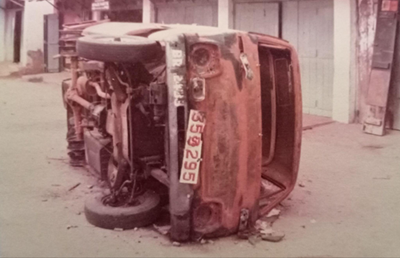
Tha-tha’s orange Mazda van, destroyed. Captured July 27, 1983 (approximately).
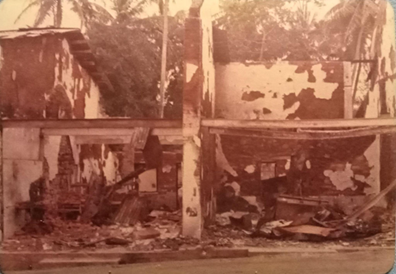
Royal Printers and my grandparent’s home, destroyed. Captured July 27, 1983 (approximately).
The Serpent[நாகம் Nāgam]
The serpent in Avvaiyar’s poem is an ouroborous meant to represent the unawaked consciousness. It sleeps at the base of the spine, coiled around itself, eating its own tail. In the poem, Avvaiyar honours the elephant god Pillaiyar, the Remover of Obstacles, for bringing her awareness to the cycles of the sun, moon, and fire—life, death, and rebirth. For awakening the serpent within her as she approached the end of her own life. In this conversation between the poet and the god, the snake has no say. A kind of self-mutilation, ingesting parts of itself it may not have been ready to let go. The moment the tail passes into its mouth is the end of countless other possibilities. Perhaps it knows there is no choice in the matter, that to survive is to let go of what was and what might have been, endlessly.
But I often wonder, does the serpent grieve its tail?
○○○
Earlier this year, I came across a report by the Sri Lankan government titled the Presidential Truth Commission on Ethnic Violence (1981-1984). It included hundreds of testimonies from Tamil survivors, documenting horrific murders and the destruction of property. As if written in an autopsy report, I found a line referencing Tha-tha’s printing press: …Royal Printers, where 40 persons worked. During the communal riots of July 1983 it was destroyed. There was something dreadful about seeing a pivotal moment in our family’s history distilled into a single line. Determined to see the remains of Royal Printers for myself, I flew to the island with Amma.
The rest of the drive into Hali-Ela was quiet—I spent most of it admiring the fog as it rolled over mountain tops, slid down their green slopes, and then dissipated over the valley—interrupted only by the sound of Amma’s voice as she recounted her childhood memories. I was last in Sri Lanka in 2005, after the LTTE and the Sri Lankan army agreed to a ceasefire to deal with the aftermath of the Indian Ocean tsunami. I was returning to a different island.
As we drove through Tamil areas scarred by economic crises and natural disasters, I remembered the particularly absurd passages of the truth commission report. A kind of reckless optimism bordering on satire. One passage reads, “pursuing a utopian ideal would be akin to chasing after a mirage in the desert. But if we do recognize, that indeed, we are in the midst of a desert, we would realise that we have no choice but to keep on chasing after the mirage until we reach the oasis. Surely, we will, hard though our way! And oasis, there are!”
And oasis, there was, I thought, as Amma and I eventually found ourselves in front of her old house—or rather, where it used to be. Replacing her old home was a concrete building with a green sign that read: Hithamithuru Beer Shop. Next to the house, where Royal Printers once was, was a convenience store. For a while she simply stared above the shop’s sign, at nothing. “There was a window there,” she eventually said. “That’s where we used to sit, in the bedroom, after the curfews started. I still hear the soldiers’ boots marching down the road. We saw everything from that window. Some nights, when the town was dark, we could see the stars. Other nights, we’d sit under the windowsill and write poems. The stories that window could tell.”
Amma didn’t want to ask the beer shop owner if we could see inside and suggested we try her Sinhalese neighbour instead. We walked left from the store, two doors down, unsure if anyone would be home. We peeked through the gate and saw a man laying tiles on the veranda. He noticed us, went inside, and to Amma’s surprise returned with Nissanka, the youngest of the family. He welcomed us with a big smile, a hug, and invited us in for tea.
Their conversation drifted easily to memories of their childhood and of my grandparents. He eventually led us downstairs and through the kitchen to his backyard. Nissanka’s yard was neat, a small path cut through the thick bushes and rows of palm trees towards the ravine. A seven-foot concrete wall blocked the view of my grandparents’ property—an addition by the new owners. Nissanka pointed to a mound I could climb onto for a better view of the adjacent yard. A lump grew in my throat as I climbed up and peered over the wall. From up top, I saw only broken concrete, tall grass, and the heaps of garbage which now filled the yard. Only a single door from Royal Printers had withstood years of demolitions, as if keeping vigil.
Turning my head away from Amma and Nissanka, I started to weep quietly. I grieved the life my grandparents built, and the life that could have been. A life we could have shared. But I had to remember that even if Royal Printers was destroyed, it wasn’t gone.
On the way to Hali-Ela we stopped in Colombo to visit Tha-tha’s friend, Sivarajan, who for decades worked at Royal Printers as Tha-tha’s right hand. We met at the restaurant which he started with his son a few years back. Over tea, he reminisced about his days working for Tha-tha. He said it was Tha-tha’s teachings that gave him the courage to build this restaurant. He even recited one of Tha-tha’s proverbs from memory, “a man who can’t respect one penny will never make ten pennies.”
As if it were pollen carried by the wind to more fertile ground, the memory of this place lived on in those who still spoke my grandparents’ names with reverence, in those who learned something from their lives. It lived on in Amma, and now, in me.
In her book, A Paradise Built in Hell (2009), Rebecca Solnit writes about the big and small acts of connection in crisis, which are “by [their] very nature unsustainable and evanescent, but like a lightning flash it illuminates ordinary life, and like lightning it sometimes shatters the old forms. It is utopia itself for many people, though it is only a brief moment during terrible times.” She adds that the work of making joy and freedom in crisis “can inspire people to return to that society in its everyday incarnations with renewed powers and ties.”
As we walked back towards the house, Nissanka told us about his mother who kept an eye on the property after the pogroms. Strangers bought and sold the land, never staying more than a few years. The river behind the house had dried up and the jackfruit trees had stopped bearing fruit.
“Only ghosts live there now,” Nissanka’s mother often said.
I turned back to look at my grandparents’ home one last time, listening for their ghosts. Perhaps it was just the cold breeze rustling against the palm trees, but for a moment, I could almost hear them laughing.
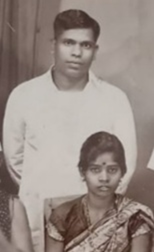
For my grandparents, Kaathan Veeramalai Pitchaimuthu and Rasamma Pitchaimuthu. For their children—my mother, uncle, and aunts. And for the Tamil people—in the mountains, by the ocean, and those far from home.

Athavarn is an Eelam Tamil facilitator, writer, and event curator. His writing engages with memory, community, ecology, and spirituality as terrains for political transformation. As a facilitator, he supports social movements to navigate conflict and cultivate shared purpose in times of uncertainty. He loves R&B, astrology, tarot, sci-fi, his friends, and his family. He lives on the lands of the Mississaugaus of the Scugog Island First Nation. athavarn.com.
 BACK TO ISSUE