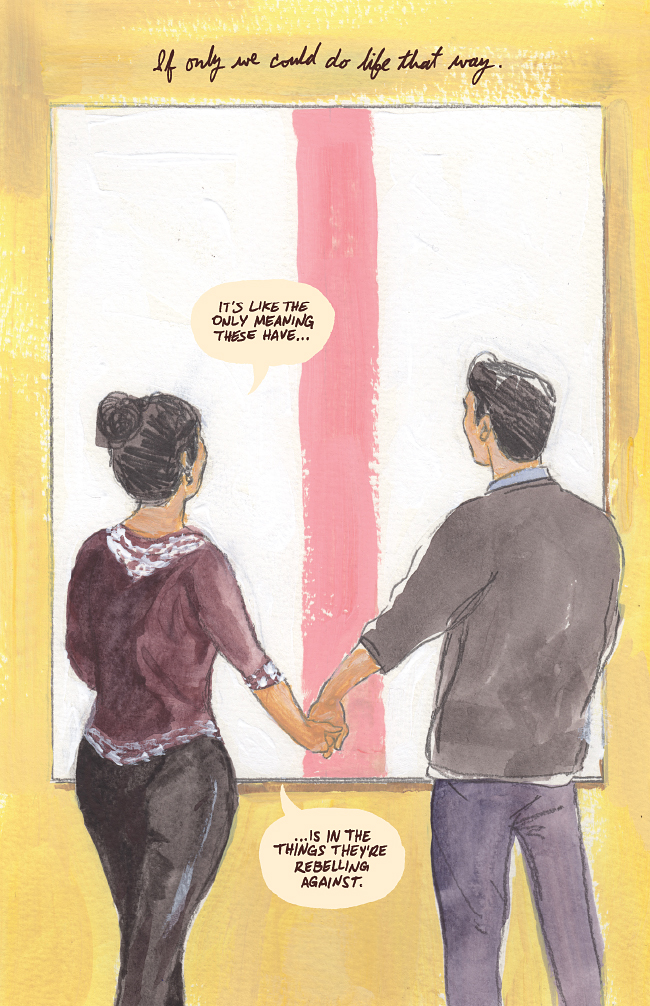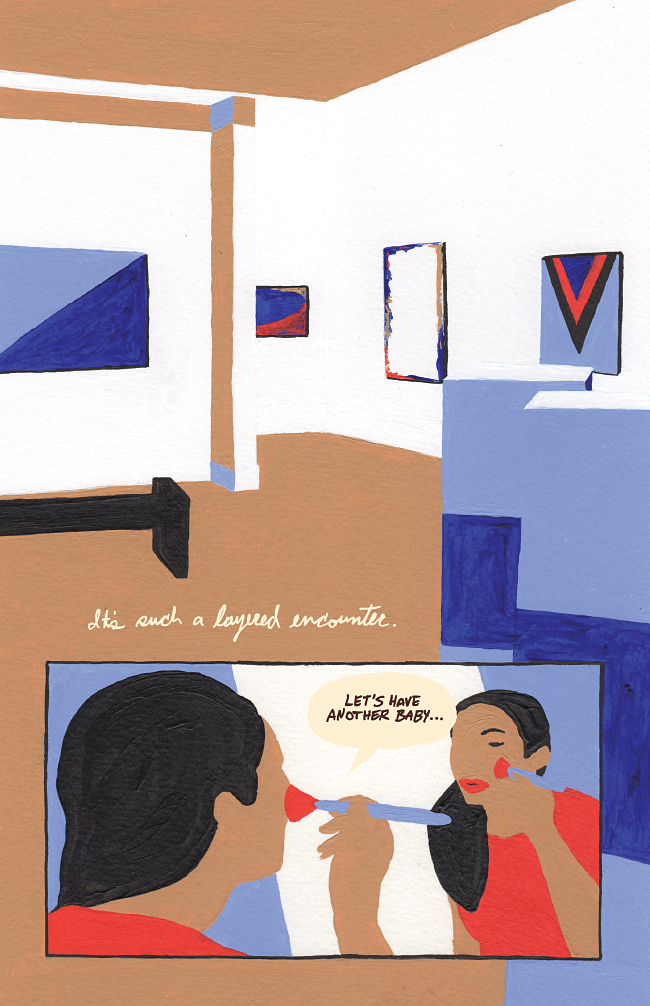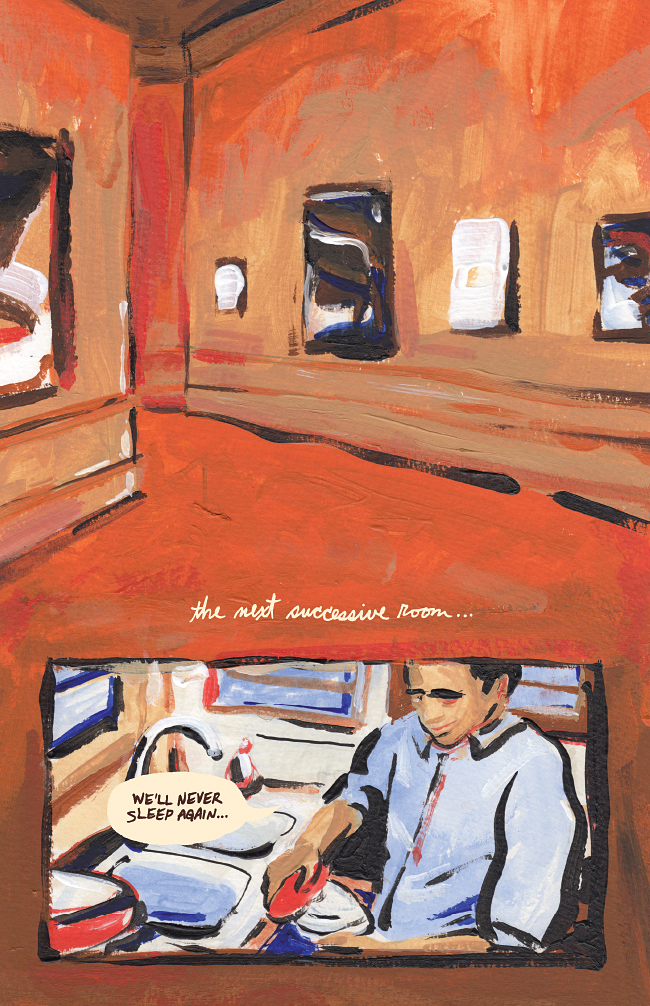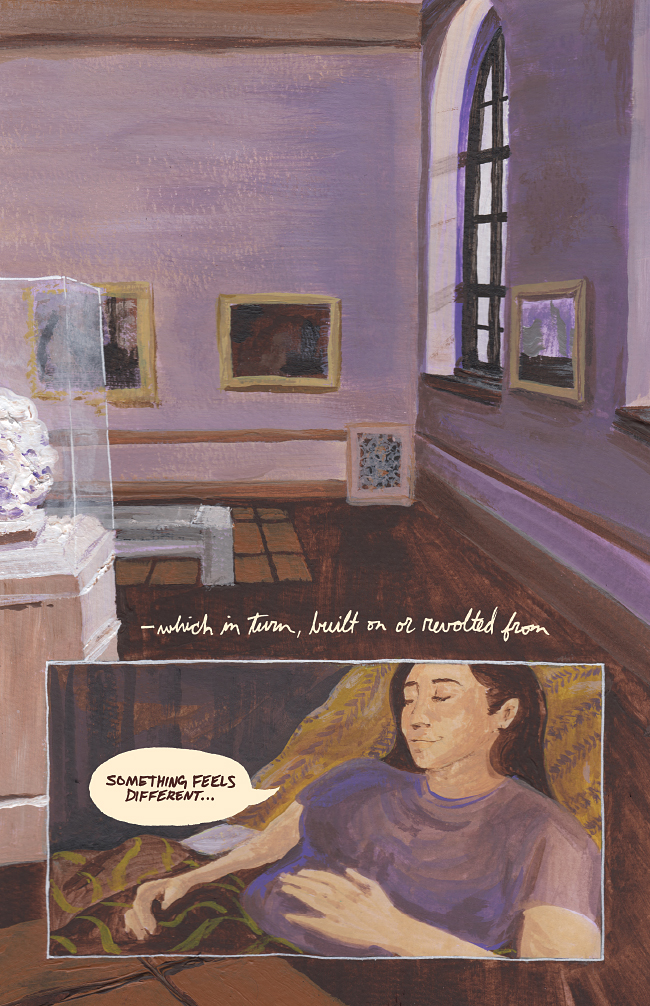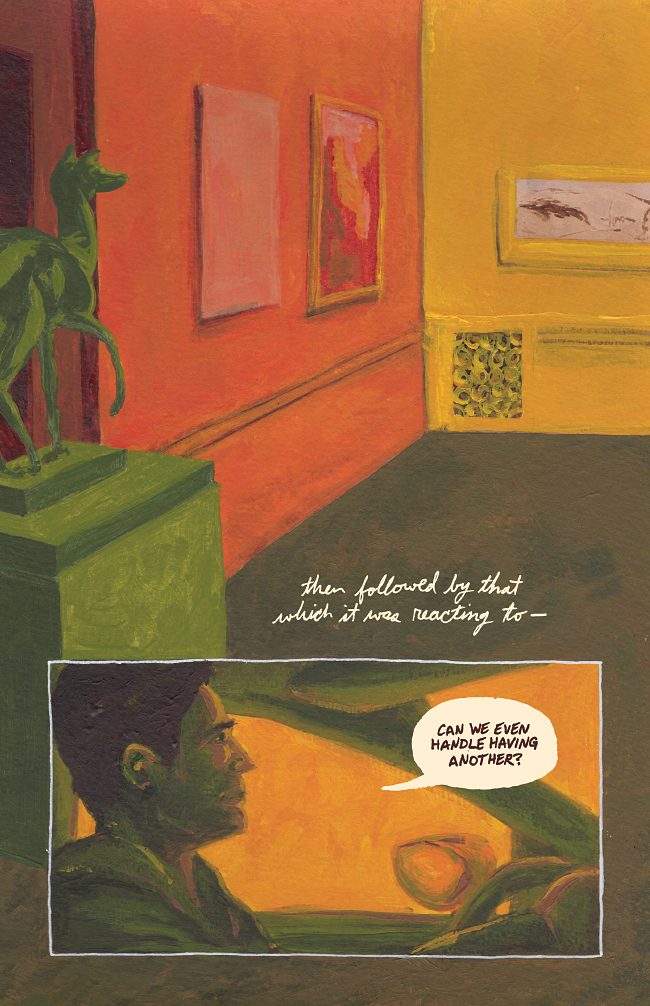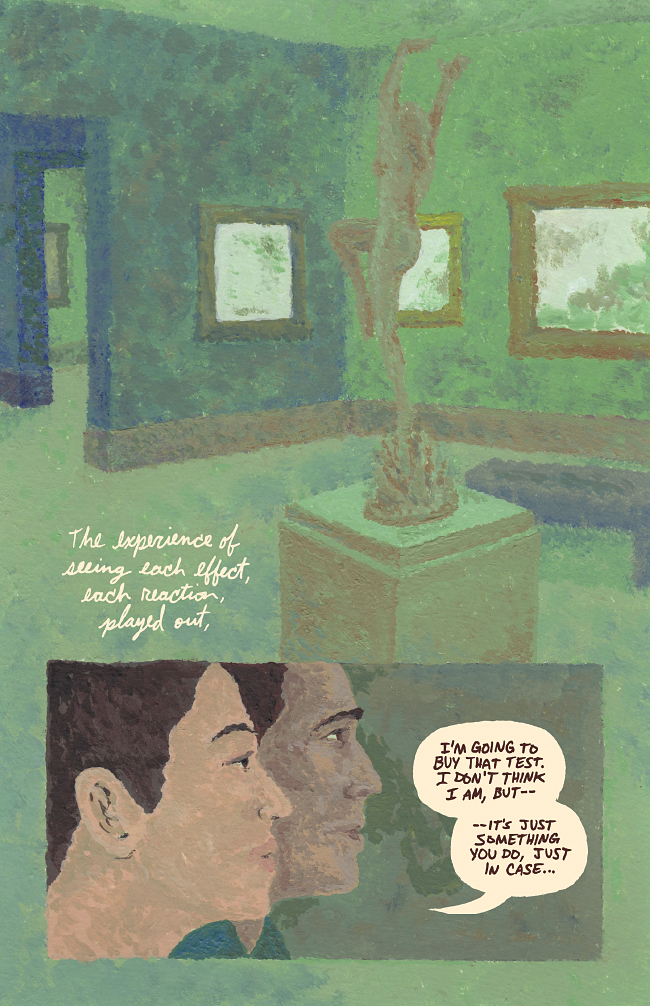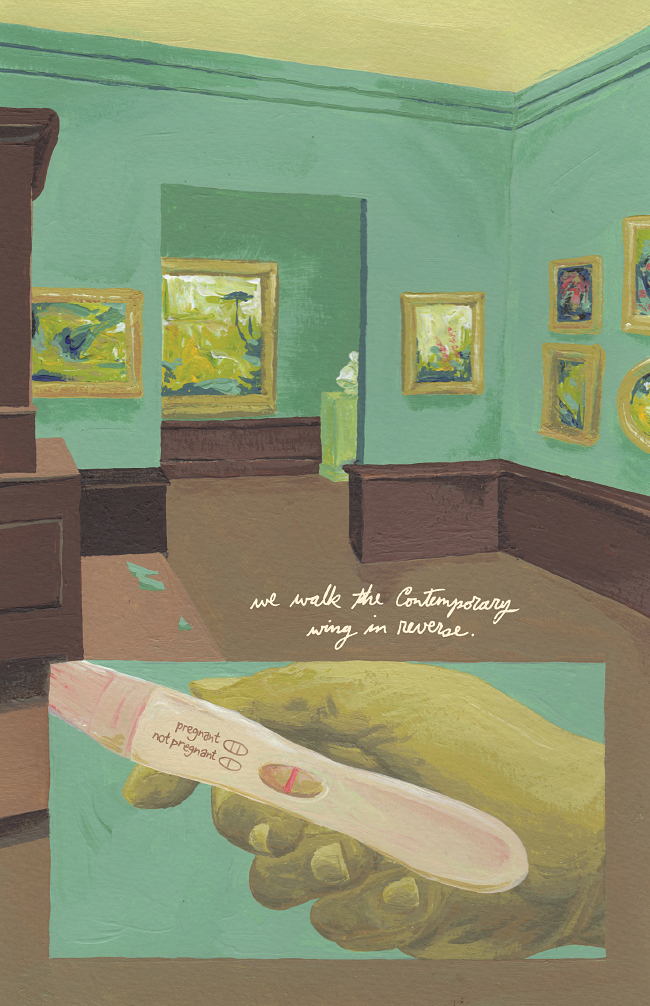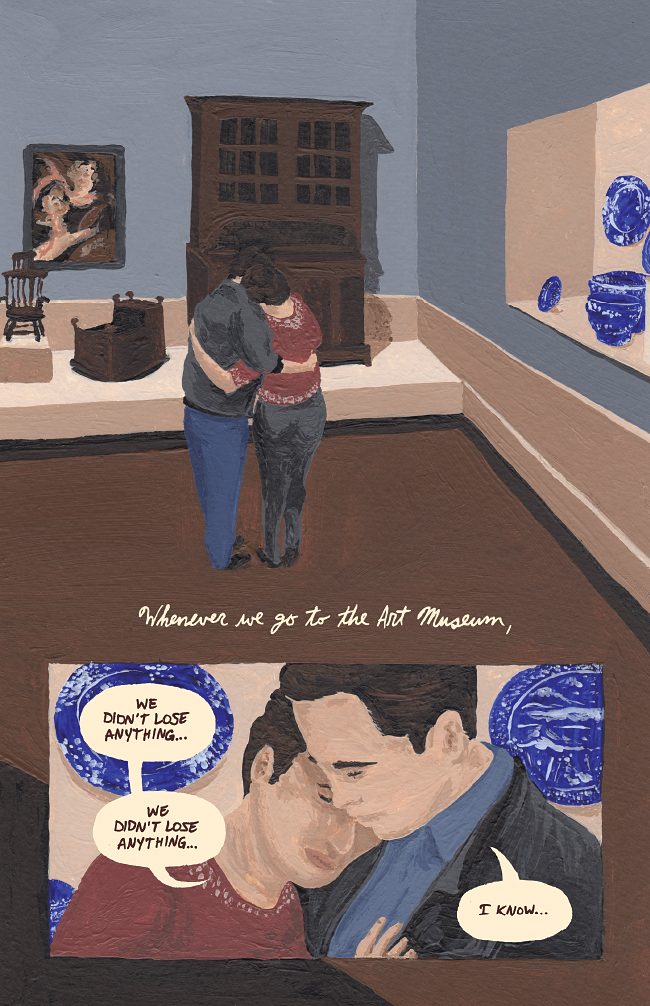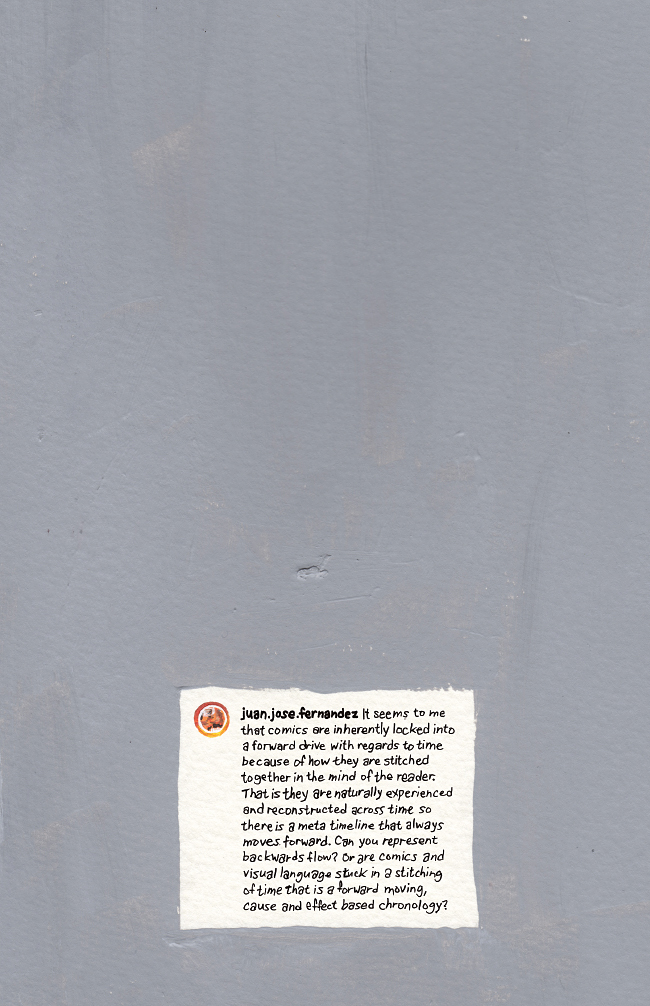
Mita Mahato is a Seattle-based cut paper, collage, and comix artist and educator whose work focuses on lost, discarded, and disappeared animals and objects. Her book of poetry comix, In Between, is listed in The Best American Comics: The Notable Comics of 2019 and her silent comic book Sea received the award for “Best Comic Book of 2017” from Cartoonists Northwest. Her work is published in Coast/No Coast, Shenandoah, Illustrated PEN, MUTHA, Drunken Boat, and Seattle Weekly and has been exhibited widely (including at SOIL Gallery, Seattle; Gene Siskel Film Center, Chicago; Schnitzer Art Museum, Pullman; and Antenna Gallery, New Orleans). Mita is Associate Curator of Public and Youth Programs at the Henry Art Gallery, serves on the organizing board for the arts organization Short Run Seattle, and teaches community art workshops to all ages.
having two or more languages is a cock fight, beaks snap ping at each other’s necks for the domain and trained only for that they only want to see blood and feathers, whether that means life or death, no ifs, ands, or buts; tampoco quieren dudas,quejas o peros– pero…when people ask me what language i think in, i tell them ithinkin dreams,
with no policing of language or fear of white canons amputating our limbs that grasp, uphold, embrace, and carry our families and countries limitations conclude our selves. we seldom speak in fear of our tongues being corralled and caged. see, my mother always told me to ar ti cu late my words when i spic out my mind that the gringo teachers won’t like if i’m late to enter discussions about me. the first professor to diagnose my speech problems was yt they diagnosed me with Too-Many-Words,
from different sources fighting for conquest of my brain and tongue rememberto cite sources in MLA! she told me the amalgamation of languages was a f o u n t a i n not of youth, but of proof of my country’s resilience. if only my grade school teachers were the same way, instead of enforcing inglés and Spanish. i could barely banish one language when one whispered in my ear the answer to a question, or when the other mumbled poetry that insisted to be spit out. outside of my country, people only ask for my first and last name but how will they know
i carry my mother’s with me wherever i go? i also inherited her universal language of laughter and dance her kindness her poise her habit of getting so enraged, when anger bubbles to brim, neither she nor I can identify whose mother to shit on, what r’s an s’s to scrimp and save, what other way than to summarize a hurracounous rage with a savory and all-encompassing puñeta i not only mutter carajo or hijoeputa, but yell out FUCK.
Li-berate-ion
noun. (plural: inconceivable)
the act of being on the loose, a tightening of the noose, being unchained and lacking every possible possession except for a ripped Bible that’s bloodstained and muddles passages like Exodus 6:6;
synonymous to unaffiliated, poverty-stricken, unlucky, inconceivable; see Chile, Cuba, Haiti, Venezuela… Examples: See, L’Ouverture’s version of liberation only gave his people a quavering economy; Communism doesn’t birth liberation in the crib of an uncivilized country, but rather spawns chaos.
related to those-countries-that-were-ungrateful-of-the-Crown and those-who-read-Marx; see Guevara, Che.
antonym to hegemony, capitalist, unified, civilized, etc.
too expensive, unattainable, we’ll become Cuba! communism will run rampant, do you really want that happening to you?
María Lysandra Hernández is a BA Writing, Literature and Publishing student with a minor in Global and Post-Colonial Studies at Emerson College. She was born and raised in Puerto Rico. She is currently the Head of Writing at Raíz Magazine (@raizmagazine on Instagram), Emerson College’s only bilingual and Latinx-run publication. Her work has been published in Raíz Magazine and she can be found on Instagram at @marialysandrahern.
the hairless skin that isolates me from the world is a few millimeters thick (thicker on finger tips thinner in elbow pits) the only contact with the world I have is through membranes of mucous (glass, opal)
through here you can come in lay eggs come out
a fruit fly is isolated from the universe by a golden exoskeleton complete with a pair of wings (opal, glass)
the fruit fly hit the space pierced right through it the fruit fly can roll its eyes inward to see its own chromosome
I am in contact with the universe through the red eyes of a fruit fly
Tumulus the mole builds a house underneath the cemetery in the town of Szklary Gorne
moving through the water with the shovels of his paws, sliding through claylike layers with his missile-slender body, patiently pushing soil out of the soil. work results are beautiful and good: a moss-carpeted bedroom, a pantry full of earthworms with slashed nerves. time to dig a well, says Tumulus and he drills down, more swiftly than a gannet, his rough fingers seeking humidity. but instead he senses emptiness. a feeling alien to moles. cold, bitterness, failure fill his nostrils. a hum, impossible to mute, arises in his head. carefully, he enters the musty coffin, crawls, curls up into a ball under the ribbed vault.
crossing over
philosophy is a ponderous column polished over thousands of years which always lacked a capital but soon it shall be capped by
Laika, a soviet scientist and astronaut, the pride of the nation. she has just reached Earth orbit (perigee of 211 km, apogee of 1659 km) on board Sputnik 2. soon she will share her reflections and the microphones fitted to the capsule will capture every word she says.
first lap cosmos abandoned basement tastes of iron rod
second lap stars rocks hurt my paws can’t hear any others
third lap home a hard capsule cosmos streets of Moscow
fourth lap my name is Kudryavka I’m a soup made of dog
recitativo of a tapeworm stuck to Maria Callas’s intestine
for O.F
I can hear her sing this is my body which I love and I don’t which I love and I don’t which I hate
I soak up the bitter night mantra rough Greek words cut glass pane I grow
when you’re up on stage it’s not you they applaud oh Violetta, Tosca, Norma, Aida but the ribbon in your guts that squeezes your waist from the inside I made you into a slender fruit from the tree of the knowledge of bel canto and brutta vita
beware my children are thriving in your flesh
systems. dissociation
the most beautiful organ is the brain enveloped with meninges, covered with the cranium can, fitting in its tracts stability, drive, and identity, which you must rip off like a used band-aid, uncover the wounds for the salt to corrode. you’re all salt, my love, and you must fall apart; out of your body Europe will precipitate a golden residue, where lead, silver, consciousness dance together
Ksenia Bolotnikova recalls Holodomor
in nineteen thirty-two, sir, there was nothing left. no crop, no potatoes, no farm or domestic animals, no wool, no sickles, no flails, no passports, no wagons, no roads, no stars—we ate everything but the knife.
the spring was cold, windy and rainy. one day, from the water collected in the hollow of my cheek a devil emerged assuring me that once I eat my daughter, I will throw up everything: the crop, the potatoes, the animals, the wool, the sickles, the flails, the passports, the wagons, the roads, the stars— I will turn the whole world inside out like a pillowcase and the famine will be over. my daughter will come back, too, safe and sound, so no loss there.
the knife was left uneaten in fear that its blade would reveal the shame hidden in-between the folds. the hand, unstopped by the angel (if an angel came down, sir, from the heavenly sky to Sofievka we would’ve eaten him inevitably, not even caring for plucking his wings), a hand, twenty-seven tiny fragile bones shining through the skin like a firefly, the hand slit the throat.
go ahead and tell them, please, to give me some bishop’s wort rootstalk. for all these years I have been trying to throw up, save Ukraine
Translator’s note:
The poems by Anna Adamowicz talk about the kingdom of Animalia but, surprisingly, it
is not the human species that constitutes the main focus of her work. Although
she does describe in detail a series of biological systems found in the human
body, she dedicates a lot of attention to the world of insects, arthropods,
reptiles, worms and, finally, mammals, where we can observe things from their
perspective. In the background there is Europe, sometimes as a place or an
organism.
Apart from allowing us to witness the world from such a
distinct position, Adamowicz’s
poems play another important role: they give voice to the voiceless. In this
way, we are able to observe Tumulus the mole building a house or accompany
Laika the dog in her short and tragic journey into space.
Moreover, Adamowicz also gives voice to those who never had a chance to speak up. One of her poems talks about Ksenia Bolotnikova, a young Ukrainian woman who lived during the man-made famine in Soviet Ukraine in the 1930s and who murdered her own daughter with the intention to feed her son and herself. Ksenia’s powerful confession enwrapped in Adamowicz’s poem is an attempt to describe the horrors of starvation without any traces of judgement because—who would dare to do that?
The biological aspect of Adamowicz’s texts was a meaningful lesson in how to translate a poem
without making it sound like an encyclopedia entry. While the author incorporates
biology into verse in the most harmonious way possible, as a translator, I
often found it challenging to recreate the novelty of her perception as well as
her carefully crafted poetic language.
Another difficulty I encountered is related to the choice of poems to submit. Adamowicz covers a wide array of themes in her volume by touching upon biological, environmental, historical, social, and cultural aspects of the world. On the one hand, I wanted to give the reader a sample of each of these factors; on the other hand, I could not help but translate the poems which affected me personally, hoping that they will likewise appeal to the reader.
Aga Gabor da Silva graduated from the University of Massachusetts, Amherst, where she studied Lusophone Literatures and Cultures. Aga also holds a Master of Arts in English from Adam Mickiewicz University in Poznań, Poland. Her first translation from Polish into English—two poems “Tights” and “Buttons” written by Bronka Nowicka—was published in the Winter/Spring 2019 issue of Lunch Ticket. Aga currently lives in sunny New Mexico with her family. When she’s not busy chasing after her three-year old, she translates literature.
Anna Adamowicz was born in 1993 in Lubin, in south-western Poland. She is a poet and a laboratory diagnostician. Her first volume of poetry, Wątpia (Doubt), published in 2016 by Kwadratura, was nominated for the Gdynia Literary Award and won third place in the “Browar za debiut” (Beer for Debut) poll. Her second collection of poetry, Animalia, was published in January of 2019 by Biuro Literackie, and a few poems from the volume have been translated into Hungarian, Slovenian, and English. You can follow Anna Adamowicz on Facebook.
The painter of Altamira (in the darkness of the cave) knows the shadows he sees on the wall are real. For him the real and apparent are indistinct for he knows the shadows undulating on the wall are (in fact) bison passing in front of the cave. Ten thousand years will have to pass twice before another bearded man can affirm something different and in another cave (by the light of another light) rethink everything from the start. But for now they are shadows (with the profiles of bison) that the painter of Altamira copies all over the cave – asking the stone gods that they may reproduce so there’s never a shortage of shadows (and for that matter bison) to hunt and eat.
O pintor de Altamira
O pintor de Altamira (na escuridão da caverna) sabe que as sombras que vê na parede são reais. Para si são indistintos o real e o aparente porque sabe que as sombras que cintilam na parede são (de facto) de bisontes que passam defronte à caverna. Será preciso que passem duas vezes dez mil anos para que outro homem de barba afirme coisa diferente e numa outra caverna (à luz de uma outra luz) pense tudo do início. Mas por agora são sombras (com o recorte de bisontes) que o pintor de Altamira copia por toda a caverna – pedindo aos deuses de pedra que elas se multipliquem para que nunca faltem sombras (e já agora bisontes) para caçar e comer.
The motion of the world
Through the church door I’d hear people’s prayers recited like someone’s times tables. I wandered the world and (listen: it was funny) the more I wandered the more I had it right (life itself seemed like it wanted to hold onto me). In a world gone belly up bats are the wise ones – I came back from the world and never admired the return (the color of the sea was the same the light in the sky was the same envy was exactly the same). Seen top to bottom each illusion is small – through the school window I’d hear times tables recited like someone’s prayers.
Movimento do mundo
Pela porta da igreja ouvia dizer orações como quem diz tabuadas. Eu errava pelo mundo e (escuta: era engraçado) quanto mais errava mais estava certo (a própria vida parecia que me queria preso a si). Num mundo de pernas para o ar os sábios são os morcegos – eu regressava do mundo e nunca estranhava o regresso (a cor do mar era a mesma a luz do céu era a mesma a inveja era a mesma). Vista de cima para baixo toda a ilusão é pequena – pela janela da escola ouvia dizer tabuadas como quem diz orações.
Wild apples
More than the first verse I am unsettled by this: who provides the second one? I scan the world with my eyelids (opening and closing my eyes) to select is to exclude to exclude is to understand to understand is to preserve. Each poem written is an opportunity like touching someone who without warning shocks you (a fish bone in your throat) nails scratching on a black board. Creating poems is like stealing wild apples (you’re expecting sweetness but what you taste is acidity). Inside the poem: sounds (around them: white space) silence put to work.
Maçãs selvagens
Mais do que o primeiro verso inquieta-me o seguinte: o segundo quem o dá? Escolho o mundo com as pálpebras (abrindo e fechando os olhos) escolher é excluir excluir é entender entender é preservar. Cada poema escrito é uma oportunidade como alguém em quem se toca e sem que se conte dá choque (uma espinha na garganta) a unha num quadro de ardósia. Fazer poemas é como ir roubar maçãs selvagens (vais à espera de doçura mas o provas é a acidez). Dentro do poema: sons (em redor: espaço branco) silêncio a trabalhar.
Translators’ note:
Professionally, João is a doctor of plastic and reconstructive surgery, and he’s a perfect addition to the long line of physician-poets. His poetry has been published in anthologies and literary magazines in Portugal, Belgium, Brazil, Bulgaria, Croatia, the Dominican Republic, France, Germany, Holland, Italy, Macedonia, Mexico, Montenegro, Spain, the United Kingdom, and the United States (and probably a few more I’m not remembering). He and I were introduced by my mentor, Robert Pinsky, who knew of my ongoing work translating the collected works of the late Alberto de Lacerda. I immediately loved João’s voice: it is inclusive without being pedestrian, and his often-tongue-in-cheek tone is very engaging. He’s also incredibly adept at packing ideas and emotion into a concise poem (almost nothing he writes goes beyond a single page), and the first-person narration puts the reader right in the middle of the action.
These three poems come from Nomad, João’s tenth book, which attests to his popularity
and success in his home country of Portugal and abroad. He gave me the
opportunity to work alongside Antonio Ladeira to translate the collection,
which is an honor in and of itself. We are thrilled for Anomaly to be
the first journal to publish part of our work—there is plenty more where this
came from.
– Calvin Olsen
Antonio Ladeira was born in Portugal in 1969. He currently lives in Lubbock, Texas, where he is an Associate Professor of Portuguese and Spanish at Texas Tech University. He holds a Licenciatura degree in Portuguese Studies from Nova University in Lisbon, and a PhD in Hispanic Languages and Literatures from the University of California in Santa Barbara. He has published five volumes of his own poetry in Portugal and two books of short stories in Portugal, Brazil and Colombia. He is also a lyricist for Jazz singer Stacey Kent.
Calvin Olsen’s poetry and translations have appeared or are forthcoming in AGNI, Asymptote, The Comstock Review, Ezra Translation, The London Magazine, and The National Poetry Review, among others. A former Robert Pinsky Global Fellow and recent Pushcart Prize nominee, Calvin now lives in North Carolina, where he is a doctoral student in Communication, Rhetoric, & Digital Media and the poetry editor at The Carolina Quarterly. More of his work can be found at his website (www.calvin-olsen.com).
João Luís Barreto Guimarães was born in Porto, Portugal, where he graduated in medicine. He is a breast reconstructive plastic surgeon and author of ten poetry books, the most recent of which are Mediterrâneo (Mediterranean, 2016), winner of Portugal’s António Ramos Rosa Award for Poetry; Nómada (Nomad, 2018), which was voted a Book of the Year by Livraria Bertrand (the oldest bookstore in the world); and O Tempo Avança por Sílabas (Time Advances by Syllables, 2019). He is also a chronicler and a translator, mainly for his blog Poesia & Lda.
Jason Hart is a visual storyteller based in Dayton, Ohio. His narrative works have appeared in Black Warrior Review, Ink Brick, Illustoria, and elsewhere.
I have a joke for you What is the only plant that grows When you feed it blood? The cotton tree.
Did you laugh?
I’ve been thinking a lot about ancestry lately, as I’m stuck still in the trap of an existential early 20s.
I’ve been thinking about who I would have been on the continent, if I should do like the diaspora— pledge my allegiance to an idea of home I’ll never be able to corroborate— claim Ghana, or Nigeria or Cote de Ivoire as the place before the chains
(my last name is French, after all.)
I took Anthropology in college and my professor told the class that Ancestry.com, really any DNA testing kit, was full of shit, and a door closed and my heart broke all over again.
There were two white people at my family’s Christmas last year. They were the only people who got 23andMe kits.
In the first creative writing class I ever took, the teacher asked everyone to go around the room, answer what our names meant what story they told
Givhan… where does that come from?
Slavery. I’ve been thinking about the ancestors as I write a book influenced by myths from a country that colonized a good chunk of the world, ones I’m familiar with because they were what got taught.
I think about them when there’s an uptick on Black twitter of posts saying shit like:
Buck up y’all, they’re dancing in the Kingdom, filled with joy at what you get to do without them chains. Make their sacrifice worth it. Make them proud.
(or whatever fits in 120 characters.)
I took a class on African Religion and almost holy disregarded the units on Catholicism and Christianity, preferring the flavor of the ATR tales, like the one where a chicken helps create the world:
Obatala climbs down a gold chain and scatters sand from a snail shell. He releases the bird to go bat shit— wherever it kicks a sandstorm of hills and valleys follows— and the world began.
(I think I should stop eating chicken)
I like to think of the Orishas as my ancestors when the flesh and blood reality of historical violence on bodies that look like mine starts to consume me.
I think of Obatala and the black cat brought to a creation myth— whose only job was to curl up beside him, keep him company in a new made world— and I see a way of life where I don’t have to be alone.
I think of Olokun livid as fuck, drowning half the new made world because a man was too stupid to ask her permission to enter and terra form her kingdom— and I don’t feel the history of Black women powerless, raped and separated from their families.
I think of Shango and how fucking sick a Black god of thunder must be— Static Shock meets John Henry meets Jesus
(but obviously not white-washed Jesus)
and I feel strong knowing he could beat the absolute shit out of Zeus, if it came to it.
But then I think of the golden chain Olorun allowed Obatala to hang off the edge of the sky in the first place—
find myself shackled to the same kind of narrative.
So I’ve been thinking about ancestry a lot, but also about theft.
The continental kind. The kind so huge it can’t be replaced by reparations
(though it’s a good fucking place to start)
The kind that has punched a hole in the fabric of this history,
a loss so permanent it’s opened a pit in me
that no number of stories could ever fill.
An Homage Of My Father
I.
My mother told me once, when I asked why I never knew Alabama soil. Blackness. The richness of my place on this earth in this tree,
a story about walking with my father and the truck that drove by and the people inside who slowed down to throw bricks at them.
I asked Did you throw them back, teach them a lesson? and her mouth said the no her eyes couldn’t, busy as they were saying something in a language I didn’t understand then, horrors I couldn’t pronounce as a child in a dialect unused to the flavor of lynching, my white teeth in this black mouth unable to let the knowledge of death slip through its gaps.
II.
My father is as Black as I like to imagine the soil in that place we were taken from.
III.
The things I know about my father, are that he used to go to movies with friends, where one person would buy the ticket and let the others in through the exit
that he learned how to drive using a friend’s car because no one in our family owned one, used to cheat at cards, palm them, have one up his sleeve to rig the game, that he walked 5 or more miles a day to get to a bus that would take him to a segregated school,
that he grew up using an outhouse, no indoor plumbing, and that his parents were sharecroppers, his father died young.
I know my father has a bad back from teaching soldiers to jump out of helicopters, that the VA hospital gives out cortisone shots in the years it takes between insurance claims and surgery,
that he joined the Air Force to get out of a South so deep and dark, he still won’t talk about it, won’t acknowledge that some part of me is curious what part of her might belong down there with the ones who never left.
I know my father had a brother who died in a motorcycle accident one who’s a trucker one who calls occasionally, another that totaled my father’s car while he was deployed in Germany, another that stopped on a highway in Seattle, threw the car with my mother and my father and himself into reverse, to take the exit he’d overshot
I know he still talks to Shirley and one other sister, Ernestine, I think, that another sister died unknown.
I know he married a white woman, had three brown daughters, that he takes care of four cats and puts money in my account when I get scared I can’t afford to be alive,
I know he didn’t tell my mother about his family reunion two summers ago, that he was silent as she yelled at him when I let it slip.
IV.
I know that some kid called him a nigger at his job and that if I could, I would rip that fucker apart tear the word out of his throat with my teeth scratch our history into his body with my nails and it still wouldn’t be enough
to keep it from happening again
to erase the trauma of all the other times he’s been called something I can’t protect him from.
V.
When I told my father about getting kicked out of a class at OSU to make a spot for the white students who hadn’t gotten in and complained, he said, Hang in there, kid
because he knows better than I ever will that you can’t be Black in this country without having some part of yourself lynched—
VI.
My father is Black as the soil I like to believe exists in that place we were taken from
and he makes me cry sometimes, when I think of all the bad things that could happen to him for existing here.
VII.
My father is Black as new earth in an old world we never got to know, and I thank the god he still believes in but I never could
that he is my father.
Juliette Givhan is a poet and MFA candidate at Oregon State University. She completed a BA in English with a minor in African American and African Studies at Michigan State University. Her writing explores popular culture, memes, myths, and the intersection of identities—all in an attempt to learn how to survive as a Black queer writer in America.
Must have me confused with someone else. I see the resemblance. But I’m not the one—
won’t be
compelled to cradle every word on my tongue behind the caging of my teeth only birthing
Black ass bon mot babies for your pleasure.
Bite my tongue? I’ve heard, hold your peace, & requests that I stay calm (& maintain the illusionof peace.
Recall, we’re all happy if we’re quiet.)
Bitch, please.
My people trapped sharp words in the esophagus, dulled them down on the concrete slabs of solitary confinement
sacrificed in silence while carving in the throat
I was here
bold subversive graffiti scrawled in the night.
The fumes of their words are why my throat is dry from how often I refuse to choke gag reflex fix my mouth.
If you only knew what I want to say when you utter: temper your temper
as if a soft word makes palatable misery as if tongue separates the bitter from sweet as if it is my party trick to swallow back the bitter pit as if tying my anger into knots like a cherry stem—
Woo—Ma’am! Bless.
I am not my grandma’s—
Child, that generation put up with what they had to.
I never learned how to sweet and swallow bad produce.
To fix my lips for long, never rouged them red, in replacement of bloodlust.
I too want words soft on skin soft on psyche lapping softly in my inner ear revolutionary love words,
like: you matter.
Until then I let sing, every word.
In Love We are all Intrepid Explorers and Cannibals
I.
In my treasure chest of infinity boxes— earrings made from the luminescent
light of his eyes, scent a cherry pit on my tongue, the freedom to take up space behind my ear,
worship in the temple of my round belly, fingers that glance along the dimple in his back,
his teeth striping electric over, under and between where my ass bisects into cheeks,
he moon tides between my thighs, remind me of hollows between his toes ripe for plucking—
universes are open for exploration.
II.
He and I consume one another a curving ouroboros, slick
and primordial, a daisy chaining organism, closed loop of two,
we claim and conquer in the name of leave forensic evidence on our tongues
savor skin as soft and salt laden as butter pecan ice cream
sipped from God’s own mouth.
Angelique Zobitz has work in or forthcoming in Sugar House Review, The Adirondack Review, Obsidian: Literature & Arts of the African Diaspora, Yemassee Journal, Glass: A Journal of Poetry, Poets Reading the News, So to Speak, SWWIM, Rise Up Review, Rogue Agent, Pretty Owl Press, Mom Egg Review, and Psaltery & Lyre amongst others. She is a Spring 2019 Black River Chapbook Finalist and a two-time 2019 Best of the Net Anthology nominee. She lives in West Lafayette, Indiana with her husband, daughter, and a wild rescue dog and can be found on Twitter and Instagram: @angeliquezobitz.
On my chest slopes a continent old, smelling of sun-baked grass, its prairie rooted in my sternum. Here, in the darkness of my ribs, I carry first mother, someone like possum, my stretch marks a border where she shed scales for fur. She laughs at our new carnivores and their sloppiness, chitters, Child, look at the way they butcher the fat from the meat. Make a glass talon of sweet trill and word. Still, careful, careful. We both know the dinosaurs never died, just changed. I tuck my head into the fault line underneath my neck where she buried herself, thank her for showing me when to hiss or bear my belly like the dead. Bless her for teaching me how to turn sweat into milk.
The Ark Will Not Save the Eurypterid
You push your finger into the sand, say—here is where we will clean the ocean. Drain all the saltwater from the world, use its orphaned film to write our God-given names. We are like lobsters; it is right to eat our woman. It is time to live on the land. And we will tell you— you can’t preach the mud off our backs, turn our truth ugly with beauty and orders. Can’t sing down our walls of mucus and you were right, we are arthropods but not lobsters to be buttered and boiled. We are sea scorpions, making footprints in boulders making a salvation of carapace making a god of ourselves making the first thing, benthic, and it was good.
Ashely Adams is a swamp-adjacent writer whose work has appeared in Paper Darts, Fourth River, Permafrost, Apex Magazine, and other places. She is the nonfiction editor of the literary journal Lammergeier. Ask her about the weather.
We expected to find it alone, just us in that sun under the evergreens among Zbylitowska Góra’s enclosed grass plots marked with names and towns for Poles, left nameless Hebrew text for Jews. Instead, we walked into a forest of flags growing wild without roots. Young boys with Magen Davids draped heavy, blue stripes over white. Boys with yarmulkes and prayer shawls and heads covered and arms wrapped in each other. So many young boys. A few older ones. A rabbi. Two boys helping another walk. A disabled boy. And another one. And then that singing. Singing rose like smoke. Dai dai dai dai dai dai dai dai dai dai. And one of those boys wailed. Wailed as the rest sang. Rocked and wailed. And they surrounded the site where children are said to have been shot. Nameless and gone. The grass. Wild flowers and bright butterflies. Neon green and white amid purple blooms. And the flags. The singing. The wailing. The rocking. The air heavy with prayer. And a smaller group of girls. Shoulder to shoulder, dressed in flags too and some carrying stones and some one another and most crying and some just standing. But that boy’s wail cut through huddled bodies. The boy carried by other boys. The boy who didn’t need the facts. Who needed to wail. But we are not crying or tearing off our clothes or lighting candles but I wish we were. Wish I could have joined them. Sang and swayed and wailed. Wish that was what we had come to do. To linger with the unnamed on their soil. To mourn. But we came to learn the facts. To know that on the first day 6,000 were shot. 2,000 Poles, 8,000 Jews, and at least 800 children by the end of the second. That the monument reads “Polish Citizens” and forgets ethnicity. We came to know the dates and times and numbers. To listen. But not to wail. To hear. But not pray. To learn without feeling. To look for light in the break between the trees, where evergreens turn black against the high-noon sun and wailing becomes song becomes prayer becomes all that’s left of god.
Julia Kolchinsky Dasbach emigrated from Ukraine as a Jewish refugee when she was six years old. She is the author of three poetry collections: The Many Names for Mother, winner the Wick Poetry Prize (Kent State University Press, 2019); Don’t Touch the Bones (Lost Horse Press, 2020), winner of the 2019 Idaho Poetry Prize; and 40 WEEKS, forthcoming from YesYes Books in 2022. Her recent poems appear in POETRY, American Poetry Review, and The Nation, among others. Julia is the editor of Construction Magazine. She holds an MFA from the University of Oregon and is completing her Ph.D. at the University of Pennsylvania. She lives in Philly with her two kids, two cats, one dog, and one husband.
every summer i am reminded sunburns on the back are the loneliest sunburns
i am going to break my phone so people can’t hear me but i can still hear them and i will hear them speak with their eyes closed for the first time
looking needing willing towards a banister in the darkness a therapy session number passed around south london bathrooms a contemporary confession booth trapping each insecurity inside a trembling voicemail your voice cracks your silence dangles
one night i see you eating up breadcrumbs your parents left for you i join you and we’re doing this together you’ll say it’s funny how creases in our fingertips tell us who we are but not how far you can run when your past has a head start nor the amount of breath you can reach in and steal from someone.
i wrap myself around your waist rest my head to your stomach to hear what futures you have been swallowing plans fermenting in the last five minutes
the sieve we inherit before i broke my arm balancing on the fence tyre tracks left a divot in my hands that felt uncomfortable for anyone to hold
the light at the end of the tunnel reaches your face in the backseat next to mine on the car ride home at 3am i ask whether you can smell the burning and you kiss me on my temples to remind me that you know the weakest spots of my skull
Oli Isaac is a multi-disciplinary artist, based in London, who works across poetry and theatre. Their poetry explores the tension of growing up with a speech impediment & trying to access language to navigate their queer and non-binary identity. Oli co-leads Clumsy Bodies, a trans and disabled-led art duo. They are currently part of Soho Theatre’s Writers lab, and are Roundhouse Poetry Collective alum. Author photo by Suzi Corker.