Maya Owen

Penetralia

 after Mary Oliver, for Karl von Frisch 
 

 If you’re having a panic attack
 you should try to notice three things,
 like your toes in your shoes, the pressure 
 that frees the cold spritz of a grape,
                     Zora 
 laughing in the other room at what 
 she'll come and show you in a minute.  
 

 With honeybees, there’s a dance 
 that means Nectar is near
 and sweet, and another expressing 
 nothing but joy. 
                Entomologists accept it now, 
 but it would be decades before the man who first noticed 
 was acquitted of “Jewish” science.
 That’s how it is with noticing: 
 when you do it first, they find a way 
 to call it madness.


 *


                     How long have you been talking?
 

 Meanwhile I’ve been diligently 
 admiring your eyelashes. Maya, 
 

 this is important, you say. You mean 
 the light on your eyelashes isn’t.  


 *


 Noticing pollinates noticing.
 Ask Mary, obliged to notice / more 
 and more about the white moths, 
 the pink moccasins. All that
 

 energy. A bee’s life 
 is like a magic well: the more you draw from it, 
 the more it fills with water, said Karl, 
 beneath his moustache made of bees. No one 
 

 finds the centre, just a wasp 
 inside a fig. The work 
                     will never be completed—
            this meting out 
 

 of secret choreographies, of a timely             
                     sprig of eyelash-light
            to those who pay attention, who move 
 towards the nakedness of things. 

Worm Song

As I’m sure you know, earthworms
have voices and sing.
I don’t need to tell you
that their stridulations
can be heard
through twelve miles of soil,
and that they emit these sounds not as we previously thought
(muscling through burrows, dislodging air)
but by opening and closing their mouths. So you know, too, they rarely
sing alone, preferring a chorus. And they have five hearts,
and two simultaneous sexes, and busy the surface
with nightly orgies. Our lives depend on the worm’s
pleasure, as well as its toil.

No doubt you’re aware that earthworms were sacred in Egypt.
Cleopatra permitted no farmer to trouble a worm in the midst of its work.

It was a good law, Cleopatra’s.
She understood—how worms, simply
by doing worm things, make date palms, plum trees, pomegranates
possible. And how gingerly
we ought to tread on the earth, saying sorry
worm, sorry, didn’t see you down there. No
no, it’s my fault. As you were.

You’ll have realised by now why I’m telling you this.

I thought that we would be sacred to someone.
I thought there would be a law on our side.

One guess
what my nation protects
instead of our trampleable
bodies, our buried
voices and songs.

Cut an earthworm,
you’ve heard, and its halves will heal whole
then shimmy off—flummoxed
but largely okay, shaking their pink
heads free of the dream
of a lengthier life.

It’s a game children play,
practicing tyranny, thrilling their friends:
look how much they can inflict
without squirming! Look
where the myth of resilience
ends.

Below loam,
beneath leafmould
a worm song winds down.
Not diminishing.
Deepening.

Maya is shown before a wall of magenta. Maya has dark or dark purple hair of a few inches length, parted at the side, and pale skin. Maya wears a black stand collar shirt, and a dark grey or black blazer with wing lapels.

Maya Owen writes, sings, and hopes to see a whale in real life. Her poems appear (or will) in The Offing, Palette Poetry, Berfrois, HAD, The Shallow Ends, Muzzle, and elsewhere. Sometimes they’re nominated for the Pushcart Prize and Best of The Net Anthology. Currently she reads for Monstering, a magazine by and for disabled women and non-binary people, and has accidentally started a queer roller skating club. She’s passionate about the proper etiquette for transporting snails to safety after rain. 


 BACK TO ISSUE

 BACK TO FOLIO

Jane Shi

myFunction*
 <!DOCTYPE html>
 <html>
 <body>
 

 <h2>delete history</h2>
 

 <p id="demo">i tried my best and it wasn't enough. i ate your breakfast and spat out your spinach.                                      angelfire xanga livejournal wordpress. </p>
 <p id="demo">web 1.0 control system system control you</p>
 

 <button type="button" onclick="myFunction()">this is me trying.</button>
 

 <script>
 function myFunction() {
   document.getElementById("demo").innerHTML = "this is when i finally fell asleep";
 }
 </script>
 

 </body>
 </html> 


* An HTML script which runs at https://www.w3schools.com/code/tryit.asp?filename=GJIAQ5GHMSIY

History Flipping**

“She mimicks the speaking. That might resemble speech. (Anything at all.) Bared noise, grown, bits torn from words. Since she hesitates to measure the accuracy, she resorts to mimicking gestures with the mouth. The entire lower lip would lift upwards then sink back to its original place.” – Theresa Hak Kyung Cha, Dictee

To meet diagnostic criteria for ASD according to DSM-5, a child must have persistent deficits in each of three areas of social communication and interaction (see A.1. through A.3. below) plus at least two of four types of restricted , repetitive behaviors (see B.1. through B.4. below).

  1. Persistent deficits in social communication and social interaction across multiple contexts, as manifested by the following, currently or by history (examples are illustrative, not exhaust;ive see text):
    1. Deficits in social-emotional reciprocity, ranging, for example, from abnormal social approach and failure of normal back-and-forth conversation; to reduced sharing of ;interests, emotions, or affect; to failure to initiate or respond to social interactions.
    2. Deficits in nonverbal communicative behaviors used for social interaction, ranging, for example, from poorly integrated verbal and nonverbal communication; to abnormalities in eye contact and body language or deficits in understanding and use of gestures; to a total lack of facial expressions and nonverbal communication.
    3. Deficits in developing, maintaining, and understand relationships, ranging, for example, from difficulties adjusting behavior to suit various social contexts; to difficulties in sharing imaginative play or in making friends; to absence of interest in peers.

Specify current severity:

Severity is based on social communication impairments and restricted, repetitive patterns of behavior.

  1. B. Restricted, repetitive patterns of behavior, interests, or activities, as manifested by at least two of the following, currently or by history (examples are illustrative, not exhaustive; see text):
    1. 1. Stereotyped or repetitive motor movements, use of objects, or speech (e.g., simple motor stereotypes, lining up toys or flipping objects, echolalia, idiosyncratic phrases).
    2. 2. Insistence on sameness, inflexible adherence to routines, or ritualized patterns of verbal or nonverbal behavior (e.g., extreme distress at small changes, difficulties with transitions, rigid thinking patterns, greeting rituals, need to take same route or eat same food every day).
    3. 3. Highly restricted, fixated interests that are abnormal in intensity or focus (e.g., strong attachment to or preoccupation with unusual objects, excessively circumscribed or perseverative interests).
    4. 4. Hyper- or hyporeactivity to sensory input or unusual interest in sensory aspects of the environment (e.g. apparent indifference to pain/temperature, adverse response to specific sounds or textures, excessive smelling or touching of objects, visual fascination with lights or movement).

Specify current severity:

Severity is based on social communication impairments and restricted, repetitive patterns of behavior.

  1. C. Symptoms must be present in the early developmental period (but may not become fully manifest until social demands exceed limited capacities, or may be masked by learned strategies in later life).
  2. D. Symptoms cause clinically significant impairment in social, occupational, or other important areas of current functioning.
  3. E. These disturbances are not better explained by intellectual disability (intellectual developmental disorder or global developmental delay. Intellectual disability and autism spectrum disorder frequently co-occur; to make comorbid diagnoses of autism spectrum disorder and intellectual disability, social communication should be below that expected for general developmental level.

Note: Individuals with a well-established DSM-IV diagnosis of autistic disorder, Asperger’s disorder, or pervasive developmental disorder not otherwise specified should be given the diagnosis of autism spectrum disorder. Individuals who have marked deficits in social communication, but whose symptoms do not otherwise meet criteria for autism spectrum disorder, should be evaluated for social (pragmatic) communication disorder.

**  The elided text is from the diagnostic criteria for Autism Spectrum Disorder from The American Psychiatric Association’s Diagnostic and Statistical Manual, Fifth Edition (DSM-5).  

Imperfections

did your skin pull frays from dining table linen did
fruit knives carve toes out of calcified chairs did
my words crack our wooden coat hanger apart did 

an absence of apology break this bottleneck spell did
it then crush our chalk-lined hands did
sirens come get me after you called did 

they scream in my body like a lost child did 
every impulse grow iridescent ash fall did
thirty-three steps on our way to mend did 

that feel too hard for us to swallow did 
you think of my grandmother when you told on me did 
you dream about tracing a line to yours did

I ask too much of you with a dirty dish tongue did
you spit out chicken bones with coals in your socks did
I wrap seventeen sheets across my face then stop did

it hurt too much to tell the truth on this couch did
it burn too much to leave our bathroom lights on did
you hang them out after dark for my corridor did

you see your imperfections at sunrise did
you forgive me for finding its shadows did
you let me forgive you too did you let me before you did

Ketchup Chip Wilson

I sublimated my violent temper 
to give myself 50 orgasms in one night

I picked my egg shell towel from off the floor
and made a leather jacket out of your Birkenstocks

I changed my name to petty 
just to change it back to Pretty Petty

I told myself I was enough 
enough times my tongue fell off
and I said, “oh no” except it sounded more like
 
owo

I realized everything I ever said to you sounded like a Hamlet
soliloquy remixed into a 24-hour lo fi hip hop anime girl studying YouTube video 

I forgot everything you ever said to me 

I wrote a sci-fi thriller about us taking down Chip Wilson 
just to wake up to realize you’re Chip Wilson’s assistant

I want to dress up for Halloween as Ketchup Chip Wilson 
but don’t want to appropriate white people culture

(anyone… have any advice on that?) 

if I projected all my intergenerational trauma onto you 
then why aren’t you playing and selling out multiple nights in a row at VIFF?

I will never be a Christmas person but this year you left me
enough of you to weave a tinsel of saliva around my winter boots

as tired and stretched and ridiculous as an American
Girl doll accessory hair ribbon

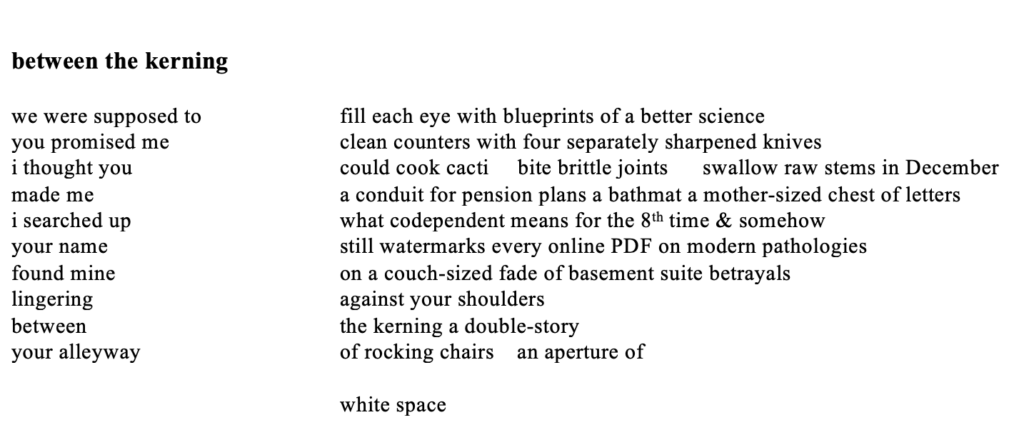
In a double exposure, Jane is shown before a white wall and a wooden bookshelf. Jane has black hair with cut bangs, that otherwise falls about the chin, and light skin. Jane wears a half-sleeved black v-neck blouse or dress, and hornrim eyeglasses. Jane is seated, and holds half of a large reddish orange citrus fruit, or pomegranate.

Jane Shi is a queer Chinese settler living on the unceded, traditional, and ancestral homelands of the Musqueam, Squamish, and Tsleil-Waututh peoples. Her writing has appeared in Briarpatch, Canthius, Plenitude, and Arc, among others. Her other accolades include being called aggressive, a Spoiled Brat, a no xiaojie, and “someone who should dress like her intellect.” Clinicians have applied Freud to her bisexual sitting habits to disastrous results. Someone once said she has BPD and should get help. Someone else asked her to google how to assert boundaries. She made up her own search engine which told her she’s autistic, instead. She wants to live in a world where love is not a limited resource, land is not mined, hearts are not filched, and bodies are not violated.


 BACK TO ISSUE

 BACK TO FOLIO

Jocelyn Patten

Lonely Diagnosis

And if my allowing myself to be brought here confuses you, if you think for one minute that I am singing one song and dancing to another, then you have not been following along. Stick to the facts. That’s what I have to tell everybody. They are clear and crisp and lay cold and unblinking on the snow banks that lined the drive here. I press my nose to the glass and nod at each, and as they pass they slip under the car and up into the backseat and down my stomach. I feel them still; they have not melted, despite the heat in this room. There are hundreds of them, and they tell the story of what has happened to me, what was done to me in the beginning, what must be stopped. I will open my mouth round and wide, and each fact will come slipping out, only to attach itself to the blank wall that faces our chairs; there they will remain hard and sharp and be beautiful and powerful and all-knowing. And all I will have to do is point and say, here, here is all that you need to know. Here is where my doctor refuses to look, and here is what my mother does not accept. But you can see it, I know you can, and you can understand what the truth is. You can stick to the facts. You will recognize the danger I am in, and order that I be removed outside the city limits, far from the grey grip of the pill-pushing death angels. Gone, wiped off their video screens, the metal disc in my brain growing weaker and weaker with every moment. Come spring, it will be mere dust, and one morning I will stand up and sneeze, and it will all be gone. 

Jocelyn Patten lives and writes in Ottawa.  


 BACK TO ISSUE

 BACK TO FOLIO

Pamela K. Santos

Coconuts, Done Threeway

.isa.

one     time     my filipino ex      ordered
this dvd      in the mail you      know      back
when porn      had more      steps you      know      catalogs
&      shipping times      starring      this brown af
gorgeous      pinay      her name      long forgotten
playing      a maid      with the      other      hot brown
maids on      their knees      brown knees & asses &
yt men      & that      brown on yt on brown on
yt      again & again      are what      comes      to
mind when      i hear      people      called coconuts

..dalawa..

Sometimes (not often) I wonder if I
am just an impersonation of an
impersonation. Nanay wasn’t born
in the Philippines and neither was I.
She cooks food off of tutorials on
YouTube, IGTV, and Facebook groups.
Murmurs Taglish curses under her breath.
She calls me Anak. I pick up her words
like fallen coconuts and when no one’s
around, I crack them open—what a waste!
They are dry inside, husks double-sided.
No wonder I feel hunger late at night.

..dalawa.. [extra credit po]

Minsan (hindi madalas) ako’y nagtataka kung ako
ay isang lamang pagpapanggap ng isang
nagpapanggap. Hindi ipinanganak si Nanay
sa Pilipinas at hindi rin ako.
Nagluluto siya ng pagkain galing sa mga tutorial sa
YouTube, IGTV, at mga Facebook grupo.
Nagmumura ng mga pabulong sa Taglish.
Tinatawag niya akong Anak. Dinampot ko yung natak niyang salita
na parang mga niyog lang na nahulog at kapag walang sinuman
sa paligid, biniyak ‘kong bukas—SAYANG!
Tuyong tuyo na sila, mga bunot ng niyog na magkabilang panig, sa loob at labas.
Aba, kaya nanatiling gutom at walang laman ang sikmura ko buong gabi.

…tatlo…

// There was this dream I had / that I was an
Old West gunfighter / and somehow I knew
my name was Manila / Mae and maybe
I had just / read Pretty Deadly / where ghosts
are more deadly than people / but people
keep you alive / after they cut pieces
of / you so maybe let’s not judge / and back
to my dream I was /decked out in a mad
hot braid / under a bad guy hat you / know
the ones for bad / dudes or anti-heroes
or /reluctant revenge-seekers / or like
moral relativists / or villains with
a conscience / or repentant killers / or
redemption hunters It was / a black hat

and so like I / had enough guns to weigh
down my belt Violence is heavy / even
in packaged form The /Manila Mae me
was like / standing in a crowded / what do
they call it / thoroughfare /no wait / more like
an empty except for the dust / winds kind
of vast flat desert /no one there but me
black-hatted / iron-heavy / soul-weary
Manila Mae me / in Cinerama
widescreen 70 mm frame
looking out / over / the America
that hated / Brown skin / in spite of an / un/
forgiving sun / exposing / every / shadow / in the
West /

….tapos na….

“We say we are Filipino; we say we are American, so, who are we,
more so, what are we; brown or white; or are we still “other”?

— From “ Ang Kundiman ng mga Niyog sa Amerika: The Lament of Seven
Hundred Seventy-Four Thousand Six Hundred and Forty Coconuts” by Fred
Cordova, in a book you have to know (which is to say you can’t stumble across it)
to find it in a library or a bookstore called “Filipinos, Forgotten Asian Americans”


Pamela K. Santos is a Pinayorker writer and artist-scholar working with multilingual materials and archival embodiment. Pamela has received support from the Sustainable Arts Foundation, Oregon Literary Fellowship, Caldera Arts, Mineral School, and Regional Arts & Culture Council, among others. Her poetry appears in Cultural WeeklyAnomalyStoked Words, Tayo Magazine, and elsewhere. She is working on her debut collection Secret Lumpia.


 BACK TO ISSUE

 BACK TO FOLIO

Jason Overby

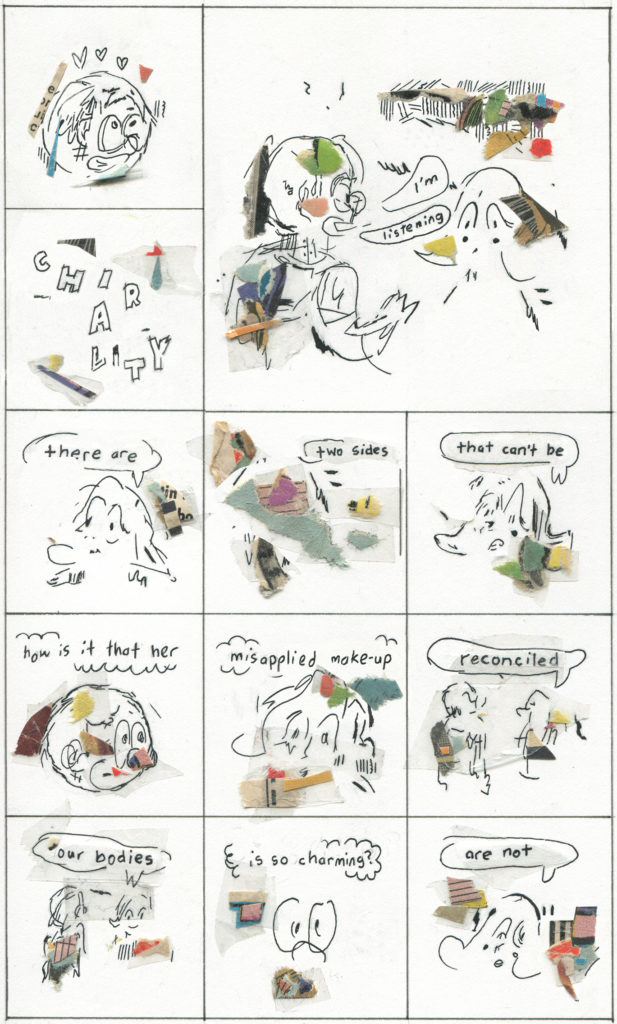
Chirality


A photo of a white man with a long beard and long hair. He appears to be getting a haircut, though the photo is ambiguous. A photo can be seen over his left shoulder, resembling Burt Reynolds.

Jason Overby lives in Portland, OR with his wife and two children. He has self-published a variety of mini-comics, including JessicaSolipsist’s Doodles, and Obligatory Artifact. His strip Apophenia appeared in Abstract Comics: The AnthologyThe Being Being, a book collecting some of this work, was published in 2015 by Gridlords. You can view many of this work at jasonoverby.art. He is currently finishing up a new work, which will be called The O.C.


 BACK TO ISSUE

 BACK TO FOLIO

Tana Oshima

Pangea (An XXL comic)


1. i am a single-celled diaspora, a marine sponge. i am an exile born with no nest or noise and when i sing i howl like an Australopithecus

(i am a balloon
attached to a string
attached to a corner
attached to a past
that lies to me
gently)

2. from the bottom of the cave, my mouth open, my feet dancing on an earth that is still whole. i am pangea, a diaspora contained in an amphora in the singular form, a single body that swells into the intemporal, a sponge, strip away the salt, the waves trick me with their disparate tongues, their laughter in a haze: foam

3. my wandering is anchored in the ethereal language, architect of the future, raw, pure structure with no roots or clothing

4. i have the power to open all doors
(but never my cave)


A photo of a Japanese-Spanish woman wearing a yellow knit cap and a black shirt with a yellow shell. Part of her comic is displayed above her, as she occupies the bottom left-hand corner of the photo.

Tana Oshima is a Japanese-Spanish writer, literary translator and visual artist exploring the field of comics. She has self-published eight mini-comics, and has translated to Spanish female novelists from Japan, such as Yuko Tsushima, Hiroko Oyamada, and Yu Miri. She is based in New York. cargocollective.com/tanaoshima_art. Instagram: @tanaoshima.


 BACK TO ISSUE

 BACK TO FOLIO

Rosaire Appel

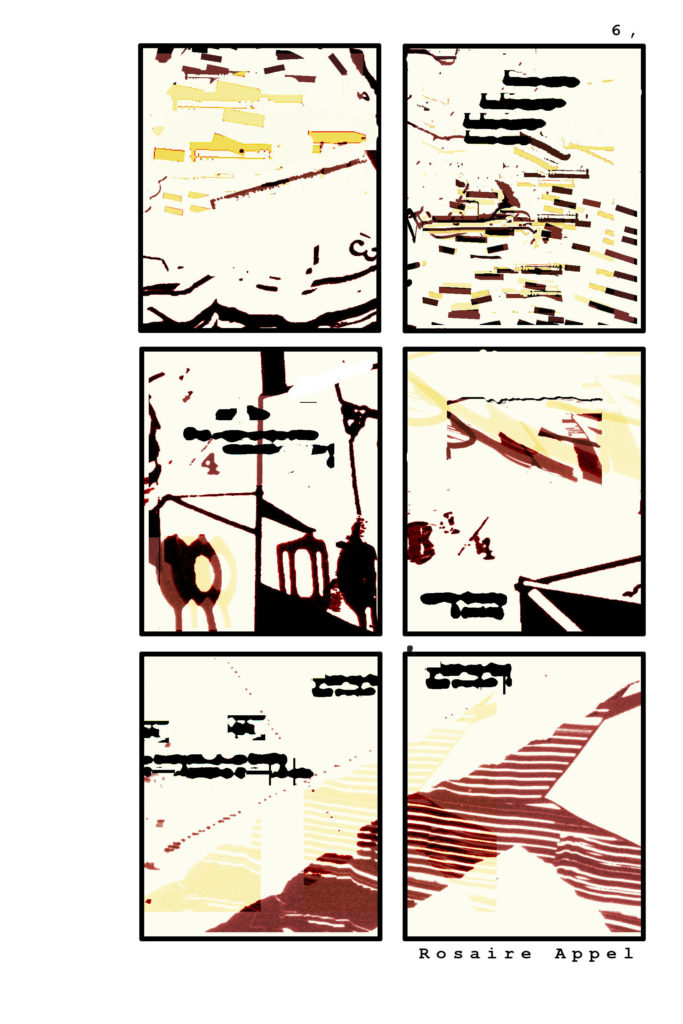
Out There


Rosaire Appel (New York) is an artist exploring interconnections among reading, looking and listening. She draws writing, sound and abstract comics. She has created many kinds of visual books, both limited editions and commercially published. Her most recent book is “Corona Panic Score”, created with ink on vintage music paper. Her sound drawings have been exhibited widely. She posts regularly on facebook and Instagram. Her website is www.rosaireappel.com.


 BACK TO ISSUE

 BACK TO FOLIO

Sabyasachi Nag

Pumpkin Flowers

Visma Sen was short, dark, and sported a grey walrus moustache. He was sixty-five. Every now and often his heart would fire up without warning, he would wheeze and choke, swing his hairy arms, and gasp for air. He would feel sweat breaking out along the deep lines on his neck, trickling down his spine. The conch of his ear would crackle with heat and his earlobes would turn red. He would sense a shiver running through his head, face, and then his entire body. His eyes would draw down as if some invisible force were calling the curtains on him. That’s it, he would think, and just as suddenly the shivering would stop. Everything would return to normal.

Almost twenty years ago when the symptoms first showed, his wife Nila insisted they see a doctor. After a short commission in the Indian Army he was still settling into big city. Gomes, a quick-tempered Methodist in his early sixties, was the only doctor they knew in Calcutta. The doctor had a large forehead, listened impatiently, wrote lengthy prescriptions, and was quick on wit. 

“No coffee, no smokes, no booze. Cut the small sins out, if you want to make room for large ones,” he said. They would laugh at his wisecracks and all would be forgotten until the symptoms returned. 

Lately, with Nila dead, whenever his heart added an extra beat, Visma would drag himself to the dresser, pull out an old aluminium medicine box and chew down a couple of aspirins. Later he would talk himself back to his feet. But last night was different.

Last night Visma hadn’t slept at all and they weren’t the regular symptoms. It was late February. In North Calcutta where winters have become shorter each year, fans had started to purr from the high ceilings. The key-wound wall-clock had yet to strike five. Outside, the sky was lit up in patches, as the sun broke through unevenly gathered clouds. The crows were out, cawing. For a moment Visma sat at the edge of the bed; in two minds—whether to get started on his two-mile walk to the park or let it go. 

His knees were sore. He could hear the stray dogs out on the street. They had barked all night as if something terrible was happening to them as everyone slept. He felt the walls around him closing in. As the barks got louder, he thought of the walking stick he had taken to the cobblers to have a piece of leather nailed to the bottom. He hated the loud metallic sound it made when striking concrete. He couldn’t have the stick back until later today, he was told. There was nothing else, and he needed something, walking these streets this early in the day. The strays scared him. More than that, he needed something for his knees to stay straight. He thought of the umbrella.

The dogs shut up after a while. He could feel his heart slamming into his chest and then slowing down. He wasn’t sure if the pounding and fluttering would get any worse. It wasn’t the usual kind of racing. Perhaps he should give it a pass today. The two mile walk to the park might be too much for him to take. 

Tomorrow, he spoke out loud as if announcing his intention to someone out in the balcony past the closed rooms down the hallway. But there was no one. 

Sensing a tug on his bladder, he clambered out of bed and rushed to the bathroom. Back by the window on the south end of the room, he felt a chill touching his bare chest. He switched off the fan and slid back under the wool blanket his daughter had gotten him from Madrid when she came visiting last summer with Enrique, her Spanish husband, and Leo, their six-year-old child who didn’t say a word during their entire visit. 

For a while he thought about them and how it might be different living in Madrid. Then he thought about dying, and how he always believed he would know exactly when he was going to go. Nothing worse than being taken hostage, he thought, more so if you don’t know where the enemy is taking you. 

Visma took a drink of water and looked at the stack of books on the bedside table—Brothers Karamazov turned to Ivan Fyodorovich’s Nightmare. One thought led to another and in his drowsiness, he couldn’t make out thought from dream. 

He may have slept a little before he started up, worrying about the pumpkin flowers in the fridge. He had wrapped and sealed them last night. Would they last another day? Would the scents stay the same? Would the edges crimple? Would they freckle up? He could always get a new bunch, he thought. He knew where to find them. But flowers up in the bazaar weren’t the same as these, he thought. He felt proud—how bright they were and how big. He thought about his son and how persistently he had to pester him to have those pumpkin seeds sent from that farm in Cameron that grew those huge pumpkins he had seen on TV. He thought of the ugly spat he had with the couriers when the package was returned undelivered, and they couldn’t locate it for a few days. His son never called him back to find out if those seeds had ever reached him, or if they were any good. But that had been six months back, or almost. 

He kicked himself out of the bed. On his feet he felt better. He was going to go. He had no choice.

Do it, he said out loud to himself before going about a series of breathing rituals he had cultivated into a pre-dawn program since his time in the army. The habit had stayed long after the seven years of commission and then the thirty years of teaching high school history and then the four years into his retirement, before his wife died. She had suffered a cerebral stroke in the shower. He wasn’t home when it happened. He knew he could have saved her life had he paid more attention to what she kept saying about the throbbing ache in her head during her final days.

They had been married thirty-five years. At first, he didn’t understand if anything would be same again. For days he shut himself up, afraid of questions. Then he felt numb, as if he were recovering from an operation after an organ had been removed. He felt no desire to do anything. He rarely stepped out of home. He barely ate. His breathing got worse. That had been the summer last year when his daughter came home with her family and nursed him back. 

When it was time for her to leave, he didn’t stay up to say goodbye. There were a million strings pulling her away to Madrid: her son’s school, the job at the university, her husband’s business, the dog in their friend’s nursery. He became bitter the instant their taxi turned the corner toward the airport. Anyone with a good ear and spare time became the object of endless whining about how everything was stacking up for an imminent apocalypse. The sky was about to fall, and it would take everyone with it.

Pessimism is that peculiar worm that inhabits our entire clan,” his son had said over the phone one day, “first it takes your intestine, then it takes your brain.” Visma hung up and stopped calling him. He decided he would sell the house, move back to the country, take back to farming in the family acreage they had been leasing out for a quarter century, ever since his own father passed. 

He needn’t have thought out loud before a stream of realtors came calling upon him with countless proposals that would take minimum effort, yielding maximum profit. “It’s crazy being alone in this house of horrors,” one of them said. “Ask your children. See for yourself if they have anything different to say.” 

Those words struck Visma like a rapier on the face. The realtor, a bald man in his thirties, was smoking between bursts of fake laughter, his teeth almost brown, he had a paunch—the kind that would make you wonder if it wasn’t a half-trainer-ball that he had strapped to his belly. Visma sensed something click inside his head—the sound of a gun slider going back and forth. He rose from his chair with a start, without uttering another word, held the realtor by the sleeve of his white voile shirt and dragged him out the front door.

Between the laboured whistling of nostrils, Visma’s mind wandered over to that instant when he had slammed the door on that realtor. Could that be the apocalypse? He remembered how everything else unravelled after that, here in this same house. 

Everything he had, the burden of all his possessions, all that he had been so desperate to shake off a moment earlier, every piece of that life lived, became history and immeasurably precious. He decided he would restore the century-old ruin of the house back to its glory. That would be the blow on the heads of those waiting for him, like vultures, to wrap up and be gone. 

Soon he would find an accomplice in Rahim Ali, the do-it-all handy-man and his young apprentice bride. With their help, he would set about the task of recovery and revival—straightening out the plumbing and the wiring; fixing the floors and ceilings and stairways; painting the walls and doors and hallways. So obsessed he would become with the idea of restoration; he wanted it to never end. 

When Rahim Ali and his wife left, he pulled out whatever knick-knackery his eyes could find buried inside trunks and boxes, drawers, cabinets, and closets—spoons and mugs, seals and flags, trinkets, quilts and photo frames—from way past and near past. He found them and mounted them to the walls, each one at a time. Almost three thousand feet of wall space, spanning three floors in the entire house, all of that turned into a canvas, until all history was exhausted. 

By then Visma Sen, restored to his pristine version, had already found Ju Li, the Chinese Tai Chi teacher at the park. Those pumpkin flowers had been her bidding. Ever since he showed her one, she would always gesture as if to ask if he had any more. He had no idea why she wanted them or what she would do with them. The only thing he could ever think was making frits out of them to eat. He wasn’t sure if Ju Li knew how to make pumpkin-flower frits the way his mother did. Nila had never learnt to do it right; she would always sear them and they would be too crunchy and bitter for his taste.

At the park, her cohorts talked about Ju Li the same way anyone would talk about a red lacewing on a white wall. Widow of a wealthy shoemaker, long gone, she was about four feet and a few inches. About fifty, the bright skin on her round face had darkened around the raised cheeks. Her cheeks and the hair on her nape glowed from the sweat she worked up every morning. The few strands of white on her neatly brushed black hair flew about her face as she walked around the park, nodding at anyone that came close or crossed her path. She had an easy manner about her. To those that didn’t know her well, it was as if she had put on a mask to hide the shadowy dark around her feet. She always had red shoes on. She spoke in Hakka to the fellow Chinese that trained at the park. To Visma’s ear, the rounded vowels sounded magical. 

When he heard her speak, he thought of her in a different way—as though he were listening to a trapped river lap against real sand under a fluorescent sky, as in a photo studio. It didn’t feel real. Yet, Visma thought about her a lot after he left the park. In the park, he was drawn to her by a power beyond any he had known—the power of a temple bell—elemental and unshakeable. Watching the precise movements of her hands and enacting after her—behind closed eyes, under the rising sun—seemed to Visma an act of revival, something that gave strength to a lot of things he had stopped caring about. 

When Ju Li’s husband died in a road accident, Visma heard people in the park say all sorts of things. It’s a rough trade; she’s the outsider they would never let in; she should sell everything when it’s still worth something; leave. But then, the same folks said, she should perhaps hang on. 

When Visma observed her hands—past the perfectly shaped fingers, past the papery skin glowing in sweat, past the precise arc of her movements—he could see a wire-mesh casting holding her in place and yet giving her freedom. It added up to something precious—he knew it was precious—the way he felt, watching her. He felt funny thinking about that, but a tinge of sadness too would cross his mind, thinking about all the rumours about her.

They said she was the kind for whom, when it came to matters of business, no person could ever be too close and no price too dear. Visma wasn’t sure. That she had not merely survived the trade, but succeeded, single-handedly, managing to keep her husband’s Bentick Street shoe store still going —what does that say? they would ask. Visma thought they were plain jealous. In a world where men make all the difference, that she was able to hold on to the same cohort of trusted shoe crafters her husband had gathered, spoke of powers beyond the obvious. “Witchcraft,” they would say, and hold on to their bellies laughing. “But demand for hand-made shoes is no longer the same,” they would add and nod gravely. 

When income from the shoe business dried out, it seems Ju Li started cooking and selling Hakka ramen in the tiny room at the back of the shoe store. So, they said. Visma wasn’t interested. Still, they would tell him about the smells from her kitchen gathering speed, about word going around that Ju Li would sell the shoe business, about the doom impending. Her people, the same band of trusted artisans, are leaving her one at a time, they’d say and look into Visma’s eyes, expecting fear or praise at the fulfilment of a dark prophesy. At the very end, it would be just her, they’d say. Just her and dirty cases filled with unsold shoes; just her and a kitchen running hard to keep up with orders ringing through the phones all hours of day. 

Inside the fridge, the plastic bag containing the flowers had sweated overnight. Visma took the flowers out, one at a time, laid them out to dry and placed them inside a pink hemp sack. 

The crossing at Onrait Second by the butcher shop is worst for the strays, he thought. It was the meat shavings around the open vat. What dog would let that go?

Visma’s mind raced, as he looked for the umbrella to take with him on the walk. It raced as he stepped down the three flights of stairs, out his house, onto the street. Today he would use a different approach, he thought: past Onrait First and Best Cycle. 

The morning was chillier than the day before. It wasn’t much later than usual, but he felt the need to walk faster. He felt his knees were slowing him down, or maybe it was the brand-new walkers his daughter bought him. They felt heavier. He could feel a tug on the chest right in the middle of the thought, almost losing balance. He didn’t know when he would see her again or Leo, the grandson who never spoke. Or for that matter, his own son who never called back. 

The desire to see his children ached with the knee and he could make out one from the other only at certain intervals. A milkman biked past. There was still some distance to the park. It sure did feel chilly today, he thought. It was then that he looked up and saw the sky was overcast. He hadn’t followed the weather lately. Perhaps there was rain in the forecast, perhaps they were just passing clouds that the winds would eventually snuff out. 

Back in the park, Ju Li had already started her Tai Chi practice with the usual band of cohort—Hong, Chang, Hao, Liang, Mitra, Lawrence, Rupert, Fu. They all hung around her in a circular formation. He knew them all by the half names, just as they knew him as Sen. He pierced the circle and went straight to Ju Li with the package dangling from his left hand, umbrella on the right. Without ever pausing, without letting his eyes rise to meet hers, he transferred the pink sack automatically on to his right hand—the hand of good deeds—before holding it out towards her. 

She seemed startled. 

“Pumpkin flowers for you”, he said. 

Her face broke into a smile at the manner Visma held the sack out for her, as if it were a bag of lost treasure being restored to its rightful owner. 

As Visma looked up, he saw Ju Li’s rippled face. Untying the knot on the hemp sack with utmost care, she held it close to her chest. Dipping her right hand inside the sack, as if it were the dark, open mouth of a well, she brought a handful of bright yellow pumpkin flowers out in the open. Now holding them close to her face, she let the petals stroke her cheeks. Taking a deep breath, she looked up at the sky past Visma’s eyes. Visma could feel his ears getting warm; he could feel his heart had started to race again.

Some of Ju Li’s cohorts looked on, politely reining in the irritation at what they thought was much fuss over something quite commonplace. Others, who had never in their lives seen pumpkin flowers so huge, drew close to Ju Li, deeply inhaling the scent of the flowers right off her open palm. 

Eventually, everyone returned to their respective places in the circle around Ju Li and she dropped the flowers back inside the sack. Visma took his place on the fringe of the circle, looking up at Ju Li as she dipped into the sack again, taking the bright yellow flowers out by the handful, holding them close to her face, she put them back again, but not before taking a deep whiff and looking out to the sky. 

She repeated the sequence again and again as if she had enough Tai Chi for the day, as if she were in trance. And when the huge fig tree under which they stood seemed to swoop down at her feet and the skies shimmied with thunder, her trance remained unbroken. 

They smell just as good as they feel she seemed to say, gesturing with her hands. 

Her cohorts laughed. And they laughed even more as she repeated the act, as if relishing the power of her gestures. Then the clouds broke and it started to rain.

Visma came up close to Ju Li. He looked at her in amazement, perhaps even the kind of prurient joy one feels upon achieving consummation in the act of giving. She gestured at his umbrella, and without a word, he flipped it open. Holding on to the sack of flowers in her left hand and Visma’s arm with her right, she egged him on, toward the gates on the south end of the park. Fully aware that his usual approach back home was toward the north, Visma let himself flow freely to the soft tug of Ju Li’s wet arm. They kept strangely silent all this time as they walked, as if she were still caught up in trance and he, fully conscious, was only too careful not to nudge her out of it. 

Weaving in and out of blinkered lanes he barely knew, Visma soon found himself at the doorway of a brick house with a wood archway painted gold. The street sign, craggy with dirt and bird shit, pointed toward Kimber Street. Visma felt numb. The doorway to Ju Li’s two storey house was so narrow he had to fold the umbrella in order to squeeze through. 

Still holding him by the arm, Ju Li pulled him through the dark hallway on the ground floor. As he walked, he could hear the sound of heavy breathing. People were still seeping in rooms lining the passageway. Someone had put tea on the boil; he could hear the kettle murmur. Past the stack of shoe boxes, past the heap of raw hides, past the mound of old bills, Ju Li strode unmindfully toward the red cement stairway to the north of the house. 

The narrow landing at the top of the stairway spread out into a whitewashed corridor that ran the entire length of the second floor. Facing the landing was a room with a bright red door and a grilled window. Behind the black iron grillwork of the window the room was dark. Toward the far left on the corridor where Visma stood, he could see a house help mopping the floor with precise movements of hand and feet. The house help looked startled as Ju Li, facing the closed door, paused for a moment, as if to catch her breath. 

Still holding on to Visma’s arm, Ju Li pushed the red doors open with a delicate foot tap. Visma noticed the doors had been pulled shut, not bolted and locked like he always remembered doing in his own house when he had to leave it to the house help even for a few minutes. 

As he stumbled on the raised saddle of the doorframe, into the darkness of the room, yielding to the tug of Ju Li’s soft hand around his extended arm, Visma paused for a moment, trying to interrupt the flow, to make sense of whatever was happening to him, whatever he thought might follow. 

Familiar objects around the room sprung out of their contours; the bed by a second window far up on the left toward the balcony facing the street outside, a work table on the right, shelves of books with gold letterings, blue and white porcelain, a wardrobe with a red raincoat and embroidered purple boxes stacked on top of each other. 

The chequered morning slimed in through the window slats and lined up on the blood-red bed sheet neatly tucked into the mahogany bed frame. Everything in the room, even ashes from burnt incense sticks, seemed to have a form, a place of its own. In the far-right of the room, toward the balcony, away from the second window, a stone Buddha sat demurely under a red electric lamp inside a carved wood shrine hung up on the wall. A raw sapodilla and a coconut sat inside a wicker basket at Buddha’s folded feet as if set up to ripen in the light. 

Visma looked around the room. Tiny Buddha idols in all shapes and sizes, in wood, brass and china, looked back at him in every imaginable posture.

It was hard making things out in the dark, but Ju Li didn’t put the lights on. Instead, she strode through the breadth of the room, sat Visma on the bed, closer to the window on the far side, and pushed the window out into the balcony. 

The damp morning sun came rushing in. Blue gnomes and angels stared back at him from the balcony between rows upon rows of bonsai banyans, mango and figs and jacaranda, bell, bougainvillea, hibiscus, dahlia and rose-lily. Tiny drops of rain hung from the branches like glass beads. 

Visma looked around for Ju Li. She had been by his side a moment ago, looking out the window. Now, she was back dipping her right hand inside the pink hemp sack again and again. Taking handful of flowers out of the sack, she was letting them fall in a brilliant shower near the folded feet of the stone Buddha inside the shrine. 

Visma felt a tug on his arm. As he turned around, he could see Ju Li holding out the hemp sack towards him, her moist eyes gesturing for him to repeat the act. 

Outside, it had long stopped raining, but the sky was still overcast. The iron grillwork was shining as though it had just got a fresh coat of paint sprayed on to it. He felt he had come a long way to find this place. He was uncertain he would ever be able to trace his way back home.


A black-and-white photo of an Indian man in dark glasses with a close-cropped beard, looking into the camera.

Sabyasachi Nag is the author of Uncharted (Mansfield Press, 2021). He was born in Calcutta, India, and is the author of two previous collections of poetry, Could You Please, Please, Stop Singing (Mosaic Press, 2015) and Bloodlines (Writers Workshop, 2006). His work can be found in Canadian Literature, Grain, The Antigonish Review, The Dalhousie Review, and The Windsor Review, among others. He is a graduate of the Writer’s Studio at Simon Fraser University and the Humber School for Writers. He lives in Mississauga, Ontario, with his wife and son.


 

 BACK TO ISSUE
 BACK TO FOLIO

Coda Danu-Asmara

A Fair Trade

Ah, Hadassah, you treat me so well. 


There are ten thousand, eight hundred and fifty-three parrots in Madrid. They came here because immigration was not properly regulated at the North African border. It is said that they have taken the majority of manufacturing jobs and deflowered the women. In response, the Spanish government has built a wall around Ceuta and Melilla. The parrot migration has ceased since then, as birds are known to respect land boundaries. 

Essay questions: 

1. Using the historical documents provided, please outline a system of inquisition best suited to differentiate parrots from non-parrots. 

2. Name three other events/invasive species/problems (not including the parrots) that necessitate the beginnings of a second Reconquista. Use descriptive language in your answer.

3. If the sterilization/mass annihilation of the parrots is to come in effect as proposed by the current Spanish government, there is a distinct possibility that one of the parrots may be a master poet of the Spanish language. Draft an apology memo to the public, being sure to highlight his or her achievements in a non-political manner.

{The answers have faded away; only the shadow of a few pencil scratches remains.}


I clutched the yellowing papers to my chest as I entered her room. I have seen her every weekend for years now. She lived at the end of every Metro line in every city, that special stop after every single passenger is gone, behind a door made from multi-colored glass on that empty platform. You won’t be able to find it if you’re not in the know—just rats and old plastic bags. You need to be referred. That’s how everybody meets her. I’d be happy to refer you too, if you like. 

But I wouldn’t recommend it.

Hadassah was a never changing being. In every session we had together, she sat silently, veiled in the quiet shadows, with only her long grey-green beak protruding from the darkness. At regular intervals it opened, slowly, almost imperceptibly. I had always assumed it was a mask, but now I’m not so sure. I sat across from her, on a chair made from a thousand insect legs. The beak nodded, and I told a story about myself. It always began like this.


{There is a photograph of a young couple, smiling on their wedding day. They, two women, are standing on a white veranda, and the rain is pouring down behind them in lucky droplets. In the background, vultures have begun to feast on the guests behind them, leaving a line of sinew and entrails around the newlyweds. According to a small news clipping stapled to the picture, marriage lasted for thirty-three days, before it came to light that they were both already married to each other’s fathers. On the back is a note written in red pen, detailing the above story, and also the words:}

Lot’s Daughters, before honeymoon. Boston.


When I first started going, I thought it would be hard to tell stories without any prompt, without any reason. My even voice shook when I first started talking about myself. It wasn’t even complicated stuff; just the usual—my name, parents’ names, place of birth, number of known siblings, medical history—all that common knowledge. I dipped a little bit into my childhood—focusing on the traumas, of course. I considered it all banal, but apparently it was enough—from somewhere within her unknowable cloak, she gave me that photograph. A story for a story. A fair trade. 

After I left, the door disappeared behind me. I somehow knew I was expected next week. 


FORECAST: 57 degrees is the high, with light showers expected in the evening. Thirty-five people will die in the city today, including Ms. Elena Castor, who will be beaten to death on the corner of Oak and Elm Streets at 11:56 PM. At least twenty people will witness her death-in-progress and make no attempts to help her. If you do not have other engagements, it would therefore be prudent to attend so that the required quota is reached. 

{A black-and-white picture of the woman is included. She looks happy.}


I constantly studied that wedding photograph in my free time, to the point that I even accidentally tore its corner from overuse. I couldn’t find any trace of the women in the photograph, or any record of any such wedding in any Boston, Massachusetts or otherwise. After receiving a few more, I came to conclusion that they were all some sort of experimental art project—complete fiction. Much later, I would realize that they were all true, as every story that has been told is somehow true; if not here, then in another world, another lifetime, or another existence of essence. 

In the next session, I told her another story, this time about a few fears and anxieties. Nothing too special—I wasn’t yet comfortable giving everything away—but I told her that I was afraid of shaking other people’s hands because their skin felt so coarse against mine. The beak nodded and nodded, even during my retelling of a nightmare I once had about falling in love with an ocean sunfish, who ended up being a poor bedmate. “Did I do well?” I suddenly asked. She responded only by giving me another story and motioned for me to leave.


{This story is a large full-color poster. A glossy picture of two men staring deeply into each other’s eyes takes up the majority of the picture. Their left hands are intertwined; their green-and-brown shirts slightly askew. Their bronze skin twinkles in the desert sunset. Behind them, Iraqi insurgents are being shot by a mounted machine gun. Their bloodstained turbans and beards look almost comical. A drone is frozen in flight overhead; its rotary blades still exude movement in the stillness. In its windy wake, the American flag flaps proudly. 

At the bottom of the poster are several words in large block letters.}

MAKE LOVE AND WAR
U.S. ARMY
ENLIST TODAY


I kept every story in a cabinet under my desk. Every night, I checked to make sure each and every one was in pristine condition. Realizing how precious they were, I memorized every story, but I began to mix them up with reality in my head. I confused friends when I talked about last year’s moon landing or the political viability of lizard men in American politics. But they shrugged it off; we were all artists, and they probably just assumed I was on one of those traditional artists’ drugs, like weed, or LSD, or unemployment. 

I tried to go more than once a week. I asked Hadassah if we could meet more frequently, but unsurprisingly, my question received no response, only that little paper story about the Army. 

I resolved simply to ride the line a few days before my scheduled appointment, but when I arrived, I could not find the door in the dusty dark subway stop. I tried again, riding a different train to the end of a different line, and found much the same. I called out her name three times, “Hadassah, Hadassah, Hadassah,” but it might as well have been the crowing of a rooster. I shamefully took the train all the way back, every stop a reminder of my impatience and my failure. 

From that experience, I sank into a deep depression for several days. Although I knew that I would see her again soon, being unable to have her whenever I wanted made me feel so hopeless and so powerless. I refused all food, save for a bit of lentil soup in the evenings, and called in sick to work every day. I must have sounded so terrible on the phone, because nobody questioned it—they always sounded so concerned when they told me to “Get well soon!” 

Lying in bed, doing nothing but rereading the stories, I dreaded the day of my appointment. What if I was too unwell to tell a story about myself? What would Hadassah say? Would she not give me a story at all? I thought about not going back. In fact, I decided, I should never go back at all. It was doing me harm, ruining my social life, making me worry and obsess, and befuddling my brain. Better to be done with the whole affair.

Yet on the day itself, I rose from under the covers and found myself on the subway again, sweating in the heat as a man played a pop song on the bongos for money. And when I was face to beak with her again, all my troubles and my stories just started spilling out. In the end, my worries were unfounded; she gave me a story before I left. 


DOCTOR’S NOTE

To Whom It May Concern:

I am writing to inform you that Ms. Tan should be excused from work today. She is feeling quite unwell for a variety of personal and embarrassing reasons, such as armpit boils and excessive flatulence, and it would be prudent to not bring them up when she returns to the office tomorrow. Furthermore, she has informed me not to disclose that she has been suffering from bouts of depression due to self-image problems and the isolation of an immigrant lifestyle; therefore, loudly screeching ‘Chino, Chino’ as she walks into the office every morning is unhelpful for her condition, especially since she is Indonesian—I would instead recommend ‘Gook,’ even if it more usually refers to Vietnamese and Korean people.

I have included my personal number at the bottom of the letter if you need to urgently contact me for any more of her confidential medical history.

Sincerely yours,

{The signature is illegible}


After about six months of seeing Hadassah, it somehow got out that I was one of hers. I’m not sure who told on me. It could have been the friend who referred me, or perhaps somebody saw me on the train, or perhaps, although unlikely, Hadassah herself. 

My friends were the first to learn. Over a game of cards in a run-down gay bar somewhere in the Village, one turned to me and said, “How’s the old bird?” 

“Who?” I replied, forcing down a draft of beer I only ordered due to peer pressure. 

“Hadassah, of course. I’ve heard you’ve been seeing her.” 

I opened my mouth to reply but he did not give me a chance. 

“Oh, don’t worry, we won’t think any less of you. We’ll treat you exactly the same as we always did.”

After that night, they stopped returning my texts. I never saw them again. 

I started getting more and more time off from work without asking for it. At first, I liked it—who wouldn’t, working as a pencil pusher? But soon it started to grow excessive. I became restless and bored. 

“Oh no, you don’t need to come in today,” my supervisor said on the phone. “Really, there’s not much work. Stay at home! You need the rest! You have a big meeting with her coming up!” 

I came in anyway. When I arrived, I found that my possessions had been thrown into the trash. Somebody I didn’t recognize was sitting at my desk, typing away at my ancient computer. 

“Don’t worry,” my boss laughed, “we’re just doing a bit of reshuffling to improve team synergy. You can work from here in the meantime.” She was pointing at the broom closet.

I raged when I saw Hadassah again. I shouted and shouted at her, over and over, at her placid, rostrate face. Pacing around the room, I called her a traitor and a life-ruiner. She did not move until I had finished my rant, upon which she gave me another document and bid me goodbye. 

On the subway home my head was heavy with tears. 

The next day, I tried to find somebody else to blame. My friend, the one who introduced me to Hadassah, picked up his phone on the fourth call. He refused to discuss her, no matter how much I asked. Eventually, I tried a new approach. “Do you know anyone else who has met her? Somebody must have introduced you to her,” I asked, my voice ragged and hoarse. 

“I try not to associate with others,” he replied. “I like to keep it a secret. I thought you would too.” 

“I have to talk to somebody else about it. I want to feel normal again,” I said, again and again, until he relented. 

“I was introduced to her by a group that meets behind the Reservoir. They are all her customers, or patients, or whatever you’d like to call it.” He paused before continuing. “I have to say, I’m very disappointed in you. I thought there was something special about you, but I suppose not.” He hung up the phone before I could say goodbye.

They met just before midnight, like all secret societies. I could easily spot them from the general homeless and drunkard population due to the bird masks and black cloaks they wore. The clothing was a cheap imitation of her majesty, but I respected the attempt. They sat around a small tree, without making any noise. At first, I thought they were playing some sort of strange schoolyard hand game—but as I approached, I realized they were exchanging tiny pieces of paper. 

I sat down in the middle of the group. They did not stop me. One handed me a story, wrinkled and worn. I unfolded it:


{It was an X-ray, depicting the mouth. In yellow pen, someone had circled the various oddities. Notes in hurried handwriting appear on the back.}

● The subject came complaining of tooth pain.
● Upon examination, it became clear that the subject appears to have only molars. Not only that, the subject also has three rows of those molars, like a herbivorous shark. 
● Every tooth has had a mark carved deeply onto the enamel. Each row had a single different mark, repeated on every tooth in that row. Being doctors of a certain stock, we quickly identified them as three Hebrew letters. From back to front, the symbols appear to be as follows: אמת. 
● Even more strangely, the subject flosses regularly.
● All these signs point to intervention of the Divine, and that this was His messenger.
● We treated him with appropriate reverence, by plunging the drill into his head while he was sedated with nitrous oxide. As expected, his body collapsed into mud postmortem. Not a single tooth could be saved for future study. 
● I have advised all my colleagues to avoid plane travel in the near future and to vigilantly screen for any possible illnesses, due to the high likelihood of vengeance.


The masked man who gave me the story looked at me expectantly, his beak glimmering in the city night. “I don’t have a story to give back to you,” I apologized. “I’ve left them all at home.” Of course, I would never have given them anything anyway—the stories were too precious to be wasted on these madmen. 

The exchanges all around me suddenly stopped. Carefully and gingerly, they folded away each piece of paper before slowly standing up to surround me. 

The one who gave me the dentist story attacked me first. His gnarled hands, calloused and covered with paper cuts, clawed at my cheeks and eyes with talon-like nails. The rest descended soon after, into a whirling melee of grey masks and red blood. I do not consider myself particularly strong, but I easily overpowered them; these Hadassah worshippers were weak, frail things, whose constitution had faded due to a drifting mind. With a grunt and a heft, I was able to push a great number of them off me and twist myself out from the brawl. The scuffle continued even in my absence. Senselessly, I watched them fight for a few minutes longer. Not a single one cried out in pain or shouted in anger, even as their heads were smashed in by steel-toed kicks. 

I quickly turned and left. I do not revel in carnage. Most of all, I was afraid of becoming like them. Perhaps it was already too late. The normal people had already acknowledged me as Hadassah’s own. I knew now more than ever I had to put a stop to it. 


The Journal of Anthropological ’Pataphyiscs

The Temporal Teleology of Diagnosis: A Survey by O’Nassis, A., Elea, Z., et al. 

Abstract: Through the careful survey of more than thirty-seven medical archives and thirteen weeks of field research, the authors have discovered that doctoral diagnosis (DD), if given by an accredited medical physician (AMP), can in fact extend past present temporal boundaries into both the past and future (P&F). Indeed, not only did perception of the subject by others drastically change for the negative after DD, so did their memories, retroactively making the subject always sick. Furthermore, DD affected the physical body of the subject in the P&F, even if s/he was not sick to begin with. In other words, it was the DD by the AMP that causes illness, not any pathogen. In a case study with eighteen participants, nine healthy (proven so through rigorously screening) and nine ridden with various stages of cancer, all nine healthy participants immediately tested positive for cancer after receiving a DD of lung cancer from an AMP. In one particular case, one healthy patient immediately collapsed and subsequently died upon hearing the DD; later autopsies found that he had died from a stage four disease, even though he had been given a clean bill of health the day prior. The authors then conclude that AMPs use their DD with discretion, especially on the general public; politicians and personal rivals are thus most suitable targets.


On my next designated appointment, I brought every single story Hadassah has ever given me. I vowed to throw them all at her feet. What then, Hadassah? What will you do when I give you nothing more?

When I arrived, she sat there, motionless as always, save for a slowly bobbing beak. I tossed the stories to the ground. I screamed. It was like losing myself.

The papers settled.

Almost immediately, I fell to my knees, nearly sobbing, as I scrounged on the ground, trying to collect every paper that I had dropped. How could I have ever let them go? They were so precious to me. Thankfully, I was able to save every one without issue—only a few bits of wear and tear, here and there. I ran my fingers over every page, counting them over and over. 

I felt the cold touch of leather on my cheek. I looked up to see Hadassah’s long face right in front of me; her gloved hands ran down my neck to my chest. She said nothing, as always, but the message was already clear. I am ill and cannot be saved. There is no magic cure. Hadassah is here to stay. I will always be marked as one of her brood, even if I try to hide it—people will know and judge and hate me for it. Her stories will constantly flutter around me like the wings of a great bird.

And yet, despite it all, I realized I could still breathe and smile.

Hadassah pulled back into the darkness. The moment was gone forever. We went back to routine. I told her my story, gained one in return, and left. 

Somewhere else, maybe in the reflection of foggy glass on a subway pulling into the station, Hadassah’s stories played out to their conclusion. My ancestors were gassed in concentration camps, my other ancestors were colonized, the love was found and lost and found again for good, and I was free to live without the shackles of diagnosis, but here, on the other side, I was still the same as I have always been. 

Through the heavy mask it was hard to read these stories, but I managed. I had to. It’s only fair—she is my keeper and treats me so well.


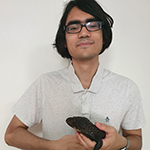
A Jewish and Indonesian man in dark-rimmed glasses and a short-sleeved white button-down shirt, holding a dark green, fairly large lizard.

Coda Danu-Asmara is a Pushcart nominated writer of many identities, including queer, Jewish, Indonesian, and autistic. His work has appeared in Thrice Magazine, The Write Launch, Punt Volat, and elsewhere. He was born in New York City but currently lives in Sydney, Australia. His lizard’s name is Siddhartha. 


 BACK TO ISSUE

 BACK TO FOLIO