POSTS

Satya Dash

Elegy for the movement of elegy

arousal          the harbinger of a flood of blood
blood sprinkles on a country’s fresh map          vermillion—

          vermillion           parting desire on a wife’s perceptible head
          head butt to crash a legendary World Cup           dream—

dream           emboldens synonyms into antonyms’ golden teeth
teeth not transmitting from master to apprentice        smiles—

          smiles           an earnest man signing his marriage certificate
          certificate the nature of my clumsy talents          forgettable—

forgettable          first words of manhood clasping a cresting wonder
wonder how you tolerated for so long my gasoline           breath—

          breath           taken away from those who went to schools unblessed
          unblessed light in sooty warehouses crossing out little    cheeks—

cheeks           docile turning right to left found blued indescribable dead
dead clad themselves in shrouds of roses smelled wholesome sad—

          sad          the untainted hurt of fruit ripened swallowed unbitten
          unbitten remains the altar of my tongue’s accomplished lack—

lack          in the shape of grace every vanquished body realized
realized a future mother waist deep in marriage miscarriage—

          miscarriage          a world I sailed past pushed by inconceivable arousal


Satya is shown, against blue and grey walls upon which a red firebox and extinguisher are visible. Satya has light brown skin and dark hair—shaved at the sides and longer on top— and a short black beard and mustache. Satya wears rectangular eyeglasses, and a mauve high-collar athletic jacket, unzipped to shown a chartreuse yellow lining and a light colored shirt beneath.

Satya Dash is the recipient of the 2020 Srinivas Rayaprol Poetry Prize. His poems appear in Waxwing, Wildness, Redivider, Passages North, The Boiler, The Florida Review, Prelude, The Cortland Review and The Journal among others. Apart from having a degree in electronics from BITS Pilani-Goa, he has been a cricket commentator too. He has been nominated previously for Orison Anthology, Best of the Net and Best New Poets. He grew up in Cuttack, Odisha and now lives in Bangalore. He tweets at: @satya043 


 BACK TO ISSUE

 BACK TO FOLIO

Hibah Shabkhez

Just The Absence

Stone trees laden with pendulous fruit
     Clack: We’ll be your volcano, 
Grant you just the absence of the boot
For one spurt of lava. Go
     Baltering then to defy the storm

Your dreams are now entangled
     With the threads of this tapis woven 
By small hands gnarled and mangled
Hunting in lurching looms their stolen
     Bread, water, school uniform


Hibah is shown against a white wall, and a brown wooden board ceiling above. Hibah has brown skin and dark hair. Hibah wears a red headscarf.

Hibah Shabkhez is a writer of the half-yo literary tradition, an erratic language-learning enthusiast, and a happily eccentric blogger from Lahore, Pakistan. Her work has previously appeared in Bandit Fiction, Shot Glass Journal, Across The Margin, Panoplyzine, Feral, Literati Magazine, and a number of other literary magazines. Studying life, languages and literature from a comparative perspective across linguistic and cultural boundaries holds a particular fascination for her. linktr.ee/HibahShabkhez.


 BACK TO ISSUE

 BACK TO FOLIO

Fleur Beaupert

Our bodies are not crime scenes

Every morning
       ‘I want the President’ to answer the invitation—
              not crime but aftermath of statistics laws colonised language

I babble in aching logics, curling
       watchful onlookers
              into microselves. My rage writes      Nudity’s script

soothes tired habits. A deregulated algorithm observes
       every precipice, kicking        words won’t cut it
              still I come to them        Flesh ushered

onto an upholstery train
        can only follow the Paddy Wagon
               of direction      ancient rhythms      humming their lines

Love is rejuvenated in spectral conspiracies
      against the woman’s protest. She consecrates every sin
            Naked passion postpones catharsis, is catharsis

Pulled out of the building, she swims strange backstroke
       through the camera’s gaze       reordering distress
             with the authority of an apocalypse

Reckoning maps around her ankles
      her movement an ablution
                                                         releasing

genderless strength, loosening along
      its equations. And in that dream my woman laughter wanders
              forever. She is narrative unmoored       throwing facts into the sea

Morning spills out      infecting neighbouring villages
        I am just a schoolgirl      sampling
               the cave’s warm tang—clothes around my ankles—

And in that dream I fall but I keep moving. Her protest
       shapeshifts, slicing waves      alive to the body’s continual
              palimpsest      how it remembers backward      to an unmade choice

Note: Quoted text, including the title, comes from footage of a woman arrested after a protest in Pretoria: News24 YouTube.

Fleur is shown against a white background. Fleur has light brown skin and short dark hair. Fleur wears a jacket with notch lapels, all of a deep plum color.

Fleur Lyamuya Beaupert (she/they) is a queer Australian writer of Tanzanian and Anglo-Indian descent. Fleur’s poetry and prose have recently been published in Not Very Quiet, Speculative City, Rigorous, Social Alternatives, Scum and Meniscus. They work as a policy officer in disability advocacy.


 BACK TO ISSUE

 BACK TO FOLIO

Justin Davis

Critical Whiteness Studies (2020)

In this highly-unanticipated documentary
series, we examine the life of
critically-unnoticed artist Justin Davis through the whiteness in his immediate vicinity. We follow the drunk white woman running her fingers through his hair as she passes him in the brewery. When he drives through Missouri’s bootheel, we ask the white state troopers how many armadillos they’ve run over. As he fills up his tank off I-55, we shine the matte white ulnas of John D. Rockefeller. The whole time, his Vampire Weekend CD plays louder and louder in the background. And make sure you catch the series finale where we air an exclusive, never-before-seen interview with the artist as a newborn, sickly, so pale that the nurses thought his mom was trying to steal a white baby. This series has already received acclaim in places like every black square on Instagram, a $5000 bill, and the cheeks of NSA agents who may or may not be dropping in on Davis’ calls right now. We’ve been told it feels more honest than honesty. Like a case, it feels like it’s still making itself. We’ve been told it feels compulsively rewatchable, that the leery hills keep growing their eyes. It’s a cultural juggernaut you won’t want to miss stealing.


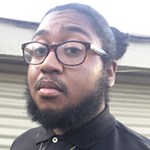
Justin is shown before lightcolored siding or cladding, and the fasica, of a dark asphalt roof. Justin has medium black skin, black hair, held back in a bun or puff, and a chinstrap beard and shorter mustache. Justine wears roundrimmed eyeglasses, and a black collared shirt fastened at the neck with a white or creamcolor button.

Justin Davis is a cultural worker and an MFA candidate at the University of Memphis. You can find his poems and hybrid work in places like wildness, Up the Staircase Quarterly, Apogee Journal, Glass: A Journal of Poetry, BOAAT, and Freezeray. He’s a past Pushcart Prize and Best of the Net nominee. He’s a proud union member.


 BACK TO ISSUE

 BACK TO FOLIO

Danielle P. Williams

Generational

I come from families where men don’t understand how to
love me I’ve seen their eyes I’ve lied to myself and everyone
else and still can’t seem to get it out of my thick skull It’s not
anybody’s job to love me I don’t think it’s a job at all I’ve seen
more women scarred than I’d like to I hate compliments as
threats Threats as men who should have been protecting me
Don’t you know what love means I come from families who
carry their secrets to the grave And we’ve all just been
endangering ourselves Lives whispering tomorrow away And
I can’t say that any of them know me Though I’ve cried and
stared dead in their eyes Open and shut I shout when I’m
alone and call it thick skin All these familiar hauntings I have
trauma and pain and knots that grind Sometimes I think
about men like fictional characters People who know what
love means Not the men I know God only knows the lives
they’ve lived and buried What other women hurt of them
And everyday I carry them in my worry like sling-stones to
my back I never know who to throw back I never know who
I’ll weep for first                                                    


Danielle is shown before dense green foliage. Danielle has medium dark skin and dark hair in long braids. Danielle wears roundrimmed eyeglasses, large earings of brightblue or silver, a black tanktop, and bluegreen skirt or pants.

Danielle P. Williams is a poet, essayist and spoken-word artist from Columbia, South Carolina. She is a MFA candidate at George Mason University. Danielle strives to give voice to unrepresented cultures, making it a point to expand on the narratives and experiences of her Black and Chamorro cultures. Her poems were selected for the 2020 Literary Award in Poetry from Ninth Letter. Her work appears or is forthcoming in Hobart, The Pinch, Barren Magazine, and elsewhere. For more, visit daniellepwilliams.com.


 BACK TO ISSUE

 BACK TO FOLIO

Mihee Kim

sun choke

The Korean American is a prideful sunflower
Twisting to its own image, rebellious as a
Mottled pear. Chartreuse hums juicy promises
Olive pigments lose to the cool and warm
Shades of skin flash dance in an ad for girls 12-14
Our colors baffle biological discourse
The pantone wheel shows no shade can be marketed
To all of us. At recess, I’m tired of identity so I
Sign up for sports. I dog the ball and shoot to
Shatter. Barely miss the goalie who withers thin before
A basket mouth of redwood limbs. As the ball connects
The goal shivers, grows tumescently above the field
I am frozen in my leap and kick. I blink
Darkness and collapse.

numb

The Korean American disintegrates
Twisted nettle. Proud armor for a lunchtime
Game. The goal shivers, ruptures grass in the field
Unctuous earth bubbles loam and in the
Turnover, a pear hums to keep its
Juices. Baffling biological discourse
Olive pigments army crawl in the
Skin towards each other
The pantone wheel shows no shade can be sold
To all of us. At recess, I’m tired of identity so I
Become a worm. I dig in the earth for
Shatters of dirt. Barely register the basket
Mouth of redwood limbs creeping above
I normally feel everything around me.

a beating

we tongue our losses
we weave songs from pulsing
and nothing else
a jubilee of blood butting
tenderest wrist
we      beat       the air in C-major
until our shoulders shake
center keys lightning eye between eyes
central root ruptures
earth-made filia fray down
a red-centered plume
takes the belliest cake
we        tongue        our     losses
we weave stories
from what’s happening
and nothing else
it happens now
everyone I’ve ever scared is
already scared
everyone I’ve lied to is here now
all the music of my youth
has gone to bed
fifth chakra        stutters
as I swallow kumquat
my neck reads : a debilitating mass lives here
trust no neck no wrist
no frail parts of you
hidden in pits
we tongue-sing a happening
and nothing else
we beat ourselves pink
we bust down
we bus it downtown
we ride our crowns to after home
we take the drum in our skin to mean
our bodies live
we        tongue        our     losses
we        weave ourselves into cilia
until the room is warm


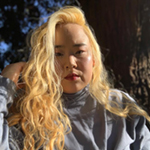
Mihee is shown, before the trunk of a tree. Mihee has light skin, long bright blond hair, and black eyebrows. Mihee wears a light grey turtleneck.

Mihee Kim (she/they) is a Queer, Korean-American artist and poet. Her work has been nominated for a Best of the Net and Pushcart Prize. Recent publications include: Asian American Writer’s Workshop, Foglifter, JetFuel Review, Apogee Journal, and poems are forthcoming in Anomaly. She earned a B.A. from UC Berkeley and an MFA at California College of the Arts. She lives, organizes and creates on Chochenyo Ohlone land, also known as beloved Oakland, California. Mihee is also Managing Director of Kearny Street Workshop, a longstanding arts nonprofit for Asian Pacific Americans.


 BACK TO ISSUE

 BACK TO FOLIO

Leslie Contreras Schwartz

Echolocation with Self and Body Parts

It’s the eyes slit into walls, half open lids
that tricks. The lips beneath the eyes blue & frost-bitten. 
Corpse pose. But a crowbar jams against cut and quartered,

clicking tongues to find the jigsaw of other parts.
A foot in the door, a silent wrenching turning beneath the ground.
Nearing exhaustion, slit eyes with lids half closing. Half breathing.

Feeling for the one other body part, a hand, a rib, a foot, 
a labia at a time. Where are you, the inner thigh calls to vastus lateralis.
Furrows of corpse flower, quartered and twinned yet firm against cuts & crowbar.

A jaw’s gotten free and is having dinner with the dandelions. 
Behind the supper party, a knee and a femur knock on the door
with cracked walls, shutters half open. Let us back in.

Outside loose limbs make cacophony with their reaching 
and clacking, hitting elbows into table corners, crowns into leg bones.
Knocked out into corpse pose. Waiting vultures in fours opening beaks like crowbars.

The unpeopled people make slits into walls, can see half 
dissolving selves in parts, whole, or half-rendered.
The crowbar useless to the coffin. 

But it’s corpse that feeds the fauna, forests the tree its crowns.
& only the mouth drops into the earth, only voice textured in fur, 
velvet in fissure and sediment. It can never be lost without its tether. 

From under the earth, waiting to hear what I’m doing 
just yet and what mercy opens its eye.

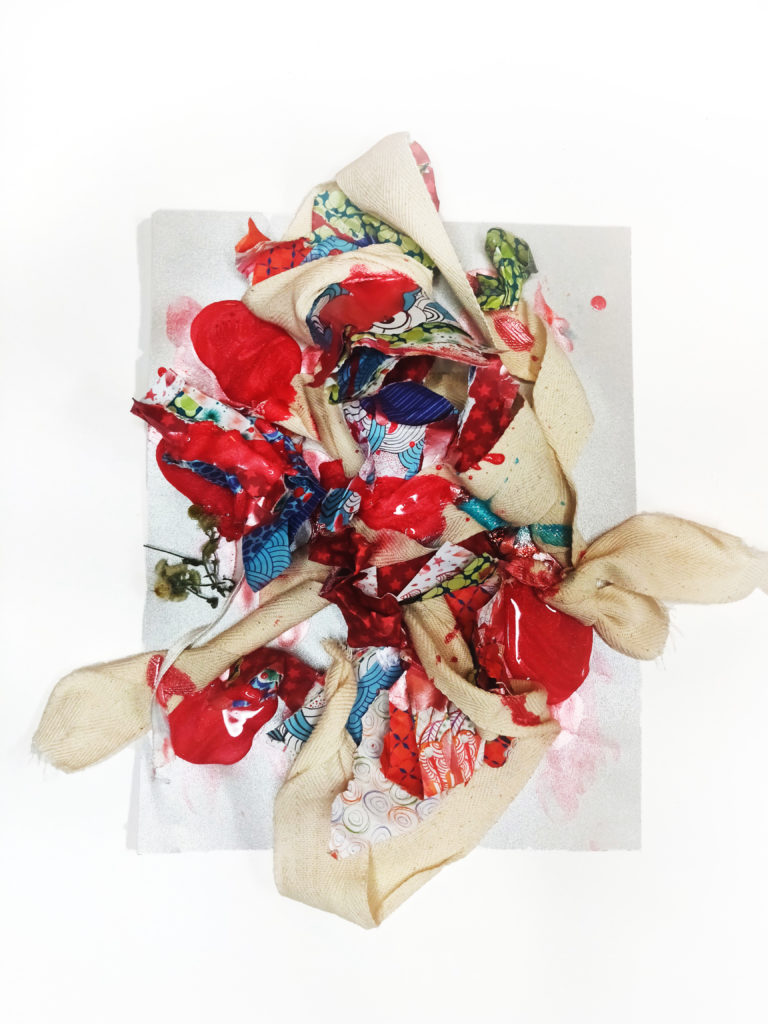
 Muscle Memory (2020)

A sculpture made of various cloths, spattered with red paint that looks like blood.

Illness and Origami

Inside ourselves, we 
are folded:

lines for future folds, reference
points, hidden or interior lines. 

An old recipe of heart songs
and nightmares.

Folds get unfolded: the blood, the veins,
the cells, the bones. 

Collapsed, secreted, warped.
A traveling purse that takes a virus whole
and lets it burrow into the spirit-matter.

This is how a year of illness 
sheds leafs from a fever-tree.

The in-and-out sight of your last love, his dark lashes.

*

Bloody coughing, half-sleeping, breathing cut 
and rough,

do the body and the mind exist in the mirror images, 
combined with double squash, swivel fold? Everything hazes as they 

exist side-by-side, in this common valley of sick.
Points are brought together at a single spot of destruction

to believe that we are so irreducibly complex—all it takes is one blow.

Folds get unfolded, in any case. The inside reverse fold, used to change
direction of a flap, and inside the body’s well sits mountain, 
valley, rabbit-ear folds creased along the walls: 

birthing flaps that wave like tattered flags
the white flutter of surrender
or the triumph of a woman’s skirt in spring.

I’m going to die like this.

*

Winter had ended and still I could not sit up.
Leave me here, I tell my husband.

*

The mind the body the mind the body
I am the object combined in three easy steps:

pre-crease forever, then collapse and collapse.


Leslie is shown, before the trunk of a tree, grass, and a wooden closedslat fence. Leslie has light brown skin and shoulderlength dark hair. Leslie wears eyeglasses or sunglasses pushed up above the hairline, a necklace of variegated metal or stained glass plates, and a short-sleeved shirt or blouse, with a scoop collar and black trim and patterning on khaki ground, the pattern of mammal- or reptile-skin.

Leslie Contreras Schwartz is the 2019-2021 Houston Poet Laureate. Her fourth book, Black Dove / Paloma Negra (FlowerSong Press, 2020), is a finalist for the 2020 Best Book of Poetry from the Texas Institute of Letters. Her work has appeared in Missouri Review, Iowa Review, [PANK], Verse Daily, Pleiades, Zocalo Public Square, and Xicanx: 21 Mexican American Writers of the 21st Century (University of Arizona, 2022), edited by ire’ne lara silva, among other publications. She is a member of the Macondo Writers’ Collective, and is a proud disabled Mexican American poet with roots in Texas and Houston going back several generations. She teaches writing workshops in the community. She is also currently a faculty member at the new  Alma College’s MFA low-residency program in creative writing.


 BACK TO ISSUE

 BACK TO FOLIO

Reil Benedict Obinque

THE OLD MAN AND THE PALE GIRL

I was alone and old and it was a sweltering Monday afternoon. Sleepy, I was lying on my rattan hammock outside of my home when a girl, around nine years old, came to me because she had gotten so pale she thought she needed a physician. 

“But I am no physician, young girl. I’m a physicist,” I said, not getting out of my hammock. 

“But aren’t you a doctor?” she asked, gripping the edge of the hammock. She was so small and so close to me I needed to get up to avoid the smell of moss stuck on her hair.

“I am a doctor in physics, not a medical doctor, so if you could please go back to your parents now, for they may be looking for you.”

I stood up and she tugged the hem of my shirt, still pleading.

“But I have travelled so long with my dog, Champ, just to reach you. We’ve crossed seven rivers and my dog died on the way here. I need your help.”

“What help?” I asked, trying to get her hands off my shirt.

“I’m getting so, so pale I’m afraid I’m becoming invisible.”

Then she extended her hands and indeed they were oddly pale her skin looked like layers of gossamers, that I could see through her if I just drew myself closer. Her face, I noticed, was as white as my balding hair. But I told her, “No. There is nothing I can do.”

I turned my back and she desperately ran after me.

“No, doctor! Please don’t turn your back on me! Look! Look what’s happening!”

And when I turned around, I noticed how one of her fingers had turned translucent. 

“Have you got no daughter, doctor?” she asked, a voice of a six-your-old articulating the thought of a middle-aged lady.

“Don’t call me doctor,” I said, taken aback still by her partial invisibility, “and I did have a daughter, but she died a long time ago.”

“Then you should know how it feels to lose a daughter, sir,” she said, back to her pleading face.

I sighed and fixed my stare at the abandoned hammock. It somehow turned into an empty cradle. 

“Sir!” 

I looked at her and her hand was gone.

“Please don’t take your eyes off me. It makes me paler,” she said. “My dog had been looking after me during our journey and see what happened when he died.”

“So you just want me to look at you?”

“Please, sir.”

“Until?”

“I don’t know.”

I wanted to shoo her away and shut the door but I was afraid the moment I open it I would see only her orange headband and her orange dress floating over her orange sandals. I let her in and made sure my eyes were all on her, trying my best not to blink.  

She walked around the house dazzled by how large it was. 

“It’s only large because it’s empty,” I said, but she was no longer listening, for she was already taking her sandals off, heading toward the couch. As she was jumping on it, I stared at her, for I had to stare at her, and realized I had not seen a girl for a long time. I had not seen a hair so curly bouncing over tiny shoulders. She was flailing her hands as though there was music only she could hear. 

She fell from the couch and it shook me from my recollection. I ran toward her and pulled her up, asking if she was okay. She just giggled and said everything was fine, but she was getting hungry.

“Do you have biscuits, sir?” she asked. “Champ and I only ate moss on the way here I think they’re growing and greening inside my stomach.”

I lead her to the kitchen table and together we ate the cookies that had been untouched inside that tin box for weeks. As she ate biscuits after biscuits, leaving not even crumbs, my eyes were still on her, for I had to, but also because I was looking at how her hand was slowly going back to normal.

She yawned and slouched on her chair. 

“I’m tired,” she said just as I was about to remind her it was rude to yawn at the dining table. “Do you have storybooks, sir? Will you read me storybooks?”

“Isn’t it too early for bedtime stories?” I asked. 

“But I am sleepy.”

I took her to my daughter’s room upstairs, keeping an eye on her, telling her not to move too much for she might trip. We reached my daughter’s room I hadn’t opened for years. She walked around the room and ran her fingers along the edges of the unused cradle, poked the bobo penguin doll, traced the surface of the empty bookshelves, asking, “Sir, where are the storybooks?”

I did not know how to tell her there were none, for there was suddenly no one to read them to, that going there for the storybooks was just an excuse to go to the room I hadn’t visited for years. 

“I forgot I sold them a long time ago,” I said instead. “But I could tell you a story!”

The truth was that I knew no children’s story, that all my life I had been burying my head on my books I had forgotten stories that once filled me happiness when I was little. Having thought of the most childish story, I asked, “Do you want to hear the story of a young man and an apple?”

She seemed excited, not knowing that minutes afterward, she would be yawning as I lectured her about gravity. So this is how you make a young girl sleep, I told myself. Talk about gravity like it is a beautiful unicorn, when gravity is what’s responsible for a heart getting heavy, when gravity is what pulls a wife’s body down when she decides to hang herself, when gravity, too, pulls an infant out of its mother’s womb during a miscarriage.

I looked at the girl already sleeping on my lap as I was in the middle of grappling for an answer to her question: will I still have my gravity when I become invisible? You will not become invisible, young girl, I should have told her. I should have comforted her by saying I will never take my eyes off her, that this time I will pay more attention, for there are things more fascinating than my hunger for knowledge and validation. I should have read her stories about wizards and witches than talk to her about Newton. I should have come home when I knew they needed my affection. I did not notice I was already smoothing the girl’s curly hair, humming a lullaby I practiced a long time ago when she told me we were pregnant. 

But I was old and alone and it was a sweltering Monday afternoon when I was supposedly lying on my hammock. My own humming lulled me to sleep. I felt my eyes drooping and I tried to fight back, but something in my head told me there was no way I could do it, and that I had been like that always. I tried to pinch myself several times but my back always felt the comfortable couch. Humming and rubbing her hair, I did not notice my eyes were already closed as I lay back and started to snore.

When I awoke, I felt the weightlessness on my lap. She was no longer there. But I knew she was in the room somewhere. It was just that I could not see her. Feeling so sorry, feeling so angry at myself for having slept, I searched for a floating dress that could have been roaming around the house. Desperate, I was about to shout her name, but I remembered I never asked for her name in the first place. But I knew she was there. She must be hiding, furious at me and how I slept when I promised I would not take my eyes off her. There must be traces of her inside the house—some foot marks she had left or pieces of furniture slightly moved to tell me where she went. But the house felt so empty that my footsteps echoed inside it. 

I searched for her until sunset, until silence enveloped me like a suffocating bag to make me feel how I was so old and so alone and it was a cold Monday night and no one could look after me. I caught a glimpse of me on the window pane. I’m getting pale, I realized. I’m getting so, so pale.

Reil is shown, before a white wall and what may be a window onto a green room. Reil has light brown skin, and dark hair, shaved short at the sides and higher on top, and a thin mustache and goatee. Reil wears a crew neck shirt patterned with thin brown and white horizontal stripes.

Reil Benedict Obinque is a calculus and physics teacher in Ateneo de Davao Senior High School. Some of his works have appeared in Dagmay, Philippines Graphic, Manila Times, Likhaan: The Journal of Contemporary Philippine Literature, and The Brown Orient.

 

 BACK TO ISSUE

 BACK TO FOLIO

Regine Cabato

Stranger Things Have Happened

These are true: In 2003, the circus came to Manila and an elephant
escaped. The eight-foot-tall mass of hide and ivory took a stroll

down EDSA, causing much traffic. In Olutanga Island,
there is a man who speaks to sea snakes. Their local nickname

is walo-walo, because their venom kills in eight days. They
do not harm him, but only live in his hut. Calamba

is native to a man who underwent 17 plastic surgeries
to look like Superman. Visit any karaoke joint in the country—

residents believe a certain Frank Sinatra single kills. My sister
has three moles precisely, which when aligned form Orion’s

Belt. When she first showed me this, I demanded: How
did that happen? North of my hometown a boy born paraplegic

stands up and walks at the age of ten. His mother says it was a gift
from a saint. Whenever I am kneeling to a Virgin of Miracles, I ask:

Is it you who writes this stuff? The devotees are a wave
of hands, reaching to grab your consecrations, the ironies

you have to offer. I’m at the back of the line, sick
of all these riddles. When I dig up all these bones, I’m sure

some femur or phalange will be missing. I’d stalk
a magician after the show, search his pockets

for rabbit holes. I am always waiting to be seized
by one more plot twist. God, just tell me how you did it.

2019 SPEAKS TO 2009

It was the best of times, it was the worst of times.

Capitalism finds a way to make you pay for things you can download for free. You’re okay with it.

Borat plays a dictator. Then he fights authoritarianism.

Friendster and MySpace are dead. Do not trust their successor.

You’ve spent over 70 hours on a TV show that will disappoint. But you’d do it all over again.

Spider-man is black. He’s also monochrome. He’s also a pig.

The Jonas Brothers break up. Don’t worry, they’re back.

Mexico’s drug war is coming to your street like gossip on the galleon from Acapulco.

Pigs are still getting sick. This time, humans can’t catch it.

Mulan supports a fascist regime.

You’ll stand for hours in a protest all because someone wants to bury a dictator and a hatchet.

My Chemical Romance breaks up. Don’t worry, they’re back.

The feud between Kanye West and Taylor Swift doesn’t end.

A Filipino hosts Blue’s Clues.

There are only 27 endemic hornbills left on the island of Sulu.

Everyone is sick of Harry Potter now, mostly due to J.K. Rowling’s Twitter account.

The Amazon is on fire.

The Philippines is the last country in the world where divorce isn’t legal, after the Vatican.

People will clap for Kim Jong Un and boo Aung Sun Suu Kyi.

So many people you do not know are dead. The two prevailing causes are dengue and hitmen.

Polio was eradicated. It’s back.

At the airport, before their flight home, your nephews—you have nephews—will cling to your side, and ask you for stories.

The world is coming together. The world is coming to shit.

In short, the period is so far like the present period, that some of its noisiest authorities insisted on its being received, for good or for evil, in the superlative degree of comparison only.

AFTER TRUTH

The excavation began in June. My companion
Billy is a scientist, so he only ever believes
in facts. I’d like to believe I’m a number one fan
of this artifact, so hard to come by since Pluto’s
on-and-off undeclaration as a planet cut short its
lifespan. Everyone on earth was minding their own
business when the Internet crashed into it
like an asteroid and jumpstarted the cretaceous
post-truth. Climate change makes for a good
deadline—what a great and terrible headline
that would be, if we ever get to release it.
But today we might as well be devotees
looking for their God. We had had many leads:
The space rover we cast gave us only rocks.
The Antarctic expedition was a bust.
The probes we sent to the Pacific came up
empty. We had heard that the Gobi Desert
was once a sea, so we pressed the shells
we found there to our ears: white noise.
Sometimes I worry: Have we been searching
for truth so long that we don’t recognize it?
What was the last thing it said before it left?
Do we even remember what it looked like—
a fossil? A papyrus? A voice? I’ve heard so many people
claim to hear him preaching in the Andes, his voice
bouncing off the back of a mountain. Only the other day
he was trapped at the bottom of a well in Egypt.
But you can believe no one nowadays. How could we,
since truth went missing? And once we found him,
how were we to present him? Would he resist
examination? Or was he lost somewhere, his leg trapped
in some canyon or cave, waiting to be found?
Some afternoons I’d tell Billy, he’s so close now
I could reach out and tug his sleeve. Or, can you hear
him? He’s laughing at us this very minute.
But at night when the tent is wrapped in the chirping
of crickets, I think of how afraid I am of chasing
the most sought after interview in the world.
When we find truth, would I be angry at him,
or relieved? Would I ask first how could you, or
do aliens really exist? or how many times
did you manifest in George Orwell’s 1984?
Sometimes I wonder if he’s off on a mission
to eat, pray, love in some Tibetan monastery
or Indian yoga camp. Sometimes I wonder
if he wants to be found. So many people
break their backs every day, waiting
for him to arrive: schoolteachers, private
eyes, criminals lined up on death rows.
One minute he is in a newsroom in New York,
the next in a birthing room in Kenya. Nowadays,
rarely ever in urban spaces, and almost never
in America. And what if I’ve been walking
on truth all along? What if truth had many surfaces?
What if truth was a sphere? Sometimes I doubt
even my companions, but trust is different from truth.
Billy is the most honest person I know, holding
the team’s shit all together. He tells us the earth
isn’t flat and we believe it. Once, on the way
to a campsite, our raw thanksgiving chicken
tumbled out of the icebox, exploding
on the mudtracked road. He told us the microbes
would kill us if we ate it. We were relieved
to have someone confirm our biases, but best believe
we’d have gobbled it up at the slightest pang
of hunger. So we roasted marshmallows
instead, on some forgotten backbone
of Canada, watching the ice melt.
He says when the truth finally occurs to us,
we’ll never believe what he has to say.
He says, we’ll probably think he’s a poem.
We’ll come up with all these adaptations of him.
We’ll cut him up into obscene lines.
No way, I tell him. Yes way, he says.
The truth can say whatever the fuck it wants,
and we’ll all still hear something else.

HERE AT THE END OF ALL THINGS

You would not believe how many people abandon
their pets. The pet store was clearing shelves, so I took a bone
and a dog and drove. The news delivers until it can’t—
a few hours before it happens, the last station broadcasts
its last goodbye: Thank you, and good night.
The end will be live tweeted, anyway.
At my office carpark, I call my parents
to tell them I love them. I hit the road
with an eighties playlist. But there’s a traffic jam
here, at the end of the world, so I get out and walk the dog
to nowhere. I thought that I would at least be busy
with paperwork, or sex. Instead, I am looking for my friends
in the last diners, the last gas stations, the last
Korean supermarkets. They are always in the last
place you look. I think of my bullies,
including the senile landlady who refused
to close the pipe when we blew off a tap by accident.
I think of my exes, even the one I never call my ex.
I think of the neighborhoods I have lived in, their flower pots
and stray kittens. I turn them over in my head,
empty their alleyways to walk my ghosts in them.
How must they be doing, I wonder, here at the end of all things?
I thought when it would arrive I would be angry; instead, I am
tired. But we have our afterlives for tiredness. Today
is for walking as far as you can. The orchestra played Autumn
right into the ocean as the Titanic sank. In the morning
we will all be frozen. I find my friends in our favorite picnic spot,
blanket spread, spreading strawberry jam on bread, overlooking
the end. I pull up a chair. The dog chases a butterfly.
Here at the end of all things, I am looking over the edge:
Everything is still. The world flickers, like a mirage—
or like a television channel, right before the static.

Regine is shown, before the pale blue frame of a door or window, with sunlit foliage shown without. Regine has light brown skin and brown hair, longer at least than shoulder length.

Regine Cabato is a journalist based in Manila. She is a recipient of the Don Carlos Palanca Memorial Award and Loyola Schools Award for the Arts for poetry. Her poems have been published in Kritika Kultura, Cha: An Asian Literary Journal, and Rambutan Literary, among others. She hails from Zamboanga City.


 BACK TO ISSUE

 BACK TO FOLIO