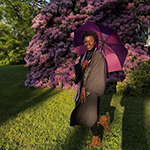
Diana Bai Fu is a poet, storyteller, and cultural worker born and raised in unceded Ohlone land (San Francisco Bay Area). Her work has been published in Foglifter Press, Honey Literary, and more. Her writing has been supported by Kenyon Review, Tin House, Bread Loaf, and Kearny Street Workshop. You can find out more about her at dianabaifu.com or follow her on Instagram @dianaaa_bai.
On Not Reading the New Translation of Berlin Alexanderplatz
James Miller is from the Texas Gulf Coast, now settled in Oklahoma City. His work has appeared in Best Small Fictions (2021), South Florida Poetry Journal, Hopkins Review, The Fourth River, UCity Review, Citron Review, San Pedro River Review, Heavy Feather Review, The Atlanta Review, North Dakota Quarterly, Psaltery & Lyre, and elsewhere. Follow him on Bluesky @jandrewm.bsky.social or at jamesmillerpoetry.com.
how to make a print some printing tips some helpful printmaking tips
Clean, the lines, and clean, your fingers, too, or else you peel the thick page from where it’s lying and it gets marked up. This can mar the design, obviously, like when a snubbed lover throws scalding water over a beautiful young man’s face, so that no one else will want what he does not have.
Wash your hands. With the right equipment, you can make 200 prints in an hour. You never know how the type in the old machines might have been used before… a campaign cartoon against FDR’s third term, for example, his nose shown bigger than it really was: a crook and a joker with a mannish wife. Or other uses.
When you meet someone, only on very certain occasions is it acceptable to ask how sick they are, such as when you’re about to have sex. Even then very often the only thing you can do is trust they were telling the truth.
Things come back. Even the stories scrubbed out of history leave small traces you can assemble if you are good at piecing together the most oblique fragments in medical records, prison sentences, the writings of parish priests on a small island somewhere no one looks.
Imagine a youth sleeping with a great lord’s wife. Their bodies are found dozing afterwards in the late afternoon light. Imagine that their bodies, then, after the lord slaughters them for their transgression, are buried in the same grave, the woman’s body on top because she was of noble blood. This kind of catastrophe can be avoided. When printing, be clean!
Remember that in a printmaking workshop, there is an abundance of light, and big windows, and broad tables, broad like the shoulders of farmers. Things feel cleaner when they are bright, and have the space to spread out. Mountains are clean when you look at them from far away and cannot see the many deaths of songbirds there, and the small girl screaming inside a wooden house.
Wash your hands before you come up against the stately metal of the presses. Manipulate the letters and the plates, there, to show a picture on an empty page the way a baby’s blank mouth is filled with teeth. No blemishes on the paper. No ink from other jobs on your hands. A print is clean when the lines avoid any reduplication or blurring – things show up only once.
If the ink your finger smudged was on the edge of the paper, far away from the design, there is a solution. Take sandpaper and scourge the page until it flakes tiny dry flecks, like skin. Gradually shave off the top layer where the ink primly sits. All that’s left will be a slight roughness barely discernable except until you take a finger and rub it across the page, feel the sensitive tip shiver.
Apollo Chastain (he/they/she) is either crying in the club or crying in the archive. Apollo’s work has been supported by Tin House and the Smithsonian Institution and appears or is forthcoming in journals including poets.org, Prairie Schooner, Meridian, the Michigan Quarterly Review, and Foglifter, among others. They are the recipient of an Academy of American Poets College Prize, nominee for a Pushcart Prize, and an MFA candidate in poetry at Washington University in St. Louis. Visit them at apollopoet.wordpress.com, or on Instagram @apollo.chastain.
about the man I thought I was in love with, how he came to me one complete morning, his hands gifting his body, his eyes saturated with hope like they were begging me to feast, the poem hadn’t come, it wasn’t winter yet, no black ice on the sidewalks, the birds still perched on the wires, waiting for a reason to leave, when he held out his hands, they turned into a vortex that swallowed me, I allowed myself to be swallowed because anything was better than being awake in my own body, because I hated my previous life, he kissed me under a sky so vast it looked like it was lying, his other head wouldn’t stop nodding like hell until I took it in my palms to pat it quiet, so I looked up to find his voice deep down my own throat, so I waited for his voice to leave, but instead it remained, like it belonged there, sometimes he would reach for it, he would swing his arms in the manner that showed he was making a demand, his ruffled hair on my cheeks, our heartbeats lying feebly on the floor, for a minute I believed he was it, a man, an intention, the soft light pouring across my face, I tell myself I could try to love him until I must, or I could lose him in the end like the others, soon, the poem began to gather itself in my stomach, it strapped itself to my legs when I was sure it was time to get out, of course I adored the poem, the way it collapsed itself inside me like the man’s voice, asking me, in the absence of love or loss, what else is there to occupy you?
Ernest Ohia is a queer Nigerian poet and editor, currently pursuing an MFA in poetry at the University of Alabama, where he also serves as Design Editor for Black Warrior Review. His chapbook manuscript, The Wanting Flesh, was a finalist for the 2025 Garden Party Collective Chapbook Contest. He is the winner of the 2025 Sita Martin Prize in Poetry. An alumnus of the Tin House Summer Workshop, his work has appeared or is forthcoming in Lolwe, 20:35 Africa, Agbowo, Rigorous, Sho poetry journal, Ex-Puritan, and elsewhere.
my homeland could be anywhere if you just take me. —James-Ibe Chinaza.
I can laugh with you again if you do not come bearing glistening pebbles for eyes. Remember, two years ago how bright the fire in which you drowned how sharp the language of your dying how precise your wavering, as though something within the city of your bones says I will be clean in death I will fade away neatly. I swear never to hurt you, so I will not talk about the rotten fruits I planted atop your grave or the portrait of the pregnant wolf which I sold for half its price. Remember ten and five years ago, how easy the breaking of all you loved and how you said everything I loved and lost comes back to me. Father, who taught me to transcribe the language of desire, to cling to the tired rope of a dwindling prayer, to make you real by calling your name. Father, I still wear your name. You who no longer remember the beauty of a wrinkled evening. Do not break yourself into bits to confuse death; dare to mend the brokenness that the language of our love never managed to detect. Always, you come to me wearing the face at peace with stillness like a creditor leaving a debt at half-a-price. I who am eternally at debt to my insane self I who may never eternally offset this grief. Come you always to relive the withering flame of this debt, this memory these names of my progenitors inscribed on the streetwalls of my heart. Father, to come again do not sit in the eyes of a beggar tempting my poor coffer, do not fit yourself into the scream of the Christmas chicken daring me to kill you again. Do not come as the blood covering my wound or as the shadow of my pet dove. I can hug you again so passionate you feel a relocation of your heart But don’t come again as the laughter of the old man next to me in a bus Or in between the lines of an academic form asking name of parents. Do not leave your footprints on the door of loneliness or your medal on the neck of a malnourished earthworm. Father, will I see you on the tip of a breathtaking crescent in the woody advent of dawn when I, leaving the bed you once lay, walk to the river And wonder how many of these stars you now own. When you come, stand at the door of my dreams, and in your cotton-soft voice whisper, come let me take you to a home made of love
Daniel Echezona is a writer and student of the University of Nigeria. In 2024, he was shortlisted for the Wanjohi Poetry Prize. His works have appeared or are forthcoming in Afrocritik, ANMLY, Brittle Paper, Neon Origami, and elsewhere.
Six feet below the white picket fence we fuck like ginkgos. We fuck like germination. Bodies split down the raphe with life, sliding into fresh green air. We’re screwing unseriously, mid-laughter, roots churning up the concrete. We’re screwing up the civilized parts of town because our memories are tendrils looping back ten thousand years before town meant fence meant garden. We heard it through the grapevine: before we were born we built mountains out of premonitions. If we keep digging we can hear the barritus of everything we’ve thought or dreamt.
Benedictions
When I believed in a god I was better at fear. Things like mornings frightened me
awake, long yellow light hanging sickly and snow-thick over the suburbs, fog
lit briefly and mysteriously from behind. They say sunrise should be
quiet but it goes off like a bomb: Walking, crushing dew which crushes on grass,
thinking I’m alone until the orioles shriek again. I have faith now in the light
that turns your eyes warm and deep,
the brick slick with ice, the certainty of finding fingers in your glove,
the shy dove making a snuggery in the eaves each day before dawn.
Tashiana Seebeck (she/her) is originally from Southern California. She holds a BA in linguistics from New York University and an MFA in poetry from Colorado State University. Her work can be found in Digging Press, West 10th, and on poets.org as a 2024 Academy of American Poets University Poetry Prize recipient.
Night glows gold like blood stains, like first lost tooth. The crunch of a change: brutal. Begin again. I hear the slow essence of retraction. It glistens. This morning I make eggs in bare feet, wilt white onto windowsill. The slim reap of my body. I’m seeing faces that aren’t mine in the mirror, some other me who scabbed and started fresh. I feel my blood pumping, every heartbeat the same lonely terror. The eggs cool. The whole house sighs. I can feel my nested wandering, the ghost’s shadow stretching, making moods that affix. The wind chimes move, catch shapes I couldn’t see. The noose of a song slopes, creeks a stair that wasn’t loose before. I feel the hollow calling: the hole in my stomach eating itself.
You want me to describe my white cotton panties, tangled mass of hair. My bones. You want to hear the ways I opened myself, let light into vein and perfect pink. Here:
The first time I ever opened the door, there was an endless dark. A sinking deepness that flattened. I mean, when it creaked on its hinge, the whole house numbed. How do you describe eternity? How do you live in a place that creases the fold? That swallows it.
McLeod Logue is a poet from Birmingham, Alabama. She received her MFA from the University of North Carolina Wilmington, where she taught creative writing. Her work has appeared in The Southern Poetry Anthology, Volume X: Alabama, West Branch, Blackbird, and elsewhere. You can find her at mcleodlogue.com.
I knew Bố Mẹ before I knew Vietnamese. But when Vietnamese didn’t sound like English, I ran away to the sexy sounds of a Spanish sueño – living la vida loca in Los Angeles with a Chicano; loving his mixed identity, I showed him my tongue, telling him Thi in Vietnamese means poem.
The way he said izquierda, I heard a poem purr, compared to the bluntness of “take a left” in Vietnamese. Bố Mẹ’s speech belonged to a busy marketplace, my tongue wagged behind, so I sharpened it with Spanglish slang, spitting “chilliando” to impress my Chicano, who also loves corridos, such a sueñolindo!
Bố Mẹ asked, “What’s a sueño?” but I’m too preoccupied, writing this poem, “Go ask Leo. He’ll tell you. He’s a Chicano,” I responded. But they wanted it in Vietnamese. Since neither of us knew, we said it in English, “Like the American dream,” as we rolled our tongues.
Just kids, they took a chance, holding their tongues, escaping while mosquitos slept, for their sueño, bearing me on US soil, speaking broken English, a language alien to my grandfather’s poems: Ông Ngoại who wrote in Vietnamese, but his verse looks chino to a Chicano,
to Leo, whom I love because he’s Chicano. He speaks Spanish with silver fluidity, yet I’m tongue- tied talking to Bố Mẹ. Too long I had pushed Vietnamese away, not knowing because of it, Bố Mẹ achieved their dream. It’s the boat that pulled them to shore, the poetry that transposes their story into this sestina in English.
I used to only want to know American English, but American Spanish sounds so sexy, Chicano. I know too little Vietnamese to write Bố Mẹ a poem, but it’s not too late to bend and fold my inherited tongue, remembering to say, “Please and cảm ơn,” so we may dream in the same language, laughing together in Vietnamese
to combine their Vietnamese with my dream- boat Chicano, creating a new name, a new tongue for a thi I’m writing now in Tiếng Anh.
Glossary of Terms
after “Glossary of Terms” by Franny Choi
Inheritance
Story
Egg
Perfection
Meaning
1: to receive something without consent
2: what is owed when one never asked to be born
singular: a rumor, a lie
plural: world building, rules making
1: unfertilized for eating
2: fertilized to bear sentient being
a circle; softness; the beginning; untouched
See also
generational x (usually trauma or wealth); ancestral; a silent destruction
translations; afterlives; herstory
a woman’s worth
Antonym
nurture
silence
emptiness
human beings; existence
Origin
if both my parents have brown eyes, I also have brown eyes
Tower of Babel
TBD – unclear what came first
the moment before the beginning
Not to be mistaken for
impending dread; reductive traits or allergies
Tower of Babbling; history; part of a multiple-floored building
the gibbous moon; inflation; rottenness
multiplying two negatives
Thi Nguyen is a California native, born in San Jose from Vietnamese refugees, and currently lives in Los Angeles. She received her MFA in creative writing, focusing on poetry, from the University of New Orleans (UNO). Her poems ruminate on issues of identity, family dynamics, and the passage of time, and have appeared in Ghost City Review, Frontier Poetry, The Indianapolis Review, and elsewhere. Outside of writing, Thi enjoys watching reality television and learning magic tricks. You can check out her website at thinguyenpoetry.wordpress.com.
“the old world is dying, & the new world struggles to be born: now is the time of monsters” — Antonio Gramsci
it will creep through the back door / slam the front one shut / it will feel gaseous / and putrid / thick with what nows / and what ofs / when liberation comes / the rivers will remember their names / the soldiers will feed themselves on the soil caked into their boots / women will flock to their balconies / polluting the air with cries of joygrief / teenagers will kiss under bridges / some will write furiously, bleeding / and some will sit on the street / all of us will cross borders / sing old love songs / burn something to baptise a new earth / the whole world will become a memorial / the whole world already is
your body is my [google] maps
after & with lines from Nizar Qabbani
at night I cyberspace my way thru memory searching all the journeys we took to one another
TEXT: I miss yr nighttime قصيدة [1] to the beauty mark on my collarbone my jugular thick & knotted; nile-like. you bite into me wa I flood
TEXT: I abdicate from history & inhabit the tale of antar wa abla wa qays wa layla. for you, I tell a story of love untethered to soil.
TEXT: LIBERATE ME! (from yr silence)
TEXT: code me into yr archive as a CHANGED BORDER: sinai of memory a reclamation. a spectered victory. I am a haunted lip on the precipice of violence.
TEXT: I am the oldest capital of grief.
TEXT: DIGITISE ME! (I would live in yr software, glitching quietly)
TEXT: wear me between dimensions, 7bb I will sigh my scent through yr screen yr fingers trace my topography so well
TEXT: ( ) un-delivered.
THE ADDRESS YOU ARE TRYING TO REACH CANNOT BE FOUND.
[1] Meaning: ode; ancestral dedication to tribe or lost love.
Aida Bardissi is a doctoral student at NYU, where she researches Egyptian film of the mid-twentieth century and its concerted national project(s), specialising in race, indigeneity, and the faultlines of belonging. Her poems have been featured or are forthcoming in Mizna, Palette Poetry, ApogeeJournal, and No, Dear Magazine. She calls on you to devote yourself to the daily practice of liberation.
reticent faces fold beneath my blade, silence pruning my fingertips to wrinkles.
acrid fog taps open my nose, burrows beneath my eyelids, surges down my throat, tickles the tender rings, brims at my lips.
tears and my gaze pools at the hollow chair on my grandfather’s dining table. mahogany heirloom of war
the knife is sharp. pungency stings like vengeance etching him into my face.
Softly, it chokes, flooding from inside.
Peeled
bits and pieces burning, sienna, soggy as sore eyes.
you stick to my tongue, astringent, like his name. it stings it bleeds when momma calls me by it.
tugs at my umbilical cord until i am child again bare feet racing through her father’s garden our footprints big and little.
the aroma crawls out the cracked window gesturing us home.
guka’s food warms a smile, giant peals of laughter. the sun peeks, round as his belly, untucks his shirt, full as a child’s heart.
Peeling
everything survives or surely dies trying.
James Joy is a non-binary Pan-African poet. They graduated from Duke University with a BA in International Comparative Studies and Gender, Sexuality, and Feminist Studies, with a minor in African and African American Studies.Their multidisciplinary work connects the legacies of history in the present. James Joy’s writing has been featured in Black Youth Project and Migrant Roots Media with work forthcoming in Kalahari Review, among others. Outside of writing, James Joy enjoys museums, Black cinema, jazz, and reading magazines. Feel free to contact them on their website.

 BACK TO ISSUE