Songs serenaded us to live fast, die young—pulsed through three-foot-tall speakers next to a stage atop which we danced and gyrated against one another in front of a dusty red velvet curtain—a relic from a previous decade—we felt the outline of each other’s bodies under tight micro skirts outfitted of the same material as the cheap leggings we wore to class the next day while our country financed wars in Iraq and Afghanistan and blood poured from the mouths and eyes of children. This was when Big Pharma got rich off white pills being crushed and snorted or swallowed by teenagers hooked from football injuries or mothers trying to forget who they were and girls were being fed heroin-chic adverts and a constant media feed that they would never be good enough and young people were being trafficked across state lines without any media attention to submit to unthinkable acts for men profiting off our misery and we bought into the idea that anywhere would be better than here. I got off on anyone looking at me as I danced atop a speaker, objectifying me, infantilizing me. I wore a lacey push-up bra from Victoria’s Secret, a flowy thin shirt, a long necklace with a gold feather pendant, 3-inch wedges. I had never felt so skinny. The crowd reached up to our smooth, sweaty legs—palms up, hopeful.
We had grown up with the fog of war inside of us—growing in normalcy through consistency and morphing chaos into white noise. The hum of chaos lulled us to sleep. White parents who grew up in the 80s were too focused on fulfilling the American dream, realizing nuclear family fairy tales to notice the rise of surveillance society marketed as national security. They had made it—and there was nothing that was going to pry it from their white knuckled grasp—not when they had earned it. Not after their parents had fought for our continued freedom.
Most war movies then were a phallic tug aimed toward WWII nostalgia and victory. The US was the hero, our flag hoisted high—red, white, and blue flapping in the wind like a cape cutting through bright blue sky. Individualism shoved down our throats, collectivism rejected. What does war mean to a child who lives outside of it, clutching a tiny American flag on a wooden stick, wearing a t-shirt emblazoned with the same flag and manufactured in another country using cheap labor at a propaganda machine disguised as an outlet store? I saw the American flag so innocently then—though it still represented the same ideals as today.
While the housing market crumbled and the price of college tuition skyrocketed, we grinded atop the thighs of boys and men too old for us. Once, I was sure that a man had a dildo stuffed down his pant leg where I rubbed myself up and down its shaft. His head was shaved; his jeans too tight and acid washed. Not bad, he said in my ear as I dismounted and walked away, my hair stringy and dripping sweat. The nightclub was an old theatre with the seats ripped out and the floor was sticky with cheap beer and cranberry juice. Hired photographers took pictures of the local scene and posted them to the earliest versions of social media where we clambered to be noticed, showcasing our sparkly new identities and pearly white smiles and deep V-necks, then searched online to see if our photos had made the cut the next day.
I was most often hungover, bored, waiting for the night to fall so that something deep within me could awaken. The news, current events, the real world—none of these things mattered. I was enamored with our youth, our lust, with the dark, deep sleep we fell into after running home from bars barefoot—chunky wedges held in one fist by the straps slapping against my forearm. I believed in nothing, and in that sense of nihilism, all I had were my hedonistic impulses. I fucked people I wouldn’t be able to place in a line-up the next day, went home with people I wasn’t attracted to, did things I didn’t want to do. I let myself sift through people’s fingers and hoped for the best—called it feminism and freedom—but I didn’t know how to say no to anyone. I wasn’t making choices for myself. I was living a life curated by mass marketing and Hollywood delirium. I was such an easy target, easily manipulated, eager to please, afraid of being seen negatively, willing to label traumatic experiences as a crazy night. The stories we tell hold the power to keep us alive—or bring upon our annihilation—depending on point of view.
When you grow up in the middle of nowhere, you think everyone is living a wilder, fuller life than you, so you overcompensate for the perceived inadequacies of living somewhere no one has ever heard of without pausing to wonder if it was actually a blessing. Instead of developing a counterculture focused on progressive politics, peace, and togetherness, we were fed reality television and a false sense of hope to become almost famous. The representation of women in popular culture and reality TV was a performance put on by hired “actors” or daughters of nepotism to appear dumb and slutty. Was this liberation? Was this the beauty that the pill and Plan B afforded us? To fuck without fear of procreation? To fuck without transaction or romance? To learn that to be progressive was to be wild and talk in a baby voice? I had no interest in these shows, but the culture created there leached into the real world through forms of cultural appropriation and exploitation. I still see the aftereffects happening to some women I know, a rejection of self for a character they deem more desirable and interesting. It wouldn’t be until over a decade later that the masks would fall, that we would hear the real voice of a reality star and learn that she wasn’t so dumb after all. That she had created a persona for the benefit of ratings and entertainment and sold it as authenticity. What is the self? Are we all just embodying projected personalities we see on screen? What does it mean when we latch onto specific characteristics? How much choice do we have in who we become?
Middle America was brainwashed into wanting to flee their lives and families, leave their small towns, stop focusing on community—believing that we had to go out into the “real world” to make it, baby. That was the only thing that mattered—leaving. This false narrative is still being sold today. The more that people leave for bigger cities in more expensive states, the more their small towns would wither. Almost everyone I grew up with has moved away from our hometown, including me. Instead of inheriting or opening businesses, building communities, investing in where we came from, we chose to “find ourselves” and “follow our dreams”. Instead of focusing on the collective, making city politics more progressive, lobbying for a better future, we chose to run away. Instead of being the voice of change, we chose to forgo our voices altogether and follow the same capitalist vision of the one percent. We chose to fund bigger cities and other states with our tax dollars and our time and energy. In this way, small businesses are at risk of failing and bigger corporations will continue to thrive. When progressive people move away from swing states to established blue ones, their homes lose those votes and their states become more conservative. We are tipping the scales ourselves—looking at each other in bewilderment—wondering how we got here.
Then there was the flood. Images of children hanged and burned. Videos of planes falling from the sky. Rage bait posted with an endless stream of comments and reaction videos that create more hate and division. A constant onslaught of negativity aimed toward one’s deepest insecurities so that we feel worthless and incapable of joy or change or love—so that we feel that everything is hopeless and that maybe the end is near. We perpetuate our realities. Humans are a collective. What is normalized becomes normal. Our outlook, our point of view, changes our perceived truth. Not much is hidden anymore but we sit back and accept what is given in complacency. We get distracted by misleading headlines and don’t take the time to read further, dig deeper. We can ask our phone anything—hope for the right answer—and I do. We praise false idols. We expect happiness and fulfillment and validation from posting on social media and watching clips and reels and writing out our thoughts and throwing them into the void. I crave a time that never existed. My attention span has been whittled down to nothing. Rarely can I watch a full reel—I continuously flip my thumb for the next video, the next photo, wait for the dopamine to hit, for the serotonin to save me, wait for a laugh, a sob, maybe rage—wait for anything at all. Isn’t that what the fairy tales here taught us? That if we’re good, if we’re beautiful, if we’re submissive—something will come—something will save us.
Courtney Ebert graduated from the NEOMFA program through Cleveland State University. She has work published in Atticus Review and Surely.
My fingers lock in a death grip where I sit, creaking like the branches around me. The wind brushes past the skin on my cheeks, fluttering the leaves on the vines that wrap around my arms up to my neck. It is easy to breathe around them now. We have accepted each other as one and the same, as beings that grow together until you can’t tell where one begins and the other ends.
I can’t remember why I sat here in the first place, but I know it felt safe. Hidden away from a life too open. Too dangerous. The light is always strange, a draft chilling my arms from somewhere far away. The quiet of the years I have spent here makes my ears sensitive; I flinch at any sound, even from a distance. Sometimes I think I hear laughter, boots crunching on dry ground, my best friend calling me with fractured words. I never dare listen long enough to know if they’re real.
My dark eyes only crack open slowly once a day when the sun is brightest, when the vines and I both look up towards the warmth. The roots feed on the rays, growing deeper into the skin of the forest’s single monarch, holding me down on this throne. Their embrace used to sting. They would pinch me, twist me back each time my thoughts of standing grew too large for them to hold. Now moss covers me in the soft comfort of a mother’s arms, telling a face I have forgotten that it is beautiful.
I stopped believing them as the years dragged over my body. Their words grew fragile as the stems and leaves began crawling across my face. Flashes of an older woman with the same dark hair as mine jolt across the back of my eyelids. A distant memory of my cheek being held by something softer, made up of lines engraved with kindness. These thoughts cause the leaves to whisper words of safety into my aging ears: that to live is to experience pain much worse than the nettles caressing my skull. The skull of a queen who is meant to be here, adorned with silence and time. Endless time.
The forest knows me. It has all my being entirely wrapped up in its green arms so that I cannot lie. The vines do not know that I still dream. Behind my closed eyes isn’t pitch black and counting seconds, but colour. The owner of the voice that calls to me through the trees is shining, arm outstretched to me, beckoning me forwards. I see mouths that stretch wide and a body that runs. I know it’s only a dream, but I stay there as long as I can, still and cautious, hoping the trees won’t see what I’m doing beneath their canopy.
Distant knocking always wakes me, the rattling of a door I haven’t opened in a long time. The dreams always end with a thorn-free hand, holding something that glints silver, something sharp. They are going to set me free. Finally. I can never see their face, only the lines on their palms showing me the path to freedom. The throne feels especially cold on the days after those dreams.
I feel most comfortable in the rain. The vines soak up the droplets, and the noises of the forest are swallowed by the torrent until they can’t hear my eyes join the clouds. The grey sheet of water hides my open eyes and the reflection of sunlight that remains in them, no matter how long they have tried to dry them out. My feet burn as I stare unblinkingly at the edge of the clearing, where the sun peeks through on summer days, enough to create new shapes on the ground.
My eyes track them with expert precision, wishing I could feel them with my own hands, run my fingertips through the blades of grass until they trust me enough to remove my nettle crown. My head feels heavier with every shape I trace that looks like home.
Guilt wraps around my throat to join the brambles, skin itching from the fear of my own desires. A queen who wants to leave her own kingdom truly is a traitor. A betrayal the bark of this throne will never forgive me for. Even now, my body begs me to run and submerge myself in flowing water like I have lived there before, like it knows how to.
My friend is shouting for me. I can’t hear what she is saying, and it is shattering me like a disappointed plate on a tiled floor. In the darkness of this rainy night, I try to move my left wrist and feel the thorns dig deeper, the sharpness mixing with my blood until I can taste it. The warning rushes around my body, reminding me that what’s out there, beyond the clearing, is unknown.
The stillness that once saved me is strangling me now. This throne is too soft to be made of wood. The pain in my wrist blurs beneath the pressure building in my chest.
Being the queen on this throne may be all I was meant to be, but the need to know if I could be more is all-consuming. Going out there may hurt me, grip me with something harsher than leaves until I am begging for my forest to let me back in. Still, I can’t tear my eyes away from the sunlight.
I pull my wrist harder, wiggling my fingers through the resistance until one finger becomes free. Specks of red dance amongst my landscape of green so starkly that my eyes unfocus, and the forest flickers around me. My little finger finally bends after countless years of holding tightly to the arm of this throne. It is just enough to crack the bone and feel the air underneath it. The cold shocks me enough to raise goosebumps all over my body. The skin on my cheek twitches.
I think to love myself is to suffer the consequences. Limb by limb, I will untangle myself. I will stand cold and shaking, afraid of what my name will be once I am stood on my own two feet. I need to stop the relentless burning of my body as my mind wanders to somewhere I cannot yet reach.
Tonight, when I enter my dreams, I think the face of my rescuer will become clear. I will look up into dark eyes that shine as bright as an April sunrise. Her body is scarred and stiff, yet wholly her own. The silver will flash towards me. Blood, sap and tears mixing together until I don’t know who is bleeding. I will laugh for the first time in decades as I take her hand and watch her hair flow in the cool evening breeze, held back by a crown woven from nettles.
Becca Rose is a writer based in Greater Manchester, UK. Her work explores interior worlds through image, embodiment, and emotional restraint.
Downpour: An Anatomy of Emotional Weather and the Sky’s Oldest Lesson—that Everything Changes State
Rooted like a seed or a small planetjust beginning to spin, I stirred—an underwater flicker haloed in breathlight. The wood-paneled room held me the way an old bowl holds the memory of whatever it once contained. Above me, voices drifted like weather: my mother’s alto, my father’s soft-edged tenor, tuning the atmosphere into something almost breathable. No sentence has ever been able to hold that moment without splitting at the seams.
I didn’t arrive in language. I arrived in function, lungs jerking and seizing, catching air like a match that flares and gutters in the same wind. My spirit didn’t think; it pulsed. An animal grammar older than speech, older than intention. The motor, the sails, the ship.
“Go on,” I imagine someone whispering now, as if from the underside of memory. “You are just in time.”
I learned early the scent of my mother after showers; damp, floral, a little wild. Steam still singing off her skin. That ritual, the way water slid her into another version of herself, became my first grammar of time: before and after, waking and waking again. It taught me that a body can be rewritten daily, tenderly, without apology. Inside me, something older than memory quickened—an inhabitant made of touch: the warm weight of a woman’s chest, the milk-and-muscle scaffolding of being held. I carried that architecture long before I had a name for anything.
Out past our farmhouse, where the grass turned gold from too much sun and too little rain, that inner inhabitant dreamed. Sometimes I think it dreamed of tides, small ones, shy ones, just enough to rinse thought clean, to baptize the ground that became our floor, our field, our eventual burial. We ate with plastic forks that bent in our hands. We thanked the animals we killed with a solemnity I didn’t yet understand. In those gestures, we rehearsed a violence older than language. And I floated, awkward, new, somewhere between the logic of the world and the logic of wonder. Always in the interval. Always in that crooked grace where everything is half-formed and holy, where the body remembers before the mind can speak.
Memory plays now in wide, color-smeared screens. My mind spools a dusk-colored filmstrip of beginnings: the fear of going blind; the first vision inside darkness—not an object but awareness itself. I wiped breath-ovals off windows with my sleeve, searching for myself in the blur of glass, in acres curling away in every direction. The land remembers, even if I don’t. Above the barn, a sea of stars drifts loose as thought. Some gentle gravity gathers my fragile self together, spirit, flesh, longing, bound with something holy and almost laughable.
I am a body now, furnished slowly with bones and gestures and rooms. A dwelling for memory. A vessel for desire. Still tethered, seedlike, orbiting, learning to stay. Learning to grow from the inside out.
The sky often began with a spill, as if the earth had confessed something too tender to bear alone. My father once said, “These drops are only the beginning, supposedly.” We were planting seeds, oregano or mint, and his voice held the weary awe of someone who’d made peace with mystery long ago. He said the rain would return after it grew teeth and learned to call itself a leaf. It did return, though not always as water. I saw it sliding down my mother’s face, an erosion more intimate than weather.
On the table: yesterday’s newspaper, the landline off its hook. My aunt’s voice fraying over static as she told us my grandmother had been washed away by another kind of flood. Grief rearranged itself into weather, something you prepare for with small rituals: folding tea towels, slicing fruit, anything to keep the hands from drowning.
Once rain enters the bones, it stretches the days from the inside.
Sometimes life arranges itself in small, unruly lessons. I bought packets of seeds at Walmart, the cheap kind with bright pictures of impossible blossoms, thinking maybe I could coax something into staying alive. The doctor, around the same time, handed Dad a prescription—Wellbutrin, he said gently, as though offering a handrail in a dark stairwell. Outside, winter kept rehearsing its old tricks. Inside, Dad watched war movies on loop, each explosion echoing through the walls.
“Don’t you want to watch something different?” I’d ask, though I already knew the answer.
When I left for a weekend, I forgot about the seedlings on the windowsill. I returned to find them collapsed in their pots, small silhouettes of what they could have been, already brittle with resignation. Waiting, it turns out, demands its own kind of devotion, and I hadn’t learned how quietly a life can tilt toward undoing.
You start dreaming of building forts indoors. You learn the slow art of floating through waterlogged rooms in your mind. Some days the house stays cloaked in cloud. Shadows lean into corners like forgotten guests. Time becomes a second presence pooling in the kitchen, fogging the hallway, hovering by the windows. And then, at the hour you stop watching, the first green shoot appears. Nothing grand. Just the quiet insistence of life dressing itself in an ordinary afternoon—the kind of afternoon when I carry tissues to my mother’s room without needing to ask why.
My grandmother lives forever in the armchair of my memory—spine bent like a comma, fingers knitting stories into yarn. The last time I saw her well, I washed the farm dust from my sneakers before the gray jaw of New York opened to receive us. She welcomed us with television static and the steady rhythm of crochet. She let me crack eggs into the mocha-almond tart she’d prepared days before, stories falling into my lap like warm flour.
That night, it rained. We slept together, pajamaed and safe. A week later, I wore black without understanding. Back on the farm, the rain returned, carrying its old knowing.
“Rain is holy,” my father always said. “It feeds the land.”
But holiness can take, too.
I began to fear the sky when it darkened. Rain had a habit of stealing what I loved, like a tornado, like when Dad tells me that when he was a kid, they’d hide in the innermost room because they didn’t have a basement. He says the sound was violent, “like a train,” he claims every time, and every time I listen as if it might end differently. I picture him crowded in the bathtub with his siblings, adults on the floor, the whole family clenched inside that tiny room while the wind tore at the house. Windows shattering. Pictures falling down the hallway. And yet the bathroom, this one small, stubborn shelter, left untouched, preserved.
Transformation is quiet: a green stalk breaking soil. Grief sliding under a closed door. Sorrow filtering through the body like water through stone. And years later, when I finally look up, I understand what the sky had been trying to say all along; that every loss, every tenderness, every spill and re-gathering belongs to a single water cycle, returning in forms we barely recognize. Dad understood this in a way. He never had the right gun for the things that needed ending—some regulation, some cost, some old silence around harm.
So when the raccoon wedged itself in the live trap behind the barn, he did what farmers do when the world refuses to offer clean choices. He steadied himself. He acted. He carried the weight no one else wanted to lift. Watching him then, his breath clouding in the cold, his patience worn but intact, I could see how a life becomes its own weather system.
How a man can shoulder years of storms without ever speaking of the flood. Our little life, at times, a heavy raincoat: clumsy, soaked through, yet still something that keeps us standing in the downpour.
Marie Anne Arreola is a bilingual poet and editor whose work lives at the intersection of speculative lyric, digital culture, and diaspora memory. She is a 2025 Pushcart Prize Nominee, author of Sparks of the Liberating Spirit Who Trapped Us (Foreshore Publishing, UK), winner of the Plumas en Ciernes Short Story Prize, and founding editor of VOCES, a bilingual platform for global artists and writers. Her work appears in over 40 literary journals across the US, Europe, and Latin America. She is a two-time finalist for the Francisco Ruiz Udiel Latin American Poetry Prize (V and VI editions) from Valparaíso Ediciones, and a recipient of the 2024 Young Poets Scholarship awarded by the Gutiérrez Lozano Foundation. Writing across journalism, poetry, essays, and hybrid forms, she is committed to fostering inclusive, transnational conversations that honor community histories and cultural transformation.
The morning is livid with wet and colour, the grass cool about the ankles as we pass further into the space between the either and the or.
I have brought my friends to the thinnest of places here in Singapore. Together we are threading an eastward path, along a strip of grassland that borders two worlds. On our left is the long, sharp line of wall, boundaries that mark where the property of each neighbourhood family ends and the next begins. On our right, as the low slant of a valley begins to cascade downwards, the world is shimmering with green. Pale lime of grass, emerald of fern, muddy dark bloom of trees older than memory reaching out of the last remaining primary forest beyond.
Edgelands such as these are particularly susceptible to the dislocations of the modern day. Land-scarce as the island is, forests are disappeared overnight, and what scars of earth remain are ceded just as quickly to concrete and glass. They alter and scramble the memory of a place in their rising. The pace of redevelopment means that the shape of the land changes faster than our ability to process it. Walking through a place as threatened as this, therefore, is an act of record-keeping. The land scapes itself into our feet as we move through it, etching its contours into muscle memory. To notice what is around us is to allow our senses to act as an archive – growing alive to what life still insists upon its here-ness, though the walls of the suburb on our left are ever-encroaching.
Quietly, Jacob recounts how cities were once defined by the presence of walls. They kept out the wilderness when it was still a thing to be reviled, in an age before the nostalgia of the pastoral yearned for it again. The residue of such tension remains, even this long since then. I watch the tremor of leaves reflected in long panes of glass, passing to wire fences, to steel rebar.
As we walk, the land falls and rises like the breath of a furled, sleeping thing. The babble of birdsong chases along the top of the slope’s upward curl, beyond what we can see. Something about this cacophony, so close to the forest fringe, seems out of place, and we realise why as we draw up the slope. A dozen cages hang from the boughs of the trees, and within them the birds are speaking. A magpie robin trills one lonely half of a song, drowned by the syrup water-trickle of the white-rumped shama’s whistle in the cage next to it. But the caged birds are not alone. Drawn by the familiar song, other shama have come, flitting through the trees in dark sudden fragments, singing back to the ones hung in their domes.
Miriam, reading aloud from her guidebook to the birds of Singapore, has learnt that the population of white-rumped shama in this forest is thought to have originated from released cage-birds. What do they say to each other, we wonder? To which side of the cages, swaying now in the wind, does the dream of home belong? Tail feathers dip curiously, catching light in the dappled shade like the glimmer of a midnight stream. Men sit by their van and eat their breakfast in silence, watching the birds rupture the currents of air with song.
Past the cages, a shock of bamboo has detonated out of the earth. Some three storeys high, the skyward fanning of the bamboo is an echo of birthing. There was an age in the young years of the earth when the bamboo forests were evidence that something was coming, that the steppes were about to be covered in flowing rivers of grass. Today they are much the same, proof of life. Bats nestle in the slats and slivers of space within their stems, a sign for those who look to know if a place is good for other things to grow.
Below the bamboo the earth stirs with memory. Rootbeds have been ripped clean, soil and mud rutted into troughs and trenches. These are the traces of wild boar, which are seen more often than the animal itself. At this hour, they are gone, retreated back to the groves and hollows of great trees. Such great divots and upturns of the earth are the muscular echo of their passing; freshly churned each morning, a dawn-time ghost of their presence from the night before.
“Boars are landscape engineers that alter the ecology of their woodlands,” writes the author Helen Macdonald. “Wallowing holes fill with rainwater and become ponds for dragonfly larvae, seeds and burrs caught on their coats are spread wide, and their rooting on the forest floor shapes the diversity of woodland plant communities.” Imagine the little worlds that form in these furrows—shrubs and flowers found only in deep forests, carried to and taking root at the fringe of human life. So displaced, they will die in time; the pools of water will dry out, pollinators will seek other fields. But a dying world is a world nonetheless.
I think then of the Great Forest Spirit in the film Princess Mononoke (1997), whose path is marked by abundance and decay. Fungi, grasses and flowers spring from its footsteps, growing then rotting in the same moment. The ruts left by boar are much the same; slower, but no less capable of such lushness. The forest megafauna of this small island – wild boar, sambar deer – are world-shapers and makers, and they make the film’s old gods seem curiously possible in these late days of the Anthropocene.
This morning, the ruts of the boar have come right up to the edge of the boundary wall. Soil and loam are compacted against the fence, branches at the forest fringe trampled clean into the dirt by sheer passing mass. I wonder what it must be like for the people who live in these houses, hearing the grunting and heavy tread of the herds each night as they emerge from the undergrowth. Do they listen with curiosity behind their fences, or familiar nonchalance? Or is it fear which has driven them to line the tops of the walls with shards of broken glass?
We live closer to the end of Princess Mononoke than its beginning. The old gods are gone from its world, the last Forest Spirit decapitated by zealous hunters. The flood of its ichor unmakes the towns and burns the deep wood into a scorched nothingness. But then the green insistence of the grass comes, a salve over a wound. Where the old trees have died, it grows shallow, but it grows anyway, thin new saplings complicating the borders of the town. The forest spirit is gone, mourns San the wolf girl, amidst the desolation of her sacred shelters and childhood groves. Some wounds cannot be forgiven, and she can no longer remain here. Ashitaka, the prince who must stay to rebuild the world of men, can only look upon the face of the girl whom he loves and cannot follow, as the grasses flow and flow about their feet.
The morning grows warm, unfurling the wings of butterflies and buzzards circling above us. We leave the forest fringe as the grass spills into the end of a cul-de-sac. Where the asphalt is clean and wet from last night’s rains, white fallen flowers scatter the grey like abandoned stars. Saksham plucks one of them from the floor. He recognises their name and shape from home. In Lucknow, he tells us, the Harsingar flowers scatter in the middle of October, and signal the coming of winter. The fall of flowers is a reminder for families to pull coats from cupboards, and keep each other warm. For Saksham, a ground so covered is also a sign that his mother’s birthday is coming. Tonight, he will think of flowers and call home.
Outside their house, an elderly couple pauses their game of badminton to ask where we’ve emerged from, as if we were ghosts slipped from the borders of another realm. When we tell them where we’ve been, they smile, and speak of paths they have walked through the grasses that lead deep into the nature reserve, unmarked on any map. I look back in the direction where they point, and just for a moment, the road appears momentarily to disappear beneath its blanket of moss, and the low wall of the houses seems to melt like the shadow of an open door into the shroud of leaves.
The forest spirit is all around us, insists Ashitaka to San in the film’s final frames, as the grass blurs where the buildings end and the forest begins. He is here, trying to tell us something—that it’s time for both of us to live.
Leonard Yip is a writer of landscape, place, and people. He holds a BA and an MPhil in English from the University of Cambridge, where his work on multimedia representations of Singapore’s edgelands was awarded the Members’ English prize for best overall dissertation. His essays and poems have been published with Moxy Magazine, Ekstasis, and the Nature Society (Singapore). He lives and works in Singapore, with a continued focus on the changing terrains and ecologies of the Anthropocene.
“To the tongue of the serpent that sinks and soars; you have brought the force sustaining the three; bright spheres of sun, moon and fire; the mantra unspoken asleep in the snake; and explicitly uttered it.”
—Avvaiyar (Tamil Sangam Poet) Vinayaka Ahaval, Adoration to the Remover of Obstacles Translated from Tamil by Tiru K. Swaminathan
The Tongue [நாக்கு Nākku]
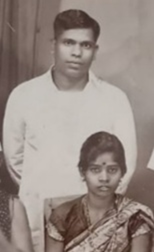
There’s a little loft in my parents’ suburban Toronto home where I come to write. It’s mostly unused—a thin layer of dust has settled over the mahogany coffee table, a large east-facing window nourishes the many plants which fill the room, and a wooden mantelpiece has turned into a small shrine for my grandparents. There’s two framed photos in front of a silver plate with incense and a small mound of thirunoor, or sacred ash. Most photos of my grandparents were destroyed during the 1983 pogroms in Sri Lanka, so we’ve framed a sepia portrait of Tha-tha which we suspect he took sometime between 1940 and 1960, and a photo taken by my older brother on his last visit to Pahti in India.
Tha-tha died before I was born and while Pahti lived with us for many years, she too died when I was young. It’s in the years that followed that I’ve come to know my grandparents, mostly through the stories they passed on to Amma and the memories of her childhood she’d recount late into the night as we sat across from each other in the living room. Whenever she told stories of life in Sri Lanka’s upcountry, it was as if she was dropped into a dream and couldn’t remember how she arrived. Each detail would lead her to the next, but she’d leave before the scene could fully play out. I avoid interrupting her, as if any disturbance might sever her connection to the past.
Sri Lanka’s upcountry, or Malayaham as we say in Tamil, is distinct from the rest of the island. In addition to the Sinhalese and Muslims, the region is home to a large population of Indian Tamils, brought to the island by the British as indentured labourers for the tea estates. They spoke a more musical Tamil, closer to a South Indian dialect than the northern one I was familiar with, using words like kochika rather than milagai for “chilli.” There were still palm trees but people walked by them gripping their scarves and jackets tightly across their bodies—though Amma says it isn’t as cold these days as it once was. The region is a stretch of tropical highlands prone to landslides due to heavy monsoons and soil erosion, the latter of which was caused by centuries of tea farming on European-owned plantations.
I find my mind wandering to the upcountry more and more. There was something drawing me there, which at first I thought was nostalgia, but I was born in Toronto and never lived there for any substantive amount of time. Longing was more accurate. A longing not only to return to the upcountry but to the version of it that lived in Amma’s mind. A version from before the riots, where my grandparents’ home still stood and if I entered, I’d find Tha-tha reading a newspaper at the dining table or Pahti tending to a bubbling pot in the kitchen. It was a longing to be with my grandparents. To ask for their vaazhthu, or blessings, as I’d seen so many Tamil kids do by bowing their heads and reaching their fingertips towards their grandparents’ feet.
In the absence of that, the loft became a temple of sorts where I could sit by the large window under my grandparents’ watchful gaze and meditate on their lives. Staring out as the sky turned to dusk in Tha-tha and Pahti’s company, watching the sun set and the moon rise over the neighbourhood, was a kind of prayer. When I eased into silence, when I truly listened, I could hear what they wanted to teach me.
The Sun [ஞாயிறு Ñāyiṟu]
Tha-tha settled in Unugalle, a tea estate south of Hali-Ela, where he was crammed into the small estate line-house his family was allotted. As an Indian Tamil, Tha-tha was disenfranchised—the 1948 Ceylon Citizenship Act made the hundreds of thousands of Indian Tamils effectively stateless and subsequent legislation criminalized the rest of the island’s Tamil minority. Amma often recalls the day her neighbour from across the road was dragged into the street by soldiers and beaten, just for looking out the window during a curfew. Instituted by the government to quell anti-Tamil violence, the curfews became one of many means for suppressing the growing Tamil resistance, and would do little to prevent the July 1983 pogrom which destroyed Royal Printers—Tha-tha’s printing press.
And still, in the midst of great fear, in the cracks of a dying nation, Tha-tha built a life. With only a third grade education he left Unugalle to start working for a tailor, sewing buttons for ten cents each and saving whatever he could to one day start his printing press. At its height Royal Printers employed over forty workers, supplying paper products throughout the upcountry. Tha-tha was not only able to provide for his family but for his siblings, cousins, neighbours, and employees. For anyone who looked like they needed help in increasingly hard times. Amma remembers her home was always filled with children—Tamil, Muslim, and Sinhalese—who Tha-tha was helping to put through school. Tha-tha often said it was his duty to give what he could, for if other children grew strong then his could too.
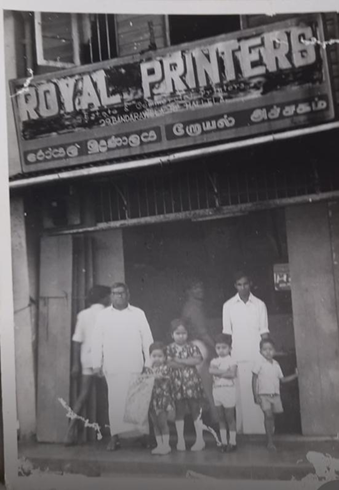
We eventually found a single photo of Tha-tha in front of his printing press—he was stout, his arms crossed behind his back, his greying hair combed neatly to the right. He wore a bright shirt with a matching sarong. A few feet above him was the shop sign: Royal Printers, Estate & Commercial Printers, 29 Banderwala Road, Hali-Ela. There were two young men who likely worked for Tha-tha rushing into the shop behind him, glancing back to realize they were interrupting the shot. Hanging in the shop window behind him were photos of Vishnu, Buddha, Jesus, and the Kaaba. A symbol of the fragile agreement to coexistence which held Hali-Ela together in the time before Sinhala nationalism took hold, before the island’s descent into the long night.
Tha-tha photographed in front of Royal Printers. (Date unknown).
On Sundays, Tha-tha would host a big feast for his family and friends—he’d have everything pulled from the showcase, gold trimmed cups and steel plates, while Pahti cooked an array of curries, something different each time. His television, which was the only one in town, was dusted for when the guests would gather around and watch a show while sipping tea. Amma remembers playing with the many children who’d visit, drawing squares on the road for hopscotch or swimming in the river behind the house, returning only after lunch was served. Tha-tha’s home became a sanctuary of sorts. It wasn’t utopia, it didn’t represent the possibility for a different kind of country, nor was the kinship of neighbours enough to stop the coming pogroms. But in his small piece of the world, they could sit around his dining table, their bellies stuffed with rice and laughter, while the TV gleamed in the opposite room. After the table was cleared and warm tea was served, everyone trickled out, returning to the reality of an island at war with the Tamils.
Wealth afforded Tha-tha a certain level of protection—like many other Tamil business owners at the time who survived the earlier pogroms unscathed—but he could always feel someone watching. There was a group of soldiers who often huddled outside Tha-tha’s door, their rifles hanging from their shoulders, demanding he serve them tea. Without opening the door he’d call for Pahti, who would rush to the kitchen and set a kettle to boil. Perhaps paradise was—and could only ever be—temporary.
After the pogroms of 1977, Tha-tha received a letter without a sender or return address—a warning from the Tamil resistance movement. Worried that further violence was coming, the letter urged upcountry Tamils to resettle in the North-East. Many upcountry Tamils had relocated or joined the movement themselves, while others fled abroad. Perhaps, in his stubbornness, Tha-tha believed that the life he built would endure the coming violence. Or perhaps he knew it wouldn’t and preferred to savour it for as long as he could. He stared at the letter for a while before leaving it at the back of a drawer. When Amma asked who sent it he shrugged his shoulders. “It’s no one, don’t worry.”
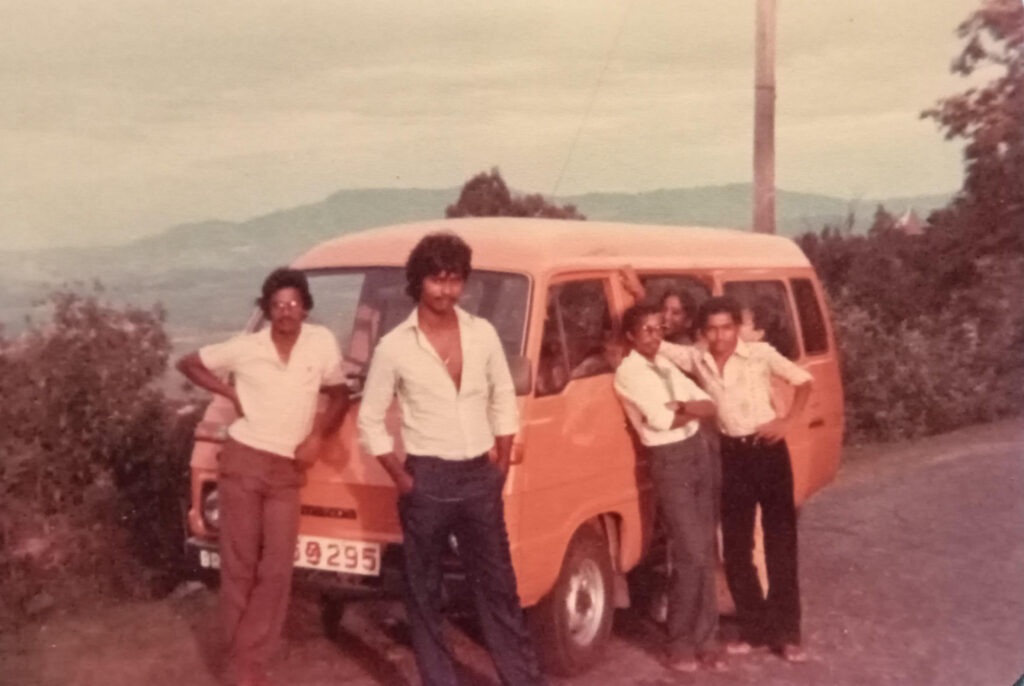
Amma and her siblings, most of whom were married or attending college, returned home for a family road trip in May 1983. Amma remembers the trip fondly—they squeezed into the orange Mazda van Tha-tha had bought only months before, then drove from Sigiriya to Yala. I eventually found a photo of the van from another trip—the boys posed around the van, their bellbottoms pulled up to their ribs, their thick black hair trimmed neatly. Amma was poking her head out from between the door and her friend’s arm, which was stylishly resting against the van.
Tha-tha wasn’t in frame. I figured he might’ve been behind the camera, directing the shot, savouring the bittersweetness of a fleeting time.
○○○
Each Thai Pongal, the Tamil harvest celebration, Amma boils sweet rice with cashews and raisins on the stove until the pot bubbles over—a gesture of thanks to the Sun for keeping us warm, for nourishing our crops, and for guiding us into a new day. I’d chew the sweet porridge slowly, savouring each grain of rice as recompense for the Sun’s labour. For the Sun’s task is an impossible one—to provide the means for life to flourish in the harshest of conditions. While we humans may be more familiar with death, the Sun is a mortal creature just the same. It too must die. When that day comes, eons from now, I wonder if it will look back and take pride in the life it made possible? There was no way for me to be certain, all I could do was finish the bowl in gratitude.
The Moon [நிலவு Nilavu]
I didn’t warm to Pahti at first. I remember the day she arrived in Toronto—Amma strategically waited until we got to the airport to tell me I’d have to share my room with her. I had just transitioned to having my own after sharing with my older brother only to find out I would have to give it up again, but this time, to my eighty-year-old grandmother. Pahti was disciplined—almost militant—which made our first few months together difficult. She’d wake each morning at 6 o’clock to comb her hair, applying a thick layer of coconut oil and pinning it back into a tight bun, taking care to ensure each thin strand of white was accounted for. The rhythmic plucking of her comb at the knots in her hair meant it was time for school.
Sri Lanka’s war against the Tamil people resumed in 2008 after a tense ceasefire—the same year Pahti arrived in Toronto. The Sri Lankan army began indiscriminately shelling tens of thousands of Tamil civilians in so-called “No Fire Zones.” What I remember of that time were mostly protests—we joined caravans of Tamils travelling from Toronto to Ottawa, Washington, and New York City—thousands of us trying to bring our people’s plight to the eyes of the world. There’s a photo of Pahti from those days that I love—she’s wearing a thick fur coat over her blue saree, her white hair pinned into a neat bun, staring solemnly at the camera as she stands in front of the Washington Monument next to my brother. After killing tens of thousands of civilians in the final stages of the war, the Sri Lankan army declared victory on May 18, 2009.
The nightmares—some of raging forest fires, some of bombs exploding, others of great floods—began a few weeks after. In my dreams, I was the only one who could see disaster coming. I’d scream for us to run but neither of my parents believed we were in any danger. I’d wake up panicked, scrambling down from the top bunk and waking Pahti. She would sit me beside her and sing a prayer, the blue glow of the moon pouring in through our bedroom window, illuminating her face as she sang. “Everything will be okay,” she’d say, before sending me back to bed. I didn’t know much about Pahti’s life then, or what she’d been through, but I knew if anyone could save us it was her.
Suffering was one of Pahti’s first teachers. Born in Nammakkal, a small city in South India, Pahti described most of her childhood as painful. Both her parents had died very young. She often spoke of the day her father died, when she took his head and placed it gently on her lap so he might feel some comfort as he passed. The time shortly after his passing was some of the most difficult. As a child, her and her siblings spent most of their time scavenging for food. On some days she’d chew on tamarind rinds just to trick her stomach into feeling full. By the time she was a teenager, her forearms had been covered in tattoos, various tribal patterns etched with a needle and a mallet—gifts from the town’s wise women offered alongside food in exchange for completing their odd jobs.
Tha-tha, who also lived in Namakkal, eventually married Pahti and took her with him to start anew in Sri Lanka. Pahti became Tha-tha’s equal—a matriarch, confidant and advisor, but most importantly a friend—she stood by him as he struggled to build Royal Printers. For the many children who Tha-tha had put through school, it was Pahti who cooked and attended to their needs.
Fear was her other teacher. A group of squatters had once holed up at one of Tha-tha’s properties in a nearby town, so he and Pahti went to investigate. The squatters had forged the land transfer documents, making it difficult to prove Tha-tha’s ownership. Upon realizing they would need their lawyer’s help settling this dispute, he returned to Hali-Ela while Pahti stayed behind to observe the squatters. Annoyed by Pahti’s presence, the squatters called the police claiming she and her children were attempting to steal the land. Amma remembers her delight when Pahti refused the policeman’s offer of water and food in protest, who instead arranged for meals through one of her nephews. He brought with him bags of curries and rice, and some sweet buns—Amma’s favourite. Once Tha-tha spoke to the police over the phone, they released Pahti and drove her back to the property, ordering the group of squatters to leave.
A few months later, the squatters returned, this time with a truckload of thugs armed with machetes. Pahti and the kids ran out of the house and scattered through the fields behind it.Kali is complex—most are unable to look past the bloodied heads of the guilty adorning her neck. But Kali is also the mother goddess—a goddess of the natural world, the margins, and liberation. In the ensuing chase, a makeshift explosive filled with sand was thrown at her, bouncing off her saree and exploding a few meters behind. Pahti narrowly escaped. Instead of hiding, she returned to the police station on foot, informing the police chief of what happened. When she returned to the house with the officers a few hours later, it was empty—plates of half-eaten food and empty beer bottles strewn across the floor. As the police were preparing to leave Pahti heard a noise coming from upstairs—the thugs had heard the police cars pull up and hid in the attic. She watched as each one was arrested and driven back to the station.
This was the Pahti I’d known—the one who caught spiders and kept away the ghosts at night. But I often wondered if underneath her quiet resolve, was a part of her that felt afraid?
Pahti wanted nothing to do with the television when Tha-tha brought it home, seeing it as a distraction from her household chores. But whenever her daughters turned it on, Pahti would stop and watch, broom in hand. She became absorbed in a popular Japanese show Oshin (1983), which followed a young girl through the hardships of her life—navigating the death of her grandmother and sister, her struggles with poverty, and the harshness of Japan’s Meiji period. The character was inspired by the life of Katsu Wada, co-founder of the Yaohan supermarket chain. Amma remembers often turning back to find tears gently rolling down Pahti’s cheek as she watched. Pahti said she saw herself in Oshin. I later found a clip of the show where in the midst of a harrowing blizzard, an imperial soldier asks Oshin if she needs help getting home. She gently declines, “I know the way.”
○○○
Pahti often said Kali atha, the goddess of war and destruction, would one day rid the earth of evil. Kali is complex—most are unable to look past the bloodied heads of the guilty adorning her neck. But Kali is also the mother goddess—a goddess of the natural world, the margins, and liberation. Celebrated during new moons, when the moon’s light no longer accompanies us through the night, Kali asks us to face our fears so that we may find our own path through the darkness. Her name can be understood as “the one who governs time” or “one who is dark.” I had always avoided spending time in the dark, afraid of what lurked within. But on the night we got the call that Pahti had passed away, it beckoned. As Amma wailed for her mother on the staircase, I quietly climbed up towards my room, shut the door, and turned off the lights. As frightening as it was, I was somehow sure that the darkness—the unknownness of a new world, one without my grandmother—wasn’t here to hurt me, but to hold me through to the other side.
The Fire[நெருப்பு Neruppu]
Tha-tha had ignored previous pogroms, first in 1955 and again in 1977, confident his wealth and status would protect them. But Pahti knew this time would be different. On July 23, 1983, the Liberation Tigers of Tamil Eelam (LTTE) killed thirteen soldiers in an ambush in Thinnevely. In response, the army killed fifty-one civilians and in the coming days, Sinhalese rioters killed, robbed, and raped Tamil civilians across the island in retribution. The rioters went town by town, armed with voter registration lists of Tamil households while the police stood by and watched as they committed horrific atrocities.
The rioters arrived in Badulla, a larger town to the north of Hali-Ela, on the following Wednesday. Many were bussed in from throughout the upcountry. “They’ve burned shops in Badulla,” Pahti said to Tha-tha, rushing back home from the store after she heard the news from the owners, who were quickly closing up and packing their things to flee. “We should stay with my niece in Unugalle. Her son said he’ll drive us up the mountain.”
“They won’t do anything,” said Thatha, shrugging her off. “How many of these riots have we seen? And look, we’re still here.” He stayed seated at the dining room table, attending to the cup of tea in front of him. They stayed that way for what felt like hours, as the rioters slowly approached down Banderwala Road, the main throughway connecting both towns.
Pahti took an empty Krisco biscuit container and ran upstairs to collect her jewelry—cherished family heirlooms, yes, but useful currency during a crisis. It reminded me of reading Octavia Butler’s Parable of the Sower (1993), where Lauren Olamina had turned a few pillowcases into her “go-bag” and filled them with what few items she could scavenge if she ever needed to flee at a moment’s notice. Nuts, some old pots, cash, and seeds. Lauren knew it wasn’t a matter of if looters would come for her small gated community, but when. Within a few hours the rioters arrived at Royal Printers.
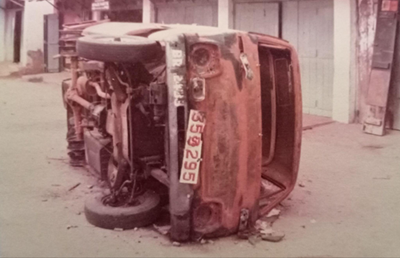
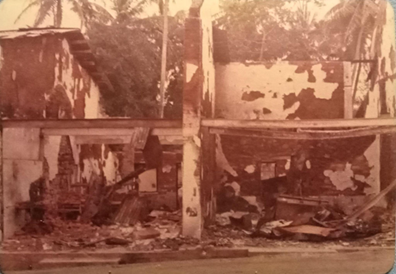
First, a group of them dragged Tha-tha’s orange van into the middle of the road and set it ablaze. Our cousins in Unugalle would later say they could see the van from atop the hill—a warning for others to stay away. Then they smashed the windows of Royal Printers and looted the building before it too was set on fire. By the time they reached the house, Pahti had come back downstairs with the Krisco container under her arm, grabbed Tha-tha by his wrist, and quietly guided him out the back door.
She stopped halfway down the steps leading towards the ravine. “Wait,” she said quietly as she pointed behind her. Tha-tha hesitated at first then followed her instruction, looking back towards the house and the printing press. “Everything we worked for is burning. Look at it. Then turn around and keep going. This story is over.”
His fragile paradise was on fire—black smoke billowed from the window, carrying the sound of cracking wood and cheering rioters. In front of him was his loving wife beneath the fire’s glow, a staircase leading behind her into the darkness. Whether they would survive the night or where they would go next, they could not have known. He had to trust that his wife knew what he needed now was to turn towards the fire and say goodbye.
They both turned back towards the ravine and ran.
Tha-tha’s orange Mazda van, destroyed. Captured July 27, 1983 (approximately).
Royal Printers and my grandparent’s home, destroyed. Captured July 27, 1983 (approximately).
The Serpent[நாகம் Nāgam]
The serpent in Avvaiyar’s poem is an ouroborous meant to represent the unawaked consciousness. It sleeps at the base of the spine, coiled around itself, eating its own tail. In the poem, Avvaiyar honours the elephant god Pillaiyar, the Remover of Obstacles, for bringing her awareness to the cycles of the sun, moon, and fire—life, death, and rebirth. For awakening the serpent within her as she approached the end of her own life. In this conversation between the poet and the god, the snake has no say. A kind of self-mutilation, ingesting parts of itself it may not have been ready to let go. The moment the tail passes into its mouth is the end of countless other possibilities. Perhaps it knows there is no choice in the matter, that to survive is to let go of what was and what might have been, endlessly.
But I often wonder, does the serpent grieve its tail?
○○○
Earlier this year, I came across a report by the Sri Lankan government titled the Presidential Truth Commission on Ethnic Violence (1981-1984). It included hundreds of testimonies from Tamil survivors, documenting horrific murders and the destruction of property. As if written in an autopsy report, I found a line referencing Tha-tha’s printing press: …Royal Printers, where 40 persons worked. During the communal riots of July 1983 it was destroyed. There was something dreadful about seeing a pivotal moment in our family’s history distilled into a single line. Determined to see the remains of Royal Printers for myself, I flew to the island with Amma.
The rest of the drive into Hali-Ela was quiet—I spent most of it admiring the fog as it rolled over mountain tops, slid down their green slopes, and then dissipated over the valley—interrupted only by the sound of Amma’s voice as she recounted her childhood memories. I was last in Sri Lanka in 2005, after the LTTE and the Sri Lankan army agreed to a ceasefire to deal with the aftermath of the Indian Ocean tsunami. I was returning to a different island.
As we drove through Tamil areas scarred by economic crises and natural disasters, I remembered the particularly absurd passages of the truth commission report. A kind of reckless optimism bordering on satire. One passage reads, “pursuing a utopian ideal would be akin to chasing after a mirage in the desert. But if we do recognize, that indeed, we are in the midst of a desert, we would realise that we have no choice but to keep on chasing after the mirage until we reach the oasis. Surely, we will, hard though our way! And oasis, there are!”
And oasis, there was, I thought, as Amma and I eventually found ourselves in front of her old house—or rather, where it used to be. Replacing her old home was a concrete building with a green sign that read: Hithamithuru Beer Shop. Next to the house, where Royal Printers once was, was a convenience store. For a while she simply stared above the shop’s sign, at nothing. “There was a window there,” she eventually said. “That’s where we used to sit, in the bedroom, after the curfews started. I still hear the soldiers’ boots marching down the road. We saw everything from that window. Some nights, when the town was dark, we could see the stars. Other nights, we’d sit under the windowsill and write poems. The stories that window could tell.”
Amma didn’t want to ask the beer shop owner if we could see inside and suggested we try her Sinhalese neighbour instead. We walked left from the store, two doors down, unsure if anyone would be home. We peeked through the gate and saw a man laying tiles on the veranda. He noticed us, went inside, and to Amma’s surprise returned with Nissanka, the youngest of the family. He welcomed us with a big smile, a hug, and invited us in for tea.
Their conversation drifted easily to memories of their childhood and of my grandparents. He eventually led us downstairs and through the kitchen to his backyard. Nissanka’s yard was neat, a small path cut through the thick bushes and rows of palm trees towards the ravine. A seven-foot concrete wall blocked the view of my grandparents’ property—an addition by the new owners. Nissanka pointed to a mound I could climb onto for a better view of the adjacent yard. A lump grew in my throat as I climbed up and peered over the wall. From up top, I saw only broken concrete, tall grass, and the heaps of garbage which now filled the yard. Only a single door from Royal Printers had withstood years of demolitions, as if keeping vigil.
Turning my head away from Amma and Nissanka, I started to weep quietly. I grieved the life my grandparents built, and the life that could have been. A life we could have shared. But I had to remember that even if Royal Printers was destroyed, it wasn’t gone.
On the way to Hali-Ela we stopped in Colombo to visit Tha-tha’s friend, Sivarajan, who for decades worked at Royal Printers as Tha-tha’s right hand. We met at the restaurant which he started with his son a few years back. Over tea, he reminisced about his days working for Tha-tha. He said it was Tha-tha’s teachings that gave him the courage to build this restaurant. He even recited one of Tha-tha’s proverbs from memory, “a man who can’t respect one penny will never make ten pennies.”
As if it were pollen carried by the wind to more fertile ground, the memory of this place lived on in those who still spoke my grandparents’ names with reverence, in those who learned something from their lives. It lived on in Amma, and now, in me.
In her book, A Paradise Built in Hell (2009), Rebecca Solnit writes about the big and small acts of connection in crisis, which are “by [their] very nature unsustainable and evanescent, but like a lightning flash it illuminates ordinary life, and like lightning it sometimes shatters the old forms. It is utopia itself for many people, though it is only a brief moment during terrible times.” She adds that the work of making joy and freedom in crisis “can inspire people to return to that society in its everyday incarnations with renewed powers and ties.”
As we walked back towards the house, Nissanka told us about his mother who kept an eye on the property after the pogroms. Strangers bought and sold the land, never staying more than a few years. The river behind the house had dried up and the jackfruit trees had stopped bearing fruit.
“Only ghosts live there now,” Nissanka’s mother often said.
I turned back to look at my grandparents’ home one last time, listening for their ghosts. Perhaps it was just the cold breeze rustling against the palm trees, but for a moment, I could almost hear them laughing.
For my grandparents, Kaathan Veeramalai Pitchaimuthu and Rasamma Pitchaimuthu. For their children—my mother, uncle, and aunts. And for the Tamil people—in the mountains, by the ocean, and those far from home.
Athavarn is an Eelam Tamil facilitator, writer, and event curator. His writing engages with memory, community, ecology, and spirituality as terrains for political transformation. As a facilitator, he supports social movements to navigate conflict and cultivate shared purpose in times of uncertainty. He loves R&B, astrology, tarot, sci-fi, his friends, and his family. He lives on the lands of the Mississaugaus of the Scugog Island First Nation. athavarn.com.
To survive is to revise. These slight adjustments. If you can —dusting the page off — survive that. — Laura Mullen, “Prose Poem (…)”
Archivist’s Note
If you are brought up in a flood-prone area, a storm becomes a part of who you are. If you grew up in a house safe from floods, the storm is something that exists on the outside— beyond portents, on the warning signs from televisions.
Consequently, a storm becomes a normal day: you elevate your possessions, wrap the furniture, evacuate, and wait for the storm to pass. After the storm, you go back home, clean up the mud, and wait for the next storm to come.
Dear River
Dear river, babbling smoothly. Where did you come from? Where are you headed? What have you done to the cattle and the people and our possessions that you have stolen away from us? Have you seen what remained in your wake? Now we stroll by the erected dike every day, all memories of your violence erased. You seem calm in your murkiness. Where are you hiding their bodies?
Storm
Declare upon us your innocence. Point us to the one who has blood in their hands. Every day you rove smoothly, and we cannot ascertain your guilt through the sheer murkiness of your mouth. Must you remember the days of our friendship, your sanctity, of how we used to lavish in your clear, open mouth: how we swam with you and washed our clothes and how we were able to hang them dry by the shore, clean and safe with certainty. Must you remember your eventual cohorts, the ravages they inflicted upon us, and how we mistook their touch for what we used to know as love. Must you remember: the day your cohorts arrived they wracked our bodies for gold; they caressed our frightened bodies in the guise of love. And we believed them: a flooded house is an emptied space; we believed that underneath this muck there remains something pure. Their touches roused trembles, quivers, panic—the things we find familiar. That our bodies were aquiver were the only things we knew for a fact; everything else proceeding that is language; interpretation.
Murkiness
Does a barren house make for a barren mouth? That our bodies are porous, that this skin, these pores, these annals of entry, the porousness of our skin; that your body, the throes of your pricks, the swarm of your touch; that your muddied caress, which was purported to be a blessing, upon touch, has consumed us, and in our want for survival, we had no choice but to be consumed in return. That these instances of touch are swarms of what you and we had touched; the junctures of our skin; the porousness of how our bodies coalesce. That the touches that roused you had not only roused you; that we are consumed by everyone else you have consumed, and we are doomed to carry that rot wherever we go, even to our bed, even in our dreams, even as we dutifully scrub our skin.
Archive
To come to writing is to claim mastery over the subject, yet I am nothing but an archivist trying to make sense of the ruins of this body archive. I am no one but an “I” attempting to catch something elusive. Suppose I was to reveal myself: here are the annals of my entry. Suppose I was to bare my weaknesses. Suppose I was to count your trespasses. Suppose I was to declare that these traces, these remnants of where your touches have lingered on my skin, are now a part of my perpetual becoming. Suppose you were to come back. What would you make of these naked battered bodies? As you may see, my body is already in itself an archive of ruins: accidental and inflicted, bloodied and bruised, drowned and disembodied, and your arrival exacerbated the shattering of the shards.
Images
To survive is to revise— these words and a jar of trapped fireflies— as I write this letter this late night, alone, thinking about us. Perhaps I still write about you within the confines of this jar. Perhaps I am writing to you in anticipation of your return. Perhaps these are utterances of my wish for a different ending. Perhaps this is us surveying ourselves in the mirror. Perhaps these words will only lead us to gawk; to be enamored with crumbling houses, fraying images, abandoned buildings, or bodies of water swarming over bodies of land. Perhaps this is not about God’s wish, but rather, the ravishing. Still, you left our bodies as crime scene and aftermath.
Notes
The epigraph ‘to survive is to revise…’ was lifted from Laura Mullen’s work “Prose Poem”, from the book Dark Archive (2011).
The concept of the human body as both porous archive and archivist was borrowed from Julietta Singh’s work No Archive Will Restore You (2018).
The phrase ‘a jar of trapped fireflies’ was an allusion to Wayne Koestenbaum’s introduction of Roland Barthes’s A Lover’s Discourse: Fragments (1977).
Jessa C. Suganob is a translingual practitioner working with image, text, and ephemera. She writes and translates in English, French, Filipino, Cebuano, Hiligaynon, and Kinaray’a in her works. Her works can be found in ANMLY, Kritika Kultura, Petrichor, TLDTD and elsewhere. She is currently the Director of Literary Arts for the art gallery Carmen Art District. She is currently based in Cagayan de Oro, Philippines.


 BACK TO ISSUE