“I Escaped Nigeria After EndSARS, but the Country Still Stresses Me” Zikoko April 11, 2025.
After bullets silenced peaceful protesters at Lekki Tollgate, a boy bundled his clothes into luggage. At the airport, he flicked his hand— 1. to his country, 2. to his father, 3. to his brother, perhaps for the last time.
See how a country cuts through a home. Migration speaks in broken dialects of a kindred. When we trace the wound’s beginning, we need not 1. blame the leaving, 2. for there is always a knot 3. tied inside the choice.
And on the evening news, a paid mouth insists no blood spilled at Lekki. I imagine the young man p r o t e s t i n g seconds before—
1. cut down by the bullet, 2. while raising the flag, 3. while singing the anthem.
And when we leave, we will not look back at home. When they ask why we fled, we will show them the wreckage. Migration was the only choice, even when it meant 1. beginning anew, 2. pleading for breath, 3. swallowing our freedom to survive.
Ferdinand Emmanuel Somtochukwu, Swan XXI, is a young emerging Nigerian poet and essayist. He has works published or forthcoming in Arts Longue, Kalahari Review, AprilCentaur, Poetry Column, Poetry Sango-Ota, Isele, and elsewhere. Connect with him on X @EmmanuelSomto17.
People depart through trains and cars and you are rend with loneliness after they are gone. Your departure imparted me with with a sullen longing. A crater of mixed emotions fell on my chest after the happy meeting was over. Dark signs like tendrils of roots begun to grow. The former state of happiness collapsed in the rearview mirror. The body is a new direction, now. I touch the glass surface of present with an unusual stance posed as questions, ‘who grows here, in this new arrangement?’ ‘Will I last the afternoon with my shadow distended due to so much longing?’ The ground is drunk on the fragrance of flowers in the riotous spring. I tie my shoelaces before going on a run. The symmetry of numerals and their internal logic commands so much respect and authority in human imagination. But words and their meaning, in essence language, is taken for granted. Thunder flashes and I must go inside to hide under the noisy newspaper sheets, their headlines screaming of the confrontation between empires. I lie in a confused silence counting the moments to rain.
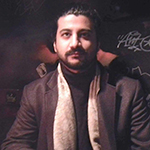
Hasham Khalid is a poet from Karachi, Pakistan. He has studied analytical philosophy at Bristol University, U.K. He dropped out in the third year of his studies. In his poetry he tries to examine the relationship between thought and experience by invoking the philosophical behind the ordinary. His poetry is not restricted to a particular style. You can find him quietly hanging out with great scholars and extraordinary poets on instagram @shashamkhalid.
how cool they looked, the boys who could afford them— safari boots, tight denim, those funny hats, hard boy brooklyn bridge stance. by now they had started smoking, had girlfriends (wives), would soon be teenage fathers— they’d join a gang, kill for the fake silver chains around their necks, later afford cotton nappies for their kids. the early age of khat and big g’s and chain links, menthols, sportsmans, patcos, sumuni, eh baba si tuende ivi alafu ntakurudisha home, the last words my father said to me before the police gave him a choice: go up state or next time we see you not even dental records will be reliable. myself, much younger, watched them in awe, heroes, later comatose, wanted to be them, even started walking like them, les mangelepa.
shuffling, drunk on some pheromone, dogs, still, we didn’t know the meaning behind the name Arafat: Mohammed Abdel Rahman Abdel Raouf Arafat al-Qudwa al-Husseini. the war, the war, the war, the war, amen. amen, the war, the war, and we are in underwear getting fucked by our maids. we were happy under our dictator, unaware of the world, mistaking tadpoles for fish, skinning rabbits, stealing molasses from freight trains my mother asking me to pass the spitoon, expecting a girl in a few weeks, the great poet’s words above the headword, Jalāl al-Dīn Muḥammad Rūmī: the light is where the wound enters you. decades later, on the news, newspapers, al jazeera, gradually we came to know Arafat, how silly we had been, in D, ignorant of the world, tiny mercenaries waging fake wars against our own— how silly still, now, watching the bombings in khan yunis, thinking we know what it all means. ask this: what is the relationship of desire to memory. where’s the river, where the sea?
Kanda Zinguri writes from Nairobi. His work appears in Peatsmoke Journal and Down River Road.
At the end of the world my father texts me, a screen on a screen.
Video of his bedroom lit by CNN. The doomsday clock reads seconds till the end. A woman in the corner speaking over footage of a nuclear blast.
How long has it been the new year? I mind distinctions, my father says, Porque estudias la lingüística.
Siempreuna vergüenza o la otra. Like Janus, central is the ears, but I begin by looking for the eyes above the words. Sinambigüedad, where the vowels keep parallel. Unlike the totality of guerra, where the hollow ü is lost like water from a dog’s open cheeks. How much desagüe contains. Sounding so of the water yet meaning the opposite —to be rid of it.
Meanwhile in Mexico a silver spotted fish washes ashore on El Quemado beach. Oarfish, the sliding scale of doom. The weight of a family put together times the length of time. It is said to be omen, agüero, of earthquakes, tsunamis. The sign only signifies the sea, but I’m paused for lo que sea.
Without season, my father brings the garden inside. Texts a video of wide windows from within. Sun green laureled white blossoms skewed iridescent by a flared lens.
Light through layer upon layer tears light itself apart.
Good night, he texts again. Though we are far from night. Good night? I try to clarify in return. Good morning, he says —que sea cigüeña flying over sea— with two laughing faces:
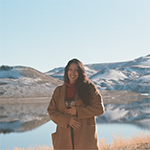
Gabriela Valencia is a poet and essayist. Her work appears or is forthcoming in Image Journal, Waxwing, The Los Angeles Review, Watershed Review, Volume, and Great Lakes Review among others. A 2024 Tin House Alum, her writing was named finalist for the 2024 Orison Books Best Spiritual Literature Award in Nonfiction and the 2023 CRAFT Hybrid Writing Contest, as well as longlisted for the 2023 Peter Porter Poetry Prize. She received her MFA in Poetry from Boston University, where she was named a Robert Pinsky Global Fellow.
forsythia magnolia all the eager flowers busting into blossom before their leaves
girlhood was a wasting disease young does bashing out their brains onto the leaves
bleeding through jeans on an inflatable mattress as even the air leaves
heirloom tomato on toast savory ovary carved heart book of sheer red leaves
motorcyclist’s skull opened on the road home cops yelling until everyone leaves
vernal pools mad with trillium trout lily geranium frog song choir in the cathedral of leaves
I hold my hand in the shape of a bud to unfurl inside her like the new green leaves
Natural History
On this forever redeye there is an extra charge for water, but I have learned to ask the flight attendants for a cup of ice, which is complimentary, sucking the chips as though fasting before surgery, a continent scrolling gorgeously beneath me, how unfortunate to be bored shitless of glory, having now seen the Hall of North American Mammals in several major cities, dioramas of taxidermy bliss where I witnessed the continent’s romances repeating: extended families of bison ranked by shagginess, mountain lion cub frozen mid-pounce for mama’s tail, coyote pups wrestling by a den marked with no scent but dust, and the two bald eagles nesting in perpetuity, cobwebs on outstretched wings, sometimes a rabbit in one’s beak, the limp thing made twice-dead like an ex-love mentioned in a poem, a former partner, for instance, tearful, trying to explain she wasn’t not gay just for sleeping with a man, ironic quarrel considering my own profession of bisexual apologetics, deliberate nebulousness of the lyric you, the speaker of the poem’s implied repertoire of handjob techniques, vague habit of introducing my partner in the cowboy way, pardner, my pardoner at the afterparty in a cassock, hickey livid above his collar, while another partner sexts me snapshots of butterflies drinking her sweat, arm hairs delicate as tripwires, and still it is so hard to describe my partners in the plural without sounding like a law firm or local accountants’ agency, all handshakes and contractual obligations, which is indeed how some people go about their polyamory, but I just love as stupidly as I can, I hope, and take dates to the big museums to see the assorted families of beasts, the carrier snails gathering other shells into their spirals, hoards small at the centre but bolder with time, like hearts I once declared in an anatomically incorrect but spiritually earnest way, like when I optimistically described as an abundance mindset the period in which I had two boyfriends and two girlfriends across two continents, not paired up for the ark but unto each their ecological niches, alcoves built into my chest, unique habitats, directional lamps to keep them in their best lights, at night I touched their switches one by one, and afterwards with glassy eyes they stared across the darkened hall into each other’s lives, but no matter their plumage, their patterns of hair, each was the first and the last of their kind, and all equally rare – there – this collector’s instinct, the need to keep what I admired behind glass, which couldn’t last, whether in one fussy diorama or a bacchanalian dozen, not for my forefathers who loved on their new birds so much they snuffed them all with blunderbusses, stuffed those beautiful bodies for museum displays, learned too late that to prize the real life is to watch it slip away beyond your vision, the creatures keeping their mysteries, choosing when to let themselves be seen, ie: when she told me about the man it wasn’t the specific gravity of him that mattered, it was that I hadn’t understood sooner she wanted to be only his, despite previous consensus re: liberal libidinal anarchy, and only then did I know I couldn’t know, or own, all there was of longing, couldn’t proclaim my dalliances were antidotes, necessary air holes poked in the humane trap of honeymooning, what did I risk, prowling my gallery of warm bodies, in picking an exhibit in which to rest, and someone to wear on my hands every day, if ever I retired from carnal manifoldness, stopped containing multitudes so literally, cooled it on fucking fucking everybody, what was I afraid of, getting rooted securely, like the sprays of withered switchgrass glued around my display, where behind my petrified form the hand-painted vistas would fade with decades, nostalgic snow eternal on the peaks, horizon-storms forever not-arriving to air devoid of petrichor, humidity-controlled, although from time to time I might look out at the other specimens, meticulous illusions of wildness, the exhibition hall narrower than I remembered, some spotlights flickering or blown completely, patches of fur shedding from my youth’s apex Charismatic Megafauna – but this assumes the museum could hold us, the lovers already clambering from our enclosures, tiptoes on scuffed wood to doors opening on dewy darkness, the forest of desire deeper than any petty diorama, more perilous, perhaps worth getting lost in, if only for our greed to be together in the thicket, beating our wings against the obvious brightness, making mosaics of our fallen scales, and even knowing I am no pinned butterfly, something silvery as a needle keens through me still, the piercing urge to turn inevitably back to you, asleep in your seat by the window, last of the free ice chips melting in my mouth like a glacier’s ghost, the other passengers clapping as we are brought down from the sky, small planet spinning against the sun like a magnificent rotisserie chicken, my bitten nails inflamed with salt, reaching for another tender thigh
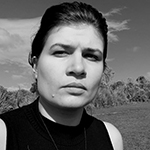
Rebecca Hawkes is a queer painter-poet from rural Aotearoa (New Zealand). She is the author of the collection Meat Lovers (AUP), and chapbooks Softcore Coldsores (AUP New Poets) and Hardcore Pastorals (Cordite). She edits NZ poetry journal Sweet Mammalian and co-edited the Pacific climate-poetics anthology, No Other Place to Stand. She holds an MFA in yearning (and, lesserly, poetry) from the University of Michigan, from which new work has found homes in places like The Threepenny Review, The Georgia Review, Palette, Noir Sauna, Phoebe, and HAD. Find her on Instagram or at rebeccahawkesart.com.
about the man I thought I was in love with, how he came to me one complete morning, his hands gifting his body, his eyes saturated with hope like they were begging me to feast, the poem hadn’t come, it wasn’t winter yet, no black ice on the sidewalks, the birds still perched on the wires, waiting for a reason to leave, when he held out his hands, they turned into a vortex that swallowed me, I allowed myself to be swallowed because anything was better than being awake in my own body, because I hated my previous life, he kissed me under a sky so vast it looked like it was lying, his other head wouldn’t stop nodding like hell until I took it in my palms to pat it quiet, so I looked up to find his voice deep down my own throat, so I waited for his voice to leave, but instead it remained, like it belonged there, sometimes he would reach for it, he would swing his arms in the manner that showed he was making a demand, his ruffled hair on my cheeks, our heartbeats lying feebly on the floor, for a minute I believed he was it, a man, an intention, the soft light pouring across my face, I tell myself I could try to love him until I must, or I could lose him in the end like the others, soon, the poem began to gather itself in my stomach, it strapped itself to my legs when I was sure it was time to get out, of course I adored the poem, the way it collapsed itself inside me like the man’s voice, asking me, in the absence of love or loss, what else is there to occupy you?
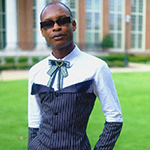
Ernest Ohia is a queer Nigerian poet and editor, currently pursuing an MFA in poetry at the University of Alabama, where he also serves as Design Editor for Black Warrior Review. His chapbook manuscript, The Wanting Flesh, was a finalist for the 2025 Garden Party Collective Chapbook Contest. He is the winner of the 2025 Sita Martin Prize in Poetry. An alumnus of the Tin House Summer Workshop, his work has appeared or is forthcoming in Lolwe, 20:35 Africa, Agbowo, Rigorous, Sho poetry journal, Ex-Puritan, and elsewhere.
with words from a lecture by Timothy Morton and Roy Ayers’ song “Everybody Loves the Sunshine”
I am never not thinking about ecology and also I am never not experiencing ecology to put it very abstractly ambiguity is a major chemical component of antifascism—art being a dirty word for propaganda, propaganda a dirty word for art—most things in America are from hell but heaven is really just hell for nice people (consider claustrophobia, uninspired music, intervals easily resolved, no ambiguity whatsoever) and philosophy is not some wire armature for ideas but a contact sport where mindbrains bump up against each other, electrified with a particular quality of not-yet-ness Darwin said the mere sight of a peacock’s tail made him want to vomit (ostensibly because its opulence undermined natural selection) because he liked it (in a gay way) And nature is (GOD) so beautiful (in a gay way) and I am a pack of cards dropped on the floor (pick me up, pick me up) and I’ve been playing fifty-two-card pickup with my gender since I realized I live in America where everything is available which logically means I am in hell but logic is how you fold your laundry or how clothes hang in your closet and eco(logy) is how organisms hang together and phenomeno(logy) is how phenomena hang together and no one can stop you (ever) from inventing new logics by which to fold your laundry even if the colors make Darwin sick I’m not explaining this very well which is fine because lack of diction induces hallucination which is fun!! until the fascists figure it out—a violation of the ecology of the mind where I struggle to remember natural beauty as queer always queerness being a major antifascist chemical sometimes I forget to go outside and then the sunshine hits my bloodstream like the inverse of hallucinogen and it’s a lie—how could everyone love the sunshine when global capitalism has weaponized the sun?– (it’s called gaslighting, it’s how ideology works) it’s called atavism, this opposite of evolving, this want to unlearn humanness, to predate logic, to lie in a field under the sun with no invisible rules laid across your body (impossible, I know, I know) so I am walking to the corner store where they sell cereal and cigarettes and sex and race and class at bargain prices (we WANT you to have this!!) and I’m pacing the aisles under sun- adjacent fluorescence looking for not-yet-ness and everything here is from the past, past expiration date, on sale, everything must go— and I’m thinking-feeling ecology (always, always) thinking of sunshine, peacocks, the store’s popcorn ceiling interspersed with rectangles of fake white light, as if there’s something brighter up there— I’m thinking who runs this place, anyway?
Esmé Kaplan-Kinsey is a California transplant living in Portland, Oregon. In their writing, they hope to explore human-nature relation and deconstruct binaries that cast humankind in opposition to the natural world. Their work appears in publications such as Adroit Journal, SmokeLong Quarterly, and the Cincinnati Review. They can be found on X/Bluesky/Instagram @esmepromise.
“But if I seize this tongue, it is because it has adopted me, and no longer cuts me from my word” —Khal Torabully
Diaspora: die, as poor (as in a poor diet) (as in diaphragm of Albas and Darianos) (as in distilleries in Northern California don’t equivocate wine c/sellar)
The
agriturismo Airbnb abuser, tour-guide-told-me-this type, non vero, non che, non capisco.
I often wonder, on that test, one our mom dreams to pass before she pass’s: which questions must they ask?
Which teet did Romulus drink from?: the right or left? Does chicken limonata have capers?: sì or no?
The insinuation of a “need for novelty” implies we wear our skin and tongues like an ornament:
but my tongue is spittiling is trying it’s best on your accents and ascent: Alalalalalala It’s like my tongue has fingernails saliva, a hand-nail in my search for sacred sounds, “real” recipes, protected piece of Tuscany.
My mom never gets so disappointed. The drop-off from her ancestors was so quick, she barely had time to see the way they walk away, in which rhythm they washed themselves or remedied their ails and how they ate off of a floor.
My sister-in-law recently acquired her US citizenship after 25 years or so, a South to North American transfer of identity that supposes itself as triumph…
So, complaining about this shouldn’t feel so comfortable. So, complaining about this shouldn’t feel so immune, immune to a boiled down water.
I simply don’t get why you hate your diaspora so much. We aren’t the ones who left. And shouldn’t I be mad that you couldn’t feed my Calabrian great aunts and uncles? You dump them out and then refuse to allow any trace of them back?
What is your country full of anyway? Why so full of yourselves, so many you’s and not me’s, so many novelties, Americanis, trying to take away your Tuscany?
Why can’t you just let us sleep, even if it’s in the toe of your boot?
Victor Hugo Mendevil is an emerging poet and literary scholar based in Boston. Originally from Seattle, he holds an MFA in Creative Writing from Hofstra University, and is pursuing his PhD in English at Northeastern University. Victor has received a fellowship by Eckerd College’s Writers in Paradise Conference in St. Petersburg, Florida, and was granted a scholarship to attend DISQUIET’s 2025 International Literary Program in Lisbon after being shortlisted for their 2025 Literary Prize in Poetry. His published work is forthcoming, or may be found, in The Malahat Review, Pangyrus LitMag, Harbor Review, and America’s Best Emerging Poets.
Diana Bai Fu is a poet, storyteller, and cultural worker born and raised in unceded Ohlone land (San Francisco Bay Area). Her work has been published in Foglifter Press, Honey Literary, and more. Her writing has been supported by Kenyon Review, Tin House, Bread Loaf, and Kearny Street Workshop. You can find out more about her at dianabaifu.com or follow her on Instagram @dianaaa_bai.
On Not Reading the New Translation of Berlin Alexanderplatz
James Miller is from the Texas Gulf Coast, now settled in Oklahoma City. His work has appeared in Best Small Fictions (2021), South Florida Poetry Journal, Hopkins Review, The Fourth River, UCity Review, Citron Review, San Pedro River Review, Heavy Feather Review, The Atlanta Review, North Dakota Quarterly, Psaltery & Lyre, and elsewhere. Follow him on Bluesky @jandrewm.bsky.social or at jamesmillerpoetry.com.

 BACK TO ISSUE