Ena Selimović translates Maša Kolanović

KONZUMING

Approaching the supermarket she heard a strange sound.

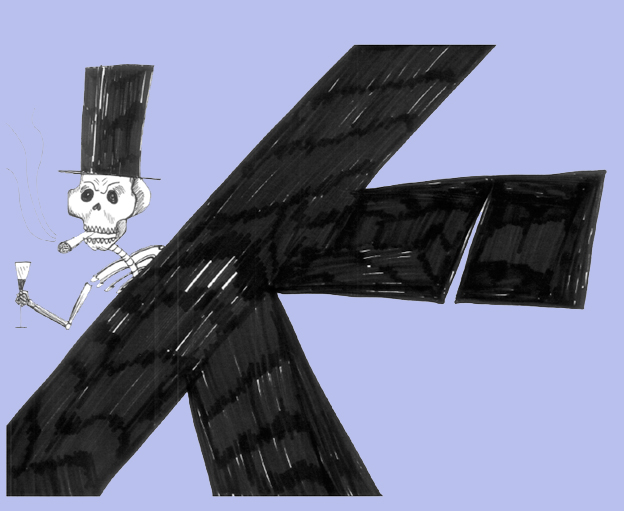
Something like the rippling and grating of a gigantic metal surface. A powerful southerly had been blowing since the night before. The parking lot was sweltering and deserted, strange even for mid-August. The intense heat and high-pressure air had seared the asphalt, and pockets of the surrounding vegetation had turned a burnt, black-brown color. It was Sunday afternoon and the color of the sky was changing to gray. The neighborhood was encircled by a wall of leaden-blue clouds from the west. Droves of shopping carts formed a large metallic snake at the fore of the parking lot, where a lone old man was sitting on the patio of the attached outdoor café. He looked like a wax figure of Pope Ratzinger with sunglasses. He was completely still. The wind made an eerie sound as it hit the metal blocks. Raising her head in search of its source, she saw the enormous first letter of the word KONZUM tottering precariously above her. She was startled out of her hypnotic gaze when two arms encircled her waist tightly from behind. Out of nowhere a large plush mask appeared right in front of her face. It looked like an elephant and a mutated insect put together. The mask was followed by two young women. They were giggling and taking pictures of her with their cell phones while the monstrosity rubbed up against her with its giant plush antennae. I’m a sqeeter, uttered a voice behind the mask. ZZZZZZZZ. I’m an old geezer. He refused to let her go. The two girls, in a fit of hysterical laughter, shoved two promotional samples of Autan insect repellant into her hands. The geezer-sqeeter kept pricking her torso with its thick stuffed snout, which hung from its head like an elongated nose. She felt totally disoriented in the midst of the ambush. The man lasciviously poked her with his snout, while the girls riled him on, ooo you reeeally stung her now, you really stuuung her, and doubled over with laughter. She hastily tore herself out of that sudden promotional assault, threw the samples of Autan on the ground, and rushed toward the store, its open doors welcoming her like a life raft. The monstrosities remained on the other side of the door. Through the glass, she watched their grimaces and convulsions like scenes from a silent horror film.

The supermarket was empty and cold as a grave. The usual advertising jingles—“Because you deserve it” and other tame melodies—were inaudible, as was the beeping of barcode scanners. At the entrance stood a cardboard cutout of a smiling Konzum mannequin with slightly larger-than-human dimensions. Below the cardboard man were the words: Konzum—with you through life, and next to him, a semi-faded sign that read: Konzum—the Croatian word for supermarket. The only other living thing in the entire store was a single cashier—a woman on the stockier side, with wavy blond hair, and barely taller than the cash register in front of her. She was holding a small bar of chocolate and preparing to take a bite.

She didn’t notice anyone else entering the store. She directed her gaze toward the ceiling, where the aisle markers were hanging on chains and lightly swaying. Meat, Dairy, Cleaning Supplies, Bakery, Beverages. She picked up a smaller red basket; she didn’t intend to buy much, just a few essentials to hold her over until the next day. Yogurt, milk, some pastries. She looked around, hoping to see other shoppers. The floor was dirty, covered with litter and footprints—like they hadn’t cleaned it for days. The shelves didn’t sport their usual abundance. Many products were on sale because of their imminent expiration date. There were no fresh fruits or vegetables, aside from blackened bananas and one soft and wrinkled cucumber. The Agrokor retail conglomerate was struggling to stay afloat, even though this was the only grocery store in the neighborhood. With all its former splendor, Konzum was going the way of the long-vanquished Diona, Slavija, and Union stores. Their shelves had gaped empty as though ahead of an impending cataclysm, before the stores closed for good. Here, too, only books remained plentiful on the rotating displays in front of the checkout lanes. They gleamed in their glossy plastic wrappers, some with a promotional gift—sunscreen lotion or a packet of instant coffee.

As she walked along the rows of empty shelves, she felt uneasy. She hoped at least one other person might be here, not counting the cashier and herself. Every now and then she’d glance between the aisles toward the cash registers. The cashier had hardly moved and was so motionless that she looked from a distance like a St. Nikola chocolate figurine in its red-and-green wrapper. In fact, the cashier seemed to be chomping down on just the one. An entire candy aisle was filled with those chocolates, left over from the holiday season—various Santa Clauses and Easter Bunnies trademarked by Milka and Lindt, reindeer, eggs, and chicks. She was heading in the direction of the bakery when she heard a sudden noise. A man in a red Konzum uniform with a cart full of beverages passed in front of her. He was starkly thin and bony, barely a pale shadow of the cardboard mannequin. He anxiously heaved the beverages like an ant with an oversized load and nearly knocked her down with the overburdened cart. At the last moment, she stepped back, in the direction of a fridge filled with cured meats. She paused in front of the fridge. It too had surprisingly little to offer. Just a few factory-sealed packages of prosciutto, mortadella, and ham. Overcast with shades of gray and brown, the squashed pieces of meat had not a hint of the appetizing bright pink color shown on their packaging. Most were plastered with yellow labels that said CLEARANCE in red letters. She stared at the meat as if they were clues to a mystery. She paused. She stroked the packages of squashed meat.

She was startled out of her thoughts by a trembling voice whispering to her: – I see you like munching meaty treats? – It was the old man she had seen in the café outside the store. How had she failed to see him enter the store and approach her? He had on an unbuttoned shirt and tinted glasses. She didn’t want to stare, but she thought his fly was open. She remained frozen in place. And then he asked her: – And do you like granddaddies?

Feeling as if she’d just been slapped in the face, she headed in the direction of the dairy aisle. The old man moved slowly and feebly. She shoved a fruit yogurt into the basket and took a carton of unrefrigerated Tetra-Pak milk from the stack. She only needed to grab some bread and then she’d get out of this rotten place. The silence in the store was abruptly interrupted by a turbo-folk song, which sounded like it was being played on someone’s phone. She soon heard humming, too. A young man she recognized from around the neighborhood had entered the store. He looked about eighteen and spent most of his time out on the street. He often turned people’s heads by belting some song on one of the benches in the park or shouting at passersby. She suddenly heard the music stop. The young man cursed his phone and the battery. She’d almost reached the bakery department. The young man, who wasn’t in her line of sight, periodically shouted something. Screw this or that thing, motherfucking noodles, coffee, frying pans, and on and on, with every item that was out of stock. He mentioned the head of Konzum last: fucking Todorić, screw that thieving fucker. From his voice, she could tell how far away he was. Then he began to hum what she presumed was another turbo-folk melody. At first so quietly that she couldn’t make out the words, then more and more loudly. His voice echoed throughout the store. Kon-zu-ming, Shit-ting, Ex-pi-ring, we’re livestock ready for a-slaughtering! She stood in the bakery department while the voice of the young man drew closer and closer to her. Kon-zu-ming, Shit-ting, Ex-pi-ring. In the bakery, there wasn’t a living soul. There were no fresh pastries, no bread. Only a few vacuum-sealed American toasted loaves with long shelf lives. Kon-zu-ming, Shit-ting, Ex-pi-ring. She waited at the counter, hoping someone would appear. The young man was getting closer and closer—he’d spotted her now and was heading straight towards her. Kon-zu-ming, Shit-ting, Ex-pi-ring. She stood motionless at the counter. The young man stopped humming and walked right up to her. She could feel his breath. He smelled like cigarettes and neglect. She turned and looked into his eyes. The whites were streaked with tiny red lightning bolts. His face looked strangely bloated. They stood there, side by side, in tense silence. All of a sudden, an eruption of noise—of glass bottles, at the other end of the store. She shuddered. She broke into a run in the direction of the checkout. The aisle markers above her began to sway. At the checkout, the cashier was gone. She heard only a voice that asked her if she had a Multiplus discount card. She looked around in wonder for the source of that faint female voice. It seemed to be coming from a pile of chocolate crumbs on a red-and-green wrapper lying on the counter.
 

Translator’s Note:

Dear Pests and Other Creepy Stories (Poštovani kukci i druge jezive priče), published by Profil Knjiga in 2019, is a short story collection by acclaimed Croatian writer Maša Kolanović. The twelve stories dramatize the creeping spread of capitalism in contemporary Eastern Europe. Woven together through the metaphor of cockroaches and other “pests”, the stories expose the absurd and sinister facets of otherwise familiar situations—like going to IKEA, signing up for a phone plan, or vacationing on the beach. The stories move from the aggressively gentrified Adriatic coast (hyped as the setting for Game of Thrones) to Zagreb’s socialist-era high-rises (home to many of Kolanović’s characters) and its metropolitan outskirts (where refugees are detained from entering “Europe proper”).

Alongside “Unending” (story #7) (which appeared in Asymptote) and “Dolls from Chernobyl” (story #8) (which appeared in Two Lines Journal, in Vlad Beronja’s translation), the story published here—“Konzuming” (story #10)—offers a nightmarish sketch of the mega-chain grocery store Konzum, where a young woman confronts an onslaught of sexualized brand advertisements and factory-sealed packages of processed foods. Since late-capitalist forms of empire weaponize bad poetry, the story’s violence unfolds to the accompaniment of cutesy jingles and catchy slogans. This soundtrack not only poses a significant translational challenge—in late-capitalist terms, an exponential one!—but also reveals the story’s global reach in an era of privatization and hyper-concentrated wealth.

“Konzuming” explicitly names Ivica Todorić, the once-CEO of Agrokor, which he would later transform into the joint stock company Konzum. Serving as a leading player in 1990s privatization processes, Todorić came to monopolize the retail industry, becoming one of the wealthiest men in the region. As its acquisitions billowed beyond manageability and private pockets were more readily lined than store shelves, the company was forfeited to the Croatian government. While federal authorities charged Todorić with embezzlement, those charges were later dropped. Kolanović’s story bravely bears witness to this recent history.

 

Maša Kolanović is an award-winning author best known for her genre-bending works of fiction and poetry. Her books include the poetry collection Pijavice za usamljene (Leeches for the Lonely, 2001), the novel Sloboština Barbie (Underground Barbie, 2008), the prose poem Jamerika (2013), and the short story collection Poštovani kukci i druge jezive priče (Dear Pests and Other Creepy Stories, 2019). The latter received the 2020 EU Prize for Literature, the Pula Book Fair Audience Award, and the Vladimir Nazor Prize for Literature. She is an associate professor in the Department of Croatian Studies at the University of Zagreb.
Ena Selimović is a Yugoslav-American writer and co-founder of Turkoslavia, a translation collective and journal. Her work has appeared in Words Without Borders, Los Angeles Review of Books, The Dial, and World Literature Today, among others, and has received support from the American Literary Translators Association, the American Council of Learned Societies, and the National Endowment for the Arts. She holds a PhD in comparative literature from Washington University in St. Louis.


 BACK TO ISSUE

 BACK TO FOLIO

Kelly Gray

Wood Thrush As Ghost //as text//as diagnosis//as journal//as erasure//as poem//as Reddit forum//as haibun//as list//

Before: There was a thrush on the windowsill
when the man came in.
After: The thrush built a nest in the desk.
Before: The girl had not felt her body.
After: Therefore, could not feel the atrophy.
Before: Body parts hinged by tendon to bone.
After: Body parts separated to float up and
away. Hanging among the rafters of the old
home. A side of leg. An esophagus. Her
collarbone caught on ceiling. To lament the
organ lost: song.
Before: She had woken to the call of the thrush.
After: She could not sleep and lay in bed waiting
for the eh-oh-lay of the bird who saw it all.

Dilapitatia
Disorder Class: Obsession

    1. 1. Recurrent and persistent thoughts about dilapidated homes
    2. 2. Finds it difficult or unable to control the need to be near dilapidated homes
    3. 3. The obsession is associated with three or more of the following six symptoms (with at least some symptoms present for more days than not for the past 6 months)
      1. a. Fantasies of trespassing, insists that property and home are constructs
      2. b. Xanthoria and Ramalina, jarred
      3. c. Breaking glass windows to enter abandoned homes, only to undress in the roofless kitchen
      4. d. A box kept in the trunk of car containing a pinhole camera, a crowbar, a collection of wooden doorknobs
      5. e. Not able to accommodate
        responsibilities such as work and family, instead, takes long road trips with maps marked with yellow
        squares
      6. f. Collects antique field guides

April 13th
Some people collect porcelain figurines. Some, tin photographs of other people’s families. Or masks once used for rituals, now hung on

walls, showcasing the flex of ownership (over
the dead! over the liminal!) interwoven into
elements of design, from kitsch to bohemian.
But to collect an entire home through a dark
chamber, this has required a certain
relationship to the art of trespass. {etymology:
cross, traverse, infringe, violate; euphemism
for “to die.”} The jump of a fence, a parallel
amble along a darkly wooded driveway, a swift
turn into a backroad pullout, waiting till cars
have passed. Behold!

The obsession with the dilapidated is as much
about eco-reclamation as it is about
recognizing the house as body. Roofs with long
exhales. Moss giving way to a shingled
meadow. Swifts in the chimneys, bats in the
walls. Doors contracted within their frame,
summer swelling, winter unhinging.
Sometimes, a vine like a fist around a throat,
and a long wait as the home drops to its knees.
Once, nothing but a brick fireplace. Out of its
mantle I found a sprawling rosemary bush, and
below, the dirt heavy hearth now a den of
foxes, little bones littered at the mouth.

I take to photographing the yellow ones. Butter
and flaxen against calla lilies and ferns. Creamy
peelings, the first owner’s (now dead, body in
the rural cemetery, unmarked) preference for
climbing roses, camellias now left unchecked.
The trembling arches of Japanese Snowballs
and in the backyards, the beautiful garden
sheds hugged by hellebores and foxgloves.

When I was a child there was a yellow house.
On the painted porch, a small wooden rolltop
desk that belonged to the original inhabitant of
the home. The rolling feature stuck open, each
stacked drawer exposed, like the inside of a doll
house. Here, I placed my findings from the
garden, the fragment of a fox skull, a northern
flicker’s orange feather, the tail of a lizard.

It’s hard to say when the nest was built. Grass,
sticks, mud, like a cup for eggs that eventually
appeared, speckled and river green. I recall that
the yolk was double hot in my mouth. I gulped


as the wood thrush pair looked on, my swallow exaggerated while they watched, though I can’t recall when or what they watched taken from me.

Erasure of Field Guide, Cornell’s All About Birds

Find This Bird
You’ll likely hear the Wood Thrush before you see it. The male sings his haunting, flute-like ee-oh-lay song from the lower canopy or midstory of deciduous or mixed eastern forests. To see Wood Thrushes, look for them foraging quietly on the forest floor and digging through leaf litter.
Conservation
Wood Thrush are still common throughout the deciduous forests of eastern North America, but populations declined by approximately 1.3% percent per year for a cumulative decline of about 50% between
1966 and 2019, according to the North American Breeding Bird Survey. Partners in Flight estimates a global breeding population of 12 million and rates them
14 out of 20 on the Continental Concern Score. Wood Thrush is included on the Yellow Watch List for birds most at risk of extinction without significant conservation actions to reverse declines and reduce threats. It is one of the most prominent examples of declining forest
songbirds in North America. Some of the steepest population declines have been along the
Atlantic Coast and in New England states where Wood Thrushes are most common. Habitat fragmentation on their
breeding and wintering grounds is thought to be
one reason for their decline. Fragmented habitats may have
lower quality food choices or expose nests to predators such as raccoons, jays, crows, and domestic or
feral cats, and to the Brown-headed Cowbird, which is a nest parasite. Wood Thrushes are also susceptible to the
effects of acid rain, which can leach calcium from the soil, in turn
robbing the birds of vital, calcium-rich invertebrate prey. In Central America, the loss of
lowland tropical forests shrinks their winter habitat.
Behavior
One of the first songsters to be heard in the morning and among the last in the evening, the male sings his haunting ee-oh-lay song from an exposed perch in the
midstory or lower canopy. He uses the song, which
carries through dense forest, to establish a territory that averages a few acres. Within days, a female initiates
pairing by enticing him to chase her in silent circular flights 3–6 feet above the ground.
Between flights, the prospective pair shares a perch. After pairing, the female helps defend the territory from intruders. Low-level threat gestures like breast puffing, crest raising, and wing and tail flicking are usually enough. Among the alarm calls they give is a distinctive, sharp machine-gun-like sound that can be heard from far off. Wood Thrushes

forage by hopping through leaf litter on the forest floor, tossing leaves to expose insects or probing for litter-dwelling prey. While foraging, they frequently bob upright for a look around. Pairs are socially
monogamous, though extra-pair copulations are common. New pairs form each year.

The Wood Thrush is a consummate songster and it can sing “internal duets” with itself. In the final trilling phrase of its three-part song, it sings pairs of notes simultaneously, one in each branch of its y-shaped syrinx, or voicebox. The two parts harmonize with each other to produce a haunting, ventriloquial sound.

…………………………………………………………………………….

When I found
the little bird
dead, I baked pie

after pie and hung
banners from one tree
to the next

to celebrate the flight
in my hands,
the speckle breasted enthusiasm

of someone else,
who like me, wants
to mate

in the dark shadow
of bramble.
I find myself alive again

in the quiet
between a song
and your ears.

Lay down, let us
burn our mouths
on hot berries

as the death of birds
flies in and out of us,
my bed covered

in field guides.


Reddit Forum, Dead Poets Bird Club r/hereandnow: Only recently discovered birding while dead. I have noticed that the silence after bird song feels more pronounced now that I am dead. I am trying hard to listen, to let go of being heard. There is a tension between poet and birder, I feel an unresolved reckoning.

Newtotheblue 3 yrs ago
The bird teaches us to embrace death without reservation, to fully come dead to the
beauty of the moment.

                Deadlikeyou 41 yrs go
                Find ecstasy in death, the mere sense of dying is joy enough.

                Warriorontheotherside 5 yrs ago
                Wherever the bird flew with no feet,
she found trees with no limbs.

little_deaths 13 yrs ago
I want to death and feel all the shades, tones,
and   variations    of    mental    and    physical
experience  possible  in  my  death.  And  I  am
horribly limited.

Dancinginthisworld 52 yrs ago
Hold fast to death, for if death die, death is a
broken-winged bird that cannot fly.

               little_deaths 13 yrs ago
               I am not mystical: it isn’t/As if I
thought it had a spirit.

               Irisintheafterlife 6 mo ago
               Does it matter where the birds go?
               Does it even matter what species they
               are? They leave here, that’s the point,
               first their bodies, then their sad cries.
               littledeaths: I trespass stupidly. Let be,
let be.
Warriorontheotherside 4yrs ago

It is not our deaths that divides us. It is our inability to recognize, accept, and celebrate those differences.

{In order of appearance: Mary Oliver, Emily
Dickinson, Audre Lorde, Sylvia Plath, Langston Hughes, and Louise Glück. The words alive, live, life, living, and dreams replaced with death, dead, and dying.
}

The wood thrush sings twice at once with a
double syrinx. From one side of his throat: to
mate. From one side of his throat: a mate.
Imagine being the last bird singing after all the
snails have disintegrated. The corrosion of
home is always multilayered. If you have a
home with rafters, look up. The spectral is heat
bound, rising. The wood thrush welcomes the
cowbird. Plays the ventriloquist. Trills metallic.
The looping call of
thrush, caught in the mouth of ghost,
ringing split throated


An incomplete list of thrush
species looping with types of ghosts:

                                                       Swainson’s
Myling
                                               Nightingale
Dullahan
                                            Hermit
Muma Pādurii
                  Green-cheeked
Genius loci
                          Scaly
Bodilima
                    Siberian
Egg
                 Song
Soucouyant

Kelly Gray lives in the redwoods, nine miles and seven fence posts away from the ocean. Most recently, her chapbook The Mating Calls //of the// Specter was selected for the Tusculum Review Chapbook Prize. Her writing can be found in Cream City Review, Southern Humanities Review, and Pithead Chapel, among other places. She is the recipient of the Neutrino Prize, the ArtSurround Cohort Grant, and a participant in the 2023 Kenyon Review Poetry Workshop. Gray’s collections, Instructions for the Animal Body (Moon Tide Press, 2021) and Tiger Paw, Tiger Paw, Knife, Knife (Quarter Press, 2022), can be found at writekgray.com.


 BACK TO ISSUE

 BACK TO FOLIO

Ridwan Fasasi

PLOTTED SADNESS

for my brother & others who were killed during the protest on
10th October 2020. may they find the peace they fought for

             i
IT’S 4 O’ CLOCK in the morning. & the news is still new
with guilt of names it has swallowed the night before.
dawn is in a mouth full of prayers—the adhaan is calling
us back from our death: ٱلصَّلَاةُ خَيْرٌ مِنَ ٱلنَّوْمِ ,ٱلصَّلَاةُ خَيْرٌ مِنَ ٱلنَّوْمِ
(meaning: prayer is better than sleep, prayer is better than sleep)
i am outside—pondering how each breath, like a bird,
is taking flight in our throat. i look at my brother’s body, cold
and bloody. silent, too—the birds are no longer birds in his neck.
they have all flown into the silence of men who brought him
in saying: he is a patriot, he drowned while saving his country
from a turbulent wave. Dear Lord, the origin of wounds is never the flesh,
it’s the hand holding a weapon. & I just can’t forgive this betrayal.

             ii

—maybe, the bullet will come seeking home in my
bones, too, eating through whatever chunk of flesh will
put up a shield against its entrance. maybe not.

             iii
truth is: i still carry my brother’s wound, fresh and
bloody, on my flesh. a bullet wound is only a
broken river recreating itself in our reflection.

             iv

it’s the evening before: say 6pm before the
bullet seeks home in your body. before the night becomes filled
with its essence. the sun is reclining towards darkness.
& the birds are no longer birds—they are seeking refuge in our grief.
there’s no hope for the current generation, you had said,
looking at me like you meant me. your eyes press against the
sadness walking in mine. three days before, we had listened to
the news of young men been harassed by policemen. some shot. & killed.
i close my eyes all day to see what it means to live as a corpse.
if i walk through the darkness in my eyelid, can i feel myself dying?
what is death if not a form of hunger, visible only to the closest
hour? what is dying if not how to step into the wilderness of want,
into the glory that one will burn forever?

             v
this is a poem

this is a poem in which a body interviews its death.
this is a poem in which every metaphor is about the vanity of survival.
this is a poem about my country.
this poem is a stage
             & i represent all the death that has passed through my body as survival.
             the music playing in me is silence & my body is opening doors wherever
             the silence touches
                           what i mean to say i am listening to the sound of ghosts
             as they break through my body into a field of purple lilacs, stained with reds.
                           what i mean to say is i’m listening to my brother’s last word
                                                                      before his skull broke into bullets:

             stay here, where every hand is a second closer to safety

 i’m watching his blood turn into the red sea—stretching towards me. the music
has stopped but this poem knows no end. silence, they say, is what begins and end
language. forgive me, i’m still a budding poet, what do i know? 

             vi

IT’S BEEN 4 YEARS. but isn’t it true
that sadness means the body will only forgive but not forget
the closing of wounds, will not forget the betrayal
of the flesh? i & my new lover, sits on a table at a beach festival—
quietude like a stray bullet finds its way in between us.
A girl beside our table, pointing at me says, i am surprised he is finally going on a date,
she continues, i have known him for years, he is always weeping for his country
or his dead brother or his sister in his poems. & i mean to say to her:
tell me more, girl. tell me about how every poem blooming in my head is a
deserted road & i’m a lonely river following whatever path calls it home.

             vii

Note to reader: while writing this poem/ a war is replaying in my
head/ & the sound of my keyboards sounds like the continuous triggers
of a gun/ i promise/ i’m not hearing the sounds of ghost again/ i am
only begging the rain not to rust the garden of roses behind my
window/ same way i am asking my country/ to spare my ghost another
year of survival/


(un)becoming a country: Nigeria as a case study; August 2023

after reading Angel Nafis

1912: a country was named after a river, named
             after drowning     say, nigeria   and     we plunge headfirst
                             into the terror of foreign tongues
                                           1960: the guest left,  & we sang country    the guest
                                                           left, & we sang water    the guest left & we drowned
in our violence    how do you glorify a river if not to drown in its existence?
                                                           1970: the war left us, the war stayed with us    say, the only way to
                                                           stay alive is to become one with the violence that dwells in us.
                             2020: my country does not spare a flickering thing   my country
             men, flickering things, moths dancing near a fire      in other words,
we are scared of death but home seems so familiar

                                           2050: My grandson says to put
                                           home on a gamble      & you will
                                           learn how to carve stars into the
                                           barren sky
                                           .
                                           .
                                           .
                                           .
                                           .
                                           .
                                           .
                                           .
                                           .
                                           .
                                           .
                                           .
                                           .
                                           .

                                                                         this poem will not end because i intend to end it with hope


Fasasi Ridwan (he/him), whose works have appeared/are forthcoming in Eunoia Review, Lucent Dreaming, Afrihill Press, SprinNg, Kalahari Review, and elsewhere, is a Nigerian poet of Yoruba descent. He is a member of The Swan Collective. His works have been shortlisted for the SprinNg Annual Poetry Contest, Splendor of Dawn Poetry Contest, SOBAF Poetry Slam, and also longlisted for the Akachi Prize for Literature. Find him on twitter (sorry X) @Ibn_Yushau44.


 BACK TO ISSUE

 BACK TO FOLIO

Arianne True

Bedtime Story: the girl and the quarter moon

Preface

I grew up on folk tales, not fairy tales at bedtime.
a whole different set of stories and ways
to tell them. different expectations. different lessons (I learned).
my bedtime stories spoke of women finding ways not to be sacrificed.
what I learned was
people will leave you on the cliffside to wait for a monster
who is coming to devour you—for their own peace
what I learned was
people will think some things are too big to fight and
the way to get by in their shadow is to let women die to sate it
what I learned was
most of the time, you save yourself.
you find a way to be clever or fast or loving enough
to stop the monstrous cycle right before
its jaws close around you. what I learned was
not to expect to be saved but to know
that if I was good enough at the right, constantly-changing things,
I could save myself, most times.
this carries through.
still doing it. just learning now how to
maybe stop playing this story out.
I am tired of having
to find the right way to be good enough
to be allowed to survive. to claw out my own place
with the paw I struck from the monster
you left me out to feed. tired of the blood
running down my body, from my body,
leaving my body, leaving my body curled and confined
in the softest things I have, but still, the nest I make for myself
feels some days more like I have padded the trap
I was set in as bait. lined the metal teeth with batting.
they’ll still bruise, you know, through that. can still break
an unsettled bone. some days it feels like there is no way
I leave the trap and it doesn’t spring.


Chapter 1

a quarter moon is a half moon, there
are two ways of thinking about it. a full moon
could be called a half moon, on the logic of
a quarter moon – halfway through the cycle.
there is no half moon, officially.
whatever that means. which officials.
sounds like there are two half moons to me.


Chapter 2

I see half of the face that faces me.
we call it quarter because of the cycle,
the whole cycle of new moon to new moon,
and this half-face marks the one-quarter point.
                                                                                           but
reading up on quarter moons, looking at diagrams
of moon cycles, her face emerges in a new way, and the
quarter I see is the quarter of the whole spherical moon, she round
in every dimension. that far dark. calling her half-lit face quarter
an answer, maybe, to the half we never see. this is what
persuades me to quarter moon over half moon. all we can ever have
is half the moon. and quarter moon reminds us that half the time,
all we see is just half of that.


Chapter 3

autism gave me words for things I was already doing: like masking.
it applies elsewhere too, though, has shown up so many places in my life full
of nooks, full of places someone else wants to forget. this is when,
masking is when, you feel safer hiding who and how you be
because the society you live in has convinced you
             (often accurately – this part stings the most)
that if you do not hide you, Bad Things will happen. to you.
around you. because of you. and your not-hiding. it says
do not show your autism. your adhd. your POTS, EDS, the other three,
or what ill looks like in your body.

do not show the way joy needs to fizzle out every finger when you get overwhelmed with it.
do not show how some sounds, like the sound of the scrape of that knife on the ceramic
plate, sizzle through your brain, pain searing and shaking you from the inside,
literal pain, do not show it. do not show how hard it is to walk
during a POTS episode, how hard it is to walk with long Covid,
how hard it is to walk with two feet injured from your connective tissue disorder.
do not need a wheelchair. do not look how you look when you need
a wheelchair and don’t have one. do not look how you look when you need.
do not let the expression drop fast from your face when you run out
of the energy that holds it on. do not hold an expression (out of habit)
past when you feel it. but do learn to fake the expressions that make other people feel
comfortable. like the ones that make them feel like you’re listening
because it’s how they listen, but keeping up the Listen face takes all your focus
and you don’t hear a word. learn to hold these faces all day: at school, at work, around strangers, around people who insist that you’re friends. do not let these expressions drop.
no matter what you miss. do not let them drop.


Chapter 4

before I learned what masking was and what I really sounded like inside,
with the filter of everyone else scrubbed off and my flesh close to bloody from it,
before then I only ever showed a quarter moon. it was all I felt allowed.


Chapter 5

there are two quarter moons: first and third. quarters.
one is easy to see, it’s an evening rise, visible around sunset.
the other, third quarter moon, is up when we are, most of us,
asleep. the full moon is so bright with sun that the details
get lost in the glare. this tenth-bright half-face quarter
is where you see the relief of craters. I am told even binoculars
will get you there. and see, when it is just the first quarter moon
you see, that sunset staple, you will only know the ridges
on a single side, one half of the moon. [interjection – one quarter.
still half her face is always back, back away, you will only see half a half.
it’s simple math. you may never see the other craters. and
that can be okay. but you may never know that’s all you have.
and not knowing is a different story.][whispered: you did not
realize I was missing so many essential somethings.]


Chapter 6

one eye cannot see the other. on a human face, on a moon face.
I didn’t know I was missing the other half, the other half a half,
either. it’s these past few years that have retaught me myself,
the selves I found and then lost as a child, a tween, a teen,
a twenty-something. even in private, I did not have me, not—
not even close to the way it is now. this gift of my own fullness,
access to a more actual me, one of the many strange presents
illness has left at my door so far. I am glad I chose to unwrap.


Chapter 7

but where did I really learn to hide?

who taught me the world wasn’t safe for me?

an inventory of me in the context of this country provides a case for hiding:
             my tribes survived based on how well they became invisible to white eyes
             the statistics for women receiving violence remain shocking
                           a recent trip to australia drove this home:
                           I noticed myself telling men when they were doing wrong
                                          and yelling at them when politeness didn’t work
                           and for once, didn’t fear for my safety. a miracle.
                           on returning home, I told a female friend about it.
                           she said it sounded like an alternate universe.
             the time, less than five years ago, I had to hide in the basement of my house
                           while my drunk, violent neighbor hurled homophobic slurs at the front door.
             last fall, when I felt a new foot injury burn into life, but was walking home alone, late,
            and remembered what they tell young gazelles: they pick off the weak
                           and the sickly. do not look sickly. do not limp. you have to look strong
                           enough to fight them off so they don’t try. and how much worse
                           the pain was when I got home / from bearing all that weight.
             I’m not ready to tell strangers the inventories for being
                           autistic
                                          ace
                                                    both chronically and intergenerationally poor
             I’m not ready to talk about the intersections
             but another strange gift of illness: all this extra time I spend at home
                           is time I’m not being harassed.


Chapter 8

I don’t fault myself for hiding. I celebrate learning to come out anyway. I would like to get to make only that decision, to feel safe enough to always choose it. here is my request: consider—have you taught me to hide? you. every you. it can be smaller than you think. smaller than you think you can see. but I promise you can learn. wake up for the sunrise to see that other half moon, that other quarter, in detail. you will notice the craters. no microscope. no telescope. they are so visible when you look the right way. I have already shown you so many, close up. like this.


Chapter 9

my love is one of the first to really see the back,
the proverbial dark side of the moon, the half
that gets forgotten when you call a quarter moon
a half moon. she said she wanted to see
whatever was there. I finally believed that what was there
was worth loving, could be shown to the right people.
and she was willing to walk around, to the side
you can’t see from here, and I want to convey

how sincere this is and how much that mattered. to someone who has been taught you hide whole selves to survive or be loved. it was old and it was recent. and she said “I want it all” and I said “I wouldn’t want anyone who wouldn’t” and these are why it’s different this time.


Chapter 10

all the years of hiding and pushing through, saving yourself and finding the ways to be good enough not to be killed, living by the merit du jour,

these will run you into the ground.

my bedtime stories would always end before the heroines could get the chronic illnesses we get when we overclock ourselves to survive. illnesses we then have to hide.

the phases are a cycle. new moon to new moon. have you ever seen the whole face?


Arianne True (Choctaw, Chickasaw) is a disabled queer poet and teaching artist from Seattle, and has spent most of her work time working with youth. She’s received fellowships and residencies from Jack Straw, Artist Trust, and the Seattle Repertory Theater, among others, and is a proud alum of Hedgebrook and of the MFA program at the Institute of American Indian Arts. She lives in Tacoma with her cat, wife, and dog, and is always questing for high-quality dairy-free baked goods. Arianne is the 2023-2025 Washington State Poet Laureate. You can find more at ariannetrue.com.


 BACK TO ISSUE

 BACK TO FOLIO

Christine Huang 黃凱琳

To the poet of immigrant home-building, dislocation, feminine monstrosity, and blank space

after Jennifer S. Cheng

1

you wedged your tongue between my ribs, speaking of shadows and skeletons
I split open my body so the syllables could better haunt my crevices
flesh knows how to be porous
I have always suspended my weight to keep from being known
but all my life I have
wanted to know how to speak   

2

To feel the hot touch of an echo
To hear the simultaneous fracture of bone
To study the volume and density of the silence created by a word that could not be translated
                             (because 緣分is not serendipity, 孝順 not filial piety)
To forge from the unborn shapes angled in my throat
       a metaphor, a line
To reach a hand into a crater, an interval of silence,
and encounter a sister

3

Dear Unsayable Word,
I put the shell of my ear against your spleen, waiting for you to take on mass.

4

                forgive me           unfinished sentence
                                                                    for these were all the words I knew                               
                                                                                                                                               this was all I had

5

(                                                                                                                                                                   )

6

while I was trying to make myself disappear
envying the katydid for being able to resemble its home
I tried to tell you
that all my words were filched from half-open lips
the ends of sentences plucked from colonial tombs

you said listen
when we are trying to say the world, we are trying to say its holes1
said
the body doubles what it cannot hold2
so I let my skin stretch  tear     lengthen
the femur bend to traverse the distance between
one self and another
swallow the cuticle, a hard history
at the center: a new body


1 Jennifer S. Cheng, “Dear Blank Space: A Literacy Narrative,” Literary Hub.
2 Jennifer S. Cheng, “the impact of foreign bodies; the earth collapsing,” The Nation.


Christine Huang 黃凱琳 (she/her) is a queer Taiwanese-American writer and artist. She joins the large community of voices calling for the liberation of the Palestinian people and oppressed people everywhere, and she stands in solidarity with those struggling against colonialism, white supremacy, cisheteropatriarchy, capitalism, and all systems of domination.


 BACK TO ISSUE

 BACK TO FOLIO

EMDASH

in this hydrocortisone house

arguments gust, increase knots
till soil, host two truths and a lie:

1. all my fiction is true
2. all 卖 (mài)[1] fiction is true
3. all my fickle 身 (shen)[2] is true

here, eggs are whipped frothy
with chopsticks, bilingual morning news
booming over the crowded kitchen island.

here, you can find mama in the garden,
mornings gloved in solitude.
the hummingbirds ask her again:
what’s the hypotenuse of lonely?
against a plume of kangaroo paws,
mama sprinkles crumbled eggshells
onto various plants: fertilizer full of calcium.

it’s either used for that or for family walks,
marriage on decline, domestic pantomime.

here, filial personalities pang like canker sores.
baby mangosteen observes parents bicker
behind the banister. two shadows
blustering: couda shoudas flung.
scalding wool words of chinglish
subtitled mandarin overheard.

sometimes mama & baba garden together, armistice.
curry trellises. pick cucumbers. check on the succulents.
this tender teamwork has the sweaty seedlings relieved.

baby mangosteen learns to think cubist for survival,
renovates maslow’s triangle of needs for 开心[3]
sharing only tufts of truth to either parent,
keeps her gay shrouded beneath marine layers.

she doesn’t recall a period when she liked hugging
baba. she does recall the truculent epoch she’d fake sleep
when he’d visit her near midnight after working the ER.

here, vertebrae can’t wait to grow up
especially when splintered adults
don’t understand chromosomes

arrive knowing how to refract
not reflect, some viscous violet truth—
of mimicry, of men.


[1] sold
[2] spirit, heart, ghost
[3] open heart; open mind; jubilee 


EMDASH AKA Emily Lu Gao (高璐璐) is a writer, open mic maker, and child of Chinese immigrants. She writes to heal, grow, and decolonize. They’ve earned funding from Sundress Publications, Bread Loaf Environmental Writers Conference, Jersey City Arts Council, Minnesota Northwoods Writers Conference, and Rutgers-Newark—where they received an MFA in Poetry and taught undergraduates. She has also received a Best of the Net 2023 nomination in poetry and microfiction. For publication and performance history, visit emdashsays.com. They are Missouri-born, California-raised and based in anxiety. When not writing, she’s likely telling one too many jokes.


 BACK TO ISSUE

 BACK TO FOLIO

Young Fenimore Lee

Convergent Double Golden Shovel for Leaving the Ground in Black and White

after “Rough Landing, Holly” by Yellowcard

The plane fucking crashed. Tell me what happened when we

tumbled hard, pass-pawn, stone-cracks down tattoo arms. Hard came,

myself, until I couldn’t bear it, downed a last one. Pop-tumble down

side lantern, exactly enormous, one more time, from tip to

razor, all the way to Kansas City from Ottawa to find some watch-

man, the world away. Send it. Give it the shot I’m taking. Ignited the

combustible machine-edge, little jackrabbit of a world

gauzed up, literally spilling red from its cheeks. On a walk,

witnessed absolution in a fire deep in the sky. Tomorrow, by

mourning, we’ll be ready. Hang tight. Daze and

hang it all in the air — we’re keeping it here for all

the blaze we could find — I was told that she

was forgiving, could have been brightened, but soft-found,

fading… I forgave that way to heaven. When I was

eight years, circle in, circle out, engine burst in, find trouble

walking into a million different possibilities, each playing out in

more dimension than I cared to understand. Put it on my

fucking Visa card, yes, I’ll doubt this forever, but won’t forget eyes

Didn’t just inaugurate sound, and light, but — she…

dubious, frequently hurt-slouches out the club, calls

enormous beats flying like paper slips off walls out-

shined, tip. I’m Holly, you see, minerals and minarets claim the

starter I could never find, and I guess I forgot about you, farther,

locker stuffed with that drab outfit you’d rather have bagged — that

one time she thought I’d never last in. Trust me, turn the key I

gave you, dumpling-wrapped, somehow-trying-to-fly

gas mask, I tell you the truth, disappearing into “I”

confusion. It’s time-to-take-off or a never-ever-love,

the photographs that cushion the landing. Thought that

wouldn’t put me in an early casket, but something about that sound

didn’t give me grief. I’m trying to let go of something so glowing, so

aching, I was giving back to ourselves in some cycle of give,

in the smallest of burst-full envelopes to mail to nowhere. Me

miserable, ways, trying a place to escape to — name me Holly, one

religion, some little-death, but so much more —

that do not see, so much that couldn’t drag the line

under the blue topping an endless ceiling. From

here to eternity, we’ll always wonder about the

mechanics of activating the sky,

consuming ourselves farther than she

wanted to ask for. What did I do? I’m just Holly, I just pulled

the lever, and a catastrophe unrolled beside me —

tear this fucking glassy skyscraper — this terror shine —  down

and get off the damn drugs. I’m trying to imagine some damn lights in the horizon tonight,

but unfortunately, God wouldn’t let our sins go, wouldn’t let

anything into that fitting room with that black dress — and her

telling me, “just cut off the back” — “just backless” — “just breathe” — “just go.”


Young Fenimore Lee (they/them) is a Korean-American kid, poet, and music journalist whose work has appeared in beestung, DIALOGIST, Entropy, Existere, filling Station, and other publications. Indie rock, emo, post-hardcore, and other music genres are important influences in their writing. They are editor/founder at Jellybones Mag (jellybones.net). They received a BA from Stanford University and an MFA from The New School. They are currently pursuing a PhD at Ohio University.


 BACK TO ISSUE

 BACK TO FOLIO

Mateo Perez Lara

Portal of Breaking Cycles

I do not want to feel the privilege in a man’s spit or in the way he says my name I want to feel his hands trace my stretch marks over brown body, cut his fingers on this glass of jagged healing when we touched hands was it that impulse to look a man in the eyes, want love not ask for love, I still think it’s so wrong, do I deserve an empty space he leaves when he goes, I want to be enveloped in a terrible dazzling thing, sometimes I explore how my expectations of violence intrude a tender moment, because even then I want a man’s revenge-love knife at my neck to slit.


Mateo Perez Lara (they/them/theirs) is a queer, non-binary, Latinx poet from California. They have a pamphlet of poems, Glitter Gods, showcased with Thirty West Publishing House. They have an MFA in Poetry from Randolph College. Their poems have been published in EOAGH, The Maine Review, The Acentos Review, and elsewhere.


 BACK TO ISSUE

 BACK TO FOLIO

Max Pasakorn

On the Incompatibility of Homosexuals

The first time I laid finger on a man’s abs,
I thought I hit bone—the world excavated
and pried away. Only its depths remain,
blubless and vulnerable, a body’s bare rack,
an illusion of a treasure trove. I expected
to dig deeper before I faced the residues
of his absence, but there we were: hollow
like wily trees, stretched too far sunward
our pinkies could barely touch. I watched
the ridges accordion as he heaved, muscle
isolated and splitting. A body striving to be
lonely because that was the language
it knew: live long so he can prosper. He needs
to prove to God: he worked hard so he could die
late. After sex, he shows me his FitBit,
how he loves the numbers climbing
up his arm like ants. His sweat
cascades down his concave stomach.
For a while, he looked more beautiful
than he is, body bone-sharp and angled,
a life spent whittling oneself away.
Why, I asked, would you starve
and treat it an achievement? The aircon’s whirs
meld with his stomach’s grumbles. I don’t know,
he says, suddenly aware how we were nothing
alike. I had given up appeasing boys and God.
From young, they demanded too much from me
too fast. I could not keep up. All I had left
was an appetite for self-preservation.
So I ate and ate and my stomach grew
and my body deformed
and I continued to live.


Assimilation Pantomb

I’ve grown up here searching for home
in this city teeming with square holes—
certain and cutting, everything molded
by the music of muscled machines.

In this city teeming with square holes,
I unravel my flesh to fit in. I am starved
from the music of muscled machines
side-eyeing me silly till I say: Yes,

I chose to unravel my flesh. I am starved
because I deserve it. My perfect future is
side-eyeing myself silly till I say yes
I will work hard for the shadow I want

because I deserve it. My perfect future is
sweeping its way into all you stand for.
I will work hard for the life I want.
My wrinkles will own this land.

I will sweep away all I have stood on,
a grown-up here searching for home.
My wrinkles will own this land,
certain and cutting.
                          Everything will be mold.


When I See Myself on the Big Screen

Euphoria of unkempt hair, of flat nose, of small and sleepy eyes;

Euphoria of sleeping early; of learning how rest rests upon my extinguished skeleton;

Euphoria of toying with immortality, of sleeping in and in and in;

Euphoria of knowing I am made up of acid and my assumed angelic purity is an inference
            from straight people infected by binary thinking;

Euphoria of waking up from a nightmare where I am stuck in a constantly farting toilet;

Euphoria of putting things together in the mirror to encourage diplomacy: a dress and its
            heels, a face and its doll body;

Euphoria of being too much for everyone but actually just enough for me;

Euphoria of exposition, of being lit excellently by sunlight, of being the eye, the camera and  
            the model all at the same time;

Euphoria of being alone for a hot minute, of a quiet day against the city where laughter leaves
            the mouth as homing darts;

Euphoria of enclosure, of a fan that spins above me because I need it to, of being well-  
            maintained and ill-advised;

Euphoria of memorising curse words from the dictionary so I carry blood bullets in my
            tonsils for whenever I need it;

Euphoria of photographic evidence of glow ups, of cheap 1980s eyeshadow looks slayed
            again in 2018;

Euphoria of upskilling despite not getting SkillsFuture credit from the government because
            I’m not Singaporean enough;

Euphoria of making a Sim named Max and flirting with a random buff man at the gym and
            suddenly we’re married and sharing a house with 8 other Sims and it’s actually all
            really overwhelming so I start over and start over and start over;

Euphoria of wearing a graduation gown and feeling it billow around my ankles,
            of knowing that time onstage is the only time I am allowed to be photographed with a dress;

Euphoria of an Avatar remake where queer children can learn to bend gender, of making
            apparent the magic inside us;

Euphoria of justifiably thinking that children are not at all cute but kinda gross, partly out of
            necessity so the straights will not label me (or any other gay person they meet on the
            street) as a paedophile;

Euphoria of mortality, of endings, of clean slates, of factory resets, of recycling;

Euphoria of sequels, of continuity beyond the last cut.


Max Pasakorn (he/she/they) is the author of creative nonfiction chapbook, A Study in Our Selves (Neon Hemlock Press, 2023). An alumnus of the Sewanee Writers’ Conference, the Lambda Literary Retreat for Emerging LGBTQ+ writers, and Yale-NUS College, Max has previously lived in Singapore, Thailand, and the United States. Max’s writing has won the 2024 swamp pink prize in Nonfiction and the Chestnut Review Stubborn Writers’ Contest in Poetry. Their works are in Split Lip Magazine, SUSPECT Journal, Foglifter Journal, Eunoia Review, and others. Read more at maxpasakorn.works or follow Max on Instagram at @maxpsk_writes.


 BACK TO ISSUE

 BACK TO FOLIO

Erinola E. Daranijo

Honeybees (XIV)

XIV. somewhere within my mother’s
body, a colony of honeybees have built
an apiary.

XIII. behind her, i watched as they carried
the nectar across the garden,

through the flowering field, and flew into
her.

XII. after a month, the FBC tests reveal a
low blood count. XI. anaemia the doctor
says

through his checkered socks, oval glass
frames, and stethoscope-bound neck.

X. i would go home and open the
internet to find the causes.

IX. the biopsy reveals cancer. VIII the
doctor is unsure.

VII. the honey begins to leak out the hive
VI. coating everything it touches

in a golden yellow film. V. in the coming
days, we’ll find a way to

release insecticide into the nest. VI. the
scans reveal the bees

have nested somewhere between the
cerebrum and the cerebellum.

III. this morning, the nest cracked and
leaked forth more golden yellow.

II. most of the worker bees are dead
now. I. the queen though keeps growing

fatter, and fatter, and fatter.


Erinola E. Daranijo (he/him) is a Nigerian writer. He is the Editor-in-Chief of Akéwì Magazine, and the author of the micro-chapbooks, An Epiphany of Roses (Konya Shamsrumi Press, 2024) and Every Path Leads to the Sea (Ghost City Press, 2024). He splits his time between the ‘cities’ of Ibadan, Lagos, and Cape Town. Say hi on X (formerly Twitter) at @Layworks.


 BACK TO ISSUE

 BACK TO FOLIO