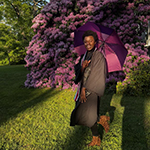
Apollo Chastain

how to make a print
some printing tips
some helpful printmaking tips

Clean, the lines, and clean, your fingers, too, or else you peel the thick page from where it’s lying and it gets marked up. This can mar the design, obviously, like when a snubbed lover throws scalding water over a beautiful young man’s face, so that no one else will want what he does not have.

Wash your hands. With the right equipment, you can make 200 prints in an hour. You never know how the type in the old machines might have been used before… a campaign cartoon against FDR’s third term, for example, his nose shown bigger than it really was: a crook and a joker with a mannish wife. Or other uses.

When you meet someone, only on very certain occasions is it acceptable to ask how sick they are, such as when you’re about to have sex. Even then very often the only thing you can do is trust they were telling the truth.

Things come back. Even the stories scrubbed out of history leave small traces you can assemble if you are good at piecing together the most oblique fragments in medical records, prison sentences, the writings of parish priests on a small island somewhere no one looks.

Imagine a youth sleeping with a great lord’s wife. Their bodies are found dozing afterwards in the late afternoon light. Imagine that their bodies, then, after the lord slaughters them for their transgression, are buried in the same grave, the woman’s body on top because she was of noble blood. This kind of catastrophe can be avoided. When printing, be clean!

Remember that in a printmaking workshop, there is an abundance of light, and big windows, and broad tables, broad like the shoulders of farmers. Things feel cleaner when they are bright, and have the space to spread out. Mountains are clean when you look at them from far away and cannot see the many deaths of songbirds there, and the small girl screaming inside a wooden house.

Wash your hands before you come up against the stately metal of the presses. Manipulate the letters and the plates, there, to show a picture on an empty page the way a baby’s blank mouth is filled with teeth. No blemishes on the paper. No ink from other jobs on your hands. A print is clean when the lines avoid any reduplication or blurring – things show up only once.

If the ink your finger smudged was on the edge of the paper, far away from the design, there is a solution. Take sandpaper and scourge the page until it flakes tiny dry flecks, like skin. Gradually shave off the top layer where the ink primly sits. All that’s left will be a slight roughness barely discernable except until you take a finger and rub it across the page, feel the sensitive tip shiver.
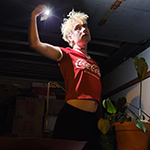
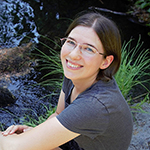
Apollo Chastain (he/they/she) is either crying in the club or crying in the archive. Apollo’s work has been supported by Tin House and the Smithsonian Institution and appears or is forthcoming in journals including poets.org, Prairie Schooner, Meridian, the Michigan Quarterly Review, and Foglifter, among others. They are the recipient of an Academy of American Poets College Prize, nominee for a Pushcart Prize, and an MFA candidate in poetry at Washington University in St. Louis. Visit them at apollopoet.wordpress.com, or on Instagram @apollo.chastain.


 BACK TO ISSUE

 BACK TO FOLIO

Desiree Remick

Dreams, State Violence, Windchimes

after “Fate, Federal Court, Moon” by Anne Carson

Dreams about studying cuneiform. Dreams about using the wrong side of the knife to scrape bread. Dreams about loss. Dreams about bodies that are not sexual, but feel sexual. Dreams about a road that goes nowhere. Dreams about meeting the president and asking him, do you know how many people you’ve killed? Dreams in which my friends are deported. Dreams about doctoring. Dreams about chemistry. Dreams about the moon. Dreams about my father as a doctor, a chemist, an astronaut, a president, a poet, a man who hates poetry. Dreams about waking up from a dream only to realize the dream continues. Dreams in which the colors run together. Dreams about trees. Dreams about telling my dreams to Freud, and he says all dreams about the moon are about my father. Dreams about loving someone I don’t recognize. Dreams about failing to recognize someone I love. Dreams in which my friends are teargassed on the streets of L.A. Dreams about meeting Annes: Carson, Boyer, Lamott, Frank. Dreams about crying in airports. Dreams about saying goodbye. Dreams about windchimes. Dreams in which one of the Annes invites me to a funeral. Dreams in which I’ve never been to a funeral. Dreams in which my friends are taken away and interrogated. Freud says all dreams about state violence are about my father. Dreams in which one of the Annes says, I’ll come back tomorrow when you’re feeling more yourself. Dreams about being myself. Dreams about being someone else: my neighbor from childhood, my most beloved friend, one of the Annes, a grey cat, a father. Freud says all dreams about my father are about love. Dreams in which the Annes tell me the pain of unrequited love, which every lover has experienced, and we gather in a circle and hold hands, we weep, we comfort each other, I ask them does life get better after a loss and they tell me they can’t tell me, no one knows, one of them says what kind of loss and I say I can’t put it into words because the loss is still growing, the worst of the loss is as yet only imagined but I dream about it every night, in smoke and the sound of bullets, in Salvadoran prisons, in American concentration camps, in the eyes of my friends, my beloved. Dreams about going to funerals. Dreams about a poem.


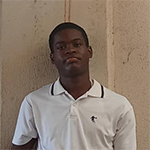
Desiree Remick holds a BFA in creative writing from Southern Oregon University. She is also the fiction editor of Nude Bruce Review. Before going to college, she taught fencing, picked cones for the forest service, and worked with a partner to translate poetry from Japanese to English. Her writing has won awards, most recently Bacopa Literary Review’s Free Verse Poetry Award, and has appeared in Thirteen Bridges, The Avenue, Westchester Review, and other places. Find her on Instagram @remick_writes.


 BACK TO ISSUE

 BACK TO FOLIO

Daniel Echezona

Visits.

my homeland could be anywhere if you just take me.
—James-Ibe Chinaza.

I can laugh with you again      if you do not come  bearing glistening pebbles for eyes.
Remember, two years ago        how bright the fire in which you drowned
how sharp the language of your dying    how precise your wavering,
as though something within the city of your bones   says I will be clean in death
I will fade away neatly.       I swear never to hurt you, so I will not talk
about the rotten fruits I planted atop your grave
or the portrait of the pregnant wolf     which I sold for half its price.
Remember ten and five years ago,      how easy the breaking of all you loved
and how you said       everything I loved and lost comes back to me.
Father, who taught me to transcribe the language of desire,
to cling to the tired rope of a dwindling prayer, to make you real by calling your name.
Father, I still wear your name.           You who no longer remember the beauty
of a wrinkled evening.
Do not break yourself into bits     to confuse death; dare to mend the brokenness
that the language of our love never managed to detect. Always, you come to me
wearing the face at peace with stillness       like a creditor leaving a debt at half-a-price.
I who am eternally at debt to my insane self     I who may never eternally
offset this grief.  Come you always to relive the withering flame of this debt, this memory
these names of my progenitors     inscribed on the streetwalls of my heart.
Father, to come again        do not sit in the eyes of a beggar tempting my poor coffer,
do not fit yourself into the scream of the Christmas chicken
daring me to kill you again.
Do not come as the blood covering my wound      or as the shadow of my pet dove.
I can hug you again so passionate        you feel a relocation of your heart
But don’t come again as the laughter of the old man next to me in a bus
Or in between the lines of an academic form asking name of parents.
Do not leave your footprints on the door of loneliness       or your medal
on the neck of a malnourished earthworm.
Father, will I see you on the tip of a breathtaking crescent    in the woody advent of dawn
when I, leaving the bed you once lay, walk to the river
And wonder how many of these stars you now own.
When you come, stand at the door of my dreams, and in your cotton-soft voice
whisper, come let me take you to a home made of love


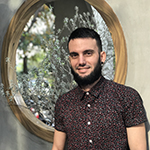
Daniel Echezona is a writer and student of the University of Nigeria. In 2024, he was shortlisted for the Wanjohi Poetry Prize. His works have appeared or are forthcoming in Afrocritik, ANMLY, Brittle Paper, Neon Origami, and elsewhere.


 BACK TO ISSUE

 BACK TO FOLIO

Tashiana Seebeck

To Participate in Queer History

Six feet below the white picket fence
we fuck like ginkgos. We fuck like germination.
Bodies split down the raphe
with life, sliding into fresh green air.
We’re screwing unseriously, mid-laughter,
roots churning up the concrete. We’re screwing
up the civilized parts of town because
our memories are tendrils looping back
ten thousand years before town meant fence
meant garden. We heard it through
the grapevine: before we were born
we built mountains out of premonitions.
If we keep digging we can hear the barritus
of everything we’ve thought or dreamt.


Benedictions

When I believed in a god I was better
at fear. Things like mornings frightened me

           awake, long yellow light hanging sickly
                                    and snow-thick over the suburbs, fog

            lit briefly and mysteriously from behind.
They say sunrise should be

                                              quiet but it goes off like a bomb: Walking,
                                 crushing dew which crushes on grass,

           thinking I’m alone until the orioles shriek again.
I have faith now in the light

                       that turns your eyes
                                    warm and deep,

           the brick slick with ice, the certainty
                                    of finding fingers in your glove,

                        the shy dove making a snuggery
                        in the eaves each day before dawn.


Tashiana Seebeck (she/her) is originally from Southern California. She holds a BA in linguistics from New York University and an MFA in poetry from Colorado State University. Her work can be found in Digging Press, West 10th, and on poets.org as a 2024 Academy of American Poets University Poetry Prize recipient.


 BACK TO ISSUE

 BACK TO FOLIO

JC Paz

Directing Julia Varley

Last night I was starving and decided to boil my certificates with salt.
Most people live on the illusion of dead-end professionalism and degrees.
I rather take the split coffee from a rotten liver &
light a match across my grades.
Soaked the cigarette in the sink and collect my ashes in vain
to feed the lamp across her ragged eyes.

Starving; and the freezer was a homework yet to be done.

Maybe staging Mayakovsky isn’t that hard once you’ve eaten
your education,
all what’s left is melting ice on the pan,
& she comes in naked and you want to fuck her and realize it’s only an image
of your sick mind
(she left after lame sex to be with her family)
& the mirror looks back at you but you are not looking at it.

I too was a blurring stain on a smoke canvas,
so I empathize with half sketched peoples
who tear the puzzle behind reflected stares.
Black ink is a bitter spice_with the right diplomas could make a tasty shawarma.

Re-composing / De-composing …
Этот вечер решал —
не в любовники выйти ль нам? —
… the dilated body on an craving stomach
is a risky game when you like paper cuts

You are in the spot light again.
Steam lamp is famine.
Text is dry.
Curtain rags smell of bacon break.
Lines fading in corporeal hunger.
Light is coming and I have to memorize the script     shut

Страсти крут обрыв —
should get some sleep
отойдите.
Oh shoot!


Homenatge als amors eterns, com el de Vicente

(…vull que el meu cos es confongui amb aquesta terra de València, que és l’amor de tots els meus amors)
V. Blasco Ibáñez

hi ha toros tan gallardos com Manuel
jumped off the tip of my tongue 
as I witnessed 
the red-stained arena tremble to
the cries of the filthy crowd

el follet de Lorca inhabits there ajar
in the twists
unparalleled of the torero
boots petting the thirsty arena
slowly as a contortionist sneaks
himself in the very
core of the plaça and the ànima mediterrània 

the big band on the upper tier march contretemps sinister, jigged; 
duo tempo 
one same ànima
the matador gentile-acclaimed stalking
the toro, beast humiliated, raging the steel

the breathing of the toro snorts through my nose feel pain through its bloodshed eyes move to the beat of the trombone (though I’m sitting still glued on the cement tier) torero no longer owns me know the rest trust that shouted olés are also meant to me have one last breath to scratch his jacket once more torero is such a gentleman gives me a few seconds to strike again allows me to trample on his barret with the dirt from my legs to get my final olé it’s his attempt to bust my ego to be forgiven to deserve or not to deserve the blessings of Donya Sol is the question 

bone dust from toro ribs is the clay used to echo the church tower calls and toro horns the most sacred chalice on high altars to savor sang de toro eucharist

there isn’t any art as pure and brave (la resta són farses, això) than a red tango on the arenas of Valencia I think we are all whooped with the final step.


Julio César Paz is a Cuban-born poet and educator, raised in a small city by the sea. He lives in Hanoi where he shares his love of poetry through regular workshops with his students. He finds joy and inspiration in taking slow motion walks with his pet turtle Antigone after school. He has co-authored Lo que aprendí al otro lado del mundo with Nuyorican poet Carmen Bardeguez Brown, and Three Poets / Tres Poetas. His most recent collection is Trínculo’s Handwritings. Find him on Twitter @jcpazwriter.


 BACK TO ISSUE

 BACK TO FOLIO

Samia Saliba

poem in which i fantasize about taking direct action against my neighbor’s eagle screech motion detector

uninhibited by the visibility of daylight i take a baseball bat to the neighbor’s motion detector at 1:46 pm on a saturday!! i didn’t even know i owned a baseball bat until it appeared in my hands!! as i approach the beast it lets out its awful screech!! CAW!! CAW!! CAW!! listen to how afraid it sounds!! when it comes down to it every system has a weakness!! this one crumples as i rip my bat into the ground!! a violent crunch, then the thudding recoil!! it feels so good to hold the answer in my hands!! the tape keeps playing but its call is weak and skipped!! Cr-xx?AW!! Cr-xx?AW!! Cr-xx?AW!! at the sound the neighbors start pouring out of their homes to see what i have started!! some look reserved, others relieved!! i pound the bat another time into the soil, so hard it leaves a mark like lightning!! the tape plays again, even quieter, and i notice the neighbors coming closer, crossing the threshold of the yard!! some of them carry their own weapons!! fists and hammers and rolling pins!! as they approach the site of rebellion the tape gasps out a feeble call!! c–aw!! c–aw!! c–aw!! we descend on it in unison as if our actions were choreographed!! in perfect rhythm we whack the shit out of the all seeing eye, the piece of shit creature!! we take our turns!! hammer, rolling pin, BAT!! hammer, rolling pin, BAT!! until it is broken into shards as small as sand!! we carefully sweep them up, so that the birds will not swallow them, though this would be poetic too!! mechanical cannibalism!! against the artificial!! we never utter a word!! when the creature is smashed there is no more sound!! when we walk down the street it belongs to us again!! that night we hear music pouring out of every window!! in every language!! the rhythm of every song sounds exactly like: hammer, rolling pin, BAT!! hammer, rolling pin, BAT!! when we crawl into our beds, we can finally sleep at night!! we can finally sleep at night.


york street

            after Hala Alyan

it was all so easy. someone brought a costume hat and we all took turns wearing it. it was halloween. we assumed we were on the same side. your roommate made garlic bread. i drank coffee at 8 pm and woke up sweating. i lived in 7 apartments. you lost all your clothes in a fire. another roommate kept guns in the house and didn’t tell anyone. i kissed a man who picked nightshade flowers. i didn’t expect it. he burned incense in his room to hide the smell. egyptian jasmine. he gave me an american fever. i never told him that i knew about the girl in his bedroom but i told a confessions page on the internet. i told you too. when we lived in different cities you called often. i liked driving even at night. i drove somewhere in seattle i had never been to find something i never found. then you called me. you said do you have a minute? i sat on a concrete block and tried to listen. that summer you were stuck above the sunset. you told me something awful about the men we used to love. i could have cried but i didn’t. i dried it all up and went storming down york street. chemical honey pouring out of the basement. even now i don’t cry much. god, forgive me, if you called i wouldn’t pick up the phone.


Samia Saliba is a poet from Washington State & a PhD candidate in American Studies & Ethnicity. She is the author of the chapbook conspiracy theories (Game Over Books, 2025) and her poems appear in Split This Rock, Apogee, AAWW, Mizna, and elsewhere. Find her at samiasaliba.com.


 BACK TO ISSUE

 BACK TO FOLIO

t.r. san

we used to be runaways in an abandoned airport

i dreamt teenage sweat in the alcove of a highway toyota, i dreamt dreaming
then waking to three ryuichi hiroki movies in a petulant row, arguing so self
-interestedly, i dreamt not a single soul airported anymore but me & my girl
friend & her girl friend, duty free-dwelling past tragedy flights, i dreamt we
lost to time by losing time on each & every other, i dreamt a soldier breaking
in on a brisk walk, green uniform unseeing, i dreamt all the real unrealized
with us the exception, i dreamt a world unworlding, i dreamt somehow arca
& xinlisupreme & tracy chapman survived, empty shelves brought to reverie
by live voices on the speaker, from the outside, cooing in, i dreamt it cool
to run all day on carpets never molding, speed heartbeat my almost-cum,
half a death, i dreamt how every flag in the ex-tamwé railway station ends
up strangling each other in the isolating heat, draped over dead soldier
windows, or down under college basement stairways, in the mess
of dripping, filthy summers: the buzzzzzzz of nothing, or on backroad
signposts, faint & neonlit at night, begging godgodgod please make me
happy here, at the least, if you won’t want to take me out. & so i found
myself waking to no movie– it was such regret, the most peace i was
ever at, a mourning– so damn me that i once thought myself free.


sex memoir abecedarian

a hand, always a hand. we are hand-first creatures.
boys become women when pressed right. of course we know, we
caved in, already. yes, the cave had sagging muscles, had never
driven a car, walked a marathon, fed on sand, or fucked itself
enough to start to fear, what is left, what is it,
for me, in this state, with this state—but the cave took it
gracefully, had a most beautiful collapse, failed tour en l’air:
hard crash fireworks, stage of rocks, all unwittingly violent.

i wanted only to write something beautiful, and be
justified in its memory. like believing wild fire for what it is. or
knowing ash as once-treasured. frankly: unsimple delusions. the body
landscapes itself with every terrible history, new contours fucked by new
mythologies, wounds a 21st-century everything-map—but the cage, it stops.
now i’m 4’11” of malnourishment. now i’m a liar. now i’m
open water and every ship i own is on happy water, party foals stumbling
piss-poor into cold lovers. and yes, so yes, the body seeks touch: see how

queers love autoerotic asphyxiation—how queers love walking back on their
raucous, repugnant, ratty words. once i met a woman who hurt me
so kindly i despised her for it.
took my dished-out masochism and fled two summers
until i could burn myself, moaning for her softer hands, praying to a
voyeur god. and let’s say it like it is—they raped me and so
would god, if he wasn’t so ashamed. o sex therapist of our heavenly father—

xylophone the thought, as you do, into his
yielding holes. unlearn shame—open up your
zipped-up heart. want it. want. what more to ask?


t.r. san is a Burmese & transgender lesbian poet, loosely based in Yangon. their work can be found in The Offing, The Cincinnati Review, Best of the Net, & elsewhere. read & reach @thoushallkill on Twitter/X or trsan.carrd.co.


 BACK TO ISSUE

 BACK TO FOLIO

James Joy

Peeling

here i stand 
peeling 
layers of skin. 

reticent faces 
fold beneath my blade, 
silence pruning 
my fingertips to wrinkles. 

acrid fog 
taps open my nose, 
burrows beneath my eyelids, surges down my throat, 
tickles the tender rings, 
brims at my lips. 

tears 
and my gaze pools 
at the hollow chair 
on my grandfather’s dining table. mahogany heirloom of war 

the knife is sharp. 
pungency stings 
like vengeance 
etching him into my face. 

Softly, it chokes, 
flooding from inside.

Peeled

bits and pieces 
burning, 
sienna, 
soggy as sore eyes. 

you stick to my tongue, 
astringent, 
like his name.
it stings 
it bleeds 
when momma 
calls me by it. 

tugs at my umbilical cord
until i am child again
bare feet racing 
through her father’s garden
our footprints 
big and little. 

the aroma crawls 
out the cracked window
gesturing us home. 

guka’s food warms a smile,
giant peals of laughter. the
sun peeks, 
round as his belly, 
untucks his shirt, 
full as a child’s heart.

Peeling

everything survives 
or surely dies 
trying.


James Joy is a non-binary Pan-African poet. They graduated from Duke University with a BA in International Comparative Studies and Gender, Sexuality, and Feminist Studies, with a minor in African and African American Studies.Their multidisciplinary work connects the legacies of history in the present. James Joy’s writing has been featured in Black Youth Project and Migrant Roots Media with work forthcoming in Kalahari Review, among others. Outside of writing, James Joy enjoys museums, Black cinema, jazz, and reading magazines. Feel free to contact them on their website.


 BACK TO ISSUE

 BACK TO FOLIO

Aida Bardissi

when liberation comes

“the old world is dying, 
& the new world struggles to be born: 
now is the time of monsters”
— Antonio Gramsci

it will creep through the back door / slam the front one shut / it will feel gaseous / and putrid / thick with what nows / and what ofs / when liberation comes / the rivers will remember their names / the soldiers will feed themselves on the soil caked into their boots / women will flock to their balconies / polluting the air with cries of joygrief / teenagers will kiss under bridges / some will write furiously, bleeding / and some will sit on the street / all of us will cross borders / sing old love songs / burn something to baptise a new earth / the whole world will become a memorial / the whole world already is


your body is my [google] maps

after & with lines from Nizar Qabbani

at night I cyberspace my way thru memory
searching all the journeys we took to one another

TEXT: I miss yr nighttime قصيدة [1] to  
the beauty mark on my collarbone
my jugular thick & knotted; nile-like.
you bite into me                           wa I flood

TEXT: I abdicate from history & inhabit the tale of
antar wa abla                 wa qays wa layla.  for you,
I tell a story of love untethered to soil.

TEXT: LIBERATE ME! (from yr silence)

TEXT: code me into yr archive as a CHANGED BORDER:
sinai of memory                          a reclamation. a spectered victory.
I am a haunted lip on the precipice of violence.

TEXT: I am the oldest capital of grief.

TEXT: DIGITISE ME! (I would live in yr software,
            glitching quietly)

TEXT: wear me between dimensions, 7bb
I will sigh my scent through yr screen
yr fingers trace my topography so well

TEXT: (
                                                                           )
un-delivered.

THE ADDRESS YOU ARE TRYING TO REACH
CANNOT BE FOUND.


[1] Meaning: ode; ancestral dedication to tribe or lost love.


Aida Bardissi is a doctoral student at NYU, where she researches
Egyptian film of the mid-twentieth century and its concerted national project(s), specialising in race, indigeneity, and the faultlines of belonging. Her poems have been featured or are forthcoming in Mizna, Palette Poetry, Apogee Journal, and No, Dear Magazine. She calls on you to devote yourself to the daily practice of liberation.


 BACK TO ISSUE

 BACK TO FOLIO

Thi Nguyen

Sestina

I knew Bố Mẹ before I knew Vietnamese. 
But when Vietnamese didn’t sound like English,
I ran away to the sexy sounds of a Spanish sueño –
living la vida loca in Los Angeles with a Chicano;
loving his mixed identity, I showed him my tongue, 
telling him Thi in Vietnamese means poem

The way he said izquierda, I heard a poem purr,
compared to the bluntness of “take a left” in Vietnamese.
Bố Mẹ’s speech belonged to a busy marketplace, my tongue
wagged behind, so I sharpened it with Spanglish
slang, spitting “chilliando” to impress my Chicano, 
who also loves corridos, such a sueñolindo!

Bố Mẹ asked, “What’s a sueño?”
but I’m too preoccupied, writing this poem, 
“Go ask Leo. He’ll tell you. He’s a Chicano,”
I responded. But they wanted it in Vietnamese.
Since neither of us knew, we said it in English,
“Like the American dream,” as we rolled our tongues.

Just kids, they took a chance, holding their tongues,
escaping while mosquitos slept, for their sueño, 
bearing me on US soil, speaking broken English, 
a language alien to my grandfather’s poems: 
Ông Ngoại who wrote in Vietnamese,
but his verse looks chino to a Chicano,

to Leo, whom I love because he’s Chicano.
He speaks Spanish with silver fluidity, yet I’m tongue-
tied talking to Bố Mẹ. Too long I had pushed Vietnamese
away, not knowing because of it, Bố Mẹ achieved their dream.
It’s the boat that pulled them to shore, the poetry 
that transposes their story into this sestina in English.

I used to only want to know American English, 
but American Spanish sounds so sexy, Chicano. 
I know too little Vietnamese to write Bố Mẹ a poem, 
but it’s not too late to bend and fold my inherited tongue,
remembering to say, “Please and cảm ơn,” so we may dream 
in the same language, laughing together in Vietnamese

to combine their Vietnamese with my dream-
boat Chicano, creating a new name, a new tongue
for a thi I’m writing now in Tiếng Anh.


Glossary of Terms

after “Glossary of Terms” by Franny Choi


Thi Nguyen is a California native, born in San Jose from Vietnamese refugees, and currently lives in Los Angeles. She received her MFA in creative writing, focusing on poetry, from the University of New Orleans (UNO). Her poems ruminate on issues of identity, family dynamics, and the passage of time, and have appeared in Ghost City Review, Frontier Poetry, The Indianapolis Review, and elsewhere. Outside of writing, Thi enjoys watching reality television and learning magic tricks. You can check out her website at thinguyenpoetry.wordpress.com.


 BACK TO ISSUE

 BACK TO FOLIO