
[The ground was wet at dawn]
The ground was wet at dawn. All night it rained but she hadn’t heard the dripping in the drainpipe. She’d been submerged in a dream, where the hero missed no opportunity to fondle the girl he had rescued from the fire. Someone else ruffled her hair. She woke up, no one by her side. She touched her pelvis, then the bed. She had to change the sheets, but before doing so, she stayed there a moment looking at the stain as if at the sky.
[El suelo amaneció mojado]
El suelo amaneció mojado. Toda la noche había llovido pero ella no escuchó el goteo en el canelón. Estaba sumergida en un sueño, donde el héroe no perdió la oportunidad de manosear a la chica que había salvado del incendio. Alguien más rizó su cabello. Despertó. Nadie estaba a su lado. Tocó su pubis, luego la cama. Tenía que cambiar las sábanas, pero antes de hacerlo, permaneció un rato mirando la mancha como si mirara el cielo.
Translator’s Note:
I met the poet Guadalupe Ángela while learning Spanish in Oaxaca, Mexico. An educator through and through, she invited me to translate some of her writing, to bring my love of poetry to my language study. After I drafted each translation, Ángela and I talked through the work together, ensuring I understood the original and she understood the translation choices. While most of her work is poetry, this piece comes from a collection of flash fiction she published in 2009 called cuchillitos, which translates to “little knives.” This untitled little knife deftly, simply showcases many of the themes woven throughout her work: girlhood and womanhood, power and sexuality, growing up, changing bodies, and our interactions with the natural world. The protagonist’s own growing, her changing body and mind, are echoed in the natural world by the ground, by the sky. The simplicity of these side-by-side images—the dreaming mind, the wet human body, the rain, the sky—called, we thought, for a near direct translation, allowing readers to encounter these juxtapositions and make sense of the echoes in their own way.
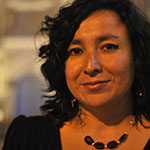
Guadalupe Ángela (1969-2020) was a prolific writer and beloved teacher from Oaxaca, Mexico. She published several books of poetry, including Hiedra de luz (2004), Conchas donde guarda la jacaranda sus semillas (2009), Poemario de las vírgenes (2013), A lápiz haikús (2013), and Autorretratos de una joven bailarina (2019). Her work is part of several anthologies and has been translated into Italian, German, and English.

Yael Kiken teaches writing and literature at Howard University and lives in Washington, DC, with her family. Zarpamos is her debut collection in translation.
 BACK TO ISSUE