
Shelter
Time is a closed
circuit, prayers
don’t get to heaven.
Through the curtains
I see
the afternoon’s silhouette, where the rain
seems so much like a whisper.
I could pass all day
embezzling daydreams, though all I do
is use the window ledge as a garden,
from which I’m hateful in private.
I always doubt
at noon, above all
when I’m barefoot.
The walls are word mirrors
at which I fling
lies and truths.
The bike rusts
in a corner, its calmness
a curious eye.
At five in the afternoon
I try to convince myself
that everything will be okay, but the food
has too much salt, and my crabiness comes back.
At night
I trust my left leg, I tell myself
that music tends to taste like cardamom
that all I have to read are memories.
At two in the morning
I realize that really
I haven’t lost much.
Translator’s Note:
Atzaed Arreola is a contemporary Mexican poet, and the first thing that stood out to me upon reading his work was his meticulously calculated voice. Each poem feels like a perfectly measured recipe of sarcasm, loneliness, and hope, giving us a final product that approaches something like discovery. I fell in love with his poetry because of this remarkable precision, which he achieves so effortlessly. “Shelter” is a prime example of this precise minimalism; while it seems like not much happens in the course of the poem, our antsy narrator passes through moments of boredom, solitude, acceptance, and despair. He’s grasping at whatever he can—music that tastes like cardamom, a rusting bicycle—to find meaning. In translating this poem—and Arreola’s work, in general—I often find myself choosing the simplest option possible in order to preserve the profundities that exist between each word. For example, in the second stanza, a very literal translation would be “Through the curtains / is how I see / the silhouette of the afternoon.” But I preferred maintaining the word count to a minimum and condensing each line to its cleanest and barest version, in keeping with the poet’s constant, intentional tone. In this way, each line break and each word has space to breathe.
I am currently working on translating the author’s full manuscript, and this poem in particular lends a sense of place, of being enclosed in one’s house and, effectively, one’s own mind. Our speaker, a modern-day antihero, attempts to achieve some equilibrium in his own emotional and physical surroundings. Ultimately, the banality of the final line, that he “hasn’t lost much,” is a sort of self-criticism, effectively negating the speaker’s own invented controversies. As such, it delivers the reader to a new vantagepoint; to a relatable, honest understanding of frustration in the everyday.

Atzaed Arreola (Mexico City, 1983) has a bachelor’s degree in Literary Creation from the Autonomous University of Mexico City. His work has been published in Cuando te vuelva a ver, Ibero León (2023), Latinoamérica en breve, Gato encerrado UAM (2017), ¡Nocauts! Microrelato internacional de boxeo, BUAP (2016), Futbol en breve / microrelatos de jogo bonito, Ed. Puerta Abierta (2014), Manifiesto azul magazine, España (2018), and Círculo de Poesía (2015).
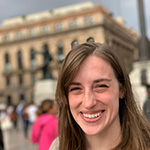
Rachel Whalen is a writer and translator from Buffalo, New York. She has an MFA from NYU and currently lives in Mexico City. Her prose, poems, and translations are published or forthcoming in Vogue, Copper Nickel, American Literary Review, and Lunch Ticket, among others. You can find more of her work at rachel-whalen.com.
 BACK TO ISSUE