
Sequential Galleries
I.
Alert to anachronistic threats,
the triad of stuffed swans remain
forever vigilant behind the glass
in a bespoke coastal marsh. Broad,
adze-scarred beams of a fort outpost
are permanently exhibited beside them,
locked forever in their glass-eyed
parallax. As for me, I take on and shed
an oscillating stiffness. The museum
offers a lancet view from high windows
out to the living sea. An intrusive pattern
leaps from the records: martins hunted
to nil, then sea otters, then beavers.
The artifact is drafted in a violent
violet hand. In the artful dim,
my hyper-aroused pupil dilates
across the pelagic surface of my iris,
bracketed by pale scars
like breaching white whales.
II.
Frozenness and the eerie
trance state of portraiture lends
a stinging but timeless quality
to the exhibit. Mugshots have
a similarly artful pull. When I peer
through the speckled fan, my headache
eases and I can read the text efficiently
and correctly. The foyer’s limestone floors
are over one hundred million years old.
They encase the compressed memory
of an ancient sea with ammonites
and a lone belemnite forever inching
across the floor. I carried rocks
in my right-hand pocket for some time,
most of them relatively young specimens
of the glacial till, but some quite ancient.
In one photograph, the grit of sleep
crusts stiffly in the man’s left eye.
III.
The Vessels have travelled thousands
of miles and years to rest here
against adobe crenelations.
The museum’s signage is directed
to them and not me. I sense an integration
of purpose in these figures who have
undertaken an epic homecoming.
We carry our language gene somewhere
on the seventh chromosome but it
is not always retrievable. Some of these
clay pots must have wondered if they
would ever hear their language again,
some must have felt certain
they would die under strange fists.
Goldfinches eating crowns of thistle;
symmetrical patterns acknowledge
and beseech rainfall. Those who shattered
have been artfully mended. Each lode
where a bone has been broken
is somewhat more robust than before.
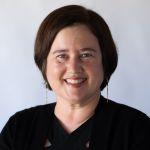
Laura Da’ is a poet and teacher who studied at the Institute of American Indian Arts. She is the author of Tributaries, American Book Award winner, Instruments of the True Measure, Washington State Book Award winner, and Severalty. Da’ is Eastern Shawnee and she lives in Washington with her family.
 BACK TO ISSUE