1
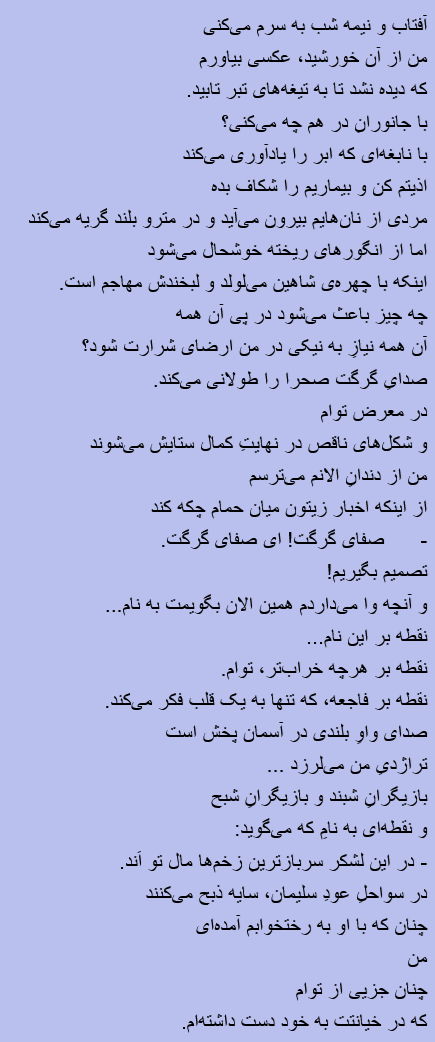
You turn the sun and midnight into my head
so I, from that sunlight, can take a photo
that’s not been seen until you shine on the blades of axes.
What do you do with wild animals?
With such sharpness of mind that reminds the clouds,
harass me and crack open my illness.
Manliness comes from my bread outside and cries in the tall metro
but finds happiness from spilt grapes,
wriggles with a falcon’s face and its smile is aggressive.
What does it cause in the wake of all that
all that need for goodness in me that becomes the fulfilment of wickedness?
Your wolf’s voice elongates the desert.
I am exposed to you
and the imperfect forms are praised with ultimate perfection.
I am afraid of the teeth of my now
of the news of olives dripping in the middle of the bathroom
— The tranquility of your wolf! Oh the tranquility of your wolf.
Let’s decide!
and whatever compels me right now to say to you by the name of…
a dot on this name…
a dot on anything more ruined, I am you
a dot on catastrophe, that only thinks of one heart.
The sound of a long letter vav spreads through the sky
my tragedy shakes …
the actors directed by the night and the actors directed by the spectre
and a dot by the name that says:
— in this army the most open fire wounds are yours
on the coasts of Suleiman’s oud, they slaughter shadows
like you who came with them to my bed
I
am so much a part of you
that I had a hand in your self-betrayal
1
3
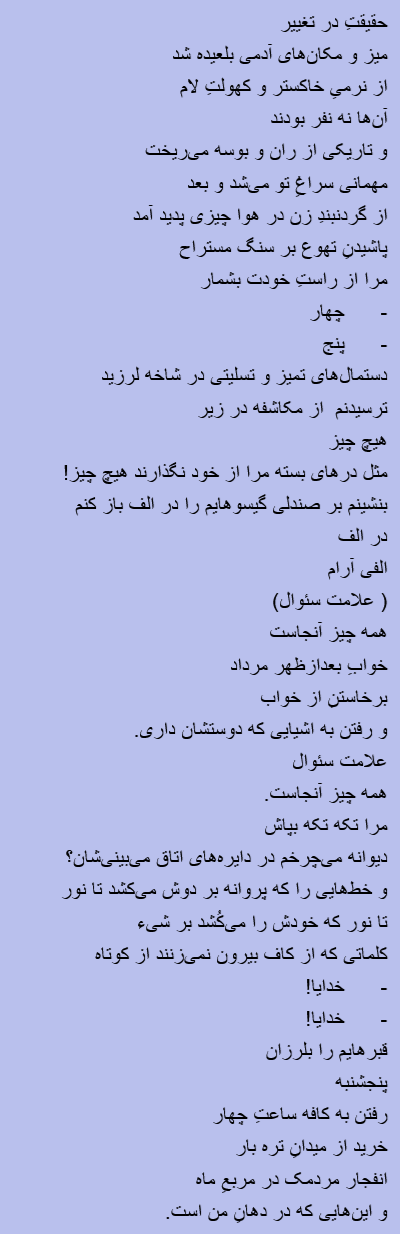
A truth in change
the table and mankind’s places are swallowed
from the softness of ash and the aging of the letter lam
they were nine people
and darkness was pouring from thighs and kisses
the party was searching for you and after
something appeared midair from the woman’s necklace
the sprinkling of nausea on the lavatory’s rock
count me from your right-hand side
— four
— five
clean handkerchiefs and a condolence shake in the branch
my fearing of discovery underlying
nothing
let nothing leave me to myself as closed doors do, nothing!
Let me sit on a chair untie my plaits into the letter alef
into an alef
a calm alef
(question mark)
everything is there
an afternoon nap in Mordad
emerging from the nap
and going to objects you like.
Question mark
everything is there.
Sprinkle me piece by piece
I spin crazily in circles of the room do you see them?
and lines the butterfly draws on the shoulder until light
until light kills itself on an object
words that don’t shortly spew from the letter kaf
— Oh god!
— Oh god!
Shake my graves
Thursday
going to the café at four
shopping in the fruit and veg market
the pupil’s explosion in a square of the moon
and these things that are in my mouth.
3
6
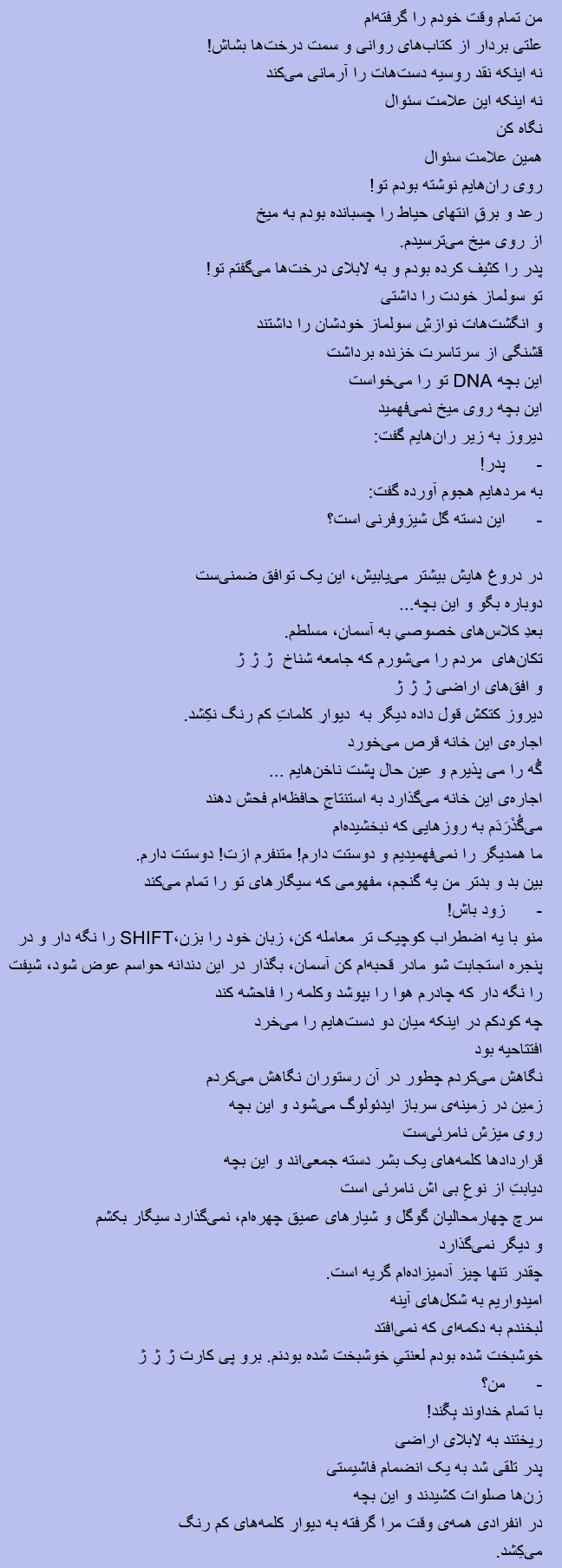
I have occupied all my time
go pick a reason from psychology textbooks and piss towards the trees.
It’s not a critic of Russia that idealises your hands
it’s not this question mark
look
the same question mark
I had written on my thighs you!
I had glued thunder and lightning at the end of the courtyard to a nail
I was afraid because of the nail.
I had dirtied my father and kept saying among the folds of trees you!
You had your own Solmaz
and your caressing fingers had their own Solmaz
beauty removed the reptile from all over you
this child wanted your DNA
this child on the nail did not understand
yesterday they said to underneath my thighs:
— father!
They stormed my men and said:
— is this bouquet schizophrenic?
You’ll find them more in their lies, this is an implicit agreement
again speak and this child…
after private lessons in sky, I mastered it.
I wash people’s jolts that sociolo -gy -gy -gy
and the horizons of lands -gy -gy -gy
yesterday their beating promised to no longer draw on the wall of pale words
this house’s rent swallows pills
I accept the shit and while under my fingernails…
this house’s rent lets them curse the conclusions of my memory
they carry me to days I haven’t forgiven
we didn’t understand each other and I love you! I hate you! I love you.
Between bad and worse I’m a treasure, a concept that finishes your cigarettes
— hurry!
Swap me for a littler anxiety, hit your tongue, hold SHIFT and to the sky in the window be compliant make me into a son of a bitch, let my attention turn into this serration, hold shift so my chador wears the air and whores out the word.
How my child buys what’s between my two hands
it was the opening ceremony
I looked at them how in that restaurant I looked at them
the ground in the background of the soldier becomes an ideologue and this child
is invisible on their table
contracts are a collection of human’s words and this child
their type two diabetes is invisible
the Google search for Chaharmahalian and the deep grooves on my face don’t let me smoke
and they no longer let me
how crying is the only thing left of my humanity.
I hope for the mirror’s shapes
my smile for the button that never falls
I had been fortunate I had been cursed for being fortunate. Mind your own business -gy -gy -gy
— me?
Let the Lord completely rot!
They poured into the folds of lands
father was regarded as a fascist appendage
the women prayed and this child
has taken all my time in solitary confinement by drawing
on the wall of pale words.
6
8
From jinns,
from those who are compelled and the left ovary, they do not have day, night, the railway of colliding trains in cold wars and in the nostalgia of Ameneh’s[1] thalamus that bring casualties from their collective dances,
from a finger that in darkness
takes a dream among the cows,
from the unconscious of Bashar al-Assad into moaning
and layers of horizon
whose colours leap outside the factory,
from there I should have asked for a god
and the relationship between the colours in my hair like a yes, has been abandoned.
They have invoked you with intense descriptions
with the repetition of this sea, the thunderbolt becomes a spell over the city
over farms who know the number of the hungry
and with many eyes the thunderbolt possesses the body of ants on night’s cliffs.
Let the swelling rain turn
like thunder
you watch over the crack and unfasten the eyelids of diamonds
the eyelid of someone’s siren is burning
the siren of opium poppies fruitful in the genetics of my male orgasms
the siren of my capitalist Cancer
that under immigration law eats cheap hearts and rare blood
the ambulance siren of a crushed Kia Sportage
in whose news I am decomposed
with my shoulder blade of yesterday
I struggle to bring it down from that same spear
onto myself.
I have poured myself over your position with exploding eyes
a liver in teeth and a knee dripped onto a shirt
you pass over my arms to your name
you become summer and autumn
who apart from me has been so afraid of praising the mountains?
Who apart from me is nearer than the temple to you
with a child in an embrace and a dagger in love
that is nocturnal, hopeless and believes in the flowering of corn in snow?
Was that praise yours that relocated the sun to the farm?
My moving adrenaline
a beginning I didn’t see bringing you into being.
You came into being from the blind, father
cured your eyes with a white pupil
and are becoming undone with my becoming a little prettier.
Take me away from this planet’s intelligence
design a particular exile for when I tune the waistcoat
we must surpass these standards
learn the levels of access to blood
and the colour given to Dubai’s structures comes from the exposure of moaning
at last I have arrived at stronger skeletal joints
the cellular mutations are inscribed into my design
and statistical headings, in which they have bound a city to bullets,
was that agony yours Lord
or do collective massacres yawn in my child?
Let me carry a burden from hungry cells
and limit the amount of nudity to society’s measures.
Father
standing at the limit of the cells for my sight, smell and touch
a Syrian child has given the gun towards the orange of your pupil
amazed, fortunate and smiling at their intermittent measles.
Just like me,
who with the same brain grows thirsty
I see the mountain that’s taller than you
and the sea that reflects only the eternal flight of birds.
In the same way I
also
with the same brain
transform into something far away
as if you could point at me
only from far away.
[1]Ameneh Bahrami is an Iranian woman who was left horrifically disfigured after an acid attack in 2004 that was committed as an act of patriarchal and religious violence.
8
Translator’s Note
To translate a poem well, you must admire it.
When I first encountered the work of Atefeh Chaharmahalian while researching the Woman, Life, Freedom protests of September 2022, during which Atefeh was arrested for her participation, I was immediately struck with admiration for her visceral and surreal lines. As I read these poems in a local café, the sound of coffee machines and chatter dimmed and my eyes widened to make room for the panoply of images, registers, and expressive possibilities they provided. After several readings alone and with my Iranian friends, I plucked up the courage to cold email Chaharmahalian, declaring my love for these poems, and with such generosity, she entrusted me, a complete stranger, with her work.
While reminiscent of the work of Nima Yooshij, Chaharmahalian’s poems function according to dream logic since for her, ‘it is still the unconscious that issues the command for every line I write’. These poems also invoke, albeit in a more compressed form, ‘spacement poetry’ (she’r hajm), where through a series of narratively unrelated lines they create an atmosphere that deeply affects the reader.
As a result, these poems are uncontainable. They are full of movement: of being pulled, dragged, taken, relocated, or placed far away. Moving and transforming, non-linearly, across the scales of body horror, societal pressures, and intense family structures, they attempt, unsuccessfully, to escape the containment of fear, death, and darkness. Imperatives act like defiant declarations, repetitions as false starts, and enjambment like a promise of escape that in the proceeding lines ‘kills itself on an object’.
I therefore decided not to impose a conclusive narrative onto these poems — to do so would contain the uncontainable — but to consider them as a series of unfurling images. I then jumped across the poems to find fleeting connections and to ensure consistency in word choice and phrasing, only occasionally changing my translation of the same word (e.g. shakl – form, shape) to maintain scansion or sound patterns in the English. My objective was to create a visceral and uncontainable poetics that matched my first impression when reading the Farsi.
A translator can feel obliged to produce a translation that is intelligible to the target audience, but some of Chaharmahalian’s uncontainable lines can be obscure. I attempted many iterations of these lines, and with suggestions from my Iranian friends and the poet herself, I have landed on the following translations. I thank Chaharmahalian and my Iranian friends for their patience, support, and illuminations.
For clarity, I did sometimes repeat the subjects of verbs, change the word order, and even add words not found in the original, such as ‘ambulance siren’ in poem 8. For the phrase ‘sarbāztarin-e zaxmhā’ in poem 1, which puns on sarbāz (soldier) and zaxm-e bāz (open wound), I translated it as ‘the most open fire wounds’, which as a phrase does exist separately in Farsi (ātash-rā bāz kardan, to open fire); I felt using it here relays both the military associations and the openness of the wound.
Moreover, Farsi grammar does not reflect gender where u’ can mean he, she, they, it and -sh can mean his, her, theirs, its. Since the subject changes so often in these poems, rather than curtailing this ambiguity, unless obvious through context, I maintained it by using the gender-neutral they, them, their. This can be seen in poem 6 where I use they, them, their to refer to ‘this child’ (in bache) and in poem 1 where the addressee ‘came with them to my bed’.
Having translated these uncontainable poems, I understand that they can only be grasped tentatively as disparate elements rather than as works you can comfortably read in one sitting. For Gayatri Spivak, translation is an erotic act: one must know the text intimately to be able to translate it. With these poems, the intimacy has not been an all-containing hug, but the touches of a lover on your arm, your hand, or the ‘lines [drawn] on the shoulder’. These touches are electrifying, fleeting, at times disconcerting, and although I cannot hold or contain them, I am still greatly moved by the uncontainable, expansive horizons they provide their reader in the darkest of moments.
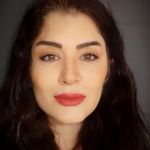
Atefeh Chaharmahalian, a poet, writer, and literary activist, is one of the prominent contemporary voices in Persian literature. She is also known as an advocate of freedom of expression and the rights of writers. Former Secretary of the Iranian Writers’ Association, Chaharmahalian has always strived to preserve freedom of thought and expression in literature. However, due to her cultural and literary activities, she has faced various pressures and restrictions. Today, Atefeh Chaharmahalian, as a writer in exile, continues her literary activities and keeps the voice of freedom and truth alive through poetry and writing.
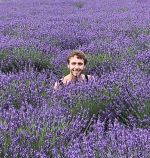
George Reiner is a poet, translator, and writer based in Ramsgate, UK, whose work can be found in & Change, The Madrid Review, The Still Point, Pamenar Press, and Green Linden Press. You can contact George by emailing him at [email protected]
 BACK TO ISSUE