
conjunction word: ( -poem=and )
/kənˈdʒʌŋ(k)pəʊIm
yesterday I saw the sea poem=and now staring at a placid pond poem=and fluttering the cherry blossoms here and there too not a bad poem=and the tufted ducks all returned to Siberia poem=and as I blankly wonder what to do tomorrow, a cute girl passes right in front of me with her dog poem=and the dog—a shiba inu—is eating something poem=and what I desire is always a blur poem=and faint laughter of lovers heard afar is us of a past poem=and now we are working toward our own happiness poem=and to live a wholesome life you need to put some effort in poem=and I am writing so much about life, somehow lost the sense of what I really want for life poem=and I do want a family poem=and yet find being alone easier poem=and still want to work poem=and want to do nothing poem=and whether to live loud and exuberant with the musics or let it go by quietly in my seat I have no idea poem=and
Translator’s Note:
し (shi) = 詩 (shi) = 詞 (shi)
and … poem … word
I see this poem by Sugawara Bin as a beautiful tapestry of mundane scenes that gently unravels itself along the repeated, consistent appearance of a conjunction word—“し (shi)”, usually used to indicate a list of parallel events, similar to the function of “and” in English—that hovers at the end of each depiction of a quotidian fragment, creating a quiet wavering rhythm throughout the poem.
However, instead of the common usage—the almost transparent representation of the conjunction word as the hiragana character “し (shi)” which has no extra significance—Sugawara wrote a homonymic kanji character, “詩 (shi)”, which literally means “poetry.” With this subtle and sly twist, each of the commonplace happenings in the string becomes, in itself, a poetic tableau that gleams through its simplicity like a raw gem.
In fact, as early as in the title, this mechanism—which moves us through the poem and makes the poem moving—has been hinted at: the original title 「接続詩」(setsu zoku-shi) also plays with the homonym “し (shi)”, replacing the more common phrase “conjunction word = 接続詞” (setsu zoku-shi) with a composite of “conjunction” (接続) and “poem” (詩).
This poetic eye—to see the folds and wrinkles in the world of caprice around us—is what Sugawara offers us through this playful poem, I believe.
The challenge to recreate such minimalistic yet complex poetic texture around the one word “し (shi)” is a challenge that has always been part of translating Japanese poetry into English: how to deal with the loss of para-aesthetic experience that comes with the innate modularity of the Japanese language. I decided to make a somewhat bold decision to actually invent a conjuncted word with “-poem” and “and” at the end of each line to recharge that sense of staccato. Still more importantly, to re-stage that slightly surreal revelation—of mundanity’s transmutation into a “poem”—only toward the end of each breath in the original piece, which is possible due to the freedom of complement placement (in this case, “poem”) in Japanese. Such magic would not otherwise easily take place within the limitation of word orders in English.
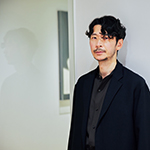
Bin Sugawara (菅原敏) is a poet whose practice moves across a wide range of forms and contexts. Alongside writing for literary journals, magazines, and newspapers, he also works as a lyricist, has given poetry readings on radio, performed internationally in Europe, the United States, and Russia, and presented work in galleries and museums. He also leads workshops in educational and social welfare settings, including at Tokyo University of the Arts.
Sugawara has collaborated with brands including Bottega Veneta, CHANEL, and Guerlain, and contributes to numerous ongoing series, including “Poetry & Painting” for ARTnews JAPAN. His recent books include “かのひと (The Dear One)” (Tokyo Shimbun, 2017), “季節を脱いで ふたりは潜る (Take Off the Seasons / The Two of Us Dive)”, and “珈琲夜船 (Coffee Nightboat)” (Raichosha, 2022 & 2024).
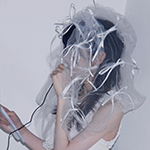
9, 煦 or Susie Zhu is a practitioner of fragility and a multi-media artist-poet who works with language, sound, rematerialized technology, time, obscurity, and ephemeral matters in many forms, including but not limited to installation, performance, and poetry in its utmost counter-disambiguation. She received dual Bachelor degrees at Brown University (Literary Arts) and RISD (Printmaking), dual MFA degrees in Creative Writing and Art+Technology at CalArts as a Truman Capote Literary Fellow and is currently pursuing a Ph.D. in English & Literary Arts at the University of Denver. She runs butter*rabbit*press and is the author of 9 poetry and artist’s books.
 BACK TO ISSUE