
33 and afraid
of the water on the bathroom’s floor
while I hold my phone in one hand
masturbate with another. Afraid of
bacteria from the burst open sewer
line swimming into potable water
pipe as old as the city. Afraid of plastic.
Petrol. News of Pterodactyls rebirthed
for fun. Direwolves sniffing diesel
and unlocking a Pleistocene memory
of genocide. Afraid of microplastic
competing with my already tired
sperm. Flagellar movements. Whips
unless asked for. Afraid of imprisonment
by glowing screens like carrot on a
diet chart of a diabetic rabbit. Afraid
of a lover asking me to stay longer
than my telomerase’s fastidiousness
to keep my life in check. Afraid of
being unable to rent a refrigerator
in the middle of summer. Ice cream
dripping on my favourite t-shirt
with a hundred holes. Afraid of walls
thin as my country’s collective temper.
Broadcasting all the secret fights and
crying tournaments I have with my
ten-year-old self. Afraid of friends’
cancer. Their heart attack. Their memory
crash. Their blood loss from slashes
as they run across streets being chased
by their relatives. Afraid of streets.
Their night time constant head turning
guidelines. Afraid of visa applications.
Being told I am not worthy in red ink
of a foreign country’s consulate made
with water drawn from my hometown’s
once ankle-depth groundwater. Afraid
half the dust in my home is my skin
unable to hold on. Afraid of failing
again and again and again and again
until trying again feels like a cloudburst.
Afraid of turning 34. Getting married
under pressure by the government
and genealogy alike. Afraid of our home
being snatched away. The one place
where papa still throws a pebble, then
another. Beats dadaji’s bamboo stick
on the black metal grill to chase away
the ghosts of unforested macaques
at 3 am. Afraid of infinite possibilities
ashen into wasted potential, just like him.
Dear Sohraab
Manchester 2013
After Lemn Sissay
Right before the girlfriend of the politician / ’s son dragged you away from me, you said, “Aapke watan se kisiko mil ke kaafi achha laga.” The provincial / in you must have recognised the townscent on me / while the cityfolk and the powerful schemed to drag / us apart. Dear Sohraab, even if your name wasn’t / Sohraab, I felt the warmth / in your callused handshake. The tip of your moustache / the right amount of pride-curved. I saw you / once again, a couple of months later, at the UNICEF concert for raising polio / awareness, and money to send back to your country. You / wearing the cyan t-shirt carrying the world / on your chest. The girlfriend of the politician’s son / hovered around him like a fly around cow / dung, came to check on you, you bowl of doodh sevaiyyan, / carrying disease. I’d have liked to meet you, know more about / your grandparents. Did they suffer like mine / for the schematics drawn by the politician’s uncle? Did your daada also start / an ice cream factory, then shut it for gelatine / wasn’t something he was comfortable handling? Your daadi / did she also call you puttha because you climbed down the family / cot she spent her final years on, while facing her / instead of looking away because somehow even at that tender age / of breastmilk and Cerelac with mashed bananas, you knew you’d want to hold her face / in your myopic eyes? Was there a communal / bakery in your nanihaal? Did your naani get a thousand / aata biscuits baked for you to take home, / share with your friends? Did your naanaa / also pass away while your mother was still too young to understand the stickiness / of grief? Do you think / our grandparents would’ve known each other in a past life, / shared the burdens of crossing over the border / of generations with each other’s shampoo-sachet-curtained grocery shops / and drought-inclined farmland? I wanted to ask you / so much, get to know whether you used Brylcreem / or watched Pokémon in an Urdu dub? Was Bulbasaur your favourite / Pokémon too? Did you also live as a joint family, drink freezer-chilled Coca-Cola and were not allowed / to buy mouser guns because they reminded your family of the past / which they somehow could never run away from? Did you / skip eating your favourite aloo patties with cancer-red ketchup, saving / your daily allowance to buy the gun anyway? Did it come with the same lemon / yellow plastic beads as mine / or was yours orange, like that of some of my friends? Thanks to the brainwashing / of an uncle who was more American than your computer / engineer cousins settled in California, did your family / also burst at its seams? Like that one shiny maroon cork ball you must have / received as a gift on your fourteenth birthday but still carried everywhere? The mouser gun, / did you hold it in your gully cricket centurion hands sobbing, mumbling apologies / to your father, repeatedly saying that you’re the reason everything is / falling apart? And did your father, instead of shouting and screaming / at you, maybe even flash heating / your cheek with his righteous backhand that made even / the pro table tennis players shudder for a moment / during a district level tournament, got down on his knees / and engulfed you in his heating pad warmth, of which you knew until then only / from a distance? Did your father have diabetes too? / And blood pressure? Maybe the lungs of a smoker / not because he smoked cigarettes or beediyan but sat immersed in a room / that always reeked of agarbatti and dhoop, and a dysfunctional liver / because of a bad vaidyashala prescription? We could have compared / notes on whether you collected tazos from packets of masala chips, or third copy glossy / decks of WWF trading cards, back when WWF meant as much / wrestling as pandas. From the looks of it / you would never have been called a panda by your bullies like I was, although I know / how intergenerational trauma is not just psychological. Our genetics / shaped by starvation orchestrated by the country we met in, dear Sohraab, / has made us susceptible to sugar and anger alike. How much sugar did you take, anyway, / in your morning cup of chai? Or were you like me, and had grown to like the self-defeating / taste of black coffee? What did you do / after our conversation that ended / with the division of our once-shared watan, and after the concert, where I saw you from afar? Did the
t p r
r a f l
i h a
u n i a
m t n l
for you, at any point during your stay in the city / of loom museums and sports money? Maybe one day / this rain will fall too, this rain of a fast-approaching century / of division that has coloured the bricks of clothes mills / red. Our grandfathers could have tarred their hands and lungs in them / if they’d moved to this country like so many others in the sixties and the seventies. Here, / faced yet another othering. Maybe then, we could have been family / friends, don’t you think? Fought over county cricket clubs and neighbouring countries / we would have visited to meet our respective relatives, reconnect / with our once-nourished roots? We could have draped the rainbow / of new beginnings, birthed naked in the middle of every August, / always vulnerable. Tell me, did you ever think of me like that?
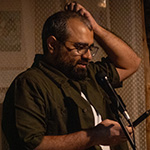
Lavanya Arora (they/he) is an independent researcher and writer from Uttarakhand, currently residing in Bengaluru, India. Their literary work has found a home in Josephine Quarterly, Frontier Poetry, Thimble Literary, and elsewhere. A 2024 Himalayan Emerging Writer, they dream of extensive dinner dates with fictional characters while (begrudgingly) editing their debut novel. Instagram: @lavaurora.
 BACK TO ISSUE