
Cold Heart Warm Hands
They wheeled in heartbreak on a stainless tray. Still warm. Still humming that one pop song that makes bartenders sigh and women order another gin. The one the jukebox stutters on when it begins. I told the intern to hold its hand until it stopped pretending to be a corpse bride. When I cut, it hissed like a can of Sprite, like the static crackle from blown speakers.
Inside was a confetti of old texts, a snapped elastic from a bra, a sticky note that said ‘sorry’ in faded pink ink. The lungs were bruised from saying ‘I’m fine,’ and the heart had tried to cauterize itself with candle wax. I tagged the body as natural causes, which is what we call it when the cause is everything.
The intern asked how many I’d seen. Thousands. Every day, same table, sometimes we play Scrabble with the entrails. A metaphor is the only organ that refuses to die. You can stab it, and shame it, and revise it. It still twitches. It reanimates in every painting and poem, in every sad sap who’s got a story to tell.
In the next drawer: butterflies in the stomach. Still alive, poor bastards circling for years, wings slick with acid, beating against the porch light. Monarchs refusing to take flight. One landed on the inside of my wrist, a stamping of orange and black burned in where the bluest vein sits.
Rock bottom was next. A geological event. Pockets full of quartz and uncashed paychecks. Every rock had a face, and every face was so disappointed, as if they finally understood they were all fool’s gold. And on every face, a tired ‘I told you so’.
I went down the line.
Cold feet: frostbitten toes chewed clean by doubt.
Thin skin: transparent, as translucent as an onion peel.
Spine of steel: actually aluminum, bent under heat, molten and misshapen.
Head over heels: a neck fracture in the shape of a foot’s arch.
Tongue-tied: a suture job from hands that sew but can’t speak.
I cataloged them all.
Cause of death: overuse.
When I opened burning bridges, the whole room smelled like family. Teeth marks crimped into the matches, and sulphur swirled in the air. I kept going. There’s protocol even for guilt—for the embers that weaken the middle and eat the pavement.
Halfway through the shift, the clipboard started to look familiar. My own handwriting, that right leaning slope of apology, the way it can’t decide to be cursive or print, so it is a mishmash of both. I licked my finger and flipped back a page. The donor was me. Not a metaphor. Just an inventory. A ledger pinned and clipped, signed and official.
I cracked the chest of open heart, he sat up mid procedure, asking for a cigarette. “We’re both dead,” I said. “Not yet,” he said blowing smoke rings with lips pursed, they floated to the ceiling. The intern fainted, mouth open as if to catch them, as if he were born smoking. I kept working, and I kept cutting. The scalpel knows what to do even when the hands don’t.
By the time I reached rock the boat, the table started swaying and the smell of sea salt was in my nose. Droplets misted my mask. Tools rattled like bones in a dryer, and the floor was sticky with metaphors swimming for their letter lives. One tried a backstroke, then to butterfly away. I stepped on its neck gently and said, “Not today.”
I took a break in the hall, on the bench where residents whisper about first deaths and the casualty of words. Someone had left a vending machine coffee, still steaming. I wrote my initials in the condensation, and I watched them fade away.
When I went back in, the room was quiet. The metaphors had stopped pretending to be corpses, stopped playacting as little dead letters. Silence is always the last trick they play. The cut is best when the ink bubbles up. I put on new gloves, and I tried to remember which body I’d started with—mine, I think. I thought about cutting into me too.
I stitched heartbreak shut with thread from a half-written love letter, I relabeled the case unresolved, wrote ‘to be continued’ in the margin. The interns were crying. They always do when they realize we’re cutting language open to see why it bleeds the same color as us.
Before I left, tongue in cheek, I checked the sink. It gurgled up vowels. The drain burped an unfinished alphabet. I dried my hands on building sandcastles in the air, granules scraping the web between my fingers, and I clocked out early.
In the parking lot, I saw a metaphor escape through the loading dock. A loose screw still turning. I thought about chasing it, but my knees ached from all the kneeling for words, a crick in my collarbone from all the looking down.
I sat in my car with the left turn signal clicking. I sat sunken, a sunken me, until the headlights turned themselves on. The rearview mirror caught my reflection at an angle that looked like someone else’s. I said, “You did good work today,” it didn’t sound like me at all.
You can’t close language cleanly. It leaks through the gauze. It hums in the drain. It grows legs and finds its way home, waking you in the night. Resting in the shell of your ear, supine on your pillow. It curls around your neck like a cat, purring. It crawls into your throat while you’re dreaming.
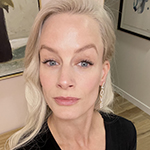
Kristen Reece is a Canadian writer who works in the oilfield. Her work explores loss, often with a Trojan horse slipped inside. She is a Pushcart Prize nominee with work appearing in Puerto del Sol, Miracle Monocle, Sky Island Journal, Bull, NUNUM, Flash Fiction Magazine, and elsewhere.
 BACK TO ISSUE