For Poets Who’ve Abandoned Couplets
When the MFA Wasn’t Worth All the Debt:
An Unveiling of makalani bandele’s Invented Visual Poetic Form ‘the cyborg’

Watch and listen to this essay before reading below-https://youtu.be/NTfmgP_OKlQ?si=gFsVpAOuVhvxEXUg
Introduction
I was first introduced to the notion of inventing my own poetic forms by fellow Affrilachian Poet and Cave Canem fellow Mitchell L. H. Douglas during a conversation about his first collection, Cooling Board: A Long-Playing Poem, just after its release. Douglas told me about his personal challenge to invent a new poetic form for every collection he writes. I thought it was a novel idea without any consideration of its possible impact on contemporary poetics or larger conversations these new forms might create and decided to do the same thing starting with my sophomore poetry collection.
In that sophomore effort, under the aegis of a winged mind, I made good on that challenge, inventing a form I call the ‘étude’. Drawing heavily from the notion of the étude in Jazz and Classical music, this form consisted of sets of instructions (different for each opus) designed by the poet to help them develop proficiency in particular poetic devices or moves they’re interested in wielding. For under the aegis, I was interested in developing my skills in parataxis, disrupting syntax, creating non-mimetic imagery and obfuscated metaphor, all to create abstract language the way Jazz is an abstract music (if music with lyrics and little to no improvisation is representational/mimetic). Thus, many of the instructions in the three opuses I wrote for the book involved deploying those rhetorical and poetic devices or moves in the poems of each opus (see examples of published etudes here & here).
For my third collection, (jopappy & the sentence-makers are) eponymous as funk, published by Futurepoem in 2024, I spent an entire book inside another invented form, the unit. The form takes its cue from Cecil Taylor’s 1966 album Unit Structures and from the musical conversation of Free Jazz ensemble performance. A unit consists of sixteen New Sentences, sixteen bars, with an additional constraint requiring language from the first and sixth sentences to reappear, recombined, in the twelfth. Speaker, subject, tone, register, syntax, and narrative direction may shift from sentence to sentence. The sentences are composed as much by how they sound against (with) one another as by continuity of theme, argument, or narrative.
I understood those rules first as a way of getting language to behave something like an improvising Free Jazz ensemble. And as I became proficient in the form and able to rely on the unit to produce the kinds of poems I am interested in, I developed a growing interest in its architecture. The question arose: what kinds of conditions/rules/constraints could a form establish that would consistently generate deviance and difference across language, sound, image, resonance, and valence? I wanted forms with architectures that could torque language away from its most familiar routes and make room for dissonance, opacity, fragmentation, polyvocality, parataxis, syntactic trouble, and the unanticipated.
“Difference is generative,” as unit_127 behind a firewall says. I have come to hear that sentence as something close to a compositional principle. Difference creates the conditions for language to take on new meanings and motivic trajectories. A shift in register can alter the pressure around an image. A scrap of theory can change what is heard in a vernacular quip. A repeated phrase can return with another valence because of what has happened around it. The composition develops through those disparate, discrete encounters.
Free Jazz helped me understand this as more than a matter of sound. An ensemble establishes conditions in which players hear and respond to one another. A response may echo, interrupt, refuse, distort, extend, or return later in altered form. I began to think about poetic form similarly: as an architecture that can create conditions for relation and make a kind of (literary) improvisation possible inside those conditions.
The unit does this through its conditions: sixteen bars, recursive recombination, New Sentence logic, shifting registers (statistics have a different register than song lyrics), and the prose block. These are some of its changes, the structures perceptible enough for variation on a theme, substitution, broken syntax, signifying, sampling, parataxis, and other operations to play against. The freedom becomes perceptible because there are changes to play against.
The forms I began inventing after the unit grew out of that architectural question: how to invent forms that advance parataxis, polyvocality, fragmentation, and polysemy. The cyborg is one such attempt: a form whose technological schematic, textual language, visual organization, and invented and borrowed poetic procedures create a field in which different materials can enter relation through the structure itself.
I. The Centrality of Form in Poetry
1. The Function of Form
Poetry, often described as the most condensed and expressive form of literature, derives much of its power not just from what it says but how it says it. Central to this “how” is form, the structural framework that governs a poem’s shape, rhythm, rhyme, and organization. Form is not merely decorative or incidental; it is a fundamental constituent of poetic meaning. Poetic form is integrally linked to a poem’s meaning and function. It shapes the reader’s expectations, organizes thought, creates tension, and provides a framework for emotional expression. Counterintuitively, constraints of form often ignite creativity. Poetic form can work symbiotically with a poem’s theme, or it can create an ironic tension by contrasting with the poem’s tone or subject. Whether through metrical patterns, rhyme schemes, rules for line repetition, or other constraints, form molds content, dictates pace, and guides emotional trajectory, shaping interpretation all along the process.
Constraint has long been one of poetry’s generative resources. Meter, rhyme, repetition, stanzaic patterns, procedural rules, and visual arrangements can lead language toward discoveries that might not have emerged otherwise. A form may reinforce the subject of a poem, exert productive pressure on it, establish expectations, or create opportunities for those expectations to be altered, interrupted, or exceeded.
Working in the unit gave this general principle a more practical urgency for me. I began to wonder what possibilities are already embedded in a form before a particular poem enters it, and how those possibilities might differ in a form I constructed myself. From there, I began thinking more generally about inherited and invented forms.
A form arrives carrying accumulated possibilities: habits of pacing and organization, patterns of recurrence, modes of argument, syntactic expectations, visual conventions, and histories of use. Those inheritances do not determine what a poet can achieve with the form, though they do participate in the compositional situation. I became progressively interested in what kinds of language a particular architecture encourages and what kinds of thinking its constraints make available. That curiosity made inherited forms newly interesting to me, particularly those whose long histories have accumulated recognizable expectations. The sonnet offered an obvious place to begin.
2. The Sonnet and the Inheritance of Form
The sonnet offers a useful example of the way a formal structure can persist while being continually reinterpreted. Developed over centuries and across languages, it still carries recognizable expectations even when contemporary poets substantially alter (even disregard) its meter, rhyme, stanzaic arrangement, or argumentative movement. Its history also demonstrates how thoroughly a form can be repurposed. Contemporary poets have used the sonnet to write about race, gender, sexuality, violence, migration, political power, grief, technology, and innumerable other subjects far removed from the circumstances of its early development. Its durability owes something to this adaptability. And that adaptability also raises a compositional question: what remains active when a form travels across centuries and cultures? Though the contemporary sonnet does not simply reproduce the worldviews of Petrarch or Shakespeare, might traces of their intentions and milieu persist? Its fourteen-line architecture, traditions of turn and development, histories of argument and address, inclination toward resolution or closure, and enormous literary archive accompany the poet into the composition.
Now those inheritances can themselves become material. A poet may revise them, signify on them, distort them, resist them, or use their familiarity as changes against which other kinds of freedom become audible. My growing interest in inventing forms developed alongside this awareness. I became curious about beginning from a different set of architectural assumptions. What kinds of architectures might be deliberately constructed to encourage polyvocality, fragmentation, opacity, parataxis, nonlinear association, shifting registers, competing valences, and other qualities I repeatedly found myself pursuing?
Formal invention, for me, became another option within the larger repertoire of poetic practice. I was especially interested in architectures and forms compatible with kinds of thinking I had encountered in poststructuralism and Black improvisational traditions: multiplicity, instability, repetition-with-difference, discontinuity, decentered meaning, and relation among heterogeneous materials. If these were qualities I repeatedly wanted language to enact, I began wondering whether I could construct forms whose rules made their emergence more likely.
3. The Gravitational Pull of the Familiar
Another reason I became interested in formal invention was the gravitational pull of familiar architectures. Poets spend years reading and writing within certain arrangements. For example, couplets, tercets, quatrains, sonnets, and stichic verse offer reliable ways of organizing language. Their prevalence helps explain their persistence, while their usefulness cannot be ignored. I first became especially conscious of this with couplets. They seemed to appear everywhere I looked. Perhaps I had simply trained myself to notice them, but I began wondering what happens when the choice of form becomes ‘low-hanging fruit,’ or ‘go to.’ What does the paired line encourage? What kinds of rhythm, balance, interruption, argument, or visual relation does it make available? What other possibilities might arise if the architecture itself became part of the compositional problem?
These questions interested me because contemporary poetry has been extraordinarily inventive in syntax, voice, rhetoric, image, genre, and subject matter. Poets today continue in the tradition of expanding what poems can sound like, who can speak within them, which languages and registers can coexist, and what kinds of experiences poetry can hold. I became interested in extending some of that experimentation into the rules organizing the form itself.
Marshall McLuhan’s familiar dictum that “the medium is the message” offers one way of thinking about this. If poetic form participates in shaping how language is generated, encountered, and related, then formal choice becomes part of the poem’s thinking. A couplet establishes one kind of pressure, a sonnet another, stichic verse another, and a visual schematic yet another. Each creates different compositional conditions.
That distinction grew more consequential for me. I was interested in asking what kinds of relations a particular architecture tends to generate among a poem’s language (materials). A fourteen-line poem can contain multiplicity. A couplet can fracture expectation. A villanelle can become radically unstable through repetition. Poets have demonstrated all of these possibilities. My own curiosity began moving toward another question: what happens if I begin with the conditions I want the composition to produce and build the architecture from there?
What kind of form might encourage several registers to come into consequential relation? What rule might cause earlier language to return altered? What architecture might bring visual, verbal, sonic, and procedural systems into the same field? What constraints might encourage language to leave its most familiar trajectories? Those questions eventually led me from the unit toward the invention of other poetic forms.
II. The Centrality of Form in Poetry
1. The MFA and the Circulation of Formal Convention
Since the expansion of creative-writing programs in the latter half of the twentieth century, the MFA has become an important part of the institutional ecology of American poetry. Workshops offer mentorship, community, sustained attention to craft, and access to traditions and contemporary practices that many poets might otherwise encounter less systematically. They have also helped create networks among writers, teachers, journals, presses, prizes, and reading communities. Any institution built around the teaching and evaluation of art, however, also participates in the circulation of aesthetic preferences. Workshop language develops. Certain poems become useful models. Particular techniques become recognizable as contemporary craft. Editors, teachers, students, and writers encounter one another across overlapping literary communities, so formal and stylistic proclivities can travel quickly.
This does not mean MFA programs produce a single poetics. Contemporary American poetry contains enormous differences in language, aesthetics, politics, lineage, and formal practice. Still, repeated exposure can make certain approaches begin to feel natural. A convention can become familiar enough that its status as a formal choice becomes difficult to notice. My own irritation with the ubiquity of couplets eventually became less interesting to me than the question behind it: how does a literary culture teach us to recognize some formal choices as immediately available? The couplet may simply be one visible example of a broader process through which arrangements become part of the common vocabulary of contemporary poetry. That process is not necessarily a problem. Shared conventions give poets something to inherit, alter, signify upon, and resist. My concern is with what happens when familiarity begins doing some of the choosing for us, when perusing a contemporary poetry journal can sometimes feel like driving across Kansas, couplet after couplet stretching out before you until the landscape begins to look indistinguishable.
2. Literary Institutions and the Conditions of Risk
The institutions surrounding contemporary poetry extend well beyond MFA programs. Journals, presses, contests, residencies, workshops, readings, conferences, universities, social networks, and prize cultures all participate in determining which poems circulate widely enough to become models for other poets. I want to avoid the appearance that I am saying these systems produce formal conformity in any direct or easily measurable way. Poets make aesthetic decisions for innumerable reasons, and experimentation itself can carry literary prestige. Still, institutions inevitably produce patterns of recognition. Writers learn what kinds of work are being published, discussed, taught, rewarded, laurelled, and reproduced. That environment may influence formal imagination indirectly. Recognition makes certain possibilities easier to see. Repeated exposure creates familiarity. Familiarity makes a structure available at the moment of composition. The question that interests me, then, is how a literary ecosystem helps establish the repertoire of forms that seem readily imaginable.
Formal invention requires a somewhat different gesture. The poet has to imagine an architecture that does not yet possess the accumulated familiarity of the sonnet, couplet, ghazal, villanelle, or other established forms. Its rules have to be devised, tested, revised, and learned through use. Often the poet has no substantial body of precedent demonstrating what the form can do. This brings me back to the question that emerged from writing the unit. If form participates in generating language and organizing relation, then inventing a form becomes one way of deliberately expanding the conditions available for composition. That possibility took on greater importance as the range of subjects, materials, and ways of thinking I wanted my poems to accommodate widened. At some point, the question shifted from ‘Which available form should I choose?’ to ‘What kind of form would I need to build to promote parataxis, call-and-response, or code-switching?
III. The Imperative to Invent New Forms
1. Form As a Response to Social and Cultural Demands
The world in which poems are made changes technologically, socially, politically, and culturally, and shouldn’t poetry at least engage with those changes through its available structures, materials, and practices? Contemporary poets write amid screens, databases, digital images, hyperlinks, algorithms, surveillance technologies, social media, machine-generated language, and forms of communication that increasingly combine visual, computational, textual, sonic, and procedural information. These conditions do not render inherited poetic forms obsolete. They do, however, expand the range of structures and materials a poem might make use of. This expansion interested me because formal invention offered another way of responding to those possibilities. If poets can alter syntax, voice, genre, rhetoric, imagery, and tone in response to changing ways of experiencing the world, why should the architecture organizing those materials not garner equal attention and risk-taking?
To invent a form is to establish a particular set of conditions for composition. Its rules can determine what repeats, what returns altered, where language can enter, how different materials encounter one another, and what kinds of relations become possible among them. An invented form therefore offers the poet an opportunity to begin with the compositional behaviors the poem is intended to encourage and construct an architecture around them. I found myself drawn to architectures that could hold several kinds of language and signification at once: verbal, visual, technological, vernacular, computational, and sonic. I wanted forms capable of generating fragmentation, polyvocality, queering, opacity, parataxis, signification, nonlinear movement, and multiple possible readings. I was especially interested in what might happen if those qualities were built into the conditions of the form rather than introduced solely through individual acts of craft. Formal invention became, for me, a way of asking a practical question: what kind of architecture might give the language a new way to proceed?
2. Genesis of ‘the cyborg’
Technological change has considerably enlarged the compositional field available to poets. Desktop publishing and image-editing software allow text and visual material to be manipulated within the same space. Digital publication permits hyperlinks, animation, sound, video, and interactive structures. QR codes can move a reader from the printed page into other media or contextual fields. More recently, generative technologies have introduced still other possibilities for producing, altering, and recombining language and images. These technologies interested me as compositional materials, but also as architectures. Computers surround us with structures designed to route information: circuits, pins, nodes, memory locations, inputs, outputs, addresses, pathways, commands. Their schematics visualize systems in which meaning and function emerge through relation. A single component means something partly because of where it is located, what it connects to, what passes through it, and what other components do in response. That architecture began to look remarkably useful for a visual poetic form.
The cyborg emerged while I was working on my fourth, still unpublished manuscript, the conditions for relations: Black study poems, a collection composed of visually inflected poems. I was looking for forms that could continue some of the compositional work I had begun with the unit while opening that work to visual language. The unit had taught me to construct conditions that encouraged disparate registers, speakers, sounds, and fragments to encounter one another. The cyborg allowed me to ask what might happen when the field of possible relations expanded beyond verbal language. I began using microprocessor and memory-chip schematics as the architecture of the poem.
The schematic provided something more consequential than an image onto which a poem could be placed. Its pins, pathways, labels, inputs, outputs, and directional logic created positions into which language could enter and be routed. Vernacular, statistics, code syntax, lyric fragments, academic jargon, found language, procedural rules, and other textual materials could occupy different parts of the field. Their placement within the schematic could produce relations that neither the individual materials nor I had completely anticipated beforehand. Here the principle I had learned through the unit reemerged as significant: difference creates the conditions for language to take on new meanings and motivic trajectories. The cyborg could place materials carrying different registers, rhythms, cultural histories, and epistemological pressures into the same architecture. A technical phrase might sit beside vernacular. Code syntax might interrupt lyric syntax. A repeated fragment might return altered because of where the schematic has routed it. The form creates conditions in which language can hear differently because of what has been placed beside, beneath, across from, and or sequence with.
The visual field of the cyborg is best understood as an operational architecture: a system that determines how different forms of language and signification are positioned, routed, revealed, transformed, or brought into relation. The chip diagram functions as a generative constraint: it determines available positions, directional pressures, routes of entry, and sites of contact for the language. The schematic becomes part of the poem’s thinking. The cyborg extends the possible relations between verbal language and diagram by establishing a field in which fragments can be distributed, redirected, interrupted, and brought into contact through the architecture. Typography, placement, directionality, code, vernacular, and borrowed poetic procedures can all participate in that field.
The work I have done with the cyborg and the unit has revealed to me one of the qualities I seek when inventing forms: an architecture capable of producing fugitive gestures that keep relations from settling into rigid hierarchical structures. In the cyborg, a fragment can escape the role conventional syntax might ordinarily assign it. Technical language can be signified upon by AAVE. Code syntax can alter the rhythm of lyric language. A borrowed poetic procedure can be rerouted through the logic of the chip schematic. Meaning can move through several linguistic and procedural systems without being forced into a single interpretive hierarchy. The name cyborg comes from that integration. The form joins poetic language to the architecture of the technological schematic so that each participates in generating and regenerating the other’s possibilities. The resulting poem is a hybrid structure in which visual, textual, procedural, spatial, and technological systems produce meaning through their relations.
IV. The Build and Operation of ‘the cyborg’ Form
1. The Function of ‘the cyborg’ Form
At its core, the cyborg is a visual-textual form in which the schematic architecture of a microchip serves as both visual field and structural framework for poetic language. Its pins, nodes, pathways, inputs, and outputs provide positions through which language can be distributed and possible directions through which the poem can be read. The schematic therefore participates directly in the poem’s composition. The visual vocabulary of the cyborg is relatively spare. Its primary visual element is the technological schematic itself and the spatial arrangement of language (textual or visual) around it. Vernacular, statistics, code syntax, lyric fragments, found language, procedural language, and other registers can occupy different locations in the field and enter relation through proximity, sequence, direction, repetition, or interruption. Parataxis is especially useful to the form because fragments can occupy separate positions without explanatory transitions between them. Call-and-response, repetition-with-difference, signifying, tonal substitution, fragmentation, and other poetic operations can occur across the schematic rather than through a single linear sequence.
The cyborg does have rules, but those rules are not fixed across every poem in the form. For one thing, chip schematics vary considerably. Some have twenty-four pins or nodes, some 40, others sixteen; their shapes may be square, rectangular, or otherwise configured, affecting how language can be positioned in relation to the chip. The poet can devise whatever procedural constraints best suit a particular schematic or composition. The architecture of the chip itself often suggests those rules. Pins, pathways, inputs, outputs, numbering systems, or directional cues may prompt a sequence, determine where language enters, or offer the reader some indication of how the poem might be navigated. In this way, the same schematic can generate very different poems depending on the rules applied to it.
2. The Political Pulse: Hacking the Form
The cyborg form also carries political possibilities for me. Its architecture lends itself to practices of rerouting, recoding, interruption, substitution, and repurposing. A schematic designed to route information and organize technological function becomes a field for poetic language. Once that architecture is opened to vernacular, code syntax, fragments, found language, quoted song lyrics, and altered procedures, the poem can begin to “hack” the assumptions built into both technological and poetic systems. This has particular resonance for Black and queer writing. Black and queer poets have long worked through revision, signifying, code-meshing, queering, indirection, recontextualization, and other strategies that alter the terms of inherited language. The cyborg can provide an architecture that encourages similar activity. Its nodes, pathways, inputs, and outputs can prompt the poet to redirect language, disrupt expected sequence, place unlike registers into contact, queer language, or devise rules that queer the way language moves through the poem. I am interested in the form as a site where Blackness and queerness can become generative compositional pressures. A technical register can be interrupted by vernacular. A schematic associated with efficiency, order, and computation can be repurposed toward opacity, ambiguity, fragmentation, hyperbole, humor, grief, or refusal. The form can hold several systems of language at once without requiring one to become the governing register for all the others. So, the formal architecture can be employed to demonstrate the kind of egalitarian world we want to build.
This capacity gives the cyborg political force when the poem activates it. It can excavate space for Black and queer futurity, critique, and self-fashioning through the act of taking an existing technological architecture and making it behave otherwise. The “hacking” occurs at several levels at once: the schematic is repurposed, poetic procedure can be rewritten, language can be rerouted, and familiar hierarchies among registers can be unsettled.
For me, inventing the cyborg was therefore an act of resistance and possibility. It offered a way to work inside the visual language of technology while refusing to leave that language in its original function. The form can become a space for poets to name, code, decode, distort, revise, and generate other possibilities for relation, identity, and expression.
V. Concluding Remarks
Inherited poetic forms exert a powerful gravitational pull. The sonnet, couplet, villanelle, prose poem, and other familiar architectures have survived because poets continue to find them useful, adaptable, and generative. Their histories also mean that they arrive carrying accumulated expectations about pacing, argument, repetition, turn, sequence, and visual organization. While these elements can become material for revision, signifying, resistance, or play, they may not always provide the conditions I want for poems working extensively through parataxis, collage, broken syntax, polyvocality, hybridity, and other less conventional compositional practices.
My concern throughout this essay has been what happens when poets become more deliberate about the architectures they choose. Familiar structures can become habitual. The place in our toolbox where we keep our forms can change very little over span of our writing life. Literary institutions, workshops, journals, and reading communities help circulate certain formal possibilities until they become part of the common repertoire. That repertoire is extensive, but it need not be exhaustive. The conditions in which poems are made continue to change. Contemporary writers work amid digital systems, code, fragmented media, networked communication, shifting social identities, multiple registers, visual information, and competing forms of knowledge. None of this makes inherited forms incapable of responding to the present. It does, however, give poets reason to ask whether other architectures might generate different compositional possibilities. That question led me from the unit to the cyborg. The cyborg allowed me to begin with a set of compositional interests and build a form around them: parataxis, polyvocality, fragmentation, nonlinear movement, signifying, code syntax, vernacular, procedural constraint, and the possibility that difference might generate new meanings and motivic trajectories. Its schematic architecture gave language new positions, routes, pressures, and relations to work through.
I have come to see formal invention as one way of enlarging poetry’s available repertoire. An invented form can establish conditions that encourage language to behave differently, invite different modes of reading, and produce relations that might not arise as readily within another architecture. It can also become an act of resistance or possibility when the poet uses it to reroute inherited languages, procedures, and systems toward other ends.
That is what interests me most about the cyborg. I believe the form adds another architecture to the field of poetics, one built from the particular pressures and possibilities I wanted my poems to encounter, and which seem increasingly relevant to our present moment. To invent a form, then, is to make another set of conditions available to language. It is to ask what kind of architecture might help a poem think, move, fracture, recur, signify, or relate in ways the poet has not yet fully heard.
The forms we inherit remain available.
Personally, I am far more interested in the forms we have not built yet. Succeed or fail, I intend to continue inventing the forms I think the future needs.
VI. Three Examples of ‘the cyborg’
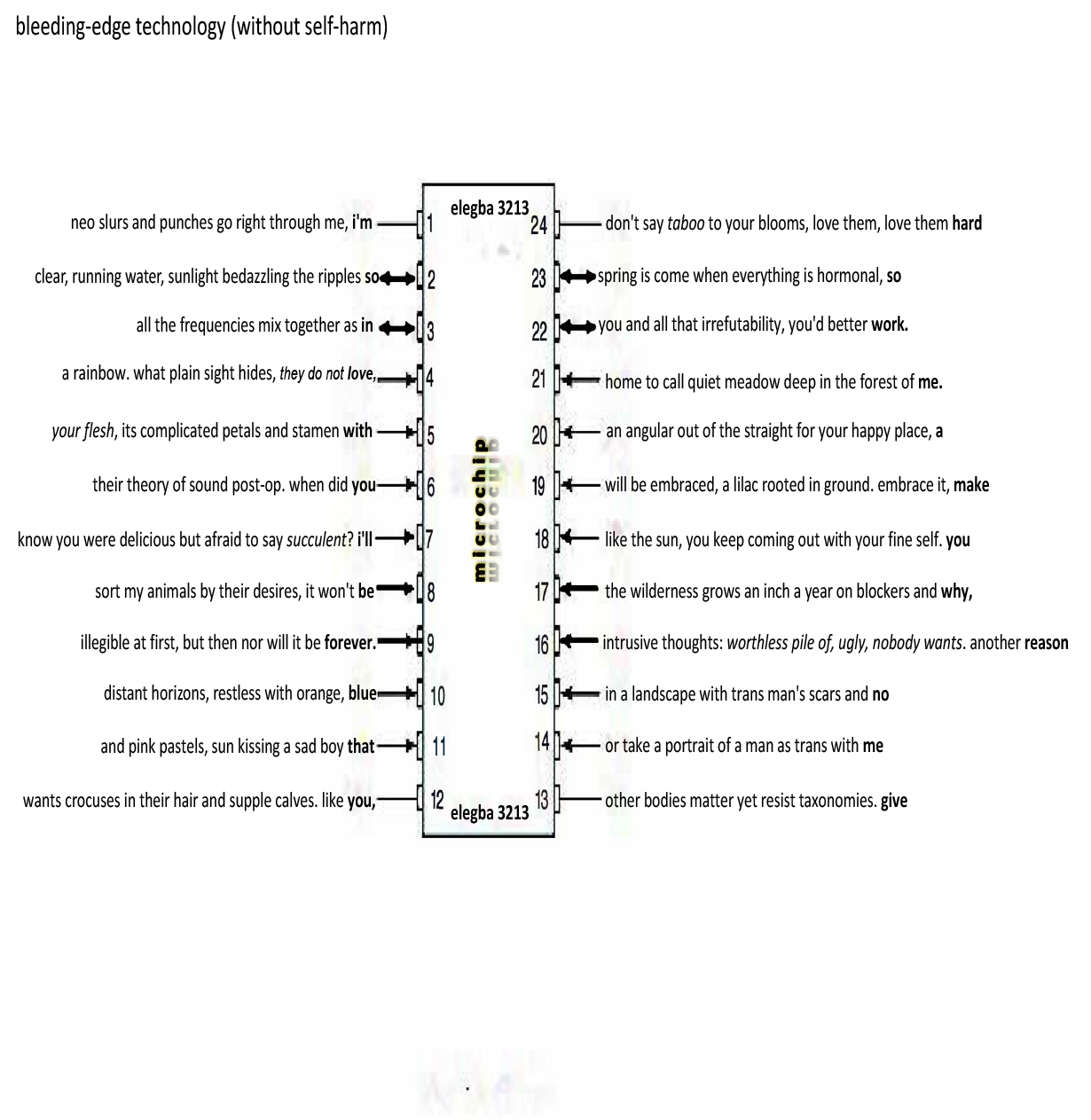
24-Pin Microchip Schematic
This schematic features 24 pins arranged around a rectangular chip, with arrows signaling input and output directions. As a poetic form, it encourages:
- Directional flow and movement: The arrows invite poets to consider the flow of language and meaning as dynamic, multi-directional processes rather than linear narratives.
- Duality and symmetry: The left-right pin arrangement can symbolize binary oppositions or dialogues, which the poem can then interrogate or subvert through its language.
The poet may choose to assign different themes or voices to each pin, creating a layered, multi-voiced work that reflects the circuitry’s interconnectedness.
A Black and queer linguistic architecture for generating an Afrofuturistic cyberspace, the powerful elegba 3213 microprocessor powers this poem, bleeding-edge technology (without self-harm). The elegba 3213 chipset is highly adaptable and can generate any number of poems, depending on whether its specifications suit the poem you want to build. See specifications below.
Specification for the elegba 3213:
The same as the Golden Shovel form invented by Terrance Hayes.
Using the words from Gwendolyn Brooks’ s famous poem “We Real Cool’ or another poem, song, phrase, line or part of such by someone else. Use each of their words as the final word of each line in your new poem. You must keep the original order of the words intact, and you must credit the author of the original line or phrase.
‘A’-part to the chorus of Erasure’s ‘A Little Respect’
For the poem, bleeding-edge technology (without self-harm), the last word in each line makes up the ‘A’-part of the chorus in Erasure’s hit song “A Little Respect” . [I’m so in love with you, I’ll be forever blue, that you give me no reason, why you make a me work so hard].
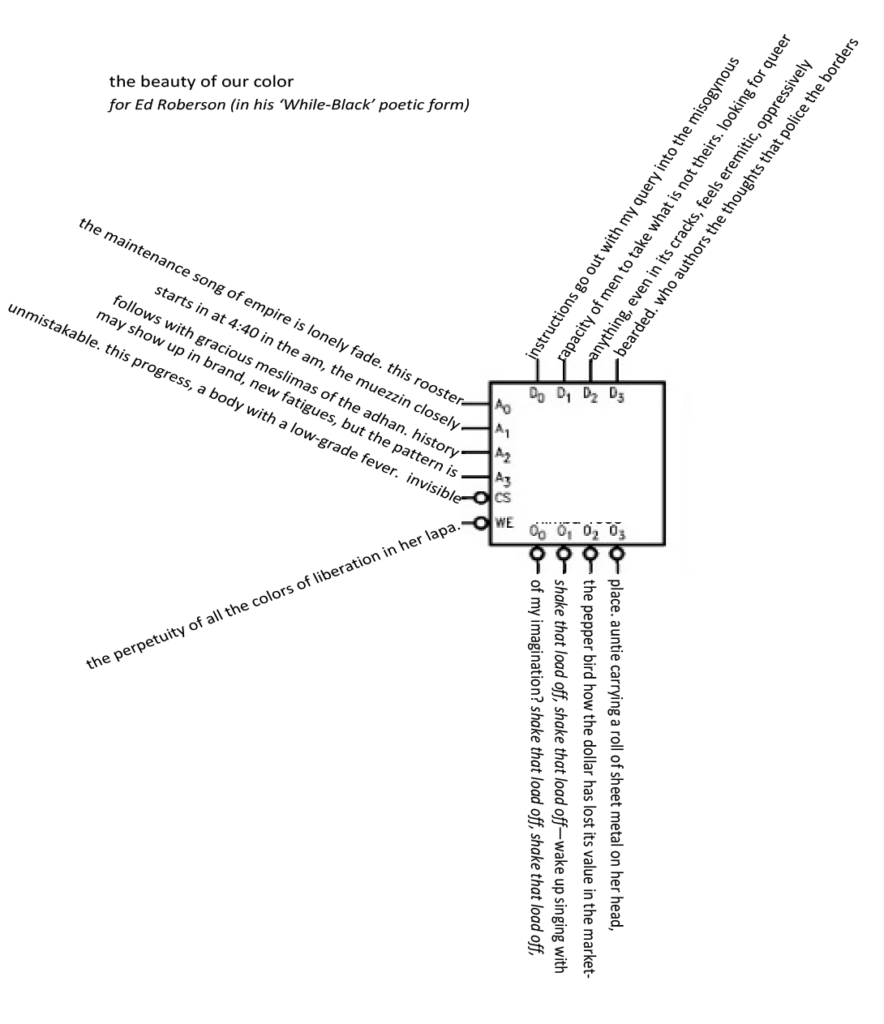
16×8 RAM Chipset Schematic
The 16×8 RAM chipset schematic features 4 address pins (A₀–A₃), 4 data input pins (D₀–D₃), control signals (CS, WE), and 4 output pins (O₀–O₃), creating a matrix-like architecture that functions as a dynamic poetic language processor. As a poetic form, it is good for:
- Modular thematic containers: Each address pin accesses a discrete “memory slot,” allowing poets to assign themes such as ancestral trauma, queer joy, or historical fragments to individual pin addresses.
- Data flowing as sensory or dialogic fragments: The data pins serve as input channels for language figures—images, metaphors, or voices—that inform by the syntax.
- Emergent poetic voice through output pins: The output pins synthesize into layered, collective meanings, reflecting the poem’s polyvocality.
- Control signals as poetic gates: The Chip Select (CS) and Write Enable (WE) pins act as switches controlling access and transformation, symbolizing processes of amplification, erasure, and reclamation. For example, activating the (We) pins can effect rewriting dominant narratives.
Unlike linear forms, it organizes language into non-linear lyric, where each node and pin become sites for modular, re-combinatory expression.
A Black and queer linguistic architecture designed for polyvocality, fragmentation, code-switching, signifying, non-hierarchical, and nonlinear relation, the nimba 1958 microprocessor generates an Afrofuturistic cyberspace for the poem, cyborg for Ed Roberson (in his ‘While-Black’ poetic form). The nimba 1958 chipset is highly adaptable and can be used to generate any number of poems, provided its specifications suit the compositional demands of the poem you want to construct. See specifications below.
Specification for the nimba 1958:
Follow the 4 aesthetic principles (or central obsessions as Roberson calls them) of ‘while black’ poetics as conceived by Ed Roberson
- The Escape or “getting free”- To illustrate this, there will be improvisation or improvisational
elements operative in the ‘while black’ poem. - The Beauty of our Color- There will be themes of the Black existential experience, and or the
centering of the black body in the ‘while black’ poem. - Get Real- There is so much duplicity in the language of White Supremacy and Whiteness. African
American vernacular and African American rhetorical tools like code-switching and signifying are
employed in ‘while black’ poems to expose and stand against the duplicity. - The Ambient Music- Because the struggle continues and the violence keeps happening, there will
be repetition in the ‘while black’ poem.
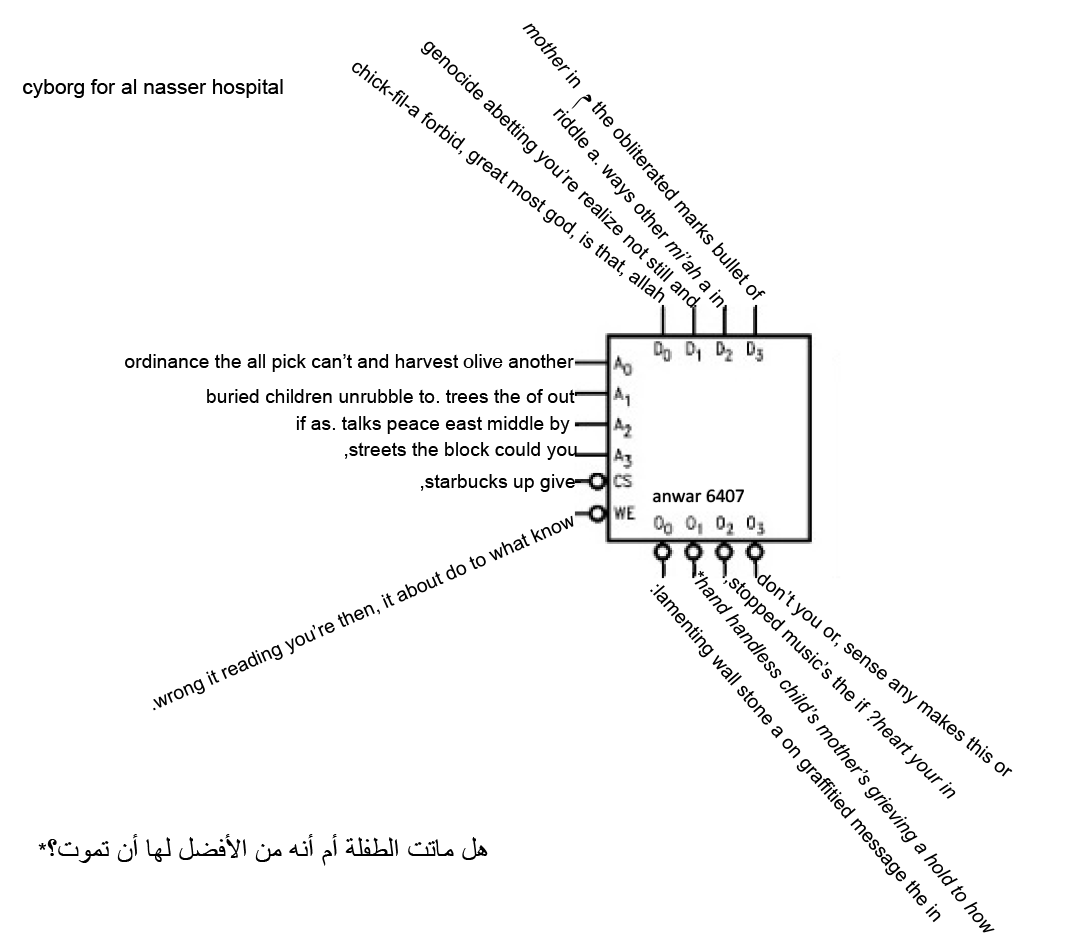
16×8 RAM Chipset Schematic (see previous poem)
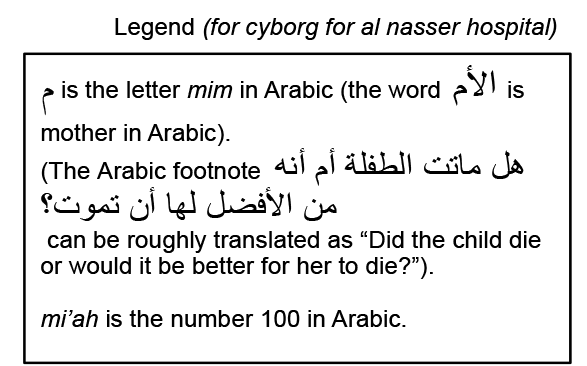
A Black and queer linguistic architecture for generating an Afrofuturistic cyberspace, introducing the powerful anwar 6407 microprocessor that powers this poem, cyborg for al nasser hospital. The anwar 6407 chipset is a highly functional and can be used in the generation of any number of poems, provided its specifications suit the compositional demands of the poem you want to build. See specifications below.
Specification for the anwar 6407:
The same as The Arabic form invented by Marwa Helal.
Poems in this form should be written right to left as in the Arabic language. It should contain an Arabic letter with an Arabic footnote, and an Arabic numeral.
Additional rules I have added:
-There must be at least one interrogative in the poem.
-There must be at least one instance of a verbed noun, adverb, or adjective

makalani bandele is the author of three poetry collections hellfightin’ (Willow Books`, 2011), under the aegis of a winged mind (Autumn House Press, 2020), winner of the 2019 Autumn House Press Poetry Prize, and (jopappy and the sentence-makers are) eponymous as funk (Futurepoem, 2024), winner of Futurepoem’s 2022 Other Futures Award. Known for his experimental poetics, he is the winner of the 2023 Miracle Monocle Innovative Writing Award, and the 2021 First Prize in Experimental Poetry Contest from the Connecticut Poetry Society. He has received fellowships from the National Endowment for the Arts, Cave Canem Foundation, the Kentucky Arts Council, Millay Colony, Obsidian Foundation UK, and Vermont Studio Center. Photo by Bob Krasner Photography.
 BACK TO ISSUE