
X
At last, the cross on his shoulders would be lifted. He would finally come down the hill for the last time. He had looked forward to this day since that fateful second—the moment he realized it was his neighbor that he loved and favored more than the Lord. He had met her in university, right on his first year. Her name was Grace, a junior, and to him she was the best person to be with for the rest of his life. It was not that way at first; but people, for better or for worse, do change. On that afternoon that was no longer ordinary, four years into the relationship, he began to look at things differently. He had asked God for an answer, and he seemed to have gotten it in good faith: Yes, my son. Do what you must. She is worth risking everything.
***
I turn the knob; the room is sparse, only giving what my money’s worth. Eyes roving around: space, bed, TV. Another door, leading to the en suite. I turn to you; your figure is by the window. Outside, a motorcycle not so audible just passed by. Then: the silence, or rather our breaths alone. You turn to me; even with the lights on, I can’t figure you out. Blank, like the bare white walls. What’s wrong, I ask. It’s like your mood has worsened. You shake your head like that would make me feel all right, then return to looking at the street. What is it that you’re looking for? If only humans can actually read minds, decipher the language of the heart. Only then will I understand the colors you now hide.
***
The process for his final decision took time, predictably. It was the same case with the rest of his peers who had heard the voice calling them years ago, reaching as far as Bohol and Surigao. It had invited them, yes, to take up their holy destiny and lead the flock to salvation, with the help of their parishes that would shoulder a part of their education. The voice was both a commanding force and a gentle push at once. To put the descendants of the chosen twelve in their place, to lead them towards leadership on the ground without the purpose of granting flight—the Lord, he surmised, was gravity and wind. The disciple who ultimately changed his mind could just throw everything he had learned out the window. But to him, perhaps a better purpose for them would arrive sooner than he thought. Surely, things would fall into place; the Lord would make that happen.
***
Sit down with me, I say to you rather hesitantly. My feet have left the floor, my legs now crossed on the bed. Trying not to move too much on this incredibly smooth surface. Poor cleaner—I may have destroyed their masterpiece. I wonder, how long did they train before their hands achieved perfection? They might not ever change jobs anytime soon. Stakes are high. Mouths to feed, including their own. In the long run, they might’ve killed away their dreams. Who even dreams of staying in their place? Doesn’t wish higher, doesn’t wish better. Or simply doesn’t search for something different from what they have. Christ, my back hurts. Pain calls for relief. You hurt me with your neck, your eyes, your lips. Still loyal to the view outside. The world is a room full of urgencies. Better to lean against the wall than suffer more in silence.
***
Life in the seminary was, admittedly, complicated to him. At least until he met Grace on campus. The scene that pushed the story forward was straightforward: they just passed by each other in the corridor. It did not take long for him to notice her; he could not get her out of his mind. It did not take long for her to notice him, too. From back glances to plain greetings to small, small talk—a bond was underway, never mind his peers and classmates, who saw the signs and warned him to not lose sight of his vocation and let a third-year girl get in the way. But he had never experienced this before; perhaps a little exploring would not hurt the Father in heaven. As expected, the exploration expanded into something else, into a commitment filled with occasional tension and a tenderness that always sought amends. The campus, located at the heart of Cagayan de Oro, proved itself to be superior to the seminary. Though he admired the latter’s surplus of trees surrounding the graying old buildings, which the school also had, he could not help but feel isolated on top of the hill. College moved so fast; once he receded from the center, towards courtesy and restraint, time moved suddenly so slowly, like clouds on a sunny day. This he only told to his trusted friends. Seminaries were built this way, they told him; young men like them were merely transients under deep discernment. They would reflect, and they would do it well and alone. With Grace in his life, with whom he had not thought of breaking up, he knew he would have to get used to it: a period of communion and prayer that required no fuss. For this, he simply had to look up at the sky and stare.
***
I’m telling you, you say firmly as you sit down on the bed. All of this, it’s absurd. And why is it absurd, I ask. Because you have set your path in stone, only for you to cast it upon the river. I only did what I had to do: pick up another stone and have you in it—and have it with me. I have you, I say. You don’t understand, do you? Understand…what is there to understand? You chose me over…God! Goodness, you exclaim, I’m going insane; don’t you see? I still don’t see your point. Oh, I don’t think you’ll ever. Why are you making this a big deal, I ask again. Are you not telling me something? It got me thinking and…I don’t think this is for me. What isn’t for you? Are you being serious right now? Yes. Us, you say. Us! We’re not meant for each other. You’ve spent years up there. He chose you. There’s nothing we can do about it…This is madness. You have to stop this madness. But what if I chose you, I ask you again. And what if I don’t? You don’t mean that. There will never be another stone in this lifetime. I don’t care. I want to build a family with you—not now, I know—soon. And you’ll end up as, what, a teacher? What’s wrong with a family of teachers? You know it, John, you say to me. This world is getting harder and harder; one of us will have to step up. It can be me; it can be you…We can live this life together, I say. Not if I don’t see my future with you. Say you didn’t mean what you said. No. You didn’t mean that. Yes, I do. No, you don’t. Yes, I do! Then tell me: why are you still here?
***
The voice that called him was not without his mother. Before the store that survived through the years providing them sustenance, she had him and no one else. He did not know his father, who had died of a work accident before he was born. She spoke quite highly of her husband, though she had resolved that their son would not be like him, especially in profession. There would in fact be no such thing as profession. He was given to her by God: “replacement” was the wrong term here. He was a blessing, without a doubt; a form of providence, a companion. So was the son offered to the mother; so shall he be offered back to the Lord. Let his home, when the time comes, not be a house, but a church. When he had to leave her domain for college and the seminary, he cried, because she cried as well. But part of him, shamefully, felt glad to be away. She would never approve of Grace. Between the two, he favored Grace more than his own mother. It was Grace’s kindness that won his heart, a kindness that his stern mama, out of necessity, did not possess. The only times he saw her soulfulness were when they prayed and heard Mass together—the aroma of candles, flowers, incense inviting him to her maternity, to the maternity of the Faith itself. But was it enough, he ruminated once while hugging Grace after one of their dates in the city that accepted them without a word. Warmth on cold nights was essential, too.
***
You kiss me at this hour, and I taste fruit. Cherries, to be exact. Flavors popping instantly at our meeting, first in the mouth. Everything else yet to be discovered. To me, this is all unchartered territory. Not to you. We don’t lay claim on each other, for we only have laurels to our names. He was wrong about this, the man who used to be in your favorite boy band: the war zone is elsewhere. This is love, I say to myself, and I believe it. I smell it in your hair: tangy, and with aloe. I hold on to it, the virtue of this word as much as I hold it with surety, neither firmly nor even tightly—just the right amount of grip, right amount of touch. Noun turns to verb. Action speaking louder this time. But what awkwardness! To struggle with your clothes that are no longer hugging you at this point. One less thing to fumble about. Now, my hands, where do I put my hands again? Instruct me; guide me. Do they travel in multiple directions, across several provinces, towns, and cities according to my wishes? I am young, capable of much of what the world wants. I don’t think I’ll ever be lost in these rugged streets. Maybe you’re having the same thoughts right now as I am. I should look at you while I’m at it. Sense you. Feel you. You, illuminated by the light outside. All is good so far. Our bodies are in the middle of converging—vessels of the ideal, the intersection of our desires. You, with eyes I can see still, in the dark, where God won’t see us (of course, I’m just projecting)…
***
During his stay uphill, he learned of something new: the “God moment.” It is a test that the Creator has prepared, a circumstance greater than man himself. It is said that once the seminarian has surpassed the God moment, he is ready for priesthood. By the time he had become familiar with the essence of the phrase, his mind had already wandered. Always lost in deep reflection, he could not help but naturally think of the priests in the seminary, those who he was helping especially during the Holy Eucharist. They must have set free their most valuable things and their most important people. In order to brave through the storm, they ought to have completely abandoned the thought of branching out to paths other than the singular road to poverty, obedience, and chastity. If it is meant for you, pondered he, then you want it. But even when you want it, does it mean it is meant for you? God surely knew how hard it was for the men in His service to set everything right and straight, especially when the monied parishes counted on them. How about those assigned to far-flung areas, places with small congregations that would bore a city boy to death? There had been calls for pretty radical moves, like the lifting of the last vow. If it were up to him, he would reject it outright on account of—and of course, he was aware of this—the growing number of child abuses. Loneliness and statutory rape, it must be said, need not be equated to each other. But the former as the exact reason to remove chastity? Though the mandate of celibacy was sound enough as a challenge beyond the God moment—the “man moment?”—he was a man of reasonable empathy. If it were really up to him, he would really say: Why not?
***
I’m getting the hang of this. Almost, because there are a lot of things on my mind trying to distract me from what’s happening. The clothes are already dirty despite the spotless floor. The rhythm of our separate breaths is somewhat irregular. You moan every now and then, but to my ears you are loud, like calling out to Him. Most of the time, though, you look and sound as if you’re accepting every sensation that travels through your body—and liking it. I try to fixate my eyes on your face: the cheeks I gladly caress, the forehead that kind of glistens with beads of sweat. Your body, hot and heavy, is trying to cool down; mine is doing the same. We look at each other with meaning. I continue to do my unpleasant dance with my hips. Every thrust inside you is not only a second away from release but also a backward step into the past. I was ill-informed about these things as a child. It wasn’t talked about in the family—it’d be unimaginable. I could barely recall what was taught to us in school; even the stuff I could remember isn’t enough anyhow. I can’t imagine being like my peers lately taking risks in cubicles and classrooms, to the point of getting caught: one of them was even a seminarian, from the lower years. It’s honestly crazy. Last time I heard, their IDs were taken, and they were under investigation. Tonight could’ve been another type of evening if the yesterdays were truly different. While I keep going deeper, I have the sudden urge to kiss you. You kiss me back; I let out a groan. My lips are on your neck, going all the way down to the valley where your heart lives underneath. My hand on one hill, my mouth on the other. Once again, the parts of your sum embrace it. You sigh with enough noise for everyone to hear. As I inch myself closer to happiness, I’m gathering my strength not to let go.
***
On a random Tuesday, he was informed by a relative that his mother might die. It was in the middle of the night: he kept tossing and turning in bed; his eyes did not feel like closing their lids. His phone suddenly rang. A good thing he was still awake, or he would have broken the moment’s peace. Your mama, his tita said. Her health is worsening. You need to see her immediately. And see her, he did. Coming home, even just momentarily, he could almost feel the force of childhood that was best known to him. It was as he remembered it: the harsh love, her intense devotion, his deep wanting. All was the same as when he left the house a few years ago, most notably the placements of the saints on the altar. His mother may not have cleaned them for a while, the dust settling in. When he entered the room and saw her practically chained to the bed by her condition, the past was washed away in an instant. But to his surprise, a vision of the future took its place, and it disturbed him. It was not definite, but it was terrifying anyhow—to be taken care of by nobody. Or worse, to be taken care of by a stranger. If his mother were to find out about this, she would be livid. Among other things, there is a reason why sons and daughters take care of their parents when they get old: it is a gesture of fidelity, from generation to generation. Nobody asks to be born, yes, but if there was even a morsel of love there, it would be enough to commit to labor. Nursing a mother to her good spirits, at least for as long as she lives, as death will approach us all, simbako, for the next life—what a human being owes the other is kindness. This God moment was not random at all, he later realized. Would she have considered my leaving a mistake? He would get his answer once she woke up and smiled. I am here, was what he would say first. It is my privilege to be at your disposal; and when the time comes for me, I would like to be in your shoes.
***
Lying here in bed, I see myself facing God. If it were to happen, I wouldn’t wait for death to stop by my doorstep. My legs would be on the verge of giving out, out of my awe and fear of Him. My act of facing God could be anywhere, even here in this purgatory of a room. To stand in His kingdom would perhaps be too easy. Like I deserve it, anyway. With the way things are now, it is clear: I’ve turned my back on Him. But how can He face me? Oh, but He is everywhere, yes, He is. I can find Him in all things, as the teachers have taught me. It’s not so much that He has a watchful eye but that He has a presence you can feel. I can feel Him; I can stand before Him in all directions. He is, among other things, a judge. He can look at me as His creation, analyzing, dissecting. He’s a critic; He is criticism itself. And He would regard me as an insolent, ungrateful man who knows no guilt. I would kneel. To the bothering pain in my limbs I’d surrender and not talk back. The laws of shame have put thorns on my head, and so, there’d be no use in making my case. I find the Holy Father everywhere, but He finds me, too. Just when things are going fine, they go wrong, and you go wrong as well. But it is what it is—a trite expression devoid of significance. I am good; I’m as good as I can be. Today, Lord, I’m as weary as the night. Stay by my side, but let me rest.
***
The city of his eyes would be different following his departure from the seminary, but already the downtown land on which he stood had become unfamiliar, where even if he went to the center now and then, or to school, in an air-conditioned, chaperoned bus, it was beginning to be away from him, abandoning him like a hopeless child, and a Catholic one at that, waiting for the Hand to provide, and yet what was it about its Owner that to his surprise repulsed him, enabled him to distance himself like it had leprosy, an affliction from the old times; instead, he yearned for the place that shunned him, his city with all the tall buildings and the fast pace and the mighty egos that thrived there, the city that had grown bigger and bigger, and smaller and smaller, where peddlers blocked the roads at rush hour, and funky smells would run about, and the hours were lazily wasted on coffee shops and pulutan, and parking was hard to find, and the pedestrians-slash-commuters got crankier by the damn minute, the city that used to love but now hated him, why did he want it anyway, and yet in the midst of all the denizens, the cars, the infested infrastructure, was a love that was his, a love that he had given away, for it would be too much if he had kept it inside, and Grace now owned that love, the one person whom he wanted it to have despite her forming doubts, against everything and everyone, yes, even God, because what was once upheld was not there anymore, and of course it could not be forgotten, this worry borne out of his mother’s condition, the matter that practically settled everything, not that the promise set for the hill would be abandoned for good but would be changed to fit his wishes, His will still be done, but my God, did he want Grace so badly, he could not resist her, the flesh crying out its demands, there, it has been said, and so she had to trust him more and more, they had to trust each other, if one really thought about it, how was doubt even comparable to love, a feeling that could overpower all, including the girl, who had eventually agreed to see him clandestinely in their lovely, grimy syudad, only this time, after this, he would decide not to go anywhere, not anymore, just for Grace, just for the city, which might prompt the question, is Grace even the city, of which nobody, not even him, would care to answer.
***
When I woke up, I find that you are gone. Not a trace or scent has lingered; not one word from you has stayed. You, the reason I left Christ, were here, and now you’re gone. Heaven, as they say, is a place on earth; but so is hell. What use is there to start anew and persist? On one end, there is this: the loss, the pain, the sorrow. On the other, there is that: the hope that things will get better, puhon. God might let me come back, but I want to keep going on my own, with you. Someday, as I continue existing, I’ll take a more assured breath. But between those polarized ends, what will happen in the middle? I don’t know yet. But I’m sure I will soon—in God’s perfect time.
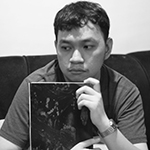
Alessandro Kennz Nioda hails from the Philippines. He teaches English at Xavier University–Ateneo de Cagayan while pursuing his MFA degree at De La Salle University. He has been part of anthologies published in his country, such as Hulagway: Empire and Emporia (National Commission for Culture and the Arts, 2024) and Brave New Words Vol. 2: Disability Justice (Paper Trail Projects, 2026). He also has a play that was (re)staged by Dulaang Atenista.
 BACK TO ISSUE